

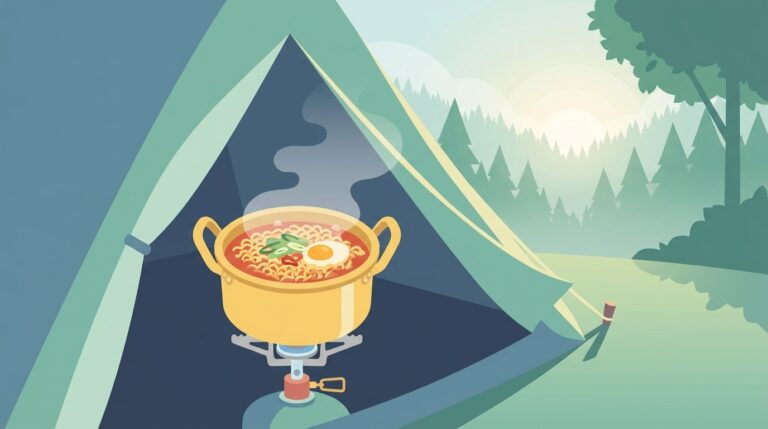
Rise and Shine! The Ultimate Korean Camping Ritual: Eating Morning Ramen Like a Local
안녕하세요! (Annyeonghaseyo!) I’m your friendly Korean editor and local guide from Daily Hangul. Have you ever dreamed of waking up in a cozy tent, surrounded by the misty green mountains of Gapyeong or the gentle sound of waves in Gangneung?
If you ask any Korean what the highlight of a camping trip is, they won’t just say the campfire or the beautiful scenery. They will eyes-light-up and yell: “Achim Ramyeon” (아침 라면 – Morning Ramen)!
In Korea, eating spicy, steaming hot instant noodles right after waking up in the cold morning air is a sacred ritual. Today, we’re going to learn the exact survival phrases you need to sound like a seasoned Korean camper at level A2. Let’s dive in!
1. Top 3 Expressions for the Perfect Morning Ramen
① 아침에 라면 먹을래요? (Achim-e ramyeon meogeullaeyo?)
- Pronunciation: Ah-chim-ae rah-myeon meo-geul-lae-yo?
- Meaning: “Would you like to eat ramen in the morning?”
- K-Culture Moment: In K-Dramas, “Would you like to eat ramen?” can sometimes be a cheeky invitation to stay over. But on a campsite, this is a 100% wholesome, pure, and exciting invitation to start the best day ever.
- Editor’s Insight: This uses the friendly grammar structure -(으)ㄹ래요? which gently asks about someone’s preference. It is polite yet intimate.
- Situation Spectrum:
- Friends & Casual: ✅
- Coworkers: ⚠️ (A bit casual, but fine if you are camping together!)
- Bosses & Elders: 🚫 (Better to say “라면 드실래요?” – Ramyeon deuseullaeyo?)
- 🤔 Think About It: Why does sharing a single pot of ramen feel so bonding? In Korean culture, eating from the same pot symbolizes family and closeness.
② 국물이 진짜 시원해요! (Gungmuri jinjja siwonhaeyo!)
- Pronunciation: Goong-mool-ee jeen-jja shee-won-hae-yo!
- Meaning: “The soup is so refreshing!” (Literal: “The soup is really cool!”)
- K-Culture Moment: You will hear Koreans say “시원하다” (siwonhada) while gulping down burning hot, spicy soup. Don’t worry, they aren’t confused! In a culinary context, “siwonhada” means the soup is satisfying, deeply savory, and clears your throat or cures a hangover.
- Editor’s Insight: Use this expression with a deep, happy sigh after your first sip. Your Korean friends will think you are a true local!
- Situation Spectrum:
- Friends & Casual: ✅
- Coworkers: ✅
- Bosses & Elders: ✅
- 🤔 Think About It: Does your language have a word that means both “refreshing” for cold weather/drinks and “deeply satisfying” for hot food?
③ 꼬들꼬들하게 끓여 주세요 (Gkodeul-gkodeul-hage kkeuryeo juseyo)
- Pronunciation: Ggo-deul-ggo-deul-ha-gae ggeul-yeo joo-sae-yo.
- Meaning: “Please cook the noodles firm/al dente.”
- K-Culture Moment: Koreans take their ramen noodle texture very seriously. 꼬들꼬들 (gkodeul-gkodeul) is a fun onomatopoeia describing bouncy, slightly undercooked, chewy noodles.
- Editor’s Insight: If you prefer your noodles soft and fully cooked, you can say “푹 끓여 주세요” (pook kkeuryeo juseyo – “Please cook it thoroughly”).
- Situation Spectrum:
- Friends & Casual: ✅
- Coworkers: ✅
- Bosses & Elders: ✅
- 🤔 Think About It: Korean has many descriptive words for food textures (chewy, crispy, soft). Why do you think texture is so important in Korean food culture?
2. Textbook Korean vs. Real Korean
When you learn Korean from a book, it can sound a bit like a robot. Let’s look at how to sound natural at a campsite!
Asking to make ramen together
- 📖 Textbook: 라면을 끓이겠습니까? (Ramyeoneul kkeurigeasseumnikka? – Will you boil ramen?)
- 🗣️ Real Korean: 라면 콜? (Ramyeon kol? – Ramen? Deal/Are you down?)
- 💡 Why the difference? Modern Koreans love using the word 콜 (col / Call) to mean “I’m down!” or “Deal!”. It is quick, friendly, and perfect for casual camping vibes.
Describing a puffy face in the morning
- 📖 Textbook: 얼굴이 부었습니다. (Eolguri bueotseumnida. – My face is swollen.)
- 🗣️ Real Korean: 얼굴이 팅팅 부었어요! (Eolguri tingting bueotseoyo! – My face is super puffy!)
- 💡 Why the difference? Sleeping in a tent after eating salty food can make your face swell. 팅팅 (tingting) is a vivid word that emphasizes extreme puffiness in a cute, self-deprecating way.
3. K-Culture Deep Dive & Camping Etiquette
4-1. The Magic of the Pot Lid (냄비 뚜껑 – Naembi Ttukkeong)
If you are eating ramen out of a yellow nickel-silver pot (양은냄비 – yangeun-naembi), you might notice there are no bowls. Don’t panic! Koreans often fold the metal pot lid into a small cone or use it flat as a makeshift plate to cool down hot noodles. Sharing directly from the pot is a warm sign of affection and closeness.
4-2. Han River Style Cooking vs. Mountain Camping
In cities, you can use automated ramen-cooking machines at convenience stores. But when camping in the mountains, you must use a portable gas stove (버너 – beoneo). Be sure to check the wind! Korean campers often build small wind shields to keep the water boiling fast.
4. Live Roleplay: Waking up in Gapyeong
Let’s practice! You are camping with Minho, a friendly Korean camping pro. It is 7:30 AM, and the campsite is cool and quiet.
- Minho: 🎭 (Stretching and walking out of the tent) 잘 잤어요? 아침에 공기가 진짜 맑네요.
(Jal jasseoyo? Achim-e gong-gi-ga jinjja malg-neyo.)
“Did you sleep well? The morning air is really clear.” - You: 🎭 (Shivering slightly but smiling) 네, 진짜 좋네요! 조금 추워요.
(Ne, jinjja joh-neyo! Jogeum chu-wo-yo.)
“Yes, it’s really nice! It’s a little cold.” - Minho: 🎭 (Rubbing hands together) 그럼… 우리 뜨거운 라면 먹을래요?
(Georeom… uri tteu-geo-un ramyeon meogeullaeyo?)
“Then… shall we eat some hot ramen?” - You: 🎭 (Eyes sparkling) 와, 라면 콜! 제가 물 올릴까요?
(Wa, ramyeon kol! Jega mul ollilkkayo?)
“Wow, ramen? Deal! Shall I boil the water?” - Minho: 🎭 (Setting up the gas burner) 고마워요. 어떤 스타일 좋아해요?
(Gomawoyo. Eotteon seuta-il joh-ahaeyo?)
“Thanks. What style do you like?” - You: 🎭 (Making a firm gesture with fingers) 저는 꼬들꼬들하게 끓여 주세요!
(Jeoneun gkodeul-gkodeul-hage kkeuryeo juseyo!)
“For me, cook it al dente, please!” - Minho: 🎭 (Laughing) 오, 라면 먹을 줄 아시네요! 떡이랑 계란도 넣을까요?
(Oh, ramyeon meogeul jul asineyo! Tteok-ilang gyeran-do neoheulkkayo?)
“Oh, you know how to eat ramen! Shall we add rice cakes and eggs too?” - You: 🎭 (Nodding happily) 네, 다 좋아요!
(Ne, da joh-ayo!)
“Yes, everything is good!” - Minho: 🎭 (Handing you the pot lid) 자, 뜨거우니까 여기에 덜어 드세요.
(Ja, tteu-geo-uni-kka yeogi-e deoleo deuseyo.)
“Here, it’s hot, so scoop it onto this (lid) to eat.” - You: 🎭 (Taking a bite of noodle and sipping the soup) 국물이… 진짜 시원해요!
(Gungmuri… jinjja siwonhaeyo!)
“The soup is… truly refreshing!”
🔀 Decision Point!
Minho asks: “밥도 말아 먹을래요?” (Bap-do mara meogeullaeyo? – “Do you want to mix some rice into the soup too?”)
* Option A: “아니요, 배불러요.” (Aniyo, baebulleoyo. – No, I’m full.)
* Option B: “네! 찬밥 있어요?” (Ne! Chanbap isseoyo? – Yes! Is there cold rice?)
* Option C: “밥은 맛없어요.” (Babeun mateopseoyo. – Rice tastes bad.)
🏆 Best Choice: Option B
Adding 찬밥 (chanbap – cold rice) to remaining ramen soup is the ultimate Korean campsite secret! Cold rice absorbs the soup much better than warm rice, making it incredibly tasty. Minho will be amazed by your expert food knowledge!
🚫 Risk Choice: Option C
Saying “rice tastes bad” is a bit too direct and might kill the cozy breakfast vibe. It is better to politely say “배불러요” (I am full) if you don’t want any.
5. 10-Second Emotion Shadowing Drill
Let’s practice speaking with real Korean feelings! Pay attention to the pauses (/).
- [🥺 Cold but hopeful]
아침에 / 라면 / 먹을래요?
(Ah-chim-ae / rah-myeon / meo-geul-lae-yo?) -
[😊 Extremely satisfied]
와! / 국물이 / 진짜 / 시원해요!
(Wa! / goong-mool-ee / jeen-jja / shee-won-hae-yo!) -
[😤 Determined and picky]
꼭! / 꼬들꼬들하게 / 끓여 주세요!
(Ggok! / ggo-deul-ggo-deul-ha-gae / ggeul-yeo joo-sae-yo!)
6. K-Culture Mini Dictionary
- 꼬들면 (Gkodeul-myeon): Chewy, al dente instant noodles. The favorite style of most Koreans.
- 해장 (Hae-jang): Waking up the stomach or curing a hangover, usually with warm, spicy soups.
- 양은냄비 (Yangeun-naembi): A lightweight yellow aluminum pot. It heats up extremely fast, making it perfect for ramen.
- 불멍 (Bul-meong): A compound word combining “Bul” (fire) and “Meong” (spacing out). It refers to relaxing while watching a campfire.
7. Traveler’s Survival Kit
If you visit a campsite or a local Korean mart, use these three lines:
- 부탄가스 있어요? (Butan-gaseu isseoyo?) – “Do you have butane gas canisters?” (For your portable stove!)
- 여기서 가장 매운 라면이 뭐예요? (Yeogiseo gajang maeun ramyeoni mwoyeyo?) – “What is the spiciest ramen here?”
- 나무젓가락 좀 주세요. (Namu-jeotgarak jom juseyo.) – “Please give me some wooden chopsticks.”
📌 Editor’s Travel Note: When navigating to campsites outside Seoul, Google Maps can be inaccurate in South Korea. Always download the Naver Map App Download Page to find your way safely to beautiful forest campsites. For proper road signs and local names, refer to the National Institute of Korean Language Romanization Standards.
8. Deep Reflection: The Power of “We” (우리)
In many Western cultures, dining is structured around individual plates. However, Korean food culture is built around 공동체 (gongdongche – community). Sharing a single hot pot of ramen with mismatched chopsticks in a tent represents shared warmth. It breaks down social barriers faster than any business meeting. Next time you eat ramen, try sharing it directly from the pot with someone you care about!
9. FAQ & Avoiding Mistakes
Q: Is eating ramen for breakfast healthy in Korea?
A: Generally No, but culturally Yes! Koreans know that ramen is high in sodium and might make their faces puffy. However, when camping, the joy of eating cozy, warm soup outdoors overrides any health concerns. It is considered a special cheat-day treat!
Q: Can I put the ramen packet in after the noodles?
A: It is a heated debate! There is a playful, ongoing debate in Korea about whether to put the soup powder (supeu) or the noodles (myeon) in first. Putting the powder in first slightly raises the boiling point of the water, which true enthusiasts prefer!
🚨 Common Mistake Warning!
- Wrong: Using “맛있겠다” (Masitgetda) to a senior coworker without polite endings.
- Correct Action: Always add -요 (-yo) to make your expressions polite! Say “맛있겠어요!” (Masitgesseoyo! – That looks delicious!).
10. Action Missions
- 🥉 Bronze (Mirror Challenge): Say “국물이 진짜 시원해요!” with a giant smile in front of your mirror.
- 🥈 Silver (Social Challenge): Take a picture of your next ramen and post it on Instagram with the hashtag
#DailyHanguland the caption꼬들꼬들하게! - 🥇 Gold (Real Life Challenge): Order a ramen at a Korean restaurant or campsite store and ask the cook: “꼬들꼬들하게 끓여 주세요!”
11. Interactive Quiz Challenge
Test your skills below!
Q1. What does “시원하다” (siwonhada) mean when eating hot ramen?
- The soup is physically cold.
- The soup is refreshing and satisfying.
- The soup is too spicy.
Q2. Fill in the blank: “Please make my noodles al dente!” -> “_______하게 끓여 주세요!”
👉 Click to reveal the Answers & Explanations!
- A1 Answer: 2. It means deeply satisfying and throat-clearingly good!
- A2 Answer: 꼬들꼬들 (gkodeul-gkodeul). This means bouncy and firm!







