

Slay Your First Korean Hoesik: The Ultimate Guide to Toasts and Company Dinner Survival
안녕하세요! (Annyeonghaseyo!) It’s your favorite cultural navigator and senior editor at Daily Hangul (매일한글).
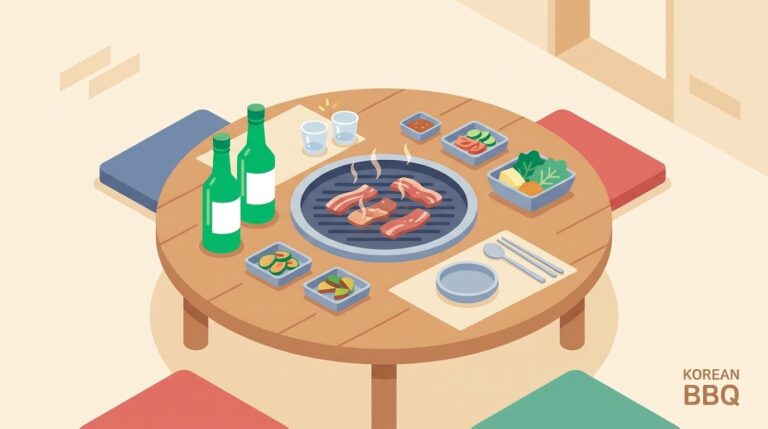
Picture this: You are sitting at a bustling, smoky 삼겹살 (samgyeopsal – pork belly) restaurant. The grill is sizzling, green bottles of 소주 (soju) are clinking, and the laughter of your Korean colleagues fills the air. Suddenly, your manager turns to you with a wide grin and says, “Our new team member, Alex, will give us our next toast!”
Your heart drops. Your mind goes completely blank. What do you say? Do you just shout “Cheers”? Or is there a magic phrase that will make your team erupt in cheers and instantly seal your status as the ultimate office ‘insider’ (인싸 – inssa)?
Don’t panic! Today, we are cracking the code of 회식 (hoesik – company dinners) and mastering the art of the perfect Korean toast. Based on years of helping expats navigate the corporate jungles of Seoul, I’ve compiled the absolute best phrases, physical manners, and cultural secrets to turn your next company dinner into a massive success.
Phase 2: 3 Essential Korean Toasts Analyzed
1. 건배 (Geonbae)
- Pronunciation: Geon-bae (Sounds like “gun-bae”)
- Meaning: “Dry glass” (Literal) vs. “Cheers!” (Real-world Nuance)
- K-Culture Moment: This is the universal toast you hear in almost every K-Drama, from office classics like Misaeng (미생) to casual neighborhood pub scenes. It is safe, respectful, and classic.
- Editor’s Insight: Think of “Geonbae” as your black-tie outfit. It is never out of place, highly polite, and safe for any demographic, from the CEO to your junior colleague.
- Situation Spectrum:
- Casual (Friends): ✅
- Semi-formal (Coworkers): ✅
- Formal (Bosses/Seniors): ✅
- 🤔 Think About It: “Geonbae” shares the exact same Chinese characters (乾杯) as the Japanese “Kanpai” and Chinese “Ganbei.” Why do you think these neighboring cultures all prioritize the concept of making the glass “dry” together?
2. 청바지 (Cheongbaji)
- Pronunciation: Cheong-ba-ji (Sounds like “cheong-bah-jee”)
- Meaning: “Blue jeans” (Literal) vs. “Youth is right now!” (Real-world Nuance)
- K-Culture Moment: This is a classic 줄임말 (jurimmal – acronym) toast. It stands for: 청춘은 바로 지금! (Cheongchun-eun baro jigeum! – Youth is right now!)
- Editor’s Insight: Shouting this shows you have a playful, witty understanding of Korean office humor. Older managers especially love this retro, energetic toast. It screams: “I am ready to have fun with the team!”
- Situation Spectrum:
- Casual (Friends): ✅
- Semi-formal (Coworkers): ✅
- Formal (Bosses/Seniors): ⚠️ (Best used when the atmosphere is already relaxed and warm!)
- 🤔 Think About It: Why does Korean corporate culture love acronym toasts like “Cheongbaji”? How does turning a mundane word like “blue jeans” into a profound statement about youth break down stiff office hierarchies?
3. 위하여 (Wihayeo)
- Pronunciation: Wi-ha-yeo (Sounds like “We-ha-yeo”)
- Meaning: “For the sake of…” (Literal) vs. “To our success/health!” (Real-world Nuance)
- K-Culture Moment: Often used in high-level business dinners. Usually, the leader makes a short speech about the company’s future, shouts a goal, and ends with “…을 위하여!” (For…!)
- Editor’s Insight: This is a powerful, grand toast. If you want to wish your team success on a new project, this is your go-to phrase. It has a slightly dramatic, cinematic feel to it.
- Situation Spectrum:
- Casual (Friends): ⚠️ (Might sound a bit too serious for a casual chat)
- Semi-formal (Coworkers): ✅
- Formal (Bosses/Seniors): ✅
- 🤔 Think About It: Notice how “Wihayeo” focuses on a collective goal (e.g., “For our team’s health!”). How does this reflect the community-first mindset of Korean society compared to individualistic toasts in the West?
Phase 3: Textbook Korean vs. Real Korean
Sometimes, what you learn in a standard language app sounds incredibly robotic at a lively Korean table. Let’s look at two classic examples:
1. Proposing a Clink of Glasses
- 📖 Textbook Korean: “우리 술을 마시며 건배합시다.” (Let us drink alcohol and make a toast.)
- 🗣️ Real Korean: “우리 짠해요!” (Uri jjan-hae-yo! – Let’s clink!) or simply “짠!” (Jjan! – Clink/Cheers!)
- 💡 Why the difference? “짠” is the delightful onomatopoeia for glasses clinking. In social settings, Koreans love energetic, sensory-rich words that immediately bring people closer together.
2. Warning Someone Not to Sip (Playfully!)
- 📖 Textbook Korean: “한 번에 다 마시십시오.” (Please drink it all at once.)
- 🗣️ Real Korean: “원샷~!” (Won-syat! – One shot!) or “꺾으면 안 돼요!” (Kkeokk-eumeon an dwae-yo! – No bending/breaking the flow!)
- 💡 Why the difference? “꺾다” literally means to bend. In drinking culture, “꺾어 마시다” means to break up your drink into small sips. Saying “꺾으면 안 돼요!” is a playful, cheeky way to encourage everyone to down their glass together.
Phase 4: K-Culture Deep Dive & Non-Verbal Manners
In Korea, how you drink is just as important as what you say. Let’s look at the unspoken body language rules that will make your Korean colleagues respect you instantly.
4-1. The Art of Nunchi (눈치) and Body Language
- The Two-Hand Rule: Never pour or receive a drink with one hand. Always use both. When pouring, hold the bottle with your right hand and lightly support your right wrist or forearm with your left hand.
- The Shielded Sip: When taking a drink in front of someone older or higher in rank, turn your head slightly away from them. Use your left hand to shield your glass as you take a sip. This is a profound sign of respect.
4-2. The Magic of Somaek (소맥)
Korean dinners are famous for 소맥 (somaek)—a golden ratio mix of 소주 (soju) and 맥주 (beer). Making it is practically a performance art! If you learn to make a perfect Somaek with a spoon-tap (to make the bubbles explode), you will instantly become the star of the night.
Phase 5: Interactive Roleplay: The Hoesik Hero
Read the scenario and make your choice!
The Setting
You are at a cozy, glowing pork belly restaurant. Sizzling meat fills the air with delicious aromas. Green bottles line the table. Your team has just finished a massive project.
The Cast
- Manager Kim: Loud, passionate, loves classic Korean corporate jokes.
- Minji: Your supportive, energetic peer coworker.
- You (Alex): The enthusiastic expat team member.
The Dialogue
- Manager Kim: “자, 다들 잔 채우시고! (Ja, dadeul jan chae-u-sigo!)”
(Alright, everyone fill up your glasses!) - Minji: “부장님, 여기 소맥으로 말아드릴까요? (Bujangnim, yeogi somaek-euro mara-deurilkkayo?)”
(Manager, shall I mix some Somaek for you here?) - Manager Kim: “좋지! 알렉스도 소맥 괜찮나? (Jochi! Alex-do somaek gwenchanna?)”
(Great! Alex, is Somaek okay for you too?) - Alex: (🎭 Nodding politely with two hands on the glass) “네, 저 아주 좋아합니다! (Ne, jeo aju joahamnida!)”
(Yes, I like it very much!) - Minji: (🎭 Enthusiastically pouring the drink) “소맥 제조 들어갑니다~! (Somaek jejo deoreogamnida~!)”
(Somaek production starting~!) - Manager Kim: “오늘 알렉스가 들어오고 팀 실적도 아주 좋아! 알렉스가 건배사 한 번 해봐! (Oneul Alex-ga deureo-ogo tim siljeok-do aju joa! Alex-ga geonbaesa han beon haebwa!)”
(Our team performance has been great since Alex joined! Alex, give us a toast!) - Alex: (🎭 Surprised but smiling confidently) “아, 제가요? 영광입니다! (Ah, jega-yo? Yeong-gwang-imnida!)”
(Oh, me? It’s an honor!) - Minji: (🎭 Whispering supportively) “청바지! 청바지 해봐요! (Cheongbaji! Cheongbaji haebwayo!)”
(Cheongbaji! Try Cheongbaji!) - Alex: (🎭 Standing up slightly, raising the glass with two hands) “제가 ‘청바지’로 하겠습니다! 제가 ‘청춘은 바로!’ 하면 ‘지금!’ 해주세요! (Jega ‘cheongbaji’-ro hagessnida! Jega ‘cheongchun-eun baro!’ hamyeon ‘jigeum!’ hae-juseyo!)”
(I’ll do ‘Cheongbaji’! When I say ‘Youth is right!’, please shout ‘Now!’) - Manager Kim & Minji: (🎭 Laughing warmly, raising their glasses high) “오~! 준비됐어! (Oh~! Junbi-dwesseo!)”
(Oh~! We’re ready!)
🔀 Decision Point: How do you deliver the climax?
- Option A: Shout “청춘은 바로! (Cheongchun-eun baro!)” confidently, wait for them to shout “지금! (Jigeum!)”, and then drink while turning your head slightly away.
- Option B: Shout “원샷! (Wonsyat!)” at Manager Kim and slam your glass on the table.
- Option C: Say, “저는 술을 못 마십니다. 건배사는 생략하겠습니다. (I can’t drink. I will skip the toast.)” with a serious face.
💡 Feedback on Your Choice:
- Best Choice (A): Perfect! You matched the energetic, respectful vibe of a modern Korean office. By using a fun acronym and showing proper physical manners (turning your head), you proved you are both culturally savvy and polite.
- Risky Choice (B): Shouting “Wonsyat!” directly at a senior while slamming your glass can come across as aggressive or overly casual. Keep things playful but respectful!
- Vibe-Killer Choice (C): While it is completely fine to drink soda or water instead of alcohol, skipping the toast entirely ruins the shared team moment. Even with water, you can still lead a fun toast!
Phase 6: 10-Second Emotional Shadowing Drill
Let’s inject some real soul into your Korean! Practice these phrases with the emotional guide below:
- [😊 Excitedly & Loudly]
“청춘은 / 바로 / 지금!”
(Cheong-chun-eun / ba-ro / ji-geum!)
Pause briefly at each slash and build up the energy! -
[🥺 Politely Declining/Limiting Alcohol]
“죄송하지만 / 제가 / 술찌라 / 조금만 / 받을게요.”
(Joe-song-ha-ji-man / je-ga / sul-jji-ra / jo-geum-man / ba-deul-ge-yo.)
Translation: I’m sorry, but I’m a weak drinker, so I’ll just take a little bit. -
[😎 Confidently & Warmly]
“우리 / 다 같이 / 짠할까요?”
(U-ri / da ga-chi / jjan-hal-kka-yo?)
Translation: Shall we all clink our glasses together?
Phase 7: K-Culture Mini Dictionary
| Word | Romanization | English Meaning | Cultural Context |
|---|---|---|---|
| 회식 | Hoesik | Company Dinner | A vital part of Korean corporate life where colleagues build trust and vent stress over food and drinks. |
| 소맥 | Somaek | Soju + Beer | The ultimate hybrid drink of Korea, celebrated for its smooth taste and the social performance of mixing it. |
| 2차 | Icha | Second Round | Moving the party to a second location, usually a cozy beer pub or a karaoke box (노래방). |
| 흑기사 | Heukgisa | Black Knight | Someone (usually male) who drinks a shot for you when you’ve reached your limit. (Female version: 흑장미 – Heukjangmi). |
Phase 8: Traveler’s Survival Kit
Heading out for a night in Seoul? Here are your emergency tools:
Survival Phrases TOP 3
- “물 좀 주세요” (Mul jom juseyo)
- Pro Tip: Keep this handy! Drinking lots of water between shots is the ultimate secret to surviving a long Hoesik.
- “대리 좀 불러주세요” (Daeri jom bulleo-juseyo)
- Pro Tip: If someone drove to the dinner, they must use a 대리운전 (daeri-unjeon – designated driver service). This phrase asks the restaurant or app to call one.
- “화장실 어디예요?” (Hwajangsil eodi-yeyo?)
- Pro Tip: Crucial phrase when the Somaek starts catching up to you!
📌 Editor’s Travel Note: After a night of Hoesik, do not try to hail a taxi on the street. Download the Kakao T mobile application beforehand to secure a safe and quick ride home. Also, use Naver Map for Korean route navigation to easily find your way back to your hotel.
Phase 9: In-Depth Reflection: “One Step Deeper”
In the past, Korean company dinners were infamous for forced drinking and rigid hierarchy. However, modern Korean society is undergoing a massive shift. Led by the MZ Generation (Millennials and Gen Z), many companies are replacing traditional heavy drinking nights with “culture-focused Hoesik”—such as attending sports games, going to escape rooms, or enjoying high-end lunches.
This evolution represents a fascinating cultural negotiation: maintaining the beautiful Korean value of 공동체 의식 (gongdongche uisik – community spirit) while respecting personal boundaries and work-life balance (워라밸 – worabaen).
💬 Your Turn: How are team accomplishments celebrated in your home country? Do you have company dinners, or do you prefer to keep work and life completely separate? Let us know in the comments below!
Phase 10: FAQ & Common Mistakes
Q: Do I absolutely have to drink alcohol at a Korean Hoesik?
A: No. Modern Korean companies are very understanding of health, religion, or personal choices. It is perfectly fine to drink cider (soda) or water. However, keep your glass filled with something so you can participate in the toasts!
Q: What if a superior pours a drink for me while my glass is still half-full?
A: In Korean drinking etiquette, you should never refill a glass that isn’t completely empty (개잔 – gaejan). Quickly drink what is left in your glass (remember to turn your head!), and then hold out your empty glass with both hands to receive the fresh pour.
Q: Can I pour my own drink?
A: No. Pouring your own drink (자작 – jajak) is traditionally considered impolite or associated with bad luck in drinking culture. Always wait for a colleague to offer, or proactively offer to pour for them first!
🚨 Common Mistakes Warning Board
- Pouring with a single hand: Doing this to a superior is a major etiquette slip. Keep that left hand supporting your right arm!
- Staring directly at the boss while drinking: Remember the “Shielded Sip.” Turn your head slightly to show humility.
- Letting a superior’s glass stay empty: Keep your eye on the boss’s glass. If it’s empty, politely say, “한 잔 올려도 되겠습니까?” (May I pour you a glass?).
Phase 11: Action Missions
- 🥉 Bronze (Mirror Challenge): Stand in front of a mirror and practice shouting “청바지!” with maximum energy, while holding an imaginary glass with two hands.
- 🥈 Silver (Network Challenge): Take a photo of your favorite drink (beer, coffee, or even juice!) and post it on social media with the caption: “오늘도 수고하셨습니다! 짠! 🍻 #매일한글 #DailyHangul”
- 🥇 Gold (Real-world Challenge): Next time you are eating out with Korean friends or colleagues, proactively suggest a toast using “짠!” or “청바지!”
- 🎮 K-Culture Mission: Watch the hit Korean drama Work Later, Drink Now (술꾼도시여자들). Spot a scene where the characters make a toast and write down what phrase they used!
Phase 12: Interactive Quiz Challenge
1. Which toast is an acronym meaning “Youth is Right Now!”?
- A) 건배 (Geonbae)
- B) 청바지 (Cheongbaji)
- C) 위하여 (Wihayeo)
Show Answer
Correct Answer: B) 청바지 (Cheongbaji)
It stands for 청춘은 바로 지금! (Youth is right now!).
2. Fill in the blank: When clinking glasses with a colleague, you can casually say “____!”
Show Answer
Correct Answer: 짠 (Jjan)
This mimics the sound of glasses hitting each other!
3. True or False: It is polite to pour your own drink during a Korean dinner.
Show Answer
Correct Answer: False
Pouring your own drink (자작 – jajak) is considered a faux pas. You should always pour for others and let them pour for you!







