

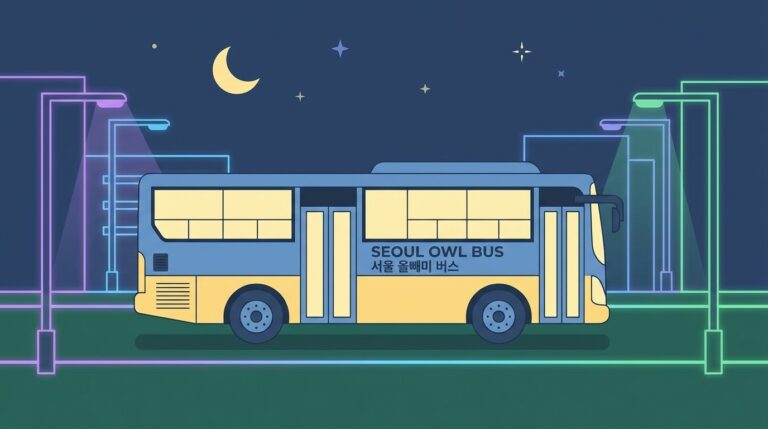
Missed the Last Subway in Seoul? Master the “Owl Bus” (올빼미 버스) Like a Local
Phase 1: Empathy (스토리 몰입형 오프닝)
안녕하세요! Welcome back to another masterclass from Daily Hangul’s Chief Editor. As your trusty local navigator, I have a quick question for you:
Picture this. You are in Hongdae (홍대) or Itaewon (이태원) with your Korean friends. It is 1:00 AM. You’ve just finished a sizzling round of late-night Korean BBQ, followed by some lively singing at a Noraebang (노래방). You check your phone, and a cold sweat breaks out: the last subway train has already departed.
You open your ride-hailing app, only to see the dreaded “high demand surcharge” and a 40-minute wait time. Your local friends, however, do not look panicked at all. They smile, point to a distant blue neon sign, and say: “올빼미 버스 타면 돼!” (Olppaemi beoseu tamyeon dwae! – “We can just take the Owl Bus!”)
If you have ever felt stranded in Seoul after midnight, you are not alone. Navigating a foreign metropolis in the dead of night is one of the most common anxiety triggers for expats and travelers. But in Seoul, late-night transit is not just a backup plan—it is a cultural phenomenon. By mastering the linguistic and systemic nuances of the Owl Bus (올빼미 버스), you will transition from a bewildered tourist to a street-smart local who can enjoy Seoul’s nightlife with absolute confidence.
This guide is inspired by the real-life trials of my C1-level students who knew the grammar books inside out but froze when they had to navigate the late-night transit rush. Let’s make sure you never get stranded again!
Phase 2: Core Phrases (핵심 표현 3선 심층 분석)
1. 막차 끊겼어요 (Mak-cha kkeun-gyeot-seo-yo)
- Pronunciation: [Mak-cha kkeun-gyeot-eo-yo] / Sound-alike: “Mock-cha kkeen-gyut-uh-yo”
- Meaning: The last ride (train/bus) is cut off / I missed the last ride.
- K-Culture Moment: This is the ultimate climax line in romantic K-Dramas. One character realizes the makcha is gone, meaning they “have” to spend more time together. In real life, it is just a highly practical announcement made during a gathering.
- Editor’s Insight: The word 막차 (mak-cha) combines 막 (last/final) and 차 (vehicle/car). The verb 끊기다 (kkeun-gida) means “to be severed” or “cut off.” Saying “막차 끊겼어요” carries a nuances of inevitability—it’s not necessarily that you were late, but rather that the system has shut down for the night.
- Situation Spectrum:
- Friends/Casual (막차 끊겼어): ✅
- Colleagues/Semi-formal (막차 끊겼어요): ✅
- Superiors/Formal (막차가 끊겼습니다): ✅
🤔 Think About It: Why does Korean use the passive “cut off” (끊겼어요) instead of the active “I missed” (놓쳤어요) in daily transit conversations? It subtly shifts the focus from individual failure to the objective state of the environment—a beautiful reflection of the context-dependent nature of the Korean language.
2. 올빼미 버스 어디서 타요? (Ol-ppae-mi beo-seu eo-di-seo ta-yo?)
- Pronunciation: [Ol-ppae-mi beoseu eo-di-seo ta-yo] / Sound-alike: “All-phem-ey bus uh-dee-suh tah-yo?”
- Meaning: Where do I catch the Owl Bus?
- K-Culture Moment: If you ask a local police officer or a convenience store clerk this in the middle of the night, they will immediately recognize that you know your way around Seoul. It instantly earns you “insider” respect.
- Editor’s Insight: 올빼미 (ol-ppae-mi) literally means “owl.” These midnight buses have an “N” prefixed to their route numbers (e.g., N13, N31, N62), standing for “Night.” Asking for the “Owl Bus” by name rather than just “late-night bus” (심야 버스 – sim-ya beoseu) shows you understand Seoul’s unique urban branding.
- Situation Spectrum:
- Friends/Casual (올빼미 버스 어디서 타?): ✅
- Colleagues/Semi-formal (올빼미 버스 어디서 타요?): ✅
- Superiors/Formal (올빼미 버스 정류장이 어디입니까?): ⚠️ (A bit too stiff for a late-night street setting, but grammatically correct)
3. 노선도 한번만 확인해 주세요 (No-seon-do ham-beon-man hwa-gin-hae ju-se-yo)
- Pronunciation: [No-seon-do ham-beon-man hwa-gin-hae ju-se-yo] / Sound-alike: “No-sun-dough hahm-bun-mahn hwah-ghin-hae ju-seh-yo”
- Meaning: Please check the route map for me just once.
- K-Culture Moment: Imagine standing under a bus shelter in the chill of a Seoul autumn night, trying to decipher the complex, overlapping color-coded transit routes. Asking a nearby friendly local with this phrase will get them to whip out their KakaoMap app in seconds.
- Editor’s Insight: Adding 한번만 (ham-beon-man – just once) softens the request significantly. It signals politeness and a desire not to inconvenience the other person, which is crucial in Korean social dynamics.
- Situation Spectrum:
- Friends/Casual (노선도 좀 봐줘): ✅
- Colleagues/Semi-formal (노선도 한번만 확인해 주세요): ✅
- Superiors/Formal (노선도를 확인해 주시겠습니까?): ✅
Phase 3: Textbook Korean vs. Real Korean (실전 비교)
When you study Korean in an academic setting, the phrases are often designed for perfect, sterile environments. Let’s look at how native Seoulites actually speak at 2:00 AM.
Situation 1: Letting your friends know you cannot stay longer because of transit limits.
- 📖 Textbook Korean: “지하철 운행 시간이 끝났기 때문에 저는 이제 가야 합니다.” (Because the subway operating hours have ended, I must go now.)
- 🗣️ Real Korean: “나 막차 탈 시간이라 먼저 일어날게!” (It’s time for me to catch the last ride, so I’ll head out first!)
- 💡 Why the difference? “먼저 일어날게” (literally, “I will stand up first”) is the standard, natural way to announce your departure from a social gathering without breaking the flow of the evening.
Situation 2: Asking if there is a night bus operating to your neighborhood.
- 📖 Textbook Korean: “제가 거주하는 지역으로 운행하는 심야 버스가 존재합니까?” (Does a late-night bus operating to my residential area exist?)
- 🗣️ Real Korean: “혹시 우리 동네 가는 N버스 있어요?” (By any chance, is there an “N-bus” that goes to my neighborhood?)
- 💡 Why the difference? Locals refer to the Owl Bus system casually as N버스 (N-beoseu). Using “우리 동네” (our neighborhood/my neighborhood) sounds warm and natural compared to the clinical “거주하는 지역” (residential area).
Phase 4: K-Culture Deep-Dive & Non-Verbal Manners (문화 코드 & 비언어적 매너)
4-1. The Midnight Bus Etiquette (눈치와 매너)
- The Silent Zone: Unlike daytime buses where faint chatter is common, the Owl Bus is often incredibly quiet. Many passengers are exhausted office workers, students, or service staff headed home. Keep your voice to a whisper if you are traveling with a friend.
- The Card Tap Dance (태그): In Korea, you must tap your transit card (T-Money) upon boarding and before getting off. On late-night buses, the driver wants to keep things moving. Have your card or phone ready in your hand before you step up. Fumbling through your bag at 2:30 AM will earn you some heavy sighs (the classic Korean sigh of impatience).
4-2. The Cultural Backdrop: Why “Midnight” in Korea is Different
In many Western capitals, late-night public transit is notorious for feeling sketchy or unsafe. In Seoul, the Owl Bus is incredibly safe, well-lit, and heavily monitored by CCTV. The existence of the Owl Bus is a direct response to Korea’s “Work Hard, Play Hard” culture. With dinners (Hoesik) often lasting into “Round 2” (2차) or “Round 3” (3차), the city government realized that providing affordable, safe, late-night transit was essential to keep the economic and social engines of the city running smoothly.
Phase 5: Interactive Roleplay Scenario (실전 롤플레이)
Setting: Outside Exit 9 of Hongdae Station. It is 1:30 AM. Neon signs are blinking, and the crisp night air is filled with the smell of nearby street food. You are standing with your Korean friend, Min-jun.
Cast:
- You (The Expat/Traveler)
- Min-jun (The Tech-savvy Seoulite)
1. 민준: (Looking at his watch with a start) 앗! 벌써 한 시 반이네? 우리 완전히 시간 가는 줄 몰랐다!
   Min-jun: (Ah! It's already 1:30? We completely lost track of time!)

2. You: (Panicking slightly) 어떡하죠? 지하철 벌써 끊겼겠네요. 제 기숙사 신촌인데 걸어갈까요?
   You: (What should we do? The subway must be cut off by now. My dormitory is in Sinchon, should we walk?)

3. 민준: (Laughing) 신촌까지 걸어가기엔 너무 멀지! 걱정 마, 우리에겐 올빼미 버스가 있잖아.
   Min-jun: (It's too far to walk to Sinchon! Don't worry, we have the Owl Bus.)

4. You: (Curious) 올빼미 버스요? 그게 밤늦게 다니는 버스 맞죠?
   You: (The Owl Bus? That's the one that runs late at night, right?)

5. 민준: (Nodding) 응, 맞아. 번호 앞에 'N'이 붙어 있어. 신촌 가는 건 N26이나 N62 타면 될 거야.
   Min-jun: (Yeah, correct. It has an 'N' before the number. To go to Sinchon, we can take the N26 or N62.)

6. You: (Relieved) 다행이네요! 그런데 정류장은 낮에 타는 곳이랑 똑같아요?
   You: (What a relief! But is the bus stop the same as the one we use during the day?)

7. 민준: (Pointing to the center lane bus station) 응, 저기 도로 중앙 정류장 있지? 거기로 가면 돼. 마침 버스 곧 오네!
   Min-jun: (Yeah, see that center lane station over there? We can go there. Conveniently, the bus is coming soon!)

8. You: (Checking T-Money card) 아, 교통카드 잔액이 부족하면 어쩌죠?
   You: (Ah, what if my transit card balance is insufficient?)

9. 민준: (Reassuringly) 편의점 바로 옆에 있으니까 충전하고 오면 돼. 내가 여기서 줄 서 있을게.
   Min-jun: (There's a convenience store right next to us, so you can go charge it. I'll line up here.)

10. You: (Smiling) 고마워요, 민준 씨! 저 얼른 다녀올게요!
    You: (Thank you, Min-jun! I'll be right back!)
🔀 Decision Point!
When you return from the convenience store, you notice the bus is arriving, but there is a long queue. How do you approach the door?
- A) Push through politely saying “Excuse me” (실례합니다) to get a seat.
- Editor’s Feedback: 🚫 Oh no! Even at 1:30 AM, line-cutting is a major taboo in Korea. People are tired; respect the queue.
- B) Silently wait your turn behind Min-jun and tap your card immediately upon boarding.
- Editor’s Feedback: ✅ Best Choice! This shows perfect cultural awareness (Nunchi). You keep the line moving and respect the collective late-night fatigue.
- C) Wave to the bus driver to stop and shout “Wait for me!” (기다려 주세요!).
- Editor’s Feedback: ⚠️ Highly unnecessary. The bus stops at the designated platform anyway, and shouting will attract negative attention in a quiet nocturnal setting.
Phase 6: 10-Second Emotion Shadowing Drill (10초 감정 섀도잉)
Let’s practice speaking with the exact emotional pitch of a native speaker. Pay attention to the pause markers /!
Drill 1: Expressing panic/disappointment about missing the last ride
- Phrase: “아, / 진짜 / 막차 끊겼어요?”
- Emotion Guide: [🥺 Worried & Slightly Disbelieving]
- Pronunciation Flow: Ah… / jin-jja / mak-cha kkeun-gyeot-eo-yo?
Drill 2: Finding relief upon spotting the Owl Bus route
- Phrase: “다행히 / N버스 / 아직 다녀요!”
- Emotion Guide: [😊 Hugely Relieved & Excited]
- Pronunciation Flow: Da-haeng-hi / En-beo-seu / a-jik da-nyeo-yo!
Phase 7: K-Culture Mini Dictionary (K-Culture 미니 사전)
| Word (Hangul / Romanization) | English Translation | Real-world Contextual Usage |
|---|---|---|
| 올빼미 버스 (Ol-ppae-mi Beo-seu) | Owl Bus | Seoul’s late-night bus network operating between 11:30 PM and 6:00 AM. |
| 막차 (Mak-cha) | The Last Ride | The ultimate deadline for social gatherings. Saying “막차 타야 해요” is a socially bulletproof excuse to leave. |
| 회식 (Hoe-sik) | Company/Group Dinner | The social gatherings after work that are the primary reason the Owl Bus system is so heavily utilized. |
| 택시 대란 (Taek-si Dae-ran) | Taxi Chaos/Shortage | The midnight phenomenon where finding an empty taxi in popular spots becomes almost impossible, making the Owl Bus the true savior. |
Phase 8: Traveler’s Survival Kit (여행자 서바이벌 키트)
Top 3 Lifesaver Phrases:
- “이 버스 신촌 가요?” (I beoseu Sinchon gayo? – Does this bus go to Sinchon?)
- Pro-Tip: Just swap “Sinchon” with your destination (e.g., Gangnam, Hongdae).
- “카드 두 명인데요.” (Kadeu du myeong-inde-yo – Two people on one card, please.)
- Pro-Tip: If you are paying for a friend with your T-Money card, tell the driver before tapping.
- “여기 내릴게요!” (Yeogi naeril-ge-yo! – I’ll get off here!)
- Pro-Tip: Use this if the stop buzzer isn’t working and you need to alert the driver immediately.
📌 Editor’s Travel Note
- Navigating App: Do not rely on Google Maps for late-night transit in Korea; it is often inaccurate. Download Naver Map or KakaoMap. They display the real-time location of “N” buses, including exactly how many minutes are left until arrival and how crowded the bus currently is.
Phase 9: “One Step Deeper” — Cultural Reflection (한 발 더 깊이)
Korea’s Ppalli-Ppalli (빨리빨리 – fast-paced) culture is usually associated with daytime speed and efficiency. However, the Owl Bus system proves that this efficiency extends deep into the night. It represents a collectivist consideration for the working-class and late-night commuters. Instead of letting transit stop entirely, Seoul dynamically recalibrates its resources to ensure that even at 3:00 AM, the city is connected. This continuous movement reflects a societal standard where public convenience and safety are paramount collective values.
💬 Your Turn: How does your hometown handle late-night transit? Is there an equivalent to the “Owl Bus,” or do people rely entirely on private cars or taxis? Let us know in the comments below!
Phase 10: FAQ & Common Mistakes (자주 묻는 질문 & 실수)
Q: Does the Owl Bus cost more than the regular daytime bus?
A: Yes, but only slightly. While a standard daytime bus costs around 1,500 KRW, the Owl Bus fare is slightly higher (around 2,500 KRW), which is still an absolute bargain compared to a 20,000+ KRW late-night taxi fare.
Q: Can I transfer from one Owl Bus to another for free?
A: Yes! The transfer discount system (환승할인) still applies to Owl Buses within Seoul, provided you tap your card when getting off and board the next bus within 40 minutes (extended from the daytime 30-minute limit for commuter convenience).
Q: Do Owl Buses run every 5 minutes?
A: No. Because they operate late at night, intervals are longer—usually between 15 to 35 minutes. Always check your Naver Map app so you don’t end up waiting at the stop for half an hour!
🚨 Common Mistakes Warning Board
- Waiting at the wrong side of the road: Owl buses often run on very specific loop routes. Make sure you check the direction of the bus on your map app before waiting.
- Forgetting to press the stop button: Unlike some countries where night buses stop at every station, in Korea, you must press the red “Stop” (하차) button before your stop, or the bus will skip it.
- Trying to pay with large cash bills: Most Seoul buses are transitioning to “Cashless Buses” (현금 없는 버스). Always carry a charged T-Money card or have a credit card with transit capabilities handy.
Phase 11: Action Missions (액션 미션)
- 🥉 Bronze (Room Challenge): Look in the mirror and practice saying “막차 끊겼어요” three times with a dramatically disappointed face. Record yourself to check your pronunciation.
- 🥈 Silver (Network Challenge): Open your social media or language exchange app, and write a sentence using today’s expressions: “어제 친구랑 노느라 막차를 놓쳤어요. 그래서 올빼미 버스를 탔어요!”
- 🥇 Gold (Real-world Challenge): Next time you are out in Seoul past midnight, do not open a taxi app. Instead, find the nearest central bus lane, locate an “N” bus route on KakaoMap, and successfully ride it home!
Phase 12: Interactive Quiz Challenge (퀴즈 챌린지)
1. Situational Judgment
What is the most polite and natural way to tell your colleagues you must leave a late-night dinner because of transit limits?
* A) 지하철 안 하니까 지금 가야 합니다.
* B) 막차 끊기기 전에 먼저 일어나겠습니다.
* C) 저 그냥 갈게요, 안녕히 계세요.
View Answer & Explanation
Correct Answer: B
“막차 끊기기 전에 먼저 일어나겠습니다” (I will head out first before the last ride is cut off) is incredibly polite, acknowledges the social context, and provides a perfectly logical reason that every Korean will immediately respect and understand.
2. Fill in the Blanks
Complete the dialogue:
* A: 벌써 새벽 두 시예요! 이제 택시 타야 해요?
* B: 아니요, 저기 ( _____ ) 버스 정류장에서 N26번 타면 돼요.
View Answer & Explanation
Correct Answer: 올빼미 (or 심야)
“올빼미” is the local nickname for the Seoul late-night bus system. “심야” (late-night) is also grammatically correct and widely understood!
3. True or False
- Statement: Seoul’s Owl Buses have routes that all start with the letter “O” for Owl.
View Answer & Explanation
Answer: False
They start with the letter “N” (standing for Night), followed by numbers representing the districts they connect (e.g., N26 connects District 2 and District 6).







