

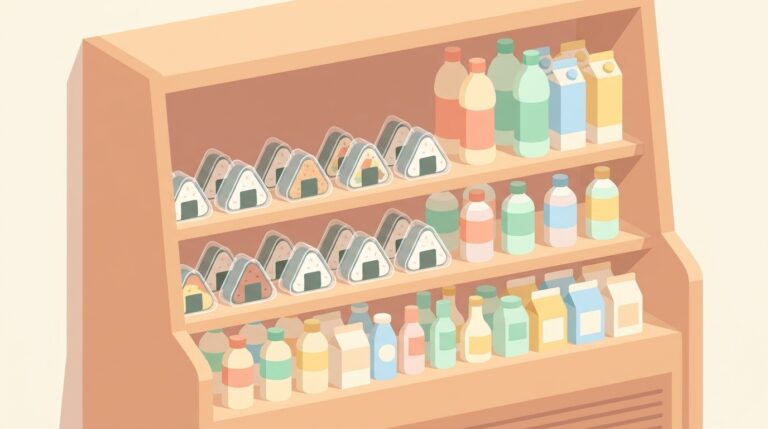
Lost in a Korean Convenience Store? How to Find and Order Triangle Kimbap Like a Local
Phase 1: 안녕하세요! (An-nyeong-ha-se-yo!) Welcome back, my lovely language learners!
It’s your favorite friendly Korean editor from Daily Hangul here! Imagine this: It’s 11:00 PM in Seoul. You’ve been walking around Hongdae all day, and your stomach is starting to rumble. You step into a brightly lit CU or GS25 convenience store. You’ve seen your favorite K-Drama characters sit by the window, happily munching on those cute, plastic-wrapped triangles called 삼각김밥 (Samgak Kimbap).
You walk up to the refrigerated shelf… but wait! There are so many options, and you can’t seem to find the exact one you want. The cashier is looking at you, and suddenly, your mind goes blank.
Don’t panic! Today, we are going to learn how to find your dream snack using super simple, A1-level Korean phrases. By the end of this guide, you won’t just find your Kimbap; you’ll sound like a local doing it, and maybe even impress the cashier! Let’s dive in!
Phase 2: Deep Dive into 3 Core Expressions
1. 삼각김밥 어디 있어요? (Sam-gak-gim-bap eo-di is-seo-yo?)
- Pronunciation: Sam-gak-gim-bap eo-di is-seo-yo? / Sound-alike: “Sam-guck-gim-bop uh-dee eat-suh-yo?”
- Meaning: Where is the triangle kimbap?
- K-Culture Moment: This is the ultimate survival phrase. You see this search play out in almost every slice-of-life K-Drama when characters need a quick, cheap meal.
- Editor’s Insight: “어디 있어요?” (eo-di is-seo-yo?) means “Where is it?”. You can put absolutely any item before this phrase. Want milk? “우유 어디 있어요?” (U-yu eo-di is-seo-yo?). It’s that easy!
- Situation Spectrum:
- Friends / Casual: ✅
- Store Clerks / Semi-formal: ✅
- Bosses / Formal: ✅ (Highly polite and perfect for any store clerk!)
- 🤔 Think About It: In English, we ask “Where is…?” but in Korean, we literally say “Where does it exist?”. It’s a beautiful way of looking at the world, searching for the existence of your delicious snack!
2. 이거 매워요? (I-geo mae-wo-yo?)
- Pronunciation: I-geo mae-wo-yo? / Sound-alike: “Ee-guh mae-wo-yo?”
- Meaning: Is this spicy?
- K-Culture Moment: Korean convenience stores love spicy food (like the famous Fire Chicken Noodles!). Some triangle kimbap flavors like spicy pork can pack a serious punch. Use this to save your tongue!
- Editor’s Insight: This is a vital safety phrase for beginners. If the cashier nods and says “네” (Ne – Yes), you might want to look for another flavor like Tuna Mayo (참치마요 – Cham-chi-ma-yo)!
- Situation Spectrum:
- Friends / Casual: ✅
- Store Clerks / Semi-formal: ✅
- Bosses / Formal: ⚠️ (A bit casual for a formal business dinner, but perfect for shopping!)
3. 데워 주세요. (De-wo ju-se-yo.)
- Pronunciation: De-wo ju-se-yo. / Sound-alike: “Day-wuh joo-seh-yo.”
- Meaning: Please heat/warm it up.
- K-Culture Moment: Did you know some Koreans prefer their kimbap cold, while others love it warm? Warming up beef bulgogi kimbap makes the fat melt and tastes 10 times better!
- Editor’s Insight: “주세요” (Ju-se-yo) means “Please give me” or “Please do for me.” It is the magic word for politeness in Korea. Always use it!
- Situation Spectrum:
- Friends / Casual: ✅
- Store Clerks / Semi-formal: ✅
- Bosses / Formal: ✅
Phase 3: Textbook Korean vs. Real Korean
Let’s look at how textbooks sometimes make things way too complicated compared to how real Koreans speak in the streets of Seoul.
Asking where the kimbap is located
- 📖 Textbook Korean: 삼각김밥은 어느 진열대에 위치합니까? (Sam-gak-gim-ba-beun eo-neu jin-yeol-dae-e wi-chi-ham-ni-kka? – “On which display stand is the triangle kimbap located?”)
- 🗣️ Real Korean: 삼각김밥 어디 있어요? (Sam-gak-gim-bap eo-di is-seo-yo? – “Where is the triangle kimbap?”)
- 💡 Why is it different? Real-life Korean values speed and efficiency. Store clerks are busy, and you want your food fast. Keep it simple and direct!
Asking the clerk to microwave your food
- 📖 Textbook Korean: 이것을 전자레인지에 데워 주시겠습니까? (I-geot-eul jeon-ja-re-in-ji-e de-wo ju-si-get-seup-ni-kka? – “Would you be so kind as to warm this up in the microwave oven?”)
- 🗣️ Real Korean: 데워 주세요. (De-wo ju-se-yo. – “Please heat it up.”)
- 💡 Why is it different? Convenience stores are all about “Ppalli-Ppalli” (빨리빨리 – Hurry, hurry) culture. A short, polite “데워 주세요” gets the job done instantly with zero fuss.
Phase 4: K-Culture Deep Dive & Non-verbal Manners
4-1. Nunchi (눈치) & Body Language Tips
When you go to pay, always hand over your cash or card with both hands. Doing this shows respect and is a huge part of Korean polite culture. Also, when the clerk hands you your receipt or change, receive it with both hands while giving a slight, polite nod of your head. This simple physical gesture instantly elevates your status from “tourist” to “respectful visitor.”
4-2. The Art of Unwrapping a Samgak Kimbap
Opening a triangle kimbap is like doing origami! If you do it wrong, the seaweed (김 – gim) falls apart, and you are left holding a pile of loose rice.
1. Step 1: Grab the red tab labeled 1 at the top point and pull it straight down, wrapping it all the way around the back.
2. Step 2: Hold the left side gently and pull the plastic cover labeled 2 on the right side straight off.
3. Step 3: Hold the right side and pull the plastic cover labeled 3 on the left side straight off.
Editor’s Secret: Don’t squeeze too hard while pulling, or the rice will stick to the plastic!
Phase 5: Play the Game! Real-life Roleplay Scenario
- The Setting: It’s a rainy night at a cozy GS25 near Sinchon Station. The store smells of warm instant ramen and sweet baked sweet potatoes. K-Pop plays softly in the background. You walk up to the counter where a friendly college student cashier named Min-jun is standing.*
-
The Characters:
- You (The Hungry Traveler)
- Min-jun (The Friendly Cashier)
Min-jun: 안녕하세요! (An-nyeong-ha-se-yo!)
         🎭 (Bows head slightly with a warm smile)

You: 안녕하세요! (An-nyeong-ha-se-yo!)
     🎭 (Bows back politely with both hands in front)

You: 저기요, 삼각김밥 어디 있어요? (Jeo-gi-yo, sam-gak-gim-bap eo-di is-seo-yo?)
     🎭 (Points gently toward the refrigerators with an open palm)

Min-jun: 아, 저쪽 냉장고에 있어요. (Ah, jeo-jjok naeng-jang-go-e is-seo-yo.)
         🎭 (Points to the back corner refrigerator)

You: 감사합니다! (Gam-sa-ham-ni-da!)
     🎭 (Walks over, picks up a red-packaged kimbap, and returns to the counter)

You: 이거 매워요? (I-geo mae-wo-yo?)
     🎭 (Shows the package to Min-jun with a curious expression)

Min-jun: 네, 조금 매워요. 불고기 맛은 안 매워요. (Ne, jo-geum mae-wo-yo. Bul-go-gi mat-eun an mae-wo-yo.)
         🎭 (Nods and points to a brown-packaged bulgogi flavor on the shelf)

You: 아, 그럼 불고기로 할게요. 계산해 주세요. (Ah, geu-reom bul-go-gi-ro hal-ge-yo. Gye-san-hae ju-se-yo.)
     🎭 (Hands over the Bulgogi Kimbap and your card with both hands)

Min-jun: 봉투 필요하세요? (Bong-tu pil-yo-ha-se-yo?)
         🎭 (Holds up a small plastic bag)

You: 아니요, 괜찮아요. (A-ni-yo, gwen-chan-ha-yo.)
     🎭 (Shakes head gently with a smile)

Min-jun: 데워 드릴까요? (De-wo deu-ril-kka-yo?)
         🎭 (Gestures toward the microwave behind him)
🔀 Decision Point: What do you say now?
- Option A: “네, 데워 주세요!” (Ne, de-wo ju-se-yo!)
- Option B: “아니요, 그냥 먹을게요.” (A-ni-yo, geu-nyang meog-eul-ge-yo.)
- Option C: “싫어요!” (Sil-heo-yo!)
🏆 Choice Analysis:
- Best Choice – Option A: “네, 데워 주세요!” is perfect! It’s super polite, and you will get a warm, delicious kimbap ready to eat.
- Safe Choice – Option B: “아니요, 그냥 먹을게요” (No, I’ll just eat it as is) is also fine if you are in a rush and don’t mind cold rice!
- Risk Choice – Option C: “싫어요!” means “I hate it!” or “No way!” in a very blunt, aggressive tone. It will make poor Min-jun feel very awkward!
Phase 6: 10-Second Emotion Shadowing Drill
Let’s practice speaking with real Korean emotion! Try to mimic the pauses (/) and the feeling in the brackets:
- 삼각김밥 / 어디 있어요?
- Sam-gak-gim-bap / eo-di is-seo-yo?
- [🥺 Emotion: Hungry, desperate, but cute and polite]
- 이거 / 매워요?
- I-geo / mae-wo-yo?
- [🔥 Emotion: Scared of spicy food, asking with big eyes]
- 네! / 데워 주세요!
- Ne! / de-wo ju-se-yo!
- [😊 Emotion: Super excited and happy for warm food]
Phase 7: K-Culture Mini Dictionary
- 편의점 (Pyeon-ui-jeom): Convenience Store. In Korea, these are open 24/7 and are bright, safe havens loaded with tables, hot water, and chairs.
- 삼각김밥 (Sam-gak-gim-bap): Triangle Kimbap. A cheap, nutritious snack made of rice, seaweed, and various fillings inside.
- 2+1 (Two-plus-one): The ultimate shopping deal in Korea! Buy two of the same item, and you get one absolutely free. Look for the “2+1” tag on shelves!
- 혜자스럽다 (Hye-ja-seureop-da): An awesome slang term meaning “extremely generous” or “great value for money,” named after a famous Korean actress who endorsed a legendary, packed convenience store lunchbox.
Phase 8: Traveler’s Survival Kit
Top 3 Survival Phrases
- 봉투 주세요. (Bong-tu ju-se-yo.) – Please give me a bag.
- 카드 돼요? (Ka-deu dwae-yo?) – Do you accept credit cards? (Almost 100% of Korean stores do!)
- 감사합니다! (Gam-sa-ham-ni-da!) – Thank you!
📌 Editor’s Travel Note:
Before you land in Incheon, make sure to download the Naver Map App on your phone. Google Maps does not work well in Korea, but Naver Map will show you every single CU, GS25, and Seven-Eleven nearby in real-time!
Note: Store hours and stock may vary based on location and time of day.
Phase 9: Deep Thinking — “One Step Deeper”
In many Western countries, convenience stores are just quick transit stops to grab gas or a soda. But in Korea, the 편의점 (Pyeon-ui-jeom) is a vibrant social hub. It is a place where students study, friends meet up at 2:00 AM over ramen, and busy workers find comfort in hot, cheap meals. It shows how much Korean culture values convenience, community safety, and communal eating, even in a fast-paced modern world.
💬 Your Turn: Does your country have convenience stores like Korea’s? What is your favorite go-to snack when you are hungry late at night? Tell us in the comments below!
Phase 10: FAQ & Common Mistakes
Q: Can I heat up the kimbap myself?
A: Yes! Most Korean convenience stores have a customer microwave zone. Usually, 15 seconds is the perfect time for a triangle kimbap!
Q: Are there vegetarian options for triangle kimbap?
A: It is rare. Most contain tuna, beef, or fish sauce in the kimchi. Always look for plain salt/sesame flavors if you are strictly vegetarian.
Q: Can I sit at the tables outside the store to drink beer?
A: Yes! During summer, sitting at a convenience store plastic table with friends and drinking a cold beverage is one of the most popular local activities in Seoul.
🚨 Common Mistakes Warning:
- Pulling the plastic tabs out of order: If you pull Tab 3 before Tab 1, your kimbap seaweed will rip. Follow the numbers 1 -> 2 -> 3!
- Shouting “Hey!” to get attention: Never shout at the cashier. A soft, polite “저기요” (Jeo-gi-yo – Excuse me) is much better.
- Leaving your trash on the table: Always clean up your food wrappers and throw them in the designated recycling bins inside the store before you leave.
Phase 11: Action Missions
- 🥉 Bronze Mission: Stand in front of your mirror and practice saying “삼각김밥 어디 있어요?” smoothly 3 times!
- 🥈 Silver Mission: Take a screenshot of a triangle kimbap from a K-Drama and share it on Instagram. Tag us at
@DailyHangul! - 🥇 Gold Mission: Walk into a local Asian supermarket or Korean grocery store in your city and ask the clerk: “이거 매워요?”
- 🎮 K-Culture Bonus: Watch an episode of your favorite K-drama and see if you can spot the characters eating inside a convenience store!
Phase 12: Interactive Quiz Challenge
1. What does “데워 주세요” mean?
- A) Please give me a bag.
- B) Please heat it up.
- C) Is this spicy?
2. Fill in the blank: “삼각김밥 _____ 있어요?” (Where is the triangle kimbap?)
- A) 뭐
- B) 어디
- C) 이거
3. True or False: You should always hand your payment card to the cashier with only one hand to show confidence.
- A) True
- B) False
🎉 Click here to reveal the answers and explanations!
- Answer: B – “데워 주세요” means “Please heat/warm it up!”
- Answer: B – “어디” means “where”. So “삼각김밥 어디 있어요?” means “Where is the triangle kimbap?”
- Answer: B (False) – In Korea, always hand items and cards with both hands to show respect!







