

Keep Them Blooming! How to Ask for Long-Lasting Flowers in a Korean Flower Shop
Phase 1: Welcome to the Bloom!
안녕하세요 (An-nyeong-ha-se-yo)! Welcome back to Daily Hangul, your cozy spot for learning Korean like a true local. I’m your lead editor, and today we are going on a beautiful sensory journey.
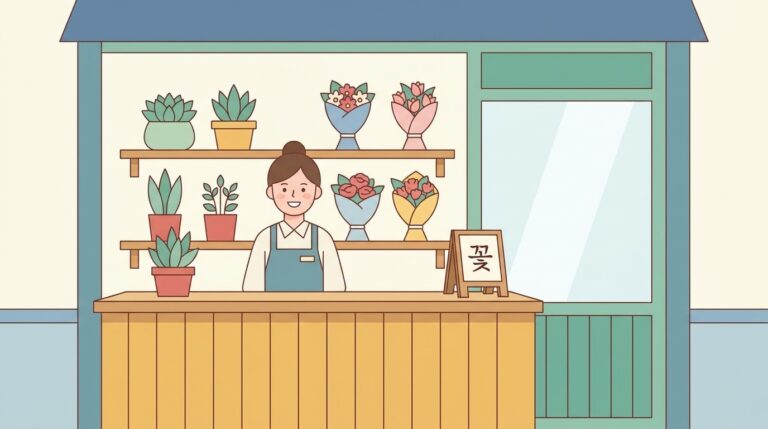
Imagine this: You are walking down a quiet, cobblestone alleyway in Yeonnam-dong, Seoul. The air smells like fresh rain and coffee. You turn a corner and see a tiny flower shop with warm yellow lights. Inside, gorgeous bouquets are displayed with that signature, effortlessly chic “K-Drama aesthetic”.
You want to buy a lovely bouquet to decorate your Airbnb, or maybe as a sweet “thank you” gift for a Korean friend who invited you to their housewarming party (집들이 – Jip-deu-ri). But there’s a catch: flowers can be expensive, and you don’t want them to wither and die in just two days! You want something sturdy, beautiful, and long-lasting.
Many of my students have confessed: “I wanted to ask the florist which flowers would last the longest, but I panicked and just pointed to the prettiest rose! It died in three days.”
Don’t worry! Today, we will learn how to ask for long-lasting flowers with confidence and charm. By the end of this guide, you won’t just walk away with beautiful blooms—you will also win the florist’s heart with your polite Korean manners!
Phase 2: Core Expressions Deep Dive
Here are the top three magic phrases you need when visiting a Korean flower shop. Let’s break them down easily!
1. 오래가는 꽃으로 추천해 주세요. (Please recommend long-lasting flowers.)
- Pronunciation: O-rae-ga-neun kko-teu-ro chu-cheon-hae ju-se-yo.
- Sound-alike Guide: “Oh-reh-gah-noon kote-eu-roh choo-chuhn-heh joo-seh-yo.”
- Meaning: “Please recommend flowers that go a long way (last long).”
- K-Culture Moment: In K-Dramas, when a lead character wants to show sincere, long-lasting love, they often choose flowers that don’t fade quickly, symbolizing their enduring feelings.
- Editor’s Insight: The word 오래 (o-rae) means “for a long time,” and 가다 (ga-da) means “to go.” Together, 오래가다 means “to last long.” Adding ~으로 추천해 주세요 (Please recommend as…) makes your request super polite and natural.
- Situation Spectrum:
- Friends / Casual: ⚠️ (A bit too formal for close friends, but okay!)
- Shop Staff / Semi-formal: ✅ (Perfect, extremely polite!)
- Formal Settings: ✅
- 🤔 Think About It: In Korean, we use the verb “to go” (가다) to describe flowers staying alive. It’s like the flowers are “traveling” through time with you! How does your language describe long-lasting flowers?
2. 어떤 꽃이 제일 오래가요? (Which flower lasts the longest?)
- Pronunciation: Eo-tteon kko-ti je-il o-rae-ga-yo?
- Sound-alike Guide: “Uh-ttuhn kko-tee jeh-eel oh-reh-gah-yo?”
- Meaning: “Which flower lasts the longest?”
- K-Culture Moment: If you watch Korean home-decorating vlogs on YouTube, creators love buying simple, single-stem flowers that last for weeks to brighten up their minimalist rooms.
- Editor’s Insight: 어떤 (eo-tteon) means “which,” and 제일 (je-il) means “the most” or “the best.” This is a simple, direct question that gets you the best options instantly! Florists love answering this because it shows you care about their expertise.
- Situation Spectrum:
- Friends / Casual: ✅ (Just drop the 요 to make it casual: 어떤 꽃이 제일 오래가?)
- Shop Staff / Semi-formal: ✅ (Very friendly and polite.)
- Formal Settings: ⚠️ (A bit casual, but acceptable.)
- 🤔 Think About It: Asking for the “longest-lasting” option shows a practical, down-to-earth side. In Korea, being practical yet aesthetic is highly valued!
3. 물은 얼마나 자주 줘야 해요? (How often should I water them?)
- Pronunciation: Mu-reun eol-ma-na ja-ju jwo-ya hae-yo?
- Sound-alike Guide: “Moor-oon uhl-mah-nah jah-joo jwoh-yah heh-yo?”
- Meaning: “How often should I give water?”
- K-Culture Moment: Many young Koreans love low-maintenance plants and dried flowers because of their busy city life.
- Editor’s Insight: 물 (mul) means “water.” 얼마나 자주 (eol-ma-na ja-ju) means “how often.” 줘야 해요 (jwo-ya hae-yo) means “must give.” Note that in Korean, we say “give water” (물을 주다) rather than “water the plant.”
- Situation Spectrum:
- Friends / Casual: ✅
- Shop Staff / Semi-formal: ✅
- Formal Settings: ✅
- 🤔 Think About It: Why does Korean use the verb “to give” (주다) for watering? It reflects a warm mindset of caring for living things as if you are gifting them life!
Phase 3: Textbook Korean vs. Real Korean
When you study with standard textbooks, you might learn sentences that sound like an instruction manual. Let’s look at how Koreans actually speak in modern flower shops!
Situation 1: Asking for sturdy, long-lived flowers
- 📖 Textbook: “수명이 긴 화초를 추천해 주시겠습니까?” (Su-myeong-i gin hwa-cho-reul chu-cheon-hae ju-si-get-seum-ni-ka? – “Would you recommend a plant with a long lifespan?”)
- 🗣️ Real Korean: “오래가는 꽃 있을까요?” (O-rae-ga-neun kkot is-seul-kka-yo? – “Do you have any flowers that last long?”)
- 💡 Why the difference? The textbook sentence uses 수명 (lifespan) and 화초 (flowering plant), which sound incredibly academic. In daily life, real Koreans keep it breezy and soft by using the ending ~있을까요? (“Would there be…?”), which sounds much more polite and gentle.
Situation 2: Asking how to take care of them
- 📖 Textbook: “이 식물의 수분 공급 주기를 가르쳐 주십시오.” (I sing-mul-ui su-bun gong-geup ju-gi-reul ga-reu-cheo ju-sip-si-o. – “Please instruct me on the hydration cycle of this plant.”)
- 🗣️ Real Korean: “물은 언제 주면 돼요?” (Mu-reun eon-je ju-myeon dwae-yo? – “When should I give water?”)
- 💡 Why the difference? Nobody talks about “hydration cycles” in a cozy neighborhood shop! 언제 주면 돼요? (“When is it okay to give?”) is simple, easy, and exactly how native speakers talk.
Phase 4: K-Culture Deep Dive & Non-verbal Manners
4-1. The Art of “Nunchi” (눈치) at the Flower Shop
When you enter a Korean flower shop, you will immediately notice how peaceful it is. Here are a few physical manners to show you respect the culture:
* Greet with a slight bow: As you open the door, make eye contact, smile, and say a soft “안녕하세요” (An-nyeong-ha-se-yo) with a 15-degree bow.
* Receive with both hands: When the florist hands you the finished bouquet, always receive it with both hands. This is a core sign of respect in Korea. Receiving things with one hand can look careless or dismissive!
4-2. The “Flower Gift” Culture in Korea
Did you know that flowers are a huge part of young Korean culture? It’s not just for anniversaries!
* Coming-of-Age Day (성년의 날): Celebrated in May, young adults who turn 20 receive roses, perfume, and a kiss.
* Mini-Bouquets: Walk around Hongdae or Sinchon, and you’ll see vending machines selling small dried flower bouquets. Koreans love giving “just because” flowers to brighten a friend’s day.
If you want flowers that last long, florists often recommend 소국 (So-guk – Chrysanthemums), 리시안셔스 (Lisianthus), or 카네이션 (Carnations). They are incredibly hardy and look gorgeous for up to two weeks!
Phase 5: Interactive Roleplay Scenario
Let’s practice! You are at a beautiful, plant-filled flower shop called “La Fleur” near Hapjeong Station. The owner, Sujin, is arranging some eucalyptus stems behind a rustic wooden counter.
- Your Role: A friendly traveler looking for a nice bouquet that won’t die quickly in your hotel room.
[Scene: A quiet afternoon. The sound of soft lo-fi music plays. The shop smells like fresh pine.]

Sujin (Florist): (looking up with a warm smile)
안녕하세요! 편하게 둘러보세요.
(An-nyeong-ha-se-yo! Pyeon-ha-ge dul-leo-bo-se-yo.)
"Hello! Please feel free to look around."

You: (smiling and bowing slightly)
안녕하세요! 저... 꽃 추천 좀 받고 싶어서요.
(An-nyeong-ha-se-yo! Jeo... kkot chu-cheon jom bat-go si-peo-seo-yo.)
"Hello! I... would like to get some flower recommendations."

Sujin:
아, 네! 선물하실 거예요? 아니면 집에 두실 거예요?
(Ah, ne! Seon-mul-ha-sil geo-yeo-yo? A-ni-myeon ji-be du-sil geo-yeo-yo?)
"Oh, yes! Is it for a gift? Or to keep at home?"

You:
제 방에 둘 거예요. 오래가는 꽃으로 추천해 주세요!
(Je bang-e dul geo-yeo-yo. O-rae-ga-neun kko-teu-ro chu-cheon-hae ju-se-yo!)
"I will keep it in my room. Please recommend long-lasting flowers!"

Sujin: (nodding thoughtfully)
방에 두실 거면 '리시안셔스'나 '소국'이 정말 오래가요. 관리가 아주 편하거든요.
(Bang-e du-sil geo-myeon 'ri-si-an-syeo-seu'-na 'so-guk'-i jeong-mal o-rae-ga-yo. Gwan-ri-ga a-ju pyeon-ha-geod-eun-yo.)
"If it's for your room, Lisianthus or small Chrysanthemums last really long. They are very easy to care for."

You:
좋아요! 그럼 그걸로 해 주세요. 아, 물은 얼마나 자주 줘야 해요?
(Jo-a-yo! Geu-reom geu-geol-ro hae ju-se-yo. Ah, mu-reun eol-ma-na ja-ju jwo-ya hae-yo?)
"Great! I'll take those then. Ah, how often should I water them?"

Sujin:
이틀에 한 번씩 화병 물을 갈아주시고, 줄기 끝을 대각선으로 조금씩 잘라주시면 훨씬 오래가요!
(I-teul-e han beon-ssik hwa-byeong mu-reul gar-a-ju-si-go, jul-gi kkeu-teul dae-gak-seon-eu-ro jo-geum-ssik jal-ra-ju-si-myeon hwol-ssin o-rae-ga-yo!)
"Change the vase water once every two days, and cut the end of the stems diagonally little by little, and they will last much longer!"

You: (receiving the wrapped flowers with both hands)
와, 꿀팁 감사합니다! 잘 키울게요.
(Wa, kkul-tip gam-sa-ham-ni-da! Jal ki-ul-ge-yo.)
"Wow, thank you for the pro-tip! I'll take good care of them."
🔀 Decision Point!
If Sujin asked you: “어떤 스타일을 좋아하세요?” (Eo-tteon seu-ta-i-reul jo-a-ha-se-yo? – “What style do you like?”)
* A) “제일 예쁜 걸로 주세요!” (Je-il ye-ppeun geol-ro ju-se-yo! – “Please give me the prettiest one!”)
* 💖 Best Choice: This is cute and shows trust in her artistic eye! Korean florists love taking pride in making their creations beautiful.
* B) “오래가는 게 제일 중요해요.” (O-rae-ga-neun ge je-il jung-yo-hae-yo. – “Lasting long is the most important thing.”)
* 👍 Good Choice: Practical and clear. She will guide you to sturdy carnations or lilies.
* C) “아무거나 괜찮아요.” (A-mu-geo-na gwaen-cha-na-yo. – “Anything is fine.”)
* ⚠️ Risk Choice: While not rude, it lacks enthusiasm. Florists prefer creating something tailored to your vibe!
Phase 6: 10-Second Emotion Shadowing Drill
Let’s add some emotional color to your spoken Korean! Try saying these sentences out loud, paying attention to the pauses (/) and the emotional cues.
- [🥺 Curious & Wondering]
“어떤 꽃이 / 제일 / 오래가요?”
(Eo-tteon kko-ti / je-il / o-rae-ga-yo?) -
[😊 Bright & Friendly]
“오래가는 꽃으로 / 추천해 주세요!”
(O-rae-ga-neun kko-teu-ro / chu-cheon-hae ju-se-yo!) -
[💖 Amazed & Grateful]
“와! / 너무 예뻐요! / 감사합니다.”
(Wa! / neo-mu ye-ppeo-yo! / gam-sa-ham-ni-da.)
Phase 7: K-Culture Mini Dictionary
| Word | Meaning | Context Insight |
|---|---|---|
| 꽃다발 (Kkot-da-bal) | Flower Bouquet | Literally translates to “a bundle of flowers.” Perfect for graduations, concerts, and birthdays. |
| 집들이 (Jip-deu-ri) | Housewarming | A huge culture in Korea. When friends move into a new apartment, you bring toilet paper (representing smoothly flowing luck) or beautiful flowers! |
| 인스타감성 (In-seu-ta-gam-seong) | Instagram Aesthetic | Used to describe trendy, visually pleasing cafes, shops, and floral arrangements. |
| 화분 (Hwa-bun) | Flower Pot / Plant | If you want something that lasts forever, skip the cut flowers and ask for a 화분! |
Phase 8: Traveler’s Survival Kit
Keep these three quick sentences in your pocket for your next trip to Seoul!
- 이거 얼마예요? (I-geo eol-ma-yeo-yo?)
- “How much is this?”
- Pro-tip: Point directly to the flower or pot you want.
- 선물용 포장해 주세요. (Seon-mul-yong po-jang-hae ju-se-yo.)
- “Please wrap it as a gift.”
- Pro-tip: Korean gift wrapping is world-class. It usually involves beautiful translucent paper and elegant ribbons.
- 카드도 하나 주세요. (Ka-deu-do ha-na ju-se-yo.)
- “Please give me a small card too.”
- Pro-tip: Writing a quick hand-written note is highly appreciated in Korea.
📌 Editor’s Travel Note: To find the absolute best neighborhood flower shops in Seoul, download the Naver Map App. Type in “꽃집” (Kkot-jip) to find highly-rated boutique florists near you with stunning “Insta-gamseong” designs!
Phase 9: A Deeper Thought — “One Step Deeper”
In many Western cultures, giving flowers is often reserved for romantic partners or major formal events. However, in Korea, flowers are integrated into daily self-care and friendships.
There is a popular trend called 소확행 (So-hwak-haeng), which means “small but certain happiness.” Buying a single tulip for 3,000 KRW (about $2.50 USD) on your way home from work to put on your desk is a classic example of so-hwak-haeng. It shows that beauty doesn’t have to be grand or expensive; even a single flower that lasts a week can bring peace to a busy lifestyle.
💬 Your Turn: How often do people buy flowers in your country? Do you give them just to say thank you, or are they only for special occasions? Let us know in the comments below!
Phase 10: FAQ & Common Mistakes
Q: Can I buy single stems in Korea, or do I have to buy a full bouquet?
A: Yes, absolutely! You can buy just one single stem (한 송이 – han song-i). Florists will still wrap it beautifully with a simple ribbon and clear paper. It is highly popular and very affordable!
Q: Are flower prices fixed in Korea?
A: In boutique shops, yes. Do not try to bargain (discount) the price at neighborhood florists. However, if you visit the massive wholesale flower markets like the Yangjae Flower Market, prices depend on the daily auction, but bargaining is still not common for casual tourists.
Q: Can I bring these flowers back to my home country?
A: Generally, no. Customs laws in almost every country strictly prohibit bringing live plants or cut flowers across borders without complex agricultural certificates. Enjoy them to the fullest during your stay in Korea!
🚨 Common Mistakes Warning Board
- Mistake: Asking “이 꽃 언제 죽어요?” (I kkot eon-je jug-eo-yo? – “When will this flower die?”).
- Correct Action: This sounds a bit too morbid! Instead, ask politely, “얼마나 오래가요?” (Eol-ma-na o-rae-ga-yo? – “How long does it last?”).
- Mistake: Receiving the flowers with one hand while holding your phone in the other.
- Correct Action: Put your phone away for 3 seconds and receive the gorgeous wrap with both hands while saying “감사합니다” (Gam-sa-ham-ni-da).
Phase 11: Your Action Missions
Let’s put your new knowledge into action!
- 🥉 Bronze Mission (The Mirror Challenge): Stand in front of a mirror and practice saying: “오래가는 꽃으로 추천해 주세요” three times with a bright, friendly smile!
- 🥈 Silver Mission (Social Media Share): Take a photo of a flower you love, post it on your Instagram story, and tag us at #DailyHangul with the caption: “오래가는 꽃”!
- 🥇 Gold Mission (Real World Challenge): On your next trip to Korea, walk into a local florist, buy a single stem of a long-lasting flower using today’s phrases, and place it in your hotel room!
Phase 12: Quiz Time!
Test your knowledge with this quick interactive quiz!
1. Match the Phrase!
Which Korean phrase means “Please recommend long-lasting flowers”?
* A) 물은 언제 줘요?
* B) 오래가는 꽃으로 추천해 주세요.
* C) 이거 얼마예요?
👉 Click to see the Answer!
Correct Answer: B
* A means “When do I give water?”
* C means “How much is this?”
2. True or False?
In Korea, it is considered polite to receive your finished flower bouquet from the florist with only one hand.
* A) True
* B) False
👉 Click to see the Answer!
Correct Answer: B (False!)
Always use both hands to receive things in Korea to show respect and warmth.
Keep blooming, keep practicing, and see you in the next lesson! 다음에 또 만나요! (Da-eum-e tto man-na-yo! – See you next time!)







