

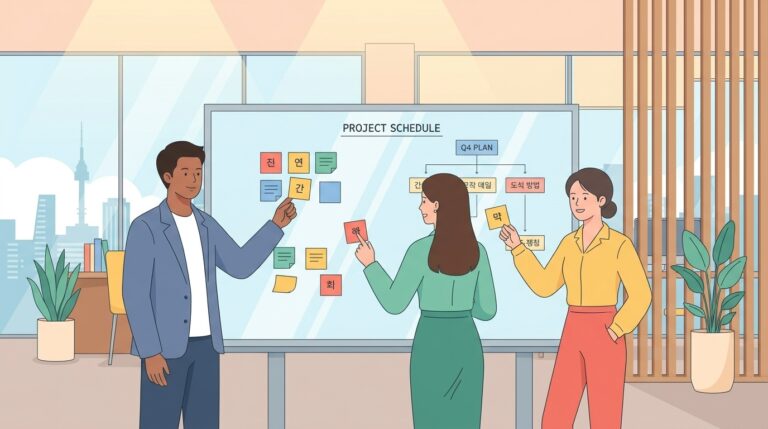
How to Lead Korean Meetings Like a Pro: Assigning Tasks and Setting Deadlines Without the Awkwardness
Phase 1: Empathy (Welcome to the K-Office!)
안녕하세요! Welcome back to Daily Hangul, your premium Korean tutoring space and local cultural guide. I’m your head editor, and today, we’re stepping right into the heart of Seoul’s bustling professional world.
Imagine this: You’re sitting in a sleek, glass-walled conference room in Seongsu-dong (Seoul’s hipster tech hub), surrounded by talented Korean developers and designers. The atmosphere is buzzing, much like a scene straight out of the hit K-Drama Start-Up. The agenda is set, the ideas are flowing, but now comes the most critical and delicate moment of the meeting: assigning tasks and setting deadlines (향후 일정 및 담당자 지정).
You want to ask Kim Dae-ri (Assistant Manager Kim) to handle the design mockups by Friday, and you need Ji-won to coordinate the client feedback. But suddenly, you freeze. How do you delegate tasks without sounding like an aggressive, overbearing boss? On the flip side, how do you avoid being so vague that nothing actually gets done?
In Korean corporate and collaborative culture, the way you assign tasks requires a high degree of linguistic emotional intelligence (what we call 눈치 Nunchi). If you use textbook, direct commands, you might accidentally create a cold, awkward wall between you and your team. But master the right intermediate (B2) phrasing, and you will not only get things done efficiently but also earn the deep respect of your Korean colleagues as a culturally savvy leader. Let’s learn how to do exactly that!
Phase 2: Deep Dive into 3 Core Expressions
Let’s analyze the top three natural expressions used by modern Korean professionals to delegate and schedule tasks.
1. ~님께서 이 부분을 맡아주실 수 있을까요? (Could you take charge of this part?)
- Pronunciation: [~nim-kkeo-seo i bu-bun-eul mat-a-ju-sil su iss-eol-kka-yo?]
- Sound-alike guide: ~nim-kkesuh ee boo-boon-uhl mah-tah-joo-shil soo eess-uhl-kkah-yo?
- Meaning: “Could you [honorific] please take care of / handle this part?”
- K-Culture Moment: This is the ultimate “soft-power” delegation phrase. In dramas like Queen of Tears or Misaeng, you will hear polite managers use this to assign high-responsibility tasks without raising their voices. It respects the individual’s autonomy while clearly setting expectations.
- Editor’s Insight: By using the honorific particle -께서 (-kkeoseo) instead of the casual -가 (-ga), and combining it with the helping verb -아/어 주다 (-a/eo juda) (to do something as a favor), you transform a flat command into a polite request for collaboration.
- Situation Spectrum (상황 스펙트럼):
- Friends & Casual Settings: ⚠️ (Slightly too formal, unless teasing a friend with high respect)
- Colleagues & Semi-formal: ✅ (Perfect for peer-to-peer delegation or horizontal teams)
- Superior & Formal: ✅ (Highly appropriate when asking a senior colleague to take the lead on a specific project)
- 🤔 Think About It: Notice how the subject “You” (당신/너) is completely omitted. Instead, we use the person’s title + -님께서. Why does Korean avoid direct pronouns in professional settings? How does this reflect the cultural emphasis on social roles rather than individual confrontation?
2. 이 업무는 언제까지 마무리 가능할까요? (When do you think you can wrap up this task?)
- Pronunciation: [i eob-mu-neun eon-je-kka-ji ma-mu-ri ga-neung-hal-kka-yo?]
- Sound-alike guide: ee up-moo-noon uhn-jeh-kkah-jee mah-moo-ree gah-nung-hahl-kkah-yo?
- Meaning: “When is it possible to wrap up/finish this task?”
- K-Culture Moment: In the fast-paced, efficiency-driven world of modern Korean startups, deadlines are crucial. However, instead of demanding “Finish this by Friday!”, asking “When is it possible?” shows that you value your colleague’s current workload and schedule.
- Editor’s Insight: The word 마무리 (ma-mu-ri) means “finishing touches” or “wrapping up.” It sounds much more professional and collaborative than simply saying “끝내다” (to end). Using ~가능할까요? (Is it possible?) leaves room for negotiation, which is highly appreciated in Korean office dynamics.
- Situation Spectrum (상황 스펙트럼):
- Friends & Casual Settings: ⚠️ (A bit stiff for ordering food or casual plans)
- Colleagues & Semi-formal: ✅ (The golden standard for deadline checking)
- Superior & Formal: ✅ (Perfect for asking your boss when they can review your report)
3. 그럼 제가 이 건을 팔로우업하겠습니다. (Then, I will follow up on this matter.)
- Pronunciation: [geu-reom jae-ga i geon-eul pal-ro-u-eob-ha-gess-seub-ni-da.]
- Sound-alike guide: guh-ruhm jeh-gah ee guhn-uhl pal-low-up-hah-get-soom-nee-dah.
- Meaning: “In that case, I will follow up on this specific matter/issue.”
- K-Culture Moment: If you watch office K-dramas, you’ll notice that young, proactive characters (think of the energetic entrepreneurs in Start-Up) often use loanwords like “팔로우업” (follow-up) or “컨펌” (confirm). It shows high energy, adaptability, and modern business savvy.
- Editor’s Insight: The word 건 (geon) is a counter/noun for “cases, projects, or issues.” Instead of saying “이 일” (this work), using “이 건” sounds highly professional. Ending the sentence with -겠습니다 (-gess-seub-ni-da) signals strong, reliable intent.
- Situation Spectrum (상황 스펙트럼):
- Friends & Casual Settings: 🚫 (Too business-like)
- Colleagues & Semi-formal: ✅ (Excellent for claiming ownership of a task during a sprint)
- Superior & Formal: ✅ (Displays proactiveness and responsibility to your superiors)
Phase 3: Textbook Korean vs. Real-World Korean
Many intermediate textbooks teach you how to ask for things in a vacuum, but real Korean office dynamics require subtle diplomatic layers. Let’s look at the contrast:
Scenario 1: Setting a deadline with a team member
- 📖 Textbook Style: “금요일까지 이 보고서를 제출하십시오.” (Submit this report by Friday.)
- Why it feels awkward: This uses the -십시오 imperative, which sounds like an army general barking orders. It can make your Korean colleagues feel defensive or micro-managed.
- 🗣️ Real-World Style: “이 보고서는 금요일까지 제출해 주시면 감사하겠습니다.” (I would appreciate it if you could submit this report by Friday.)
- The Nuance Difference: By adding -해 주시면 감사하겠습니다 (I would be grateful if you do X), you frame the deadline as a favor that you appreciate, rather than a unilateral command.
Scenario 2: Asking who will take charge of a new task
- 📖 Textbook Style: “누가 이 마케팅을 하겠습니까?” (Who will do this marketing?)
- Why it feels awkward: This feels like a teacher asking a classroom of silent students. In Korean culture, speaking up to claim a task can sometimes feel boastful, leading to awkward silence.
- 🗣️ Real-World Style: “이번 마케팅 건은 어떤 분이 담당을 맡아 진행해 주시겠어요?” (Which person would like to take charge of and proceed with this marketing project?)
- The Nuance Difference: Replacing “누가” (who) with “어떤 분이” (which esteemed person) and using “담당을 맡아 진행하다” (to take charge and proceed) makes the delegation look professional, organized, and inviting.
Phase 4: K-Culture Deep Dive & Non-Verbal Manners
4-1. “Nunchi” (눈치) and Non-Verbal Meeting Etiquette
In a Korean meeting, what is not said is often just as important as what is said. When assigning tasks:
* The Head Nod (고개 끄덕임): When assigning a task to someone, do not point your finger directly at them. Instead, make gentle eye contact, gesture with an open palm facing upward towards them, and give a slight, respectful nod.
* The Soft “Ah…” (아…): If you ask, “Is Friday possible?” and your colleague hesitates with a sigh or an “아… (Ah…)” followed by silence, this is a clear non-verbal cue that their schedule is overloaded. Do not press them directly; instead, offer an out: “일정이 좀 타이트하시죠?” (The schedule is a bit tight, isn’t it?).
4-2. The Changing Corporate Culture: “Jeong” (정) Meets Agile Sprints
Traditionally, Korean work culture was strictly top-down (수직적). However, modern Seoul workspaces (especially in IT, beauty, and creative industries) have rapidly shifted toward horizontal (수평적) collaboration. You’ll often see teams using English names or replacing titles with “~님” to encourage freer communication. Yet, even in the most modern agile startup, the core value of preserving 기분 (Gibun – feelings/morale) remains. Setting a schedule is always presented as a collaborative puzzle we solve together, rather than tasks forced upon individuals.
Phase 5: Interactive Roleplay Scenario
Setting: A modern, sunlit conference room of a creative agency in Mapo-gu, Seoul. You are sitting with Ji-won (지지원), a sharp but warm project manager, and Min-ho (민호), a talented but busy developer. You are wrapping up the sprint planning for a new lifestyle app.
![SEO Alt Text: Flat minimal illustration of three professionals in a modern Seoul office meeting room discussing a project on a white board with coffee cups on the table]
The Cast:
- Ji-won: Proactive, organized, loves using English business terms mixed with natural Korean.
- You: An intermediate level marketing coordinator trying to finalize the timeline.
The Dialogue:
- Ji-won (PM): 🎭 (Looking at the whiteboard eagerly) “자, 오늘 기획안 회의는 거의 다 끝났네요. 이제 향후 일정하고 담당자만 정리하면 될 것 같아요.”
(Translation: Okay, today’s planning meeting is almost done. Now we just need to organize the future schedule and assign responsibilities.) -
You: 🎭 (Nodding politely) “네, 맞아요. 지원 님, 우선 이번 마케팅 기획안은 누가 담당하는 게 좋을까요?”
(Translation: Yes, that’s right. Ji-won, first of all, who would be best to take charge of this marketing plan?) -
Ji-won (PM): 🎭 (Smiling, gesturing toward you) “이번 프로젝트는 저희 브랜드의 핵심이라서, 영어 마케팅에 강한 우리 에디터님께서 맡아주시면 어떨까 하는데요?”
(Translation: Since this project is the core of our brand, how about our Editor, who is strong in English marketing, takes charge?) -
You: 🎭 (Accepting confidently) “좋습니다! 그럼 제가 이번 마케팅 기획안 건은 책임지고 진행하겠습니다.”
(Translation: Sounds good! Then I will take responsibility and proceed with this marketing proposal.) -
Ji-won (PM): 🎭 (Clapping hand gently) “와, 든든하네요! 감사해요. 그러면 이 업무는 언제까지 마무리 가능할까요?”
(Translation: Wow, so reassuring! Thank you. In that case, when do you think this task can be wrapped up?) -
You (Decision Point!):
How do you respond to negotiate a realistic but professional deadline? Choose your path below!
🔀 Decision Point: Your Response
- A: “이번 주 금요일까지 끝내겠습니다. 걱정 마세요.”
- [Pronunciation: ibeon ju geum-yo-il-kka-ji kkeut-nae-gess-seub-ni-da. geok-jeong ma-se-yo.]
- B: “자료 조사가 좀 필요해서요. 혹시 다음 주 화요일까지 조율이 가능할까요?”
- [Pronunciation: ja-ryo jo-sa-ga jom pil-yo-hae-seo-yo. hok-si da-eum ju hwa-yo-il-kka-ji jo-yul-i ga-neung-hal-kka-yo?]
- C: “아… 일이 너무 많아서 그건 불가능합니다.”
- [Pronunciation: a… il-i neo-mu manh-ah-seo geu-geon bul-ga-neung-hap-ni-da.]
💡 Choices Analysis:
- Best Choice: B
- Why: It explains the realistic reason politely (“자료 조사가 필요해서요” – I need to do some research) and asks for adjustment using 조율 (jo-yul – tuning/coordination). This shows you are professional, realistic, and highly polite.
- Risky/Over-promising: A
- Why: While confident, if Friday is too tight, you might burn out. Korean offices appreciate realistic timelines over broken promises.
- Bad/Too Blunt: C
- Why: Saying “불가능합니다” (It’s impossible) directly to a manager’s request sounds extremely cold and can damage the professional harmony (기분). Always offer a soft reason and alternative.
Phase 6: 10-Second Emotional Shadowing Drill
Let’s practice speaking with real professional emotion. Read the lines out loud, focusing on the / pauses and the emotional prompts!
- [😤 Confident and Reassuring]
- “제가 / 이 건은 / 책임지고 / 마무리하겠습니다!”
- [jae-ga / i geon-eun / chaek-im-ji-go / ma-mu-ri-ha-gess-seub-ni-da!]
- Nuance Tip: Put extra energy into “책임지고” (taking responsibility) to show your team they can trust you completely!
- [🥺 Polite and Collaborative Request]
- “혹시 / 마감일을 / 조금만 / 조율할 수 / 있을까요?”
- [hok-si / ma-gam-il-eul / jo-geum-man / jo-yul-hal su / iss-eol-kka-yo?]
- Nuance Tip: Soften your voice at “조금만” (just a little) to sound highly polite and cooperative rather than demanding.
Phase 7: K-Culture Mini Dictionary (4 Business Gems)
| Word (Korean + Romanization) | English Meaning | Cultural & Professional Context |
|---|---|---|
| 업무 분담 (eob-mu bun-dam) | Division of labor | The holy grail of team efficiency. Assigning who does what clearly so nobody is overwhelmed. |
| 일정 조율 (il-jeong jo-yul) | Schedule coordination | “조율” literally means tuning an instrument. In offices, it refers to carefully tweaking deadlines so everyone is aligned. |
| 피드백 (pi-deu-baek) | Feedback | Borrowed from English but used constantly. Modern Korean workers actively seek and value constructiveness. |
| 회식 (hoe-sik) | Company dinner | Although changing, the “after-work gathering” is where loose ends from meetings are often informally smoothed over. |
Phase 8: Traveler and Expat’s Survival Kit
Even if you’re not working full-time in Seoul, these quick professional expressions will save you when managing projects, study groups, or bookings in Korea!
Survival Cards
- “일정이 변경되면 미리 알려주세요.”
- [il-jeong-i byeon-gyeong-doe-myeon mi-ri al-ryeo-ju-se-yo.]
- Pro Tip: Use this when coordinating group travels or reservations with local Korean guides. It translates to “Please let me know in advance if the schedule changes.”
- “회의록 정리해서 공유해 드릴게요.”
- [hoe-ui-rok jeong-ri-hae-seo gong-yu-hae deu-ril-ge-yo.]
- Pro Tip: “I will organize the meeting minutes and share them with you.” Great for university group projects.
- “담당자 연락처를 받을 수 있을까요?”
- [dam-dang-ja yeol-rak-cheo-rull ba-deul su iss-eol-kka-yo?]
- Pro Tip: “Could I get the contact information of the person in charge?” Extremely useful for business or complex tourist bookings.
📌 Editor’s Travel Note: To stay on top of schedules in Korea, ditch Google Calendar temporarily. Download the Naver Calendar App Store Download Page or coordinate group tasks directly via the KakaoTalk Official PC Page using their ‘Talk Calendar’ feature, which is the standard organizational tool in Korea.
Phase 9: Going Deeper — “Our” Responsibility
In Western business contexts, the focus of delegation is often on individual accountability: “This is your job, and that is my job.” However, the Korean corporate lexicon still carries the deep-rooted sentiment of “우리” (uri – we/our).
Even when tasks are split, you will often hear managers say “우리 같이 힘내봐요” (Let’s do our best together). This collectivist approach means that if a teammate is falling behind on their assigned task, others are expected to proactively step in and assist, rather than saying, “That’s not my department.” Balancing individual clarity with this spirit of mutual support is the secret to building high-functioning, happy teams in Korea.
💬 Your Turn: How does your home country handle task delegation during meetings? Is it highly direct, or do you also use soft, polite phrasing? Let us know in the comments below!
Phase 10: FAQ & Avoiding Common Mistakes (FAQ Schema)
Q: Can I use “당신” (Dang-sin) to mean “you” when assigning a task?
A: Definitely not! While textbooks translate “당신” as “you,” in real life, it can sound extremely confrontational, cold, or even like you’re starting a fight. Instead, always use the person’s name and title, such as “민호 님” (Min-ho-nim) or “팀장님” (Team Leader-nim).
Q: What should I say if I cannot meet a requested deadline?
A: Never just say “안 돼요” (I can’t). Instead, use the formula: “[Reason] 때문에 [Alternative Deadline]까지 마쳐도 괜찮을까요?” For example: “자료 보완 때문에 월요일까지 마쳐도 괜찮을까요?” (Would it be okay to finish by Monday to supplement the data?). This shows you are solution-oriented.
Q: Is it okay to use English loanwords like “컨펌” (confirm) or “마일스톤” (milestone) in Korean meetings?
A: Yes, absolutely. Modern Korean offices, especially in tech and marketing, use high amounts of







