

Why Winter Beats Summer in Korea: Master Comparative Patterns Like a Local
안녕하세요! (Annyeonghaseyo!) Hello, my lovely language learners! It’s your favorite Korean bestie and Daily Hangul tutor here.
Picture this: You are sitting in an ultra-cool cafe in Hongdae during July. It is so humid outside that your sunglasses fog up the second you walk out. You turn to your Korean friend and want to say, “I prefer winter over summer so much more!” But your brain freezes, and you end up stuttering a textbook-dry sentence: “저는 여름보다 겨울을 더 선호합니다” (I prefer winter to summer).
While grammatically correct, it sounds like you’re reading a corporate weather report!
In this lesson, we are going to learn how to naturally compare and contrast things in Korean, specifically focusing on why winter is the ultimate season (or vice versa, no judgment!). This guide is based on real-world conversations and common slip-ups from my B1-level students. By the end of this post, you’ll be debating like a true Seoulite!
1. Three Core Comparative Expressions You Need to Know
To sound like a natural, you need to move past basic translations. Let’s look at three powerful ways to compare and contrast.
① [Noun]보다 [Noun]이/가 더 좋다
- Pronunciation: [yeo-reum-bo-da gyeo-u-ri deo jo-a] / Sound-alike: “yuh-rum-bo-dah gyuh-wool-ee duh jo-ah”
- Meaning: I prefer [Noun B] over [Noun A] (Literally: “More than A, B is better”)
- K-Culture Moment: You will hear this constantly in winter-themed K-Dramas when characters are walking under the falling snow in beautiful, oversized trench coats, grabbing a warm drink.
- Editor’s Insight: The most important thing to remember is that the item attached to 보다 (bo-da) is the one you like less. Beginners often swap them! Keep them in order: [Disliked Thing]보다 [Liked Thing]이/가 더 좋다.
- Situation Spectrum:
- Friends/Casual: ✅ (여름보다 겨울이 더 좋아!)
- Semi-formal: ✅ (여름보다 겨울이 더 좋아요.)
- Formal: ✅ (여름보다 겨울이 더 좋습니다.)
- 🤔 Think About It: Why do you think Korean speakers naturally drop the subject pronoun “I” (저는/내가) in this sentence? It’s because Korean is a highly context-dependent language. If you’re the one speaking, the preference is automatically assumed to be yours!
② ~에 비하면 ~은/는 양반이다
- Pronunciation: [yeo-reu-me bi-ha-myeon gyeo-u-reun yang-ba-ni-ji] / Sound-alike: “yuh-rum-ey bee-ha-myun gyuh-wool-un yahng-bahn-ee-jee”
- Meaning: Compared to [A], [B] is a nobleman (meaning, B is in a much better, more tolerable state).
- K-Culture Moment: Imagine two office workers in Seoul complaining about the July humidity while clutching their “Ah-Ah” (Iced Americano). One says: “In this heat, winter is absolute heaven!”
- Editor’s Insight: 양반 (Yangban) refers to the traditional ruling class of the Joseon Dynasty. Saying something is a “Yangban” means it’s treated much better or is far more comfortable than the alternative.
- Situation Spectrum:
- Friends/Casual: ✅
- Semi-formal: ⚠️ (Slightly slangy, use with friendly colleagues)
- Formal: 🚫
- 🤔 Think About It: How fascinating is it that historical class terms from hundreds of years ago are still used in modern Korean slang to compare everyday weather?
③ ~에 비해서 ~이/가 훨씬 낫다
- Pronunciation: [yeo-reu-me bi-hae-seo gyeo-u-ri hwol-ssin na-a-yo] / Sound-alike: “yuh-rum-ey bee-hae-suh gyuh-wool-ee hwol-shin nah-ah-yo”
- Meaning: Compared to [A], [B] is much better.
- K-Culture Moment: When planning a trip to Korea and deciding between visiting during the humid monsoon season or the crisp, snowy winter season.
- Editor’s Insight: 낫다 (nat-da) means “to be better.” Note that because of the irregular ‘ㅅ’ drop rule, when it combines with “아/어”, it becomes 나아요 (na-a-yo), not 낫아요.
- Situation Spectrum:
- Friends/Casual: ✅
- Semi-formal: ✅
- Formal: ✅
2. Textbook Korean vs. Real Korean
Let’s look at how textbooks teach comparisons versus how real Koreans actually say them on the streets of Seoul!
Situation 1: Declaring your favorite season
- 📖 Textbook: “저는 여름보다 겨울을 더 선호합니다.” (I prefer winter to summer.)
- 🗣️ Real Korean: “솔직히 여름보단 겨울이 최고지!” (Honestly, winter is the best!)
- 💡 Why it’s different: Real conversations use 보단 (bo-dan) as a shortcut for 보다, and finish with 최고지 (choe-go-ji) which translates to “is the best, right?” to build instant rapport.
Situation 2: Expressing how unbearable the summer humidity is
- 📖 Textbook: “여름은 습하지만 겨울은 건조합니다.” (Summer is humid but winter is dry.)
- 🗣️ Real Korean: “여름 찜통더위에 비하면 겨울 추위는 아무것도 아니야.” (Compared to the summer steam-pot heat, the winter cold is nothing!)
- 💡 Why it’s different: Koreans love sensory metaphors. 찜통더위 (jjim-tong-deo-wi) literally means “steamer heat”—making you feel like a dumpling inside a steaming bamboo basket!
3. K-Culture Deep Dive & Non-Verbal Manners
3-1. Master the Winter Body Language
When debating seasons in Korea, body language plays a huge role. To express your dislike of summer, fans themselves dramatically with their hands while sighing “휴…” (Hyu…). Conversely, when praising winter, rub your hands together excitedly and say “역시 겨울이지!” (As expected, winter is the best!). It shows you are emotionally invested in the conversation!
3-2. The Winter Food Battle: Bungeoppang vs. Samgyetang
In Korea, winter isn’t just a season; it’s a culinary lifestyle.
* 겨울 (Winter): The streets come alive with small food carts selling 붕어빵 (bungeoppang), fish-shaped pastries stuffed with sweet red bean or custard.
* 여름 (Summer): To battle the heat, Koreans practice 이열치열 (i-yeol-chi-yeol), which means “fighting heat with heat.” They will wait in massive lines under the blazing sun just to eat boiling-hot 삼계탕 (samgyetang)—ginseng chicken soup!
4. Real-life Roleplay Scenario
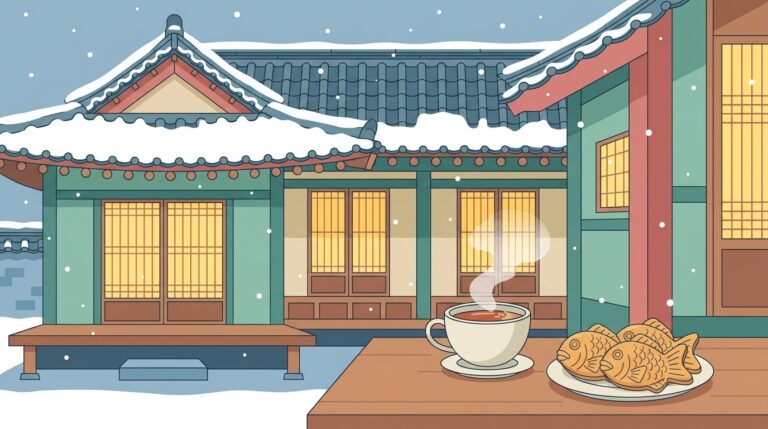
The Setting: A beautifully restored traditional Hanok cafe in Bukchon Hanok Village. The windows are fogged up from the warmth inside, and light snow is beginning to dust the dark tiled roofs outside.
The Cast: You (an adventurous traveler) and Minjun (your trend-conscious Korean friend who is wearing the unofficial national winter uniform: a long black down jacket).
Minjun: (🎭 Rubbing his hands together and blowing on them) 와, 오늘 진짜 춥다! 그치?
        [wa, o-neul jin-jja chup-da! geu-chi?]
        (Wow, it's really cold today! Right?)

You: (🎭 Smiling, holding a warm cup of ginger tea) 응, 좀 춥네. 근데 난 따뜻한 카페에 있으니까 좋은데?
     [eung, jom chup-ne. geun-de nan tta-tteu-than ka-pe-e is-seu-ni-kka jo-eun-de?]
     (Yeah, it's a bit cold. But I like being in a warm cafe!)

Minjun: (🎭 Nodding vigorously) 나도! 난 진짜 여름보다 겨울이 훨씬 좋더라.
        [na-do! nan jin-jja yeo-reum-bo-da gyeo-u-ri hwol-ssin jo-teo-ra.]
        (Me too! I really prefer winter over summer.)

You: (🎭 Taking a sip of tea) 진짜? 한국 여름은 어때? 많이 더워?
     [jin-jja? han-guk yeo-reul-eun eo-ttae? ma-ni deo-wo?]
     (Really? How is Korean summer? Is it really hot?)

Minjun: (🎭 Making a dramatic face) 말도 마! 한국 여름은 그냥 더운 게 아니라 완전히 찜통속 같아.
        [mal-do ma! han-guk yeo-reum-eun geu-nyang deo-un ge a-ni-ra wan-jeon-hi jjim-tong-sok ga-ta.]
        (Don't even get me started! Korean summer isn't just hot, it is like being inside a steamer.)

You: (🎭 Laughing) 아, 찜통더위! 한국 예능에서 들어봤어.
     [ah, jjim-tong-deo-wi! han-guk ye-neung-e-seo deu-reo-bwas-seo.]
     (Ah, steamer heat! I heard that on a Korean variety show.)

Minjun: (🎭 Pointing outside) 맞아. 그래서 여름에 비하면 겨울 추위는 진짜 양반이지!
        [ma-ja. geu-rae-seo yeo-reu-me bi-ha-myeon gyeo-u-reun jin-jja yang-ban-i-ji!]
        (Exactly. So compared to summer, this winter cold is absolute heaven!)
🔀 Decision Point: What do you say next?
- Option A: “그래도 저는 더운 게 더 나아요.” (But I prefer being hot.)
- Editor’s Feedback: Correct, but a bit too stiff because of the formal “저는”.
- Option B: “맞아, 겨울 길거리 음식이 최고잖아!” (Right, winter street food is the best!)
- Editor’s Feedback: Best Choice! This naturally transitions the conversation to winter food like Bungeoppang, making you sound highly culturally fluent.
- Option C: “여름은 정말 싫습니다.” (I really hate summer.)
- Editor’s Feedback: Way too aggressive and formal for a casual coffee chat!
5. 10-Second Emotional Shadowing Drill
Let’s practice speaking with real Korean emotion! Focus on the pauses marked by /.
- Drill 1: [😊 Excitedly & Passionately]
“여름보단 / 겨울이 / 백 배 낫지!”
[yeo-reum-bo-dan / gyeo-u-ri / baek bae nat-ji!]
“Winter is a hundred times better than summer!” - Drill 2: [🥺 Shivering & Pouting]
“진짜 추운데… / 붕어빵은 / 못 참지!”
[jin-jja chu-un-de… / bung-eo-ppang-eun / mot cham-ji!]
“It’s freezing cold… but I can’t resist Bungeoppang!”
6. K-Culture Mini Dictionary
- 롱패딩 (Long padding): The ankle-length down jacket that acts as the unofficial national winter uniform in Korea.
- 찜통더위 (Jjimtong-deowi): The suffocating, humid “steamer” heat of Korean midsummer.
- 이열치열 (Yi-yeol-chi-yeol): The traditional wisdom of “fighting heat with heat” (like eating boiling-hot soup in summer).
- 붕세권 (Bung-se-gwon): A trendy slang word combining “Bungeoppang” and “Station area” (역세권), meaning a neighborhood lucky enough to have a winter street-food vendor nearby.
7. Traveler’s Survival Kit
When traveling to Korea in winter, keep these three expressions in your back pocket:
| Korean | Romanization | English | Pro Tip |
|---|---|---|---|
| 따뜻한 걸로 주세요. | [tta-tteu-than geol-lo ju-se-yo.] | Please give me the warm one. | Use this when ordering tea or coffee in winter. |
| 핫팩 있어요? | [hat-paek is-seo-yo?] | Do you have hand warmers? | Ask this at any local convenience store. |
| 국물 좀 더 주실 수 있나요? | [guk-mul jom deo ju-sil su in-na-yo?] | Could I have a bit more broth? | Street vendors will happily refill your hot fish cake broth for free! |
📌 Editor’s Travel Note:
To find the best local winter spots, download the Naver Map App Download Page. It works much better than Google Maps in Korea and even maps out seasonal street food stalls!
8. Deep Reflection: One Step Deeper
In Korea, comparing the seasons goes beyond simple small talk about weather. It relates to the core Korean value of 정 (Jeong) — emotional bonding and connection. Winter is a season where people actively huddle together, sharing warmth over a single pot of boiling stew, or standing close around a smoky street food cart. When you express your preference for winter, you aren’t just talking about the temperature; you are romanticizing the cozy, shared human warmth that defies the cold.
💬 Your Turn: Which season do you prefer, and how do people in your home country stay cozy during the colder months? Let me know in the comments below!
9. FAQ & Common Mistakes
Q: Can I use “보다” to compare people as well as seasons?
A: Yes, absolutely! For example, “민준 씨가 저보다 한국어를 더 잘해요” (Minjun speaks Korean better than me).
Q: What is the difference between “더” and “훨씬”?
A: 더 (deo) means “more”, while 훨씬 (hwol-ssin) means “by far” or “significantly more”. Use “훨씬” to emphasize a massive difference.
Q: Is it rude to say I hate summer in Korea?
A: Not at all! Most Koreans will passionately agree with you because of the extreme humidity. Just avoid overly harsh formal verbs like “혐오합니다” and stick to “여름은 너무 힘들어요” (Summer is so tough).
🚨 Common Mistake Warning:
Many B1 learners say: “여름보다 겨울이 더 좋아합니다” (X).
Correct Action: You must use the adjective 좋다 with subject particle: “여름보다 겨울이 더 좋아요” (O) OR use the object particle with the verb 좋아하다: “여름보다 겨울을 더 좋아해요” (O).
10. Action Missions: Challenge Yourself!
- 🥉 Bronze: Record yourself saying “여름보단 겨울이 백 배 낫지!” using the Emotional Shadowing Drill.
- 🥈 Silver: Write a post on your social media using the comparative particle 보다 to compare two things you love (e.g., K-pop vs. Rock music!).
- 🥇 Gold: The next time you order a drink in a Korean cafe, confidently say, “따뜻한 걸로 주세요!”
11. Interactive Quiz Challenge
Q1. Choose the grammatically CORRECT sentence:
1) 여름보다 겨울을 더 좋아요.
2) 여름보다 겨울이 더 좋아해요.
3) 여름보다 겨울이 더 좋아요.
🔍 Show Answer & Explanation
Answer: 3
Explanation:
* 좋다 is an adjective and takes the subject particle 이/가 (겨울이 더 좋아요).
* 좋아하다 is a verb and takes the object particle 을/를 (겨울을 더 좋아해요).
Q2. True or False?
“찜통더위” refers to the shivering cold of Korean winter mornings.
🔍 Show Answer & Explanation
Answer: False
Explanation: “찜통더위” refers to the steaming hot humidity of Korean midsummer! Winter cold is often called “칼바람” (knife-like wind).







