

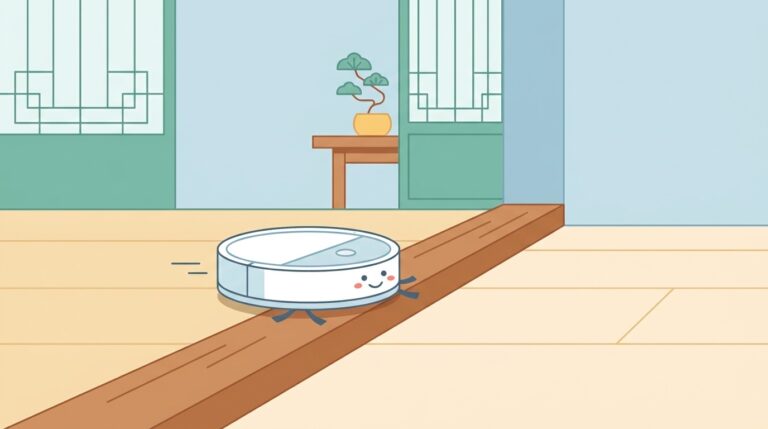
Why Koreans Call Their Robot Vacuums “Auntie” and the Art of Crossing Thresholds
안녕하세요! (An-nyeong-ha-se-yo!) Welcome back to Daily Hangul, your premium window into the living, breathing language of Korea. I’m your senior editor, and today we’re stepping inside the intimate, highly organized world of the modern Korean home.
Imagine this: You’re watching a slice-of-life K-Drama. The lead character comes home after an exhausting 14-hour shift at a Seoul tech firm. They collapse onto the sofa, sigh with relief, and say, “Ah, our Imonim did a great job today.” You scan the room, expecting to see a middle-aged housekeeper tidying up in the background. Instead, all you see is a sleek, circular robot vacuum spinning quietly in the corner.
Wait, did they just call a machine “Auntie”?
Yes, they did! In Korea, household chores have undergone a linguistic and cultural revolution. If you want to sound like a true Seoulite, you need to understand why we anthropomorphize our home appliances, and more importantly, how to navigate the architectural quirks of Korean homes—like the legendary 문턱 (munteok – door thresholds). Let’s dive deep into this cozy, ultra-practical linguistic territory.
Phase 2: Core Expressions Deep Dive
To master this cultural landscape, let’s dissect three high-frequency expressions that will make your Korean sound incredibly organic and culturally attuned.
1. 이모님 (I-mo-nim)
- Pronunciation: [i-mo-nim] / Sound-alike: “ee-mo-neem” (rhymes with “dream”)
- Meaning: Literally “maternal aunt,” but in modern Korea, it is the universal honorific for female domestic workers, restaurant servers, and colloquially, game-changing home appliances.
- K-Culture Moment: In modern Korean lifestyle forums, you will constantly see the phrase “가전 3대 이모님” (gajeon sam-dae i-mo-nim), which translates to “The Three Great Appliance Aunties”: the robot vacuum, the dishwasher, and the clothes dryer. Calling them “Imonim” is a humorous yet deeply genuine expression of gratitude for liberating us from domestic labor.
- Editor’s Insight: Using “이모님” for your robot vacuum shows you understand the subtle, affectionate humor of modern Korean daily life. It’s not just a gadget; it’s a respected member of the household!
- Situation Spectrum:
- Friends & Casual settings: ✅ (Highly natural, brings a smile)
- Co-workers & Semi-formal: ✅ (Great icebreaker about home life)
- Business & Formal: ⚠️ (Stick to “로봇 청소기” [robot vacuum] in official product pitches)
- 🤔 Think About It: Why does Korean culture use family terms like “Aunt” (이모) for people—and now machines—who help us? How does this reflect the collective, community-oriented mindset of Korean society compared to your own culture?
2. 문턱을 넘다 (Munteog-eul neomda)
- Pronunciation: [mun-teog-eul neom-da] / Sound-alike: “moon-tug-eul num-dah”
- Meaning: Literally “to cross/climb over a door threshold.” Metaphorically, it means “to overcome an initial barrier” or “to enter a new stage of life.”
- K-Culture Moment: Older Korean apartments and traditional Hanok homes have raised wooden thresholds separating rooms. Historically, buying a robot vacuum in Korea was a gamble because early models couldn’t “넘다” (cross) these barriers, leaving half the house uncleaned. Today, vacuum reviews specifically test this: “Does it cross the threshold well?”
- Editor’s Insight: While physically used for vacuums, you’ll hear this in dramas when someone finally gets hired after dozens of interviews: “드디어 취업의 문턱을 넘었다!” (I finally crossed the threshold of employment!)
- Situation Spectrum:
- Friends & Casual: ✅
- Co-workers & Semi-formal: ✅
- Business & Formal: ✅
- 🤔 Think About It: In English, we “cross a threshold” of a new year or a marriage. In Korean, the physical munteok was a daily reality of home design. How does your native language use spatial architecture to describe life achievements?
3. 손 하나 까딱 안 하다 (Son hana kkat-ttag an hada)
- Pronunciation: [son ha-na kkat-ttak an ha-da] / Sound-alike: “son ha-nah kkah-ttahk ahn ha-dah”
- Meaning: Literally “to not even wiggle a single finger.” It translates directly to “to not lift a finger” to do work.
- K-Culture Moment: Perfect for describing the ultimate luxury of having your “Imonim” do all the sweeping and mopping while you watch K-Dramas.
- Editor’s Insight: This carries a slightly sassy, indulgent nuance. When said with a grin, it highlights a sense of pampered satisfaction.
- Situation Spectrum:
- Friends & Casual: ✅
- Co-workers & Semi-formal: ✅ (Slightly self-deprecating or bragging)
- Business & Formal: 🚫 (Can sound lazy or overly informal)
Phase 3: Textbook Korean vs. Real Korean
Let’s compare the sterile sentences from standard curricula with the vivid, authentic language spoken on the streets of Seoul.
Situation 1: Describing your automated cleaning routine
- 📖 Textbook Korean: “로봇 청소기가 방을 깨끗하게 청소하고 있습니다.” (The robot vacuum cleaner is cleaning the room cleanly.)
- 🗣️ Real Korean: “우리 집 이모님이 열일 중이셔.” (Our household ‘Auntie’ is working her butt off right now.)
- 💡 Why the difference? Koreans value speed, efficiency, and emotional connection. “열일” (yeol-il) is a contraction of “열심히 일하다” (working hard). Combined with “이모님,” it paints a warm, humorous picture of a busy little machine.
Situation 2: Asking if a vacuum can handle floor barriers
- 📖 Textbook Korean: “이 청소기는 문턱을 통과할 수 있습니까?” (Is this vacuum cleaner capable of passing through the threshold?)
- 🗣️ Real Korean: “이거 문턱 잘 넘어요?” (Does this thing climb thresholds well?)
- 💡 Why the difference? Active verbs like “넘다” (to cross/climb) are far more common in spoken Korean than passive or overly formal verbs like “통과하다” (to pass/penetrate). Keep it active and punchy!
Phase 4: K-Culture Deep Dive & Non-verbal Etiquette
4-1. The Pre-Cleaning “Nunchi” (눈치)
Before your “Imonim” can clean, you must perform a uniquely Korean ritual: cleaning up for the cleaner. Because Korean apartments feature floor-based living (Ondol underfloor heating), we tend to leave thin floor mats, phone chargers, and slippers on the ground.
To show true respect to your robot “Imonim” (and save her from getting choked by a USB cable), you must scan the floor with sharp 눈치 (nunchi – situational quick-wittedness). Lifting chairs, picking up stray socks, and clearing pathways is the polite “non-verbal greeting” we give our electronic aunties before pressing start.
4-2. The Ondol (온돌) Legacy
Why are thresholds such a big deal in Korea? Traditional Korean homes utilize Ondol (온돌), an underfloor heating system. Traditionally, each room’s floor level might vary slightly depending on the heat pipes underneath, requiring structural wooden thresholds (문턱) to seal in warm air. Although modern apartments have flat floors, older villas (multi-unit low-rises built in the 90s and 2000s) still possess thick wooden barriers. Therefore, checking a robot vacuum’s “climbing ability” is an essential survival check for anyone living in a charming, older Seoul neighborhood.
Phase 5: The Mapo Studio Dilemma (Interactive Roleplay)
The Setting: You are visiting your Korean friend Min-woo (민우) at his cozy studio apartment in Mapo-gu. The floor is spotless. You’ve just finished eating black bean noodles (짜장면) delivered in classic reusable containers.
Characters:
* You (The Smart Home Enthusiast): Looking to buy a robot vacuum but worried about your apartment’s old-school thresholds.
* Min-woo (민우): A tech-savvy, proud owner of a high-end robot vacuum whom he affectionately treats like family.
민우: (배를 두드리며) 아, 진짜 잘 먹었다! 이제 청소해야 하는데... 귀찮네.
Min-woo: (Patting his stomach) Ah, I ate so well! Now I have to clean... but I'm so lazy.

You: (웃으며) 우리 짜장면 그릇 내놓는 사이에 이모님 돌리면 되잖아?
You: (Smiling) Can't we just run the 'Auntie' while we put the jjajangmyeon bowls outside?

민우: (감탄하며) 오~ '이모님'이란 단어를 쓰다니! 한국 사람 다 됐네? 맞아, 우리 이모님 깨워야지.
Min-woo: (Impressed) Oh~ using the word 'Imonim'! You've become completely Korean! You're right, let's wake our Auntie up.

You: (민우의 최신형 로봇 청소기를 보며) 근데 네 청소기, 진짜 똑똑해 보인다. 비싸지 않았어?
You: (Looking at Min-woo's latest robot vacuum) But your vacuum looks really smart. Wasn't it expensive?

민우: (어깨를 으쓱하며) 비싸긴 한데, 값어치를 해. 진짜 손 하나 까딱 안 해도 되거든.
Min-woo: (Shrugging) It was pricey, but worth every won. Seriously, I don't have to lift a single finger.

You: 부럽다. 나도 사고 싶은데, 우리 집은 오래된 빌라라 걱정이야.
You: I'm jealous. I want to buy one too, but I'm worried because my place is an old villa.

민우: 아, 빌라면 방마다 문턱이 높겠네?
Min-woo: Ah, if it's a villa, the thresholds between rooms must be high, right?
🔀 Decision Point: What do you ask Min-woo next?
- Option A: “이 모델은 문턱을 통과할 수 있습니까?” (I model-eun munteog-eul tonggwahal su istsumnika?)
- Option B: “네 청소기는 문턱 잘 넘어? 우리 집 문턱이 한 2센티 되거든.” (Ne cheongsogi-neun munteok jal neomeo? Uri jip munteog-i han i-centi doegeodeun.)
- Option C: “로봇이 문턱을 싫어해요?” (Robos-i munteog-eul silheohaeyo?)
🏆 Choice Analysis
- Best Choice: Option B! It uses natural casing (“네 청소기”), the correct colloquial verb for overcoming obstacles (“넘다”), and provides practical context (“2센티” – 2 centimeters). Min-woo will be amazed by your natural flow.
- Risk Choice: Option A. While grammatically flawless, it sounds like you are reading from a technical manual or interviewing a corporate executive. It breaks the cozy, friendly vibe of the Mapo studio.
- Bad Choice: Option C. “Does the robot hate thresholds?” sounds adorable, but it treats the machine a bit too literally like a living creature with feelings, rather than utilizing the natural colloquial idioms of Korean home care.
Phase 6: 10-Second Emotional Shadowing Drill
To make these phrases second nature, practice these drills with the specified emotional energy. Pay attention to the breath pauses (/).
- [😤 Proud & Bragging]
- “우리 집 / 이모님 덕분에 / 손 하나 / 까딱 안 해!”
- Uri jip / imonim deokbune / son hana / kkat-ttak an hae!
- “Thanks to / our household Auntie, / I don’t lift / a single finger!”
- [🥺 Worried & Earnest]
- “내 방 문턱이 / 너무 높은데… / 잘 넘을 수 있을까?”
- Nae bang munteog-i / neomu nopeunde… / jal neomeul su isseulkka?
- “My room’s threshold / is so high… / do you think it can climb over?”
Phase 7: K-Culture Mini-Dictionary
| Word (한글/Romanization) | English Equivalent | Cultural Context |
|---|---|---|
| 이모님 (Imo-nim) | Auntie / Savior | Originally a term for your mother’s sister, now used to affectionately elevate high-utility home appliances to family status. |
| 문턱 (Munteok) | Door Threshold | The physical barrier between rooms in traditional Korean architecture. Today, a primary benchmark for testing smart-home robot vacuums. |
| 열일 (Yeol-il) | Working Hard / Crushing It | Slang combining “열심히” (diligently) and “일” (work). Used for humans and hardworking machines alike. |
| 집순이 / 집돌이 (Jipsuni / Jipdori) | Homebody | A female (집순이) or male (집돌이) who loves staying indoors. They are the primary buyers of “Imonim” appliances. |
Phase 8: Traveler’s & Expat’s Survival Kit
If you are living in Korea or planning a long-term stay, use these emergency phrases to manage your living space:
- “이거 필터 어떻게 비워요?”
- I-geo pil-teo eo-tteo-ke bi-wo-yo?
- Pro Tip: “How do I empty this filter?” Use this when asking a landlord or roommate about maintaining the vacuum.
- “문턱 경사로 필요할 것 같아.”
- Munteok gyeong-sa-ro pil-yo-hal geot gata.
- Pro Tip: “I think I need a threshold ramp.” If your apartment has massive thresholds, search for “문턱 경사로” on shopping sites to buy small rubber ramps for your vacuum.
📌 Editor’s Note: If you are looking for secondhand home appliances during your stay in Korea, do not use Craigslist. Instead, download the Daangn Market App (당근마켓 – Carrot Market), Korea’s hyper-local neighborhood marketplace, to find great deals on robot vacuums near you.
Phase 9: Deep Reflection — Humanizing the Domestic Sphere
In many Western cultures, technology is viewed strictly through a utilitarian lens—tools to be optimized. In Korea, however, we have a long linguistic history of integrating tools into our social fabric. By calling a machine “이모님” (Auntie), we elevate domestic labor. It acknowledges that keeping a clean home is hard, valuable work, and if a machine does it for us, it deserves a title of familial respect. It reflects the warmth (Jeong / 정) that Koreans naturally project onto their environments.
💬 Your Turn: Do you have a nickname for your vacuum or home appliances in your country? Do people anthropomorphize technology in your culture, or is it strictly business? Let us know in the comments below!
Phase 10: FAQ & Common Pitfalls
Q: Can I call a male server or male housekeeper “이모님”?
A: No! “이모님” is strictly female (maternal aunt). For male restaurant staff, you should use “사장님” (Sajangnim – Owner/Boss) or “여기요” (Yeogiyo – Over here, please).
Q: Is it rude to call an actual human housekeeper “이모님”?
A: Quite the opposite! It is highly polite. Using “이모님” treats them like respected family members rather than mere employees. However, never call them just “이모” (without the honorific “님”), as that can sound dismissive or overly familiar.
Q: Does “문턱” only apply to houses?
A: No! You will often hear “문턱이 낮다” (The threshold is low) used to describe an accessible restaurant, an easy-to-learn hobby, or a welcoming university program.
🚨 Common Pitfalls to Avoid
- Calling your boss “이모님”: Unless your boss is literally your mother’s sister, never use this in the office. It is strictly for home, restaurants, and domestic machines!
- Confusing 고모 (Gomo) with 이모 (Imo): “고모” is your father’s sister. We never call appliances “고모님.” Only “이모님” gets the cleaning crown!
Phase 11: Daily Hangul Action Missions
- 🥉 Bronze (Solo Mission): Take a photo of a messy corner of your room. Point at it and say out loud: “이모님, 청소 부탁해요!” (Imonim, please clean up!)
- 🥈 Silver (Social Mission): Post a video of your vacuum cleaner (or you cleaning) on Instagram or Threads and caption it: “오늘도 우리 집 이모님은 열일 중!” (Today again, our home Auntie is working hard!)
- 🥇 Gold (Real-world Mission): Go to a Korean home appliance store (like Himart / 하이마트) or a domestic community forum, and ask a question using our keyword: “이 모델 문턱 잘 넘나요?”
Phase 12: Interactive Quiz Challenge
Test your knowledge of Korean domestic slang and cultural nuance!
Q1. Which of the following is NOT part of the “Three Great Appliance Aunties” (가전 3대 이모님)?
- A) Robot Vacuum (로봇 청소기)
- B) Dishwasher (식세기)
- C) Electric Rice Cooker (밥솥)
- D) Clothes Dryer (건조기)
Answer: C) Electric Rice Cooker. While deeply loved, the rice cooker is a traditional staple, not part of the modern trio of “labor-liberating” Aunties!
Q2. Fill in the blank: “Our robot vacuum is so amazing, I don’t have to lift a single finger!” -> “우리 로봇 청소기 진짜 최고야, 손 하나 (______) 안 해도 돼!”
- Answer: 까딱 (kkat-ttak)
- Explanation: “손 하나 까딱 안 하다” is the complete idiomatic expression for not lifting a finger.
Q3. True or False: Traditional Korean ‘Ondol’ heating is the historical reason why many Korean houses have door thresholds (문턱).
- Answer: TRUE. The underfloor heating pipes created slight elevation differences between rooms, requiring thresholds to trap warm air inside specific living zones.






