

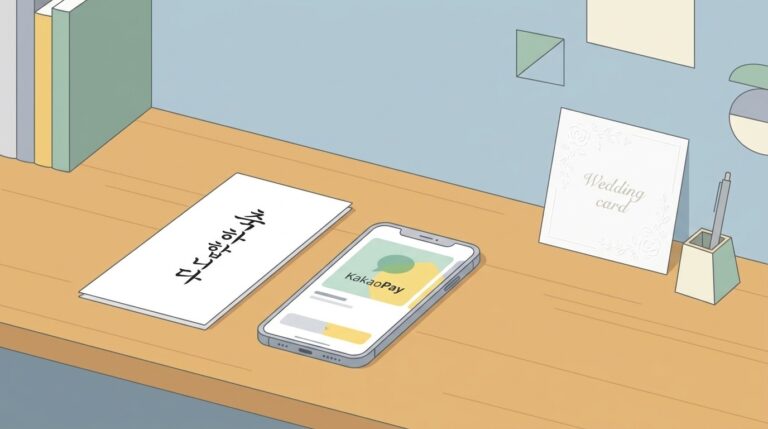
Mastering Korean Corporate Etiquette: The Unwritten Rules of Gyeongjosa (경조사) and Cash Gift Etiquette (축의금)
Phase 1: Empathy & Search Intent (The White Envelope Dilemma)
Imagine this: You are sitting at your desk in a sleek, high-rise office in Yeouido, Seoul. The hum of productivity surrounds you. Suddenly, your teammate hands you a beautifully embossed white card: a Cheongcheop-jang (청첩장 / wedding invitation). Your heart sinks, not out of malice, but from a sudden wave of social anxiety.
You know that attending is a gesture of goodwill, but the real test lies in the unwritten ledger of Korean corporate society. How much cash do you put in the envelope? Is 50,000 KRW (₩50,000) an insult? Is 100,000 KRW too generous for someone you only exchange polite nods with by the water cooler? What if it’s a funeral—Bui-geum (부의금)—and not a wedding?
This is the intricate world of Gyeongjosa (경조사), the collective term for life’s major celebratory and sorrowful milestones. For foreign professionals operating at a C2-level of linguistic competency, mastering the spoken language is only half the battle; the true pinnacle of fluency lies in decoding these unspoken socioeconomic rituals. In this comprehensive guide, we will unpack the mathematics of Korean corporate cash gifting, explore the cultural history of reciprocity, and arm you with the exact linguistic scripts to handle these delicate interactions with effortless poise.
Phase 2: Deep Dive into Key Expressions
1. 축의금 (Chugui-geum)
- Pronunciation: [Chug-ui-geum] / Sounds like “choog-wee-geum” with a sharp stop on the “g”
- Meaning: Congratulatory cash gift (literally, “congratulations union money”).
- K-Culture Moment: In the critically acclaimed corporate drama Misaeng (미생), we see the young office workers pooling resources and agonizing over their financial contributions. It is not merely a gift; it is a physical manifestation of your social distance and career standing.
- Editor’s Insight: Cash in Korea must always be gifted in odd-numbered increments (30,000, 50,000, 70,000 KRW) or the round number of 100,000 KRW. Odd numbers represent Yang (positive, light, and auspicious energy) in traditional yin-yang philosophy. Giving 40,000 KRW is an absolute taboo, as the number four (사 / Sa) is homophonic with death (사).
- Situation Spectrum:
- Casual (Close Friends): ✅ (Usually ₩100,000 to ₩200,000+)
- Semi-formal (Co-workers): ✅ (Usually ₩50,000 if not attending, ₩100,000 if attending)
- Formal (Bosses/Key Clients): ✅ (Usually ₩100,000 to ₩150,000+)
- 🤔 Think About It: Why does Korean society rely so heavily on monetary gifts instead of physical registry items (like in Western cultures)? How does this reflect the transition of historical agrarian mutual aid into a hyper-efficient capitalistic framework?
2. 조의금 / 부의금 (Joeui-geum / Bui-geum)
- Pronunciation: [Jo-ui-geum / Bu-ui-geum] / Sounds like “jo-ee-geum” / “boo-ee-geum”
- Meaning: Condolence money sent to a grieving family.
- K-Culture Moment: In the bittersweet masterpiece drama My Mister (나의 아저씨), the community comes together to fill a desolate funeral hall with flowers and financial contributions, showing how these cash gifts serve as an essential social safety net.
- Editor’s Insight: While wedding money (Chugui-geum) is presented in a plain white envelope with the groom or bride’s name written on the back, condolence money (Bui-geum) must be placed in a white envelope, ideally with vertical Hanja (Chinese characters) for condolence printed on the front, and your name written vertically on the back-left.
- Situation Spectrum:
- Casual: ✅ (₩50,000 – ₩100,000)
- Semi-formal: ✅ (₩50,000 for standard colleagues, ₩100,000 for close teammates)
- Formal: ✅ (₩100,000+)
- 🤔 Think About It: How does the linguistic distinction between Joeui (expressing sorrow) and Bui (assisting with funeral expenses) change your perspective on what this financial contribution represents?
3. 경조사 (Gyeongjo-sa)
- Pronunciation: [Gyeong-jo-sa] / Sounds like “gyung-jo-sah”
- Meaning: Family events or milestones, encompassing both joyous occasions (경사 / Gyeong-sa) and mournful ones (조사 / Jo-sa).
- K-Culture Moment: A major plot driver in many Korean slice-of-life movies is the sheer frequency of these weekend events, highlighting how a professional’s personal life is deeply integrated with their corporate collective.
- Editor’s Insight: Think of Gyeongjosa as a highly structured system of social insurance. When you pay into someone else’s event today, you are effectively buying a micro-bond that they will cash in and return to you when your own major life events occur.
- Situation Spectrum:
- Casual: ✅
- Semi-formal: ✅
- Formal: ✅
- 🤔 Think About It: Does the expectation to attend and contribute to Gyeongjosa foster genuine community solidarity, or does it impose an exhausting financial and psychological tax on modern Korean workers?
Phase 3: Textbook Korean vs. Real-World Korean
To sound truly fluent and socially integrated, you must abandon the rigid, overly formal sentences found in outdated academic manuals and embrace the subtle, context-heavy phrasing used by real professionals.
Scenario 1: Quietly negotiating the “going rate” of a cash gift with a peer
- 📖 Textbook Korean: “동료의 결혼식 축의금으로 얼마의 금액을 기부해야 합니까?” (How much money should I donate for a colleague’s wedding cash gift? – Too robotic and transactional.)
- 🗣️ Real-World Korean: “혹시 이번 김 대리님 결혼식 축의금, 다들 얼마씩 하세요?” (By the way, how much is everyone doing for Assistant Manager Kim’s wedding gift? – Natural, collaborative, and socially intelligent.)
- 💡 Why the Difference? In Korea, discussing money directly can feel crass. Framed as “What is everyone doing?” (다들 얼마씩 하세요?), you defer to the collective standard, showing that you value team harmony over isolated decision-making.
Scenario 2: Politely declining an invitation but offering to send cash
- 📖 Textbook Korean: “저는 갈 수 없으니 계좌번호를 알려주시면 돈을 보내겠습니다.” (I cannot go, so if you give me your account number, I will send money. – Borderline rude, sounds like paying off a debt.)
- 🗣️ Real-World Korean: “제가 선약이 있어서 직접 참석은 못 하지만, 마음이라도 전하고 싶어서요. 혹시 실례가 안 된다면 봉투 전달해 드릴 분이 계실까요? 아니면 편하게 송금해 드려도 될까요?” (I have a prior engagement so I can’t attend in person, but I’d love to send my regards. If it’s not rude, is there someone I can pass the envelope to, or would it be easier if I wired it?)
- 💡 Why the Difference? Real Korean prioritizes the preservation of Chaemyeon (체면 / face). Framing the transaction around “sending my warm feelings” (마음이라도 전하고 싶다) makes the monetary gift feel personal rather than cold and automated.
Phase 4: Cultural Codes & Non-Verbal Protocol
+-------------------------------------------------------------+
|                   THE KOREAN GIVING RULER                   |
|                                                             |
|  [₩50,000] ---------------- [₩100,000] ----------- [₩150k+]  |
|  Standard rate;             Attending wedding;     Close team;
|  not attending;             Direct teammate;       Substantial
|  casual acquaintance        significant connection support     |
+-------------------------------------------------------------+
Visual Representation: Recommended cash gift brackets based on professional distance.
(Alt Text: A minimalist graphic chart showing the hierarchy of Korean corporate cash gifting: 50,000 KRW for non-attendance or casual acquaintances, 100,000 KRW for close colleagues or when eating the venue food, and 150,000+ KRW for close teammates or mentors.)
4-1. The Art of Nunchi (눈치) and Body Language
- The Two-Handed Hand-off: When presenting an envelope (Bong-tu / 봉투), never hand it over with one hand. Always use both hands, or support your right wrist/forearm with your left hand. This is a subtle physical sign of deep respect.
- The Color Code: Always wear muted tones. At a wedding, guests must never wear solid white (to keep the spotlight on the bride—violators are labeled Minpye-hagaek / 민폐하객, or “nuisance guests”). At a funeral, wear dark charcoal or navy, and black socks are an absolute must. Taking off your shoes at a funeral hall only to reveal bare feet or bright neon socks is an instant social catastrophe.
4-2. The Reciprocity Machine: Pumassi (품앗이)
Historically, Pumassi was an agrarian system of exchanging labor during harvest seasons. Today, this has mutated into the modern Gyeongjosa ledger. In most Korean families, there is a literal physical notebook (or digital spreadsheet) that logs every single KRW received from colleagues and relatives over decades. When a colleague’s family member passes away, they will check how much you gave them in the past, and match that exact amount when your family experiences a milestone. It is a highly rationalized, long-term social contract.
Phase 5: Interactive Corporate Roleplay
Setting: The high-end pantry of a major conglomerate in Gangnam. Sunlight streams through the glass windows. You are holding a premium latte. Enter Deputy General Manager Kim (김 차장), a veteran of the company who knows everything about corporate survival.
[Cast]
- You: A high-performing, culturally astute foreign executive / senior manager.
- Deputy General Manager Kim (김 차장): The gatekeeper of office tradition.
- 김 차장: (Sipping his espresso, looking curiously at the invitation on your desk) “어, 김 과장! 그것도 주말에 있는 이 대리 결혼 청첩장이지? 이번에 갈 거야?”
(Uh, Manager Kim! Is that also Assistant Manager Lee’s wedding invitation for this weekend? Are you going this time?) - You: “아, 네 차장님. 그렇지 않아도 지금 고민 중이었어요. 일요일 오후라 일정이 좀 애매해서요.”
(Ah, yes, Deputy GM. Actually, I was just contemplating that. It’s Sunday afternoon, so my schedule is a bit tight.) - 김 차장: “에이, 그래도 같은 본부인데 참석하는 게 모양새가 좋지. 이 대리가 평소에 김 과장 일을 얼마나 열심히 돕는데.”
(Hey, but you’re in the same division, so showing your face looks better. You know how hard Assistant Manager Lee works to support your projects.) - You: “맞습니다. 이 대리님이 늘 고생하시죠. 만약 제가 참석하게 되면 축의금은 얼마가 적당할까요?”
(You’re right. Lee always goes above and beyond. If I do attend, what amount do you think is appropriate for the cash gift?) - 김 차장: “요즘 호텔 식대 장난 아닌 거 알지? 5만 원만 내고 와서 밥 먹으면 사실 혼주 입장에서는 조금 적자야. 직접 와서 식사할 거면 10만 원이 국룰이지.”
(You know hotel catering costs are insane these days, right? If you only give 50,000 KRW and eat, the host actually loses money. If you eat in person, 100,000 KRW is the unwritten rule.) - You: “아, 밥값도 고려해야 하는군요! 만약 제가 부득이하게 참석하지 못하고 마음만 전하게 된다면요?”
(Ah, I see! I must factor in the meal cost. What if I genuinely can’t attend and just want to send my regards?) - 김 차장: “그럴 때는 그냥 5만 원만 봉투에 넣어서 가는 사람 편에 보내면 돼. 요즘은 카카오페이로도 많이들 송금하니까 편하게 모바일로 보내도 되고.”
(In that case, you can just put 50,000 KRW in an envelope and send it with someone who is going. Since many people use KakaoPay transfers these days, you can just send it via mobile.) - You: “그렇군요. 그럼 차장님은 이번에 참석하시나요?”
(I see. Are you attending this time, Deputy GM?) - 김 차장: “나는 당일 지방 출장이 있어서 못 가거든. 그래서 미리 모바일로 축의금 보냈어. 김 과장도 잘 판단해서 해봐!”
(I have an out-of-town business trip that day, so I can’t go. I already sent my gift via mobile. Make a sensible choice, Manager Kim!)
🔀 Decision Point: What is your next move?
- Option [A]: Deciding you want to save money, you attend the wedding alone, enjoy the luxury buffet, and hand over an envelope containing ₩50,000.
- Option [B]: You cannot attend the wedding, but you proactively send ₩50,000 via KakaoPay to Assistant Manager Lee along with a warm, customized congratulatory message.
- Option [C]: You want to show off your wealth and status, so you give ₩300,000 even though you are not in the same direct team, bypassing your own direct supervisor’s gift amount.
🏆 Best Choice Analysis:
- Option [B] is the absolute pinnacle of modern corporate intelligence. By sending ₩50,000 and a warm message, you respect the host’s financial balance (no meal cost incurred on them), fulfill your social obligation, and maintain professional harmony.
- Why Option [A] is a Risk: Giving ₩50,000 and eating a high-end buffet is often gossiped about as No-show-boda-mot-han (worse than not showing up). With soaring inflation, wedding meals often exceed ₩60,000 per head.
- Why Option [C] is a Risk: Gifting too much can make your peers and immediate superiors look bad (ruining the Chaemyeon hierarchy). It also burdens the recipient, who now feels obligated to match that massive amount when you have an event.
Phase 6: 10-Second Emotion Shadowing Drill
To master the natural cadence and flow of these awkward conversations, mimic these sentences with the exact emotional tones indicated.
- [😊 Friendly but discreet]
“혹시 / 이번 결혼식 / 축의금 / 다들 / 얼마씩 하세요?”
Hok-si / i-beon gyeol-hon-sik / chug-ui-geum / da-deul / eol-ma-ssik ha-se-yo?
(By the way… for this wedding… cash gift… how much is everyone doing?) -
[🥺 Apologetic yet warm]
“제가 / 직접 참석은 / 못 하지만, / 마음만은 / 꼭 전하고 싶어서요.”
Je-ga / jik-jeop cham-seok-eun / mot ha-ji-man, / ma-eum-ma-neun / kkok jeon-ha-go si-peo-seo-yo.
(I cannot attend in person, but I truly wanted to send my warmest thoughts.) -
[💼 Confident and professional]
“축의금 봉투는 / 안내 데스크에 / 직접 제출하시면 / 됩니다.”
Chug-ui-geum bong-tu-neun / an-nae de-seu-keu-e / jik-jeop je-chul-ha-si-myeon / doep-ni-da.
(You can submit the cash envelope directly to the welcome desk.)
Phase 7: K-Culture Mini Dictionary
-
국룰 (Gung-rul)
- Translation: The unwritten, universal law of society.
- Context: A portmanteau of “guk” (nation) and “rule.” In the corporate context, ₩100,000 for attending a wedding is the ultimate Gung-rul.
- 품앗이 (Pumassi)
- Translation: Mutual cooperative labor / reciprocal social insurance.
- Context: The bedrock agricultural concept that explains why modern Koreans keep precise records of family event donations to ensure exact financial reciprocity.
- 청첩장 모임 (Cheongcheopjang Moim)
- Translation: Wedding invitation gathering.
- Context: The bride and groom-to-be must host dinner or drinks for friends and colleagues to hand over the physical invitation. The hosts must pay for this meal entirely. If you receive an invitation without a Cheongcheopjang Moim, a smaller gift is culturally acceptable.
- 답례품 (Dapryepum)
- Translation: Thank-you return gift.
- Context: If you do not eat at a wedding or funeral, the hosts often provide a small gift (like premium cookies, rice cakes, or hand sanitizer) as a physical token of appreciation for your financial contribution.
Phase 8: Traveler & Expat Survival Kit
- Survival Phrase 1: “축하드립니다! 두 분 앞날에 행복만 가득하시길 바랍니다.” (Congratulations! I wish nothing but happiness for your future path.)
- Survival Phrase 2: “삼가 고인의 명복을 빕니다.” (I offer my deepest, respectful condolences to the deceased. – The absolute golden standard sentence for funerals.)
- Survival Phrase 3: “모바일 청첩장 링크 다시 한번 보내주시겠어요?” (Could you send me the mobile invitation link once more?)
📌 Editor’s Travel & Expat Note:
- Financial Apps: In contemporary Korea, paper envelopes are slowly yielding to digital convenience. Downloading and setting up Toss Bank or KakaoPay with your foreign registration card (ARC) is essential. It allows you to send cash instantly via chat with customized, virtual “envelope” animations that read Chuk-ha-hae (축하해 / Congratulations).
- Emergency Envelopes: If you must use physical envelopes, do not scramble at the venue. Go to any nearby convenience store (CU, GS25) and ask for “축의금 봉투” (congratulatory envelope) or “부의금 봉투” (condolence envelope). Most venues (wedding halls and funeral homes) also provide them for free in the lobby, complete with calligraphy brushes and desks to write your name.
Phase 9: Deep Reflection — “A Step Deeper”
The Korean system of Gyeongjosa cash transactions often shocks Westerners who view relationships through a lens of individualistic emotional expression rather than collective economic duty. Yet, this system is a beautifully rational solution to a modern problem. By institutionalizing social support, Koreans ensure that no single family is financially ruined by the astronomical costs of a sudden funeral or a lavish wedding. It is a safety net built on mutual respect and shared memory.
As the corporate world becomes increasingly globalized, younger generations (Gen Z and Millennials) are starting to question the financial strain of these endless obligations, giving rise to simplified ceremonies and digital-only interactions. Nevertheless, the underlying current of Jeong (정 / affectionate communal attachment) remains unchanged.
💬 Your Turn: How does your home culture handle the financial burdens of weddings and funerals? Is there a similar system of tacitly mandatory cash gifting, or do you rely on registries and community volunteering? Share your experiences in the comments below!
Phase 10: FAQ & Common Mistakes
Q: Can I put clean, crisp, brand-new bills in a condolence envelope?
A: No, absolutely not. While crisp, newly minted bills (Shin-gwon / 신권) are highly preferred for weddings and New Year’s celebrations (to symbolize a fresh, beautiful start), they are considered highly insensitive at funerals. Gifting brand-new bills at a funeral implies that you were anticipating the death and prepared clean money in advance. Use standard, gently circulated bills instead.
Q: What if I receive a wedding invitation but I am not close to the person at all? Am I still forced to pay?
A: Depends. If you do not work in the same immediate department and rarely speak, you are not culturally obligated to contribute. However, if they invite you to a Cheongcheopjang Moim (invitation dinner) or if you share a small team room, the standard minimum of ₩50,000 sent via bank transfer is highly recommended to keep the daily atmosphere comfortable.
Q: Is there a specific way to write my name on the envelope?
A: Yes. Write your name vertically on the back-left of the envelope. If you are representing a company or a specific department, write the company/department name to the right of your name, slightly smaller, so the host immediately knows which “Julian” or “Sarah” you are when reconciling their ledger.
🚨 Common Mistakes Warning Board
- Gifting in Even Numbers (Except 100,000): Gifting 20,000 or 40,000 KRW is viewed as unlucky. Stick strictly to 30,000, 50,000, 70,000, or 100,000 KRW.
- Wearing Red/Bright Colors to a Funeral: This is an unforgivable breach of respect. Even dark red ties or bright, patterned scarves must be avoided. Keep everything strictly monochrome, muted, and dark.
- Opening the Envelope in Front of the Host: Never check the cash or open the envelope at the reception desk. Hand it over subtly, receive your meal coupon (Sik-gwon / 식권), and walk away immediately.
Phase 11: Action Missions
- 🥉 Bronze Mission (Mirror Training): Stand in front of a mirror and practice handing over a hypothetical envelope using both hands, gently bowing your head, and saying: “진심으로 축하드립니다” (My sincere congratulations).
- 🥈 Silver Mission (Social Network Challenge): Next time you see a Korean acquaintance post a major life update (wedding, promotion, family loss) on LinkedIn or Instagram, write a culturally precise comment using the appropriate high-level Korean vocabulary we learned today.
- 🥇 Gold Mission (The Real-world Shadowing): If a colleague invites you to an event, discreetly approach a close Korean teammate and ask: “혹시 이번에 다들 어떻게 하시는지 여쭤봐도 될까요?” (May I ask how everyone is handling the gift amount this time?) to practice your social negotiation skills.
-
🎮 K-Culture Mission: Watch any classic K-Drama wedding or funeral scene (e.g., Crash Landing on You or Hospital Playlist). Pay exclusive attention to the check-in desk: look for the stack of white envelopes, the ledgers being signed, and the distribution of meal tickets.
Phase 12: Interactive Quiz Challenge
1. Situational Judgment
Q: You are attending the wedding of a direct colleague in your immediate team. You plan to attend the ceremony and bring your spouse to enjoy the luxury buffet. What is the most appropriate gift amount?
* A) ₩50,000
* B) ₩100,000
* C) ₩150,000 – ₩200,000
Reveal Answer & Explanation
Correct Answer: C
Explanation: Since you are bringing a plus-one to a high-end venue, you are consuming two meals (which likely cost the couple over ₩120,000 total). A contribution of ₩150,000 or ₩200,000 is necessary to ensure the couple does not lose money on your attendance. If you were attending alone, ₩100,000 would be perfect.
2. Fill-in-the-Blank
Q: Complete the sentence to politely inquire about the going rate for a colleague’s family event: “이번 김 부장님 모친상, 조의금 다들 ______ 하세요?”
* A) 얼마씩 (eol-ma-ssik)
* B) 왜 (wae)
* C) 어디서 (eo-di-seo)
Reveal Answer & Explanation
Correct Answer: A
Explanation: “얼마씩” (how much each) is the natural, indirect way to ask about the collective contribution rate: “How much is everyone doing for General Manager Kim’s mother’s funeral condolence money?”
3. True or False
Q: It is considered highly respectful to prepare crisp, brand-new bills from the bank to put in a condolence envelope for a funeral.
* True
* False
Reveal Answer & Explanation
Correct Answer: False
Explanation: Brand-new bills are for happy occasions like weddings. For funerals, use gently circulated, standard bills to show that you did not anticipate the tragedy.







