

Decoding ‘Jeong’ (정) and ‘Han’ (한): The Invisible Emotional Threads of Korean Culture
안녕하세요! (Annyeonghaseyo!) Your friendly neighborhood editor from Daily Hangul is here! 🌸 Have you ever watched a K-Drama and wondered why the characters cry so intensely over seemingly small acts of kindness, or why a neighborhood shop owner tosses an extra warm sweet potato into your bag without asking for a single Won?
Today, we are diving deep into the very soul of the Korean language. We aren’t just memorizing grammar; we are exploring two untranslatable emotional states that define how Koreans love, grieve, and build lifelong bonds: 정 (Jeong) and 한 (Han).
By understanding these nuances, you won’t just speak Korean—you will connect with Koreans on a profound, emotional level. Let’s unlock these cultural superpowers together! 🚀
Phase 1: The Warmth of ‘Jeong’ and the Ache of ‘Han’
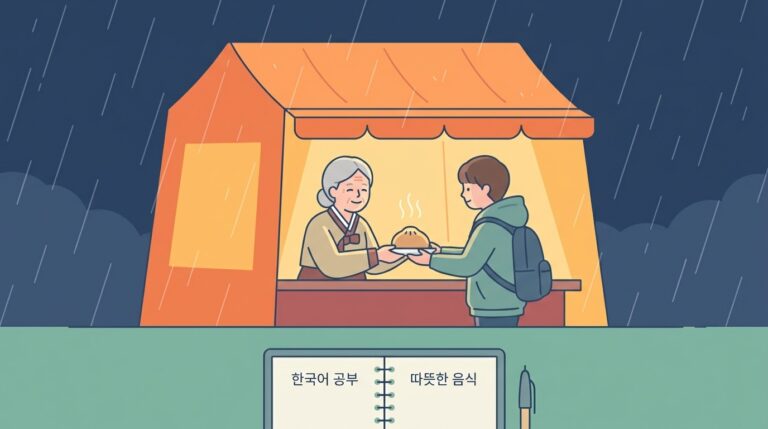
Imagine walking into a small, steam-filled tavern (실내포차 – Sillae-pocha) in Mapo, Seoul on a rainy Tuesday evening. The owner, an elderly lady you’ve only met twice, greets you like a long-lost grandchild. She slams down a sizzling plate of green onion pancakes (파전 – Pajeon) and says, “먹고 힘내! (Eat and cheer up!)” She doesn’t charge you for it. That warm, fuzzy, unexplainable bond is 정 (Jeong).
But as you look around, you hear an old folk song playing on the radio, filled with a deep, sorrowful melody that makes your chest tighten. That resilient, beautiful grief born of historical hardships is 한 (Han).
Many intermediate (B2) learners struggle because they try to translate these words directly. “Jeong” is often translated as love or affection, and “Han” as resentment or grudge. But these translations completely miss the mark! Let’s unpack the real-world nuances so you can sound like a true cultural insider.
Phase 2: Deep Dive into 3 Core Nuance Expressions
Let’s analyze the key expressions that represent these complex emotions in daily life.
1. 정이 많다 (Jeong-i man-ta)
- Pronunciation: [Jeong-i man-ta] / Sound-alike: “Jung-ee mahn-tah”
- Meaning: Warm-hearted / Full of affection and empathy.
- K-Culture Moment: Think of the warm-hearted neighbors in Reply 1988 who constantly exchange plates of food until everyone’s dining tables are full. That is the epitome of being “정이 많은 사람” (a person with a lot of Jeong).
- Editor’s Insight: Saying someone has “정이 많다” doesn’t just mean they are nice. It means they are deeply empathetic, care about others’ pain, and easily build emotional attachments.
- Situation Spectrum:
- Friends/Social (Casual): ✅
- Colleagues (Semi-formal): ✅
- Superiors/Elders (Formal): ✅ (Highly respectful and complimentary)
- 🤔 Think About It: Is there a single word in your native language that captures this specific blend of empathy, social duty, and unconditional warmth?
2. 정들었다 (Jeong-deul-eot-da)
- Pronunciation: [Jeong-deu-reot-da] / Sound-alike: “Jung-deul-ut-dah”
- Meaning: Grown attached / To have developed a bond over time.
- K-Culture Moment: That bitter-sweet scene in Crash Landing on You where the soldiers and the heroine realize they have grown too close to say goodbye easily.
- Editor’s Insight: “정들다” is beautiful because it can apply to people, pets, or even an old, squeaky neighborhood. It implies that time has woven your lives together.
- Situation Spectrum:
- Friends/Social (Casual): ✅
- Colleagues (Semi-formal): ✅
- Superiors/Elders (Formal): ⚠️ (Use cautiously; with boss, say “정말 정이 많이 들었습니다” to show deep gratitude upon leaving)
- 🤔 Think About It: “정들었다” often happens without you even realizing it—even with someone you used to bicker with! Why do you think human attachment in Korea is viewed as an involuntary process of time?
3. 한이 맺히다 (Han-i maet-hida)
- Pronunciation: [Han-i maet-hee-da] / Sound-alike: “Hahn-ee maet-hee-dah”
- Meaning: To accumulate unresolved sorrow, regret, or grief in one’s heart.
- K-Culture Moment: The heartbreaking, soulful wailing in Korean Pansori (traditional musical storytelling) or the quiet, enduring grief of characters in historical dramas like Mr. Sunshine.
- Editor’s Insight: This isn’t just a brief sadness. It’s a collective, historically-rooted sorrow that has settled deep in the soul. Yet, Koreans don’t just sink into it; they channel “Han” into art, music, and hard work.
- Situation Spectrum:
- Friends/Social (Casual): ⚠️ (Very heavy term; used mostly metaphorically in daily conversations)
- Colleagues (Semi-formal): ✅
- Superiors/Elders (Formal): ✅
- 🤔 Think About It: Why is “Han” considered a source of creative energy and resilience in Korea rather than just a negative emotion?
Phase 3: Textbook Korean vs. Real Korean
Let’s see how textbook phrases compare to native-level expressions of these deep emotions.
Situation 1: Expressing thanks for unexpected warmth or extra food
- 📖 Textbook Korean: 친절하게 대해 주셔서 정말 감사합니다. (Thank you very much for treating me kindly.)
- 🗣️ Real Korean: 역시 우리 이모님, 정이 넘치시네요! (As expected of our Imo-nim, you are overflowing with Jeong!)
- 💡 Why the difference? The textbook version is polite but maintains a sterile, professional distance. Saying “정이 넘치다” (overflowing with Jeong) instantly melts the ice and welcomes you into their warm, communal circle.
Situation 2: Expressing regret and attachment when leaving a job or city
- 📖 Textbook Korean: 이곳을 떠나게 되어 아주 아쉽습니다. (I am very sad to leave this place.)
- 🗣️ Real Korean: 그동안 정말 정이 많이 들었는데 아쉬워서 어떡해요… (I’ve grown so deeply attached over this time, what should I do… I’ll miss it so much.)
- 💡 Why the difference? The real Korean version focuses on the invisible thread of connection (정) that was built, acknowledging the emotional weight of separating those threads.
Phase 4: K-Culture Deep Dive & Non-Verbal Manners
To master “Jeong” and “Han,” you have to understand the body language and cultural codes that go with them.
4-1. The Body Language of ‘Jeong’ (정)
- The Two-Handed Rule: When someone with whom you share Jeong offers you a side dish or pours you a drink, always receive it with both hands. Supporting your right forearm or wrist with your left hand is a physical manifestation of showing Jeong—it communicates: “My attention and respect are fully on you.”
- The Eyes of Empathy: When listening to a friend’s worries, avoid looking distracted. Tilt your head slightly, sigh softy (“아이고… / Aigoo…”), and lean in close. In Korea, physical proximity equals emotional closeness.
4-2. The Cultural Code of ‘Han’ (한) in K-Pop & Cinema
- K-Pop’s Hidden Melancholy: Ever wondered why so many K-Pop ballads or even upbeat tracks (think of BTS’s Spring Day or Blackpink’s Lovesick Girls) have an underlying, bittersweet sadness? That is Han transformed into modern pop. It is the art of feeling sorrow yet dancing through it.
Phase 5: Rainy Night in Jongno — Roleplay Scenario
Let’s put your emotional intuition to the test.
The Setting: A retro outdoor tent bar (포장마차 – Pojangmacha) in Jongno, Seoul. Rain is pattering against the orange plastic tarp. Steam rises from a bowl of hot fishcake soup (어묵탕 – Eomuktang).
Your Character: You are a foreign professional who has worked in Seoul for a year.
The NPC: Min-jun (민준), your coworker who has been your mentor and close friend. He is moving to the Busan branch next week.
Min-jun: (Sighs, pouring you a cup of Soju) 벌써 다음 주면 제가 부산으로 가네요.
          [Beol-sseo da-eum ju-myeon je-ga Bu-san-eu-ro ga-ne-yo.]
          (Wow, it's already next week that I head down to Busan.)

You: (🎭 Receive the cup with both hands, nodding slowly)
      시간이 참 빠른 것 같아요. 처음에 제가 실수 많이 했을 때 도와주신 게 엊그제 같은데...
      [Si-gan-i cham bpa-reun geot gat-a-yo. Cheo-eum-e je-ga sil-su man-i haes-seul ttae do-wa-ju-sin ge eot-geu-je gat-eun-de...]
      (Time flies so fast. It feels like yesterday when you helped me when I made so many mistakes at first...)

Min-jun: (Smile warmly) 에이, 제가 뭘요. 우리 회사에서 OO 씨가 제일 열심히 했잖아요.
          [Ei, je-ga mwol-yo. U-ri hoe-sa-e-seo OO ssi-ga je-il yeol-sim-hi haes-ja-na-yo.]
          (Oh, come on, I did nothing. You were the most hardworking person in our company.)

You: (🎭 Look into his eyes with a bittersweet expression)
      [Select your response below...]
🔀 Decision Point: What do you say to Min-jun to show genuine Korean nuance?
- Option A: “부산에 가면 꼭 성공하셔야 합니다.” (You must succeed when you go to Busan.)
- Option B: “민준 씨랑 짧은 시간 동안 정말 정이 많이 들었나 봐요. 마음이 짠하네요…” (I guess I’ve grown so deeply attached to you over this short time, Min-jun. My heart feels a bit empty/stung…)
- Option C: “부산은 맛있는 음식이 많으니 좋겠어요!” (Busan has a lot of delicious food, so that must be nice!)
💡 Feedback & Analysis:
- Best Choice: Option B! This is the ultimate “Jeong” response. It directly references the emotional bond (정들다) and uses the highly native word 짠하다 (to feel a poignant, bitter-sweet ache in the heart). Min-jun will likely keep in touch with you forever after hearing this!
- Risk Choice: Option A. While encouraging, it sounds like a cold, business-like professional parting statement. It lacks warmth.
- Awkward Choice: Option C. While technically true, shifting the focus to food when your mentor is expressing sentimental sadness ruins the mood (눈치 없다 – lacking tact).
Phase 6: 10-Second Emotion Shadowing Drill
Let’s practice speaking with real soul. Pay attention to the pauses (/) and really mimic the emotional cues!
- [🥺 Bitter-sweet & Affectionate]
- “벌써 / 정이 많이 들었나 봐요… / 아쉬워요.”
- [Beol-sseo / jeong-i man-i deu-reot-na bwa-yo… / a-swi-wo-yo.]
- (I guess / I’ve already grown so attached… / I’m so sad to see you go.)
- [😊 Grateful & Warm]
- “이모님, / 정을 이렇게 듬뿍 주시면 / 저 자주 올 수밖에 없잖아요!”
- [I-mo-nim, / jeong-eul i-reo-ke deum-ppuk ju-si-myeon / jeo ja-ju ol su-bakk-e eop-ja-na-yo!]
- (Imo-nim, / if you give me this much Jeong / I have no choice but to come here often!)
Phase 7: K-Culture Mini Dictionary
| Word (Hangul / Romanization) | Meaning | Real-world Context |
|---|---|---|
| 미운 정 (Miun Jeong) | “Hate-Jeong” / Affection born of conflict | The weird bond you form with a roommate or colleague you used to argue with constantly. |
| 정성 (Jeongseong) | Devoted sincerity / Heart-pour | The painstaking effort put into preparing a home-cooked meal or a handmade gift for someone you cherish. |
| 서운하다 (Seounhada) | Slightly hurt or sad due to unmet expectations | The soft pain you feel when a close friend forgets to text you on your birthday. |
| 신파 (Shinpa) | Melodramatic tear-jerker | A plot style in K-dramas (like Miracle in Cell No. 7) designed to trigger immense crying, tapping into collective Han. |
Phase 8: Traveler’s Survival Kit
If you are traveling around Korea, carrying these three phrases in your back pocket will unlock unparalleled hospitality!
Survival Cards
- “덤으로 주신 거예요? 와, 정말 정이 넘치시네요!”
- [Deom-eu-ro ju-sin geo-yeo-yo? Wa, jeong-mal jeong-i neom-chi-si-ne-yo!]
- Pro Tip: Use this when a traditional market vendor throws in an extra piece of fruit or snack for free (덤 – Deom).
- “한국에 오니까 정을 정말 많이 느끼고 가요.”
- [Han-gug-e o-ni-kka jeong-eul jeong-mal man-i neu-ki-go ga-yo.]
- Pro Tip: Say this to your guesthouse host or local tour guide before leaving. It is the highest compliment you can pay to Korean hospitality.
📌 Editor’s Travel Note: To truly experience “Jeong” in the wild, skip the high-end luxury stores for a day and visit a local traditional market using the Naver Map Application. Use the search term “전통시장” (Traditional Market) to find places where elderly grandmas (Halmeoni) still dish out portions that are double what you pay for!
Phase 9: Deep Reflection — “One Step Deeper”
Why does Korea place such immense value on Jeong and Han? It boils down to resilience and community. Throughout history, the Korean peninsula faced countless invasions, wars, and rapid economic shifts.
In times of extreme poverty and sorrow (한 – Han), the only way to survive was by clinging together as one big family, sharing the last bowl of rice (정 – Jeong). This collective mindset survives today in the way Koreans eat out of shared hot pots and work late to help a struggling colleague.
💬 Your Turn: How does your culture express these deep bonds of shared survival and love? Do you have an equivalent of “Jeong” or “Han”? Let me know in the comments below! I read every single one.
Phase 10: FAQ & Common Mistakes
Q: Can I say “I feel Han (한)” when I am just angry at my boss?
A: No. Han is a deep, long-term, existential sorrow. If you are just annoyed or mad at someone, use 화나다 (to be angry) or 억울하다 (to feel unfairly treated/frustrated).
Q: Is “Jeong” the same as romantic love (사랑)?
A: Absolutely not. Romantic love can spark instantly. Jeong is slow; it accumulates quietly over time through shared meals, mundane moments, and even arguments. You can have Jeong for your mailman, your cat, or your worst enemy!
🚨 Common Mistake Alert!
- Wrong: “나는 그 가게에 정을 샀어.” (I bought Jeong at that shop.)
- Correct: “그 가게는 정말 정감이 가요.” (That shop really feels warm and inviting/I feel drawn to it.)
- Why: Jeong is not a physical commodity. It is an abstract feeling of emotional warmth that must “grow” (들다) or “overflow” (넘치다).
Phase 11: Daily Hangul Action Missions!
- 🥉 Bronze (Mirror Challenge): Look in the mirror and practice saying “정이 많이 들었어요” with a genuine, slightly teary-eyed smile. Get used to the facial muscles!
- 🥈 Silver (Social Challenge): Share a post on Instagram or X of your favorite K-Drama couple or friendship, and caption it: “이 둘은 정말 정이 넘쳐요!” (These two are really overflowing with Jeong!). Don’t forget to tag us!
- 🥇 Gold (Real-Life Mission): The next time you visit a local Korean restaurant, look the owner in the eyes when they bring out extra side dishes, smile warmly, and say, “잘 먹겠습니다! 이모님 정이 정말 많으세요.” Watch how their face lights up!
Phase 12: Interactive Quiz Challenge
Test your emotional intelligence of Korean nuance!
1. Which situation best describes “미운 정” (Miun Jeong)?
- A) Falling in love at first sight with a beautiful stranger.
- B) Growing fond of your annoying coworker because you’ve bickered and worked together for three years.
- C) Feeling angry because someone cut in front of you in the subway.
👉 Click to reveal the Answer & Explanation
Answer: B!
Miun Jeong translates to “hate-attachment.” It represents the uniquely Korean concept of growing attached to someone despite (or even because of) your constant bickering over a long period.
2. Fill in the blank:
“처음에는 어색했지만 같이 일하면서 이제는 정말 많이 ______.”
(It was awkward at first, but working together, now we have really grown attached.)
- A) 화났어요 (grew angry)
- B) 정들었어요 (grew attached)
- C) 한이 맺혔어요 (became sorrow-knotted)
👉 Click to reveal the Answer & Explanation
Answer: B!
“정들었어요” is the perfect fit for describing how emotional bonds slowly grew over time spent working together.
3. True or False: “Han (한)” is a purely negative, useless emotion that Koreans try to erase.
- A) True
- B) False
👉 Click to reveal the Answer & Explanation
Answer: B (False)!
While Han is born of sorrow and suffering, it is culturally viewed as a creative, resilient power. It is channeled into beautiful music, passionate art, and driving ambition to overcome obstacles.
See you in the next unit! 다들 정이 넘치는 하루 보내세요! (Have a day overflowing with Jeong, everyone!) 💖







