

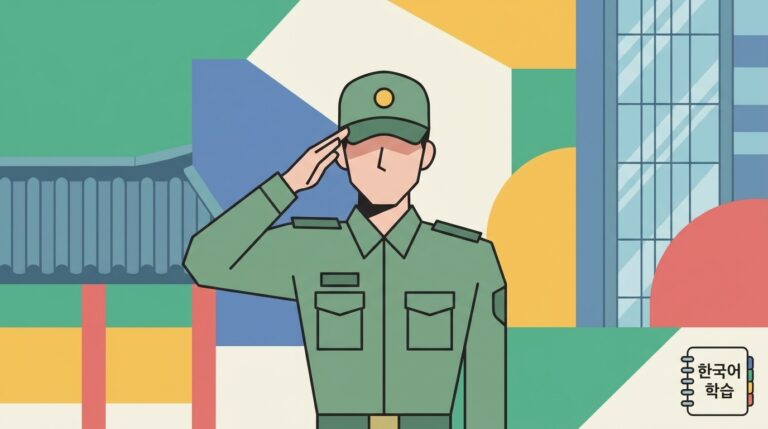
Why Do They Sound Like Soldiers? Demystifying Korean Military Hierarchy & Language
안녕하세요! Welcome back to Daily Hangul, your premium Korean culture navigator and friendly tutor. Have you ever been watching a thrilling K-Drama like D.P. or Descendants of the Sun and wondered why the male characters suddenly sound like sharp, high-tempo robots when they speak to their superiors? Or perhaps you’ve joined a Korean company and felt an invisible, incredibly structured force guiding how people address each other.
Today, we are diving deep into the heart of Korean military culture (한국의 군대 문화), specifically focusing on hierarchy and the chain of command (군대 계급 사회와 상명하복). By the end of this guide, you won’t just understand the words; you’ll understand the cultural DNA that shapes modern Korean social structures, workplaces, and everyday conversations. Let’s march in!
Phase 2: Core Expressions Deep Dive
To navigate any hierarchical space in Korea, you must master the specialized linguistic armor used by those in uniform. Here are three crucial expressions that define this rigid system:
1. 안녕하십니까! (An-nyeong-ha-sim-ni-da!)
- Pronunciation: [An-nyeong-ha-sim-ni-da] / Sound-alike: “An-young-ha-seem-nee-dah!” spoken with absolute military precision, snapping the final syllable.
- Meaning: “How are you?” (Highly formal/honorific)
- K-Culture Moment: Think of a rookie soldier entering the barracks, immediately saluting while barking this greeting so loudly the windows rattle.
- Editor’s Insight: This isn’t your casual cafe greeting. In the military, greeting a superior requires maximum energy to show respect and alertness.
- Situation Spectrum:
- Friends & Casual: 🚫
- Co-workers & Semi-formal: ⚠️
- Superiors & Formal: ✅
- 🤔 Think About It: Why does Korean have a completely different level of politeness just for hierarchy? How does your native language display deference to authorities?
2. 시정하겠습니다! (Si-jeong-ha-get-seum-ni-da!)
- Pronunciation: [Si-jeong-ha-get-seum-ni-da] / Sound-alike: “She-jeong-ha-get-seem-nee-dah!”
- Meaning: “I will correct this immediately!” (Literal: I will rectify.)
- K-Culture Moment: A scene in D.P. where a soldier is being scolded by his sergeant. Instead of saying “I’m sorry,” he shouts this phrase with a straight posture.
- Editor’s Insight: Saying “sorry” (죄송합니다) can sometimes sound like an excuse in the military. Saying “시정하겠습니다” focuses entirely on the future action and immediate obedience.
- Situation Spectrum:
- Friends & Casual: 🚫
- Co-workers & Semi-formal: ⚠️
- Superiors & Formal: ✅
- 🤔 Think About It: Reflect on the difference between apologizing and promising immediate correction. Why is the latter more valued in a high-stakes military setting?
3. 잘 못 들었습니다? (Jal mot deuret-seum-ni-da?)
- Pronunciation: [Jal mot deu-reot-seum-ni-da?] / Sound-alike: “Jal-mot-deu-reot-seem-nee-dah?” with a rising, sharp tone at the end.
- Meaning: “Excuse me?” (Literal: I did not hear well.)
- K-Culture Moment: When a private is given an unclear order amidst the chaos of training and must politely ask for clarification without sounding incompetent.
- Editor’s Insight: In the military, asking “What?” (뭐라고요?) is a major taboo. This expression acts as a shield, politely putting the blame on one’s own hearing rather than the superior’s delivery.
- Situation Spectrum:
- Friends & Casual: 🚫
- Co-workers & Semi-formal: ⚠️
- Superiors & Formal: ✅
Phase 3: Textbook Korean vs. Real Korean
Let’s compare the sterile sentences in textbooks with the raw, high-intensity vocabulary used in the actual chain of command.
Situation 1: Correcting a Mistake
- 📖 Textbook Korean: 죄송합니다. 다음부터 조심하겠습니다. (I am sorry. I will be careful next time.)
- 🗣️ Real Korean: 시정하겠습니다! (I will correct it immediately!)
- 💡 Why the Difference? In a military environment, passive apologies waste time. Superiors want to hear a proactive commitment to immediate rectification.
Situation 2: Asking for Re-explanation
- 📖 Textbook Korean: 죄송하지만 다시 말씀해 주시겠습니까? (Excuse me, but could you please say that again?)
- 🗣️ Real Korean: 잘 못 들었습니다? (Pardon? / I missed that?)
- 💡 Why the Difference? Speed and brevity save lives in the field. “잘 못 들었습니다?” is incredibly efficient, conveying respect and readiness while demanding immediate repetition.
Phase 4: K-Culture Deep Dive & Non-Verbal Manners
4-1. Nunchi (눈치) and Non-Verbal Military Protocol
In a hierarchical system, your body language speaks louder than your voice.
* The Salute (경례): When saluting, your hand must form a straight line with your forearm, placed precisely at the corner of your right eyebrow. A lazy salute is considered an act of defiance.
* Eye Contact (시선 처리): Unlike Western cultures where direct eye contact shows confidence, staring directly into a superior’s eyes during a reprimand is seen as challenging authority. Keep your eyes focused slightly lower, such as on their collar or chin, maintaining a rigid posture.
4-2. The Ghost of Military Structure in Korean Corporate Life
Why should non-military learners care? Because modern Korean corporate life (회사 생활) often mirrors military structures. The concept of 상명하복 (Sang-myeong-ha-bok – obedience to orders), although rapidly evolving, still influences how project deadlines are managed and how junior employees navigate the delicate hierarchy of “Seonbae” (senior) and “Hubae” (junior).
Phase 5: Interactive Boot Camp Roleplay
The Setting: You are an expat working in a highly traditional Korean logistics firm during a mandatory weekend team-building “Boot Camp” style retreat. Rain is pouring outside. You are standing before Team Leader Park (박 부장), who is notorious for his military-style discipline.
Cast:
* You (Alex): A mid-level manager trying to show respect without losing your cool.
* Team Leader Park (박 부장): A veteran manager who values discipline and structure above all else.
Dialogue
- Team Leader Park: (🎭 Looking sternly at your report) 신 대리, 이 프로젝트 기획안 마감일까지 마칠 수 있겠어?
- You: (🎭 Standing straight, shoulders back) 네! 기한 내에 완수하겠습니다!
- Team Leader Park: (🎭 Frowning at a data discrepancy) 여기 3페이지 수치가 작년 데이터랑 안 맞는데? 어떻게 된 건가?
- You: (🎭 Feeling a cold sweat) 아, 그 부분은 제가 미처 확인하지 못했습니다.
- Team Leader Park: (🎭 Shouting slightly over the rain) 일을 이렇게 대충 할 거야? 현장에서 이런 실수 하나가 어떤 결과를 가져오는지 몰라?
🔀 Decision Point: How do you react to the scolding?
- Option A: “죄송합니다. 기분이 나쁘셨다면 사과드립니다.” (I am sorry. I apologize if I offended you.)
- Option B: “시정하겠습니다! 데이터를 즉시 대조하여 다시 보고드리겠습니다!” (I will correct it! I will cross-reference the data immediately and report back!)
- Option C: “제 잘못이 아니라 마케팅 팀에서 데이터를 늦게 줬습니다.” (It is not my fault; the marketing team sent the data late.)
Best Choice: Option B
- Why: In hierarchical structures, deflecting blame (Option C) or focusing on emotional apologies (Option A) ruins your credibility. Option B demonstrates that you accept responsibility and are ready to execute the solution immediately.
Phase 6: 10-Second Emotional Shadowing Drill
Let’s inject absolute conviction and authority into your pronunciation. Pay attention to the pauses (/) and commit to the emotion!
- [😤 Sharp, Alert, and Obedient]
- 시정 / 하겠습니다! (Si-jeong / ha-get-seum-ni-da!)
- [😳 Tense but Professional]
- 잘 / 못 / 들었습니다? (Jal / mot / deuret-seum-ni-da?)
Phase 7: K-Culture Mini Dictionary
- 다나까체 (Da-na-kka-che): The strict military speech style where sentences must end only in “~다” (da) or “~까” (kka). It eliminates casual sentence endings entirely.
- 상명하복 (Sang-myeong-ha-bok): “Obedience to the orders of superiors.” The core ethos of military and traditional Korean corporate hierarchy.
- 기수 (Gisu): Class or batch number. In Korea, your entry year or training cohort determines your hierarchy relative to others.
- 군기 (Gungi): Military discipline. Often used metaphorically in schools or clubs when juniors are expected to show high respect.
Phase 8: Traveler’s Survival Kit
Top 3 Military-Inspired Greetings
- 충성! (Chung-seong!): “Loyalty!” (The standard salute greeting for the army).
- 필승! (Pil-seung!): “Certain Victory!” (The standard salute greeting for the Navy and Air Force).
- 수고하셨습니다! (Sugo-ha-syeot-seum-ni-da!): “Thank you for your hard work!” (Essential to say to colleagues after an intense day).
📌 Editor’s Note: If you want to explore military historical sites or monuments in Seoul, make sure to download the Naver Map App as Google Maps does not provide detailed pedestrian routes in Korea due to security regulations.
Phase 9: Deep Thinking — “One Step Deeper”
Korean military culture is not just about national defense; it is a giant social melting pot. Because almost all able-bodied Korean men undergo mandatory military service, this shared experience creates a lifelong cultural bond. It teaches young men how to operate within high-stress, hierarchical systems. When they return to civilian life, these behavioral traits naturally integrate into universities, corporate structures, and even friendship circles.
💬 Your Turn: Does your country have mandatory military service? How does your culture handle hierarchy and strict obedience? Let’s discuss in the comments below!
Phase 10: FAQ & Avoiding Common Pitfalls
Q: Can I use “다나까체” in normal daily life?
A: Generally, no. Using it in a casual setting like a coffee shop will make you sound incredibly stiff and awkward—almost like a robot. Stick to “~해요” (haeyo) style for normal, polite civilian life.
Q: What is the biggest mistake foreigners make with hierarchy?
A: Using casual language (반말) prematurely to someone who has been in the organization longer than you, regardless of their biological age. Always let the senior person initiate casual speech.
Phase 11: Action Missions
- 🥉 Bronze: Record yourself saying “시정하겠습니다!” with a straight back and sharp eyes.
- 🥈 Silver: Watch an episode of a military K-Drama and identify when characters use “다나까체”.
- 🥇 Gold: The next time a Korean senior colleague points out a minor mistake, respond confidently with “시정하겠습니다!” and watch their eyes light up with respect!
Phase 12: Interactive Quiz
1. Which speech style requires ending every sentence in “~다” or “~까”?
Click to reveal answer
Answer: 다나까체 (Da-na-kka-che). This style is designed to eliminate ambiguity and maintain maximum authority.
2. T/F: In a military setting, saying “죄송합니다” is always preferred over “시정하겠습니다”.
Click to reveal answer
Answer: False! “시정하겠습니다” (I will correct it immediately) is highly preferred because it focuses on instant action rather than passive apology.







