

Talk About Your Age in Korean Like a True Local
안녕하세요! (Annyeonghaseyo!) Welcome back to Daily Hangul, your premium Korean learning space. I’m your senior editor and Korean culture navigator.
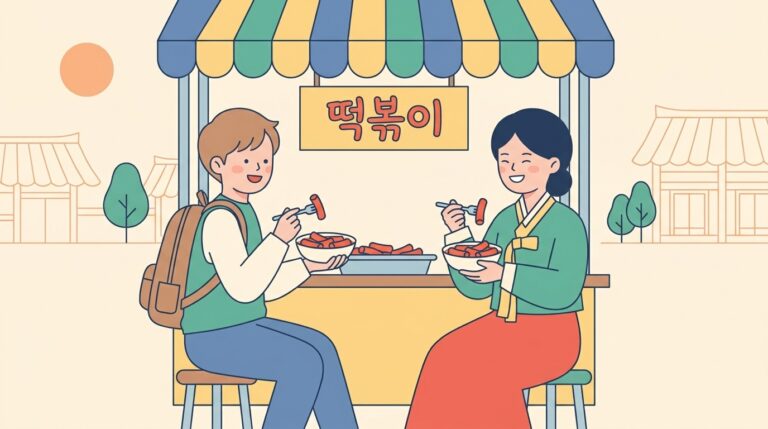
Imagine this: You are sitting at a cozy, glowing tent stall (포장마차 – Pojangmacha) in Seoul. The smell of spicy rice cakes (떡볶이 – Tteokbokki) fills the air. You’re laughing with some newly made Korean friends when suddenly, the big question lands:
“How old are you?” (몇 살이에요?)
Your heart skips a beat. In many Western cultures, asking someone’s age right away can feel a bit too personal. But in Korea? It is the ultimate key to social connection! Today, we will learn exactly how to talk about your age in Korean with confidence, grace, and cultural flair at an A2 level.
Phase 2: Three Essential Age Expressions for Daily Life
To speak like a natural, you need to master these three core expressions. Let’s break down how, when, and why to use them.
1. 저는 [Age]살이에요. (Jeoneun [Age]-sal-i-eyo.)
- Pronunciation: Jeo-neun [Age] sal-ee-yeo-yo (Sounds like: “Chuh-nun … sal-ee-yo”)
- Meaning: I am [Age] years old.
- K-Culture Moment: This is the golden standard sentence used by K-Pop idols during interviews or self-introductions when they want to be polite but approachable.
- Editor’s Insight: To say your age, you must use Native Korean numbers (하나, 둘, 셋…) and attach 살 (sal), which means “years old.” Note that some numbers change slightly before “살” (e.g., 스물 becomes 스무살 / seumu-sal).
- Situation Spectrum:
- Friends/Casual: ✅
- Workplace/Business: ✅
- Elders/Superiors: ⚠️ (Best to use a more polite honorific form here)
- 🤔 Think About It: Why do you think Korean uses two different number systems? We use Sino-Korean for phone numbers and dates, but Native Korean for counting age. How does your language handle different types of counting?
2. 몇 살이에요? (Myeot sal-i-eyo?)
- Pronunciation: Myeot sal-ee-yeo-yo? (Sounds like: “Myut sal-ee-yo?”)
- Meaning: How old are you? (Literal: “How many years old are you?”)
- Real-world Nuance: This is a friendly, standard polite way to ask someone’s age. Use this with classmates, peers, or people who look around your age.
- Situation Spectrum:
- Friends/Casual: ✅
- Workplace/Business: ⚠️ (Can feel slightly too direct)
- Elders/Superiors: 🚫 (Never use this with people much older than you!)
3. 나이가 어떻게 되세요? (Na-i-ga eo-tteok-ge doe-se-yo?)
- Pronunciation: Na-ee-ga uh-ttuk-gae dwe-sae-yo?
- Meaning: What is your age? (Literal: “How does your age become?”)
- Editor’s Insight: This is a beautifully soft, polite “cushion” phrase. By asking “how does it become” instead of “how old are you,” you show great respect and social intelligence (눈치 – Nunchi).
- Situation Spectrum:
- Friends/Casual: ⚠️ (A bit too formal for close friends)
- Workplace/Business: ✅
- Elders/Superiors: ✅
Phase 3: Textbook Korean vs. Real Korean
Let’s compare what textbooks teach with how Koreans actually talk in real life!
Situation 1: Talking to a close friend of the same age
- 📖 Textbook Korean: 저는 스물두 살입니다. (Jeoneun seumul-du sal-imnida. – “I am 22 years old.” Very stiff and robotic.)
- 🗣️ Real Korean: 나 스물두 살이야. (Na seumul-du sal-i-ya.) or simply “나 스물둘! 너는?” (Na seumul-dul! Neoneun? – “I’m 22! You?”)
- 💡 Why is it different? Among close friends of the same age, formal endings are dropped immediately to create a warm, sibling-like bond.
Situation 2: Asking a senior at work politely
- 📖 Textbook Korean: 몇 살이에요? (Myeot sal-i-eyo? – Too blunt for hierarchical workplace settings.)
- 🗣️ Real Korean: 혹시 실례가 안 된다면, 나이가 어떻게 되시나요? (Hoksi sillye-ga an doenda-myeon, na-i-ga eo-tteok-ge doe-si-na-yo? – “If it’s not rude, may I ask your age?”)
- 💡 Why is it different? Adding 혹시 실례가 안 된다면 (“if it’s not a discourtesy”) softens the question perfectly, making you sound professional and incredibly polite.
Phase 4: K-Culture Deep-Dive & Non-verbal Manners
4-1. Physical Manners (Body Language)
When telling your age to someone older, it’s not just about words—it’s about your posture.
* The Head Tilt: Tilt your head down slightly (a mini-bow) to show humility.
* The Drink Etiquette: If you find out someone is older than you during a dinner, remember to turn your head to the side when drinking water or alcohol. This is a sign of high respect!
4-2. The Big “Korean Age” Shift
You might have heard that Koreans are born “one year old.” However, in June 2023, Korea officially transitioned to the international age system (만 나이 – Man Na-i).
Despite this legal change, socially, Koreans still ask for your birth year (몇 년생 – Myeot-nyeon-saeng) to establish who is the “older sibling” (형/누나/오빠/언니) and who is the younger one. Age in Korea is not about being better; it’s about finding your comfortable place in the social family.
Phase 5: Live Roleplay in Hongdae
Let’s test your skills! You are at a trendy Korean BBQ restaurant in Hongdae with your classmate, Minjun.
- Setting: Retro lights, sizzling pork belly, and K-Pop playing softly in the background.
- Cast: You (the learner) and Minjun (your friendly Korean classmate).
- Minjun: (Smiling warmly) 우리 오늘 진짜 재미있네요! 혹시 몇 살이에요?
(Woo-ri o-neul jin-jja jae-mi-it-nae-yo! Hok-si myeot sal-i-eyo?)
“We’re having so much fun today! By the way, how old are you?” -
You: (Blinks, remembering Native numbers) 저는 스물세 살이에요. 민준 씨는요?
(Jeo-neun seumul-se sal-i-eyo. Min-jun ssi-neun-yo?)
“I am 23 years old. How about you, Minjun?” -
Minjun: (Surprised) 어! 진짜요? 저도 스물세 살이에요! 우리 동갑이네요!
(Eo! Jin-jja-yo? Jeo-do seumul-se sal-i-eyo! Woo-ri dong-gap-i-nae-yo!)
“Oh! Really? I’m 23 too! We are the same age!”
🔀 Your Decision Point!
Minjun is the same age as you. How do you respond to make the bond stronger?
- A) “아, 네. 반갑습니다.” (Ah, ne. Ban-gap-seup-nida.)
- B) “우와! 우리 동갑이니까 말 편하게 해요!” (Uwa! Woori dong-gap-i-ni-kka mal pyeon-ha-ge hae-yo!)
- C) “제가 형/오빠네요!” (Je-ga hyeong/oppa-nae-yo!)
Verdict:
- Best Choice is B: “Wow! Since we are the same age, let’s speak casually!” This is the fastest way to drop the formal barriers and become true friends.
- Bad Choice is A: Too cold! It sounds like you want to keep your distance.
- Risky Choice is C: Incorrect! You both are the same age, so you cannot call yourself older.
Phase 6: 10-Second Shadowing Drill
Let’s practice your pronunciation with real emotions. Say these out loud!
- [😊 Friendly & Excited]
저 / 스물두 살이에요! / 반가워요!
(Jeo / seumul-du sal-i-eyo! / Ban-ga-wo-yo!)
“I’m / 22 years old! / Nice to meet you!” -
[🥺 Respectful & Soft]
나이가 / 어떻게 / 되세요?
(Na-i-ga / eo-tteok-ge / doe-se-yo?)
“What / is your / age?”
Phase 7: K-Culture Mini Dictionary
- 동갑 (Dong-gap): Same age. Finding a “Dong-gap” friend instantly makes Koreans feel relaxed and comfortable.
- 만 나이 (Man Na-i): International age. Used in official documents.
- 빠른 생일 (Ppa-reun saeng-il): “Early birthday.” People born in January or February who entered school a year early.
- 학번 (Hak-beon): The year you entered university (e.g., “Class of ’22”). Often used to determine social hierarchy even if ages are slightly different.
Phase 8: Traveler’s Survival Kit
Here are three phrases you will use immediately when traveling in Korea:
- “몇 년생이세요?” (Myeot nyeon-saeng-i-se-yo?) – “What year were you born?” (Great for making friends!)
- “말 편하게 하세요.” (Mal pyeon-ha-ge ha-se-yo.) – “You can speak casually to me.”
- “제가 더 동생이에요.” (Je-ga deo dong-saeng-i-eyo.) – “I am the younger one.” (Shows great modesty.)
📌 Editor’s Travel Note: To easily find your way around Korea’s bustling food spots, download the Naver Map App Download Page before you arrive. Google Maps does not work perfectly in Korea due to security laws!
Phase 9: Deep Reflection — “One Step Closer”
In many countries, asking age is a taboo. But in Korea, it is an act of care. By asking your age, a Korean is trying to find out how to address you properly, how to treat you with the right amount of respect, and what social role they should play for you. It is about creating harmony, not separation.
💬 Your Turn: How does your culture feel about asking someone’s age? Let us know in the comments below!
Phase 10: FAQ & Common Mistakes
Q: Is it rude to ask age on the first meeting in Korea?
A: No, it is not rude. Actually, it is very common because it helps Koreans know which speech level (formal or casual) to use with you.
Q: Do I use Hana-Dul-Set or Il-I-Sam for age?
A: Always use Native Korean numbers (Hana, Dul, Set) for age with the word “살” (sal). For example: 스무 살 (20), 서른 살 (30).
🚨 Common Mistake Alert!
- Wrong: 저는 이십살이에요. (Jeoneun isip-sal-i-eyo. – Using Sino-Korean “20”)
- Correct: 저는 스무 살이에요. (Jeoneun seumu-sal-i-eyo. – Native Korean “20”)
Phase 11: Action Missions
- 🥉 Bronze: Record yourself saying your age in Korean using Native numbers!
- 🥈 Silver: Comment your age in Korean below using “저는 [Age]살이에요.”
- 🥇 Gold: Next time you meet a Korean friend, ask them: “혹시 나이가 어떻게 되세요?”
Phase 12: Interactive Quiz Challenge
How well do you know Korean age culture? Tap to find out!
Q1. Which number system is used for saying age? (Tap to expand)
Answer: Native Korean numbers (하나, 둘, 셋…).
Explanation: Sino-Korean numbers are for dates, money, and phone numbers.
Q2. What should you say if you meet someone the exact same age? (Tap to expand)
Answer: “우리 동갑이네요!” (We are the same age!)
Explanation: It’s the perfect way to start a friendly, casual relationship.







