

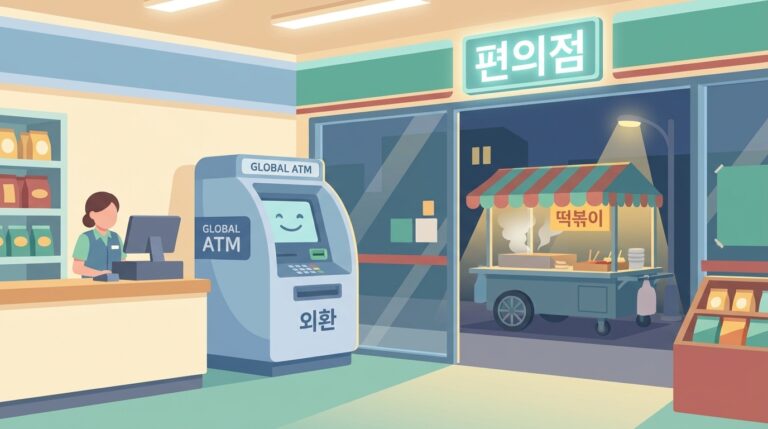
How to Withdraw Cash in Korea: Your Ultimate Warm Guide to ATMs and Banks
Phase 1: Welcome! Let’s Get Some Cash for Street Food!
안녕하세요 (An-nyeong-ha-se-yo)! I’m your head editor at Daily Hangul, your cozy Korean tutor and local guide.
Imagine this: You are walking through the beautiful, energetic streets of Hongdae. The air is chilly, and you smell the most amazing sweet aroma. You follow your nose and find a small stall selling hot, crispy, sweet Hotteok (호떡 – Korean sweet pancakes). Your mouth is watering. You reach for your credit card, but the friendly grandmother points to a small sign: “Cash Only.”
Panic! You need cash, right now! You find an ATM inside a convenience store, but the screen looks overwhelming, and you don’t know what to say if you need to ask for help.
Don’t worry! Every traveler in Korea goes through this. Korea is highly digital, but there are still magical moments—like eating street food, buying cute socks at a local market, or topping up your transit card—where cash is absolutely essential. Today, I am going to teach you exactly how to find and withdraw money (돈 찾기 – don chat-gi) like a true local. By the end of this guide, you’ll feel confident walking up to any bank or ATM in Korea!
Phase 2: The Core 3 Phrases You Need to Master
Let’s look at the three most important survival phrases for getting cash.
1. 돈 찾으려고 해요. (Don chajeuryeogo haeyo.)
- Pronunciation: Don cha-jeu-ryeo-go hae-yo. (Sounds like: “Don” as in dawn + “chaj” as in charge + “eo-ryeo-go” + “hae-yo”)
- Meaning: “I want to get (withdraw) some money.”
- K-Culture Moment: You will hear this expression in almost every family K-Drama when a mother is heading out to the market and asks her husband to go withdraw some cash first.
- Editor’s Insight: Literally, “돈” (don) means money, and “찾다” (chat-da) means to find or retrieve. So you are literally saying, “I intend to find my money.” It is the most common, natural way to say “withdraw money” in daily life.
- Situation Spectrum:
- Friends (Casual): 돈 찾으려고 (Don chajeuryeogo) ✅
- Polite/Standard: 돈 찾으려고 해요 (Don chajeuryeogo haeyo) ✅
- Formal/Business: 돈을 인출하고자 합니다 (Don-eul inchul-hago-ja hamnida) ⚠️ (A bit too stiff for daily life!)
- 🤔 Think About It: Why does Korean use “find” (찾다) instead of “withdraw” in daily speech? It reflects a mindset where your money is already yours, and you are simply going to “find” or “retrieve” it from the bank’s safekeeping!
2. ATM 어디 있어요? (ATM eodi isseoyo?)
- Pronunciation: A-T-M eo-di is-seo-yo? (Sounds like: “A-T-M” + “eo-dee” + “ees-suh-yo”)
- Meaning: “Where is the ATM?”
- K-Culture Moment: In K-Travel vlogs, you’ll see travelers wandering around convenience stores looking for that magical machine. Just ask the clerk this phrase!
- Editor’s Insight: In Korea, you don’t need to learn a complex word for ATM. Everyone, from teenagers to grandmothers, knows and uses the acronym “ATM”!
- Situation Spectrum:
- Friends (Casual): ATM 어디 있어? (ATM eodi isseo?) ✅
- Polite/Standard: ATM 어디 있어요? (ATM eodi isseoyo?) ✅
- Formal/Business: 현금자동입출금기는 어디에 있습니까? (Hyeon-geum-ja-dong-ip-chul-geum-gi-neun eodi-e itsseumnika?) ⚠️ (Way too long! You might sound like a robot from the year 2000.)
3. 수수료 있어요? (Susuryo isseoyo?)
- Pronunciation: Su-su-ryo is-seo-yo? (Sounds like: “Sue-sue-ryoh” + “ees-suh-yo”)
- Meaning: “Is there a service fee?”
- K-Culture Moment: Nobody likes extra fees! In Korea, out-of-hours ATM withdrawals or using different bank machines can incur a small fee (수수료). Asking this shows you are a smart, budget-savvy traveler.
- Editor’s Insight: “수수료” (su-su-ryo) means commission or fee. If you withdraw cash late at night or at a convenience store, you’ll see this word pop up on the screen.
- Situation Spectrum:
- Friends (Casual): 수수료 있어? (Susuryo isseo?) ✅
- Polite/Standard: 수수료 있어요? (Susuryo isseoyo?) ✅
- Formal/Business: 수수료가 발생합니까? (Susuryoga balsaenghamnika?) ⚠️ (Too formal for a quick question.)
Phase 3: Textbook Korean vs. Real-World Korean
Textbooks love formal, dictionary-perfect words. But if you use them in a real Korean bank or store, locals might look a bit surprised by your hyper-formal tone! Let’s look at the difference.
Situation 1: Telling a friend you are going to the bank to get cash
- 📖 Textbook Korean: “저는 은행에서 예금을 인출할 예정입니다.” (Jeo-neun eun-haeng-e-seo ye-geum-eul in-chul-hal ye-jeong-im-ni-da. – “I plan to withdraw my deposit from the banking institution.”)
- 🗣️ Real Korean: “나 돈 좀 찾고 갈게.” (Na don jom chat-go gal-ge. – “I’m gonna grab some cash before we go.”)
- 💡 Why the difference? Koreans value speed and friendliness. Using big words like “인출” (in-chul – withdraw) and “예금” (ye-geum – deposit) makes you sound like a financial news reporter. “돈 찾다” (don chat-da) is warm, quick, and perfectly natural.
Situation 2: Asking if a convenience store machine charges extra
- 📖 Textbook Korean: “이 자동화기기는 이용 수수료가 청구됩니까?” (I ja-dong-hwa-gi-gi-neun i-yong su-su-ryo-ga cheong-gu-doem-ni-da? – “Is a usage fee charged for this automated machine?”)
- 🗣️ Real Korean: “여기 수수료 붙어요?” (Yeo-gi su-su-ryo but-eo-yo? – “Is there a fee added here?”)
- 💡 Why the difference? The verb “붙다” (but-da) means “to stick” or “to be attached.” In real-world Korean, fees “stick” (붙다) to your transaction. It’s short, punchy, and highly idiomatic!
Phase 4: K-Culture Deep Dive & Non-Verbal Manners
4-1. The “Nunchi” (눈치) of ATM Lines
In Korea, “눈치” (nunchi) is the art of sensing other people’s feelings and respecting public spaces. When using an ATM, there are a few unwritten social rules:
1. The Privacy Line: Koreans are very protective of personal information. Always stand at least two steps behind the person currently using the ATM.
2. The Hand Shield: When entering your PIN, it is polite to cover the keypad with your other hand. It’s not because you suspect the person behind you is a thief; it’s a mutual sign of respect and privacy.
3. Quick Hands: If there is a line behind you, try not to count your cash at the machine. Grab your card, cash, and receipt quickly, step aside, and then organize your wallet.
4-2. The Street Food Cash Code
Why do we need cash in the world’s most high-tech society?
If you travel to famous food markets like Gwangjang Market in Seoul, or look for seasonal winter street foods like Bungeoppang (붕어빵 – sweet red bean fish pastries) and Tteokbokki (떡볶이), you will find that many of these tiny stalls are run by elderly vendors (affectionately called Imo – auntie, or Halmeoni – grandmother). While many now accept bank transfers (계좌이체), cash is still the gold standard of kindness and convenience for them. Carrying a few 1,000 KRW and 5,000 KRW bills in your pocket is the ultimate sign of a prepared traveler!
Phase 5: Interactive Roleplay — The Hotteok Emergency!
Let’s test your skills! You are in Hongdae. You want to buy a hot, delicious honey Hotteok, but you only have a credit card. You see a GS25 convenience store nearby. Let’s find that ATM!
The Cast:
- You: A hungry but polite traveler.
- Minji (민지): The friendly, energetic part-time worker at the convenience store.
1. You: (🎭 Walking into the store, looking around nervously)
   안녕하세요! (An-nyeong-ha-se-yo!)

2. Minji: (🎭 Smiling warmly behind the counter)
   어서 오세요! 뭐 찾으시는 거 있으세요? (Eoseo oseyo! Mwo chajeusineun geo isseoseyo? - Welcome! Are you looking for something?)

3. You: (🎭 Pointing near the back corner, hoping there is a machine)
   저기... 혹시 ATM 어디 있어요? (Jeogi... hoksi ATM eodi isseoyo?)

4. Minji: (🎭 Pointing toward the right corner next to the drink fridge)
   아, ATM기기는 저기 음료수 냉장고 옆에 있어요! (Ah, ATM-gigineun jeogi eumryosu naengjanggo yeope isseoyo!)

5. You: (🎭 Relieved, walking toward the machine)
   아! 감사합니다. (Ah! Gamsahamnida.)

6. You: (🎭 Looking at the screen. You see a notice about fees. You walk back to Minji to double-check)
   저기요, 혹시 수수료가 얼마예요? (Jeogiyo, hoksi susuryoga eolmayeyo? - Excuse me, how much is the fee?)

7. Minji: (🎭 Checking her computer screen)
   지금 시간대에는 천삼백 원 나와요. (Jigeum sigandae-eneun cheon-sam-baek won nawayo. - At this hour, it comes out to 1,300 KRW.)

8. You: (🎭 Nodding in understanding)
   아, 천삼백 원이요? 알겠습니다! (Ah, cheon-sam-baek won-iyo? Algetseumnida. - Ah, 1,300 KRW? Understood!)

9. Minji: (🎭 Cheering you on with a smile)
   카드 먼저 넣으시고 '글로벌 서비스' 누르시면 영어로 나와요! (Kadeu meonjeo neoh-usigo 'geulrobeol seobiseu' nureusimeon yeongeoro nawayo! - Put your card in first and press 'Global Service' and it will show in English!)

10. You: (🎭 Gratefully bows slightly)
   정말 감사합니다! 덕분에 돈 찾을 수 있겠어요! (Jeongmal gamsahamnida! Deokbune don chajeul su ikgetseoyo! - Thank you so much! Thanks to you, I can withdraw money!)
🔀 Decision Point!
Now, you are at the machine. It asks you to select your account type. You want to withdraw from your foreign debit card. Which button should you press?
- A) 예금인출 (Ye-geum In-chul) / Foreign Card (국외카드)
- B) 신용카드 (Sin-yong Kadeu)
- C) 송금 (Song-geum)
The Verdict:
- Best Choice: A! Pressing “Foreign Card” (or “Global Service” first) and then “Savings/Withdrawal” (예금인출) is the safest way to access your cash using a foreign debit card.
- Risk Choice: B! “신용카드” means credit card cash advance. This might charge you massive interest fees from your bank back home!
- Wrong Choice: C! “송금” means domestic wire transfer. Don’t press this unless you want to send money to someone else’s Korean bank account!
Phase 6: 10-Second Emotion Shadowing Drill
Let’s practice speaking with real Korean emotion! Match your voice to the feeling notes below.
- [🥺 Needing help, slightly embarrassed]
저기… / ATM / 어디 있어요?
(Jeo-gi… / ATM / eo-di is-seo-yo?) -
[😊 Super happy and relieved]
우와, / 돈 찾았다!
(U-wa, / don cha-jatt-da! – Wow, I got my money!) -
[😱 Shocked by a high fee]
헉! / 수수료가 / 너무 비싸요!
(Heok! / Su-su-ryo-ga / neo-mu bi-ssa-yo! – Gasp! The fee is too expensive!)
Phase 7: K-Culture Mini Dictionary
| Word | Pronunciation | English | Local Context & Meaning |
|---|---|---|---|
| 돈 (Don) | Don | Money | The ultimate daily word. Use it when buying things, talking about budgets, or looking for cash. |
| 현금 (Hyeongeum) | Hyeon-geum | Cash | “Cash” as an official term. Stalls will often have a small sign saying “현금 환영” (Hyeongeum hwanyeong – Cash welcome!). |
| 수수료 (Susuryo) | Su-su-ryo | Fee / Charge | The small charge added when using an ATM after hours (usually after 6 PM) or during weekends. |
| 붕어빵 (Bungeoppang) | Bung-eo-ppang | Fish pastry | The absolute best winter street food filled with sweet red bean paste or custard. The classic reason to have cash in your pocket! |
Phase 8: Traveler’s Survival Kit
Survival Cards (Save these on your phone!)
Card 1: Emergency ATM Locator
- Korean: 혹시 근처에 글로벌 ATM 있어요?
- Romanization: Hoksi geun-cheo-e geul-lo-beol ATM is-seo-yo?
- Pro Tip: Not all ATMs accept foreign cards. Asking specifically for a “Global ATM” will save you a lot of walking!
Card 2: Cash-Only Inquiry
- Korean: 혹시 카드 안 돼요?
- Romanization: Hoksi ka-deu an dwae-yo?
- Pro Tip: Use this politely at small markets or food stalls to double-check if they really cannot accept cards.
Card 3: Exact Fee Check
- Korean: 수수료 붙어요?
- Romanization: Su-su-ryo but-eo-yo?
- Pro Tip: Ask this to the bank teller or store clerk if the machine screen shows a confusing Korean warning message.
📌 Editor’s Travel Note:
When traveling in Korea, download the Naver Map App instead of Google Maps, as Google Maps does not update real-time walking paths in Korea. Simply type “은행” (eun-haeng – bank) or “ATM” in the Naver Map search bar to find the closest cash machine in seconds!
Phase 9: Going One Step Deeper — The Heart of Cash in Korea
Korea is one of the most cashless societies in the world. You can pay for a 1,000 KRW bottle of water with a credit card, a smartphone, or even a transit card. Yet, the culture of carrying some cash remains a warm tradition.
When we buy street food with cash, we don’t just exchange money for food. It is an interaction of warmth (정 – Jeong). When you hand cash to an elderly market vendor with both hands, you are showing respect for their hard work. In return, they might give you an extra piece of food for free (called 서비스 – seobiseu).
💬 Your Turn: How is cash viewed in your home country? Is it still widely used, or is everything digital now? Let us know in the comments below! We love reading your stories.
Phase 10: FAQ & Avoiding Mistakes
Q: Can I use my foreign visa/mastercard debit card at any ATM in Korea?
A: No. You must look for machines that have a “Global ATM” logo or a flag icon on the start screen. Standard local ATMs might reject foreign cards or fail to read the chip.
Q: Is there a limit on how much cash I can withdraw at once?
A: Yes. For safety, most Korean ATMs limit single withdrawals to 700,000 KRW to 1,000,000 KRW. Daily limits also apply depending on your home bank.
Q: What should I do if the ATM eats my card?!
A: Don’t panic! If you are inside a bank, walk to the counter. If it is in a convenience store after hours, ask the store clerk for help. They can call the security company phone number listed on the side of the machine, and an officer will arrive within 10-15 minutes to retrieve it.
🚨 Common Mistakes Alert!
- Using Credit Cards for Cash: Many tourists press “신용카드” (Credit Card) instead of “일반예금” (Savings/Debit). This can trigger high cash-advance fees from your home bank!
- Forgetting Your Card: Unlike some Western machines that spit out your card before the cash, Korean ATMs dispense cash first, and then your card. Do not walk away happy with your cash while leaving your card in the machine!
- Not Knowing Bank Hours: Korean bank ATMs inside bank lobbies usually close at 11:30 PM. Only convenience store ATMs are open 24/7.
Phase 11: Daily Hangul Action Missions!
- 🥉 Bronze Mission: Look at yourself in the mirror and say “돈 찾으려고 해요” three times out loud with a confident, polite smile!
- 🥈 Silver Mission: Write down “ATM 어디 있어요?” in the comments of our latest Instagram post at Daily Hangul to show you’re practicing!
- 🥇 Gold Mission: Next time you visit Korea (or your local Koreatown), go to a Korean convenience store and locate their ATM using only your Korean eyes!
-
🎮 K-Culture Treasure Hunt: Watch your favorite K-Drama today. Look closely at any scene where characters eat at a street cart (Pojangmacha). Do they pay with a card, or do they pull out crinkly paper bills from their pocket? Notice how they hand over the money with two hands!
Phase 12: Interactive Quiz Challenge
Test your knowledge with these quick brain teasers!
1. Which phrase means “Where is the ATM?”
- A) 돈 어디 있어요?
- B) ATM 어디 있어요?
- C) 수수료 어디 있어요?
👉 Click to reveal the Answer & Explanation
Correct Answer: B!
“ATM 어디 있어요?” is the perfect daily phrase to find a cash machine. Option A means “Where is the money?” (which sounds a bit like a bank robbery!) and Option C means “Where is the fee?”
2. True or False: You should always use the word “인출” when talking to a friend about getting cash.
👉 Click to reveal the Answer & Explanation
Correct Answer: False!
“인출” (withdrawal) is a very formal textbook term. In daily life with friends, always use the warm and natural phrase “돈 찾다” (to find money).
3. Fill in the blank: “혹시 _______ 있어요?” (Is there a service fee?)
👉 Click to reveal the Answer & Explanation
Correct Answer: 수수료 (Susuryo)
“혹시 수수료 있어요?” is a great way to ask if you will be charged extra for withdrawing money.
See you in the next lesson! Happy traveling and happy studying!
– Your Daily Hangul Editor







