

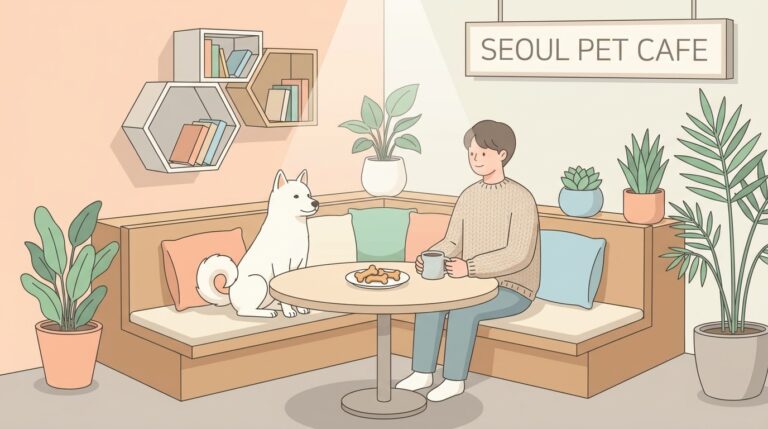
Safeguarding Your Companion: An Advanced Guide to Canine Toxic Foods in Korea
Phase 1: Empathy (스토리 몰입형 오프닝)
안녕하세요! Welcome back to Daily Hangul, your premium space for mastering high-level Korean language and culture. I’m your senior editor and cultural navigator.
Imagine this scene: You are enjoying a crisp autumn afternoon at a gorgeous, pet-friendly rooftop cafe in Yeonnam-dong. Your beautiful dog is sitting politely by your side, drawing admiring glances from the locals. A friendly Korean regular walks over, smiles warmly, and offers your pup a small bite of a traditional pastry they’ve purchased nearby. In Korea, this gesture is a profound display of Jeong (정 – social warmth and affection).
But a cold sweat breaks out. You know that local treats often hide ingredients like raisins, chocolate, cocoa powder, or sweet fillings spiced with onions and garlic—all highly toxic to dogs.
How do you decline this heartfelt gesture gracefully without breaking social harmony (Nunchi, 눈치), yet assertively enough to protect your dog?
Mastering the linguistic nuances of pet care at a C2 (Advanced) level is not just about translating “Don’t feed my dog chocolate.” It is about navigating complex social relations, understanding the shifting paradigms of Korean pet ownership, and commanding vocabulary that commands immediate respect. Today, let’s dive into the linguistic and cultural nuances of keeping your pup safe in South Korea.
Phase 2: Core Expressions (핵심 표현 3선 심층 분석)
1. 강아지한테 초콜릿은 치명적이에요
- Pronunciation: [gang-a-ji-han-te cho-kol-lit-eun chi-myeong-jeok-i-e-yo] / Sound-alike: gahng-ah-jee-hahn-teh cho-co-leet-eun chee-myung-juk-ee-eh-yo
- Meaning: “Chocolate is fatal/lethal to dogs.”
- K-Culture Moment: This phrase mirrors the tense dramatic warning you might hear in a metropolitan veterinary clinic scene in a high-end K-Drama, where a character rushes their pet to a 24-hour emergency room.
- Editor’s Insight: Instead of using the basic adjective “안 좋아요” (it’s bad), employing the Sino-Korean word 치명적 (致命的 – fatal/lethal) elevates your statement. It signals to the listener that this is not a minor dietary preference but a critical medical emergency.
- Situation Spectrum:
- Casual (친구·사석): ✅ (Perfect for serious warnings to friends)
- Semi-formal (직장 동료): ✅ (Establishes clear boundaries with colleagues)
- Formal (어른·상사): ✅ (Maintains high politeness while conveying gravity)
- 🤔 Think About It: Consider how Sino-Korean descriptors like chi-myeong-jeok (치명적) inject objective, medical gravity into a sentence. How does this compare to how you express critical boundaries in your native language?
2. 우리 애는 알레르기가 있어서 아무거나 먹이면 안 돼요
- Pronunciation: [u-ri ae-neun al-le-reu-gi-ga it-seo-seo a-mu-geo-na meog-i-myeon an dwae-yo] / Sound-alike: oo-ree eh-neun ahl-leh-roo-ghee-gah eet-suh-suh ah-moo-guh-nah muhg-ee-myun ahn dweh-yo
- Meaning: “Our baby has allergies, so you shouldn’t feed them just anything.”
- K-Culture Moment: Socializing at a high-end dog pension in Gapyeong, politely declining shared homemade dog treats from other pet parents.
- Editor’s Insight: Notice the use of 우리 애 (our kid/baby) instead of “제 개” (my dog). In contemporary Korean society, dogs are treated as literal family members (반려가족). Referring to your pet as 우리 애 humanizes them instantly and softens the rejection of food by attributing it to medical necessity (allergies).
- Situation Spectrum:
- Casual: ✅
- Semi-formal: ✅
- Formal: ⚠️ (Slightly adjust to 저희 아이 [jeo-hui a-i] for highly formal settings)
- 🤔 Think About It: Reflect on the collective pronoun 우리 (our). Even when talking about a pet that belongs strictly to you, Koreans instinctively say “우리 애.” What does this tell you about the collectivist worldview embedded in the Korean language?
3. 이 음식에 혹시 양파나 마늘이 들어가 있나요?
- Pronunciation: [i eum-sik-e hok-si yang-pa-na ma-neul-i deul-eo-ga it-na-yo] / Sound-alike: ee eum-sheek-eh hohk-shee yahng-pah-nah mah-neul-ee deul-uh-gah eet-nah-yo
- Meaning: “Does this food happen to contain onions or garlic?”
- K-Culture Moment: Inquiring at a local pet-friendly bistro about whether a shared plate or side dish contains hidden aromatics that your dog might accidentally ingest off the floor.
- Editor’s Insight: Korean cuisine is heavily built on garlic (마늘) and onions (양파), both of which cause hemolytic anemia in dogs. Asking this with the tentative adverb 혹시 (by any chance) shows exceptional linguistic grace and avoids sounding accusatory to the restaurant staff.
- Situation Spectrum:
- Casual: ✅
- Semi-formal: ✅
- Formal: ✅
Phase 3: Textbook Korean vs. Real Korean (교과서 한국어 vs 진짜 한국어)
Situation 1: Declining a piece of chocolate or human pastry offered by an elder at a park
- 📖 Textbook Korean: “개에게 초콜릿을 주는 것은 해롭습니다.” (Giving chocolate to dogs is harmful.)
- 🗣️ Real Korean: “어머, 마음은 정말 감사한데요! 저희 강아지가 초콜릿이나 단 음식을 먹으면 정말 큰일 나요.”
- 💡 Why is it different? The textbook sentence sounds like a cold warning label on a package. Real-world Korean prioritized Jeong (affection). By acknowledging their kind intention first (“마음은 정말 감사한데요” – I’m truly grateful for your kind heart) and using the colloquial phrase 큰일 나요 (big trouble will happen), you protect your pet while preserving the stranger’s dignity.
Situation 2: Urgently warning a roommate who left grapes on the coffee table
- 📖 Textbook Korean: “포도는 개의 신장에 유해하므로 치워 주십시오.” (Since grapes are harmful to a dog’s kidneys, please remove them.)
- 🗣️ Real Korean: “야, 포도 얼른 치워줘! 강아지 먹으면 진짜 난리 나.”
- 💡 Why is it different? In high-stakes situations, textbook syntax is too slow. The imperative 치워줘 (clean/remove it) combined with 진짜 난리 나 (it will be a total disaster/chaos) conveys visceral urgency that demands immediate action.
Phase 4: K-Culture Deep Dive & Non-verbal Manners (문화 딥다이브 & 비언어적 매너)
4-1. Nunchi (눈치) and Non-verbal Refusal
When someone, especially an elder (어르신), tries to feed your dog something dangerous, words are only half the battle. To maintain perfect cultural decorum:
1. The Polite Hand Wave (손사래): Gently wave one or both hands side-to-side in front of your chest. This non-verbal cue signals a polite, apologetic “no.”
2. The Micro-Bow: Slightly lower your head and shoulders to convey respect while speaking. This softens the refusal, making it clear that you are declining the food, not their kindness.
4-2. The Companion Animal Revolution (반려동물 문화)
South Korea has undergone a massive cultural shift from viewing dogs as utilitarian guard dogs to precious family members (반려견 – companion dogs). In metropolitan areas like Seoul, you will find specialized canine bakeries making pet-safe pastries. However, older generations might still hold traditional views on feeding dogs table scraps. Navigating this generational gap requires patience and precise, polite language.
Phase 5: Interactive Roleplay Scenario (실전 롤플레이 시나리오)
- Setting: A trendy pet cafe in Hannam-dong on a rainy Saturday. Jazz plays softly, and the aroma of roasted coffee fills the air. You are sitting at a low oak table with your dog.
- Cast: You (sophisticated pet owner) and Min-jun (민준 – a friendly local regular with a bubbly golden retriever).
1. 민준: (환하게 웃으며) 와, 강아지가 정말 얌전하네요! 품종이 어떻게 돼요?
   [Wa, gang-a-ji-ga jeong-mal yam-jeon-ha-ne-yo! Pum-jong-i eo-tteoh-ge dwae-yo?]
   (Smiling brightly) "Wow, your dog is so well-behaved! What breed are they?"

2. You: (미소를 지으며) 감사합니다. 진돗개 믹스인데, 순하고 사람을 잘 따라요.
   [Gam-sa-ham-ni-da. Jin-dot-gae mik-seu-in-de, sun-ha-go sa-ram-eul jal tta-ra-yo.]
   (Smiling) "Thank you. She's a Jindo mix; she's gentle and loves people."

3. 민준: (주머니를 뒤적이며) 아, 마침 제가 유기농 강아지 간식을 가지고 있거든요. 하나 줘도 될까요?
   [Ah, ma-chim je-ga yu-gi-nong gang-a-ji gan-sik-eul ga-ji-go it-geo-deun-yo. Ha-na jwo-do doel-kka-yo?]
   (Fumbling in his pocket) "Ah, I happen to have some organic dog treats on me. May I give her one?"

4. You: (감사함을 표하며) 아, 정말 감사해요. 근데 어떤 성분이 들어가 있나요? 저희 애가 장이 좀 예민해서요.
   [Ah, jeong-mal gam-sa-hae-yo. Geun-de eo-tteon seong-bun-i deul-eo-ga it-na-yo? Jeo-hui ae-ga jang-i jom ye-min-hae-seo-yo.]
   (Expressing gratitude) "Oh, thank you so much. But what ingredients are in it? Our baby has a rather sensitive stomach."

5. 민준: (간식 패키지를 보며) 어... 여기 보니까 건포도랑 초콜릿 칩 향이 살짝 들어간 수제 쿠키라네요. 강아지용이라 괜찮을 거예요!
   [Eo... yeo-gi bo-ni-kka geon-po-do-rang cho-kol-lit chip hyang-i sal-jjak deul-eo-gan su-je ku-ki-ra-nae-yo. Gang-a-ji-yong-i-ra gwaen-chan-eul geo-ye-yo!]
   (Looking at the package) "Uh... looking here, it's a homemade cookie with a bit of raisins and chocolate chip flavoring. It's made for dogs, so it should be fine!"

6. You: (깜짝 놀라며 손사래를 친다) 어머! 잠깐만요. 강아지용이라도 건포도랑 초콜릿은 정말 위험해요.
   [Eo-meo! Jam-kkan-man-yo. Gang-a-ji-yong-i-ra-do geon-po-do-rang cho-kol-lit-eun jeong-mal wi-heom-hae-yo.]
   (Startled, waving hands) "Oh dear! Hold on a second. Even if it's marketed for dogs, raisins and chocolate are extremely dangerous."

7. 민준: (의아해하며) 아, 정말요? 소량은 괜찮지 않나요?
   [Ah, jeong-mal-yo? So-ryang-eun gwaen-chan-chi an-na-yo?]
   (Puzzled) "Ah, really? Isn't a tiny amount okay?"

8. You: (단호하지만 친절하게) 아뇨, 특히 건포도는 소량으로도 급성 신부전을 일으킬 수 있어서 절대 먹이면 안 돼요.
   [A-nyo, teuk-hi geon-po-do-neun so-ryang-eu-ro-do geup-seong sin-bu-jeon-eul il-eu-kil su it-seo-seo jeol-dae meog-i-myeon an dwae-yo.]
   (Firmly but kindly) "No, especially raisins—even a small amount can cause acute renal failure, so you must absolutely never feed them to dogs."

9. 민준: (깜짝 놀라며 간식을 치운다) 아, 제가 큰 실수를 할 뻔했네요! 알려주셔서 정말 감사해요.
   [Ah, je-ga keun sil-su-reul hal ppeon-haet-ne-yo! Al-ryeo-ju-syeo-seo jeong-mal gam-sa-hae-yo.]
   (Shocked, putting the treats away) "Ah, I almost made a massive mistake! Thank you so much for letting me know."

10. You: (안도하며 활짝 웃는다) 아니에요, 많은 분들이 의외로 잘 모르시더라고요. 덕분에 저희 애가 안전했네요!
    [A-ni-e-yo, ma-neun bun-deul-i ui-woe-ro jal mo-reu-si-deo-ra-go-yo. Deok-bun-e jeo-hui ae-ga an-jeon-haet-ne-yo!]
    (Relieved, smiling warmly) "Not at all; surprisingly, many people don't know this. Thanks to you, my baby stayed safe!"
🔀 Decision Point: How would you react if an elder offered raw chocolate at a park?
Choose your path to test your cultural survival skills:
- Option A: “죄송합니다만, 저희 개가 초콜릿을 먹으면 죽을 수도 있어서 절대로 주시면 안 됩니다.” (Highly blunt, potentially offensive to elders due to aggressive vocabulary like “죽을 수도 있어서” and strict command syntax “주시면 안 됩니다”).
- Option B: “어머, 어르신! 마음은 너무 감사한데, 저희 강아지가 몸이 약해서 초콜릿 같은 걸 먹으면 병원비가 수백만 원씩 나와서요. 속상하지만 마음만 받을게요!” (Masterful diplomacy. Connects physical vulnerability with humorous reality [vet bills], softening the blow while declining elegantly).
- Option C: (Scared of conflict, you take the chocolate with a bow, say thank you, and secretly throw it away in a nearby trash can when they walk away).*
💡 Analysis of Choices:
- Best Choice: Option B. It respects the elder’s age and social position (calling them 어르신), softens the refusal with humor about vet bills, and clearly declines while maintaining perfect harmony (Nunchi).
- Risky Choice: Option A. While grammatically correct, it is far too abrasive for Korean social standards and can lead to a defensive confrontation.
- Survival Choice: Option C. Tactically safe, but it misses an opportunity to practice sophisticated Korean and establish clear boundaries.
Phase 6: 10-Second Shadowing Drill (10초 감정 섀도잉 드릴)
Practice these sentences with the exact emotional markers to sound like a native speaker who cares deeply about their pet.
1. High Urgency Warning (to a friend or partner)
- Sentence: “야! / 포도 얼른 치워! / 강아지 먹으면 / 진짜 난리 나!”
- Melodic Guide: Start high on “야!” (Hey!), pause quickly, speak “얼른 치워!” (clean it quickly!) with sharp downward emphasis, and end with a breathy, dramatic finish on “진짜 난리 나!” (serious disaster!).
- Emotional Target: [😤 Detemined, urgent, and fast-paced]
2. Polite Social Rejection (to a stranger/elder)
- Sentence: “마음은 너무 감사한데요, / 저희 애가 몸이 약해서 / 아무거나 먹으면 안 돼요.”
- Melodic Guide: Sing-song cadence on “너무 감사한데요~” with a slight rising tone at the end to show warmth, followed by a soft, apologetic drop in tone on “먹으면 안 돼요.”
- Emotional Target: [🥺 Warm, deeply apologetic, yet absolute in boundary]
Phase 7: K-Culture Mini Dictionary (K-Culture 미니 사전)
| Word (Korean + Romanization) | English Meaning | Cultural Nuance & Real-World Usage |
|---|---|---|
| 반려인 (Ban-ryeo-in) | Companion Human / Pet Parent | Replacing the old term “주인” (Owner). It reflects the deep emotional equality modern Koreans assign to their relationships with animals. |
| 개푸치노 (Gae-pu-chi-no) | Puppuccino | A portmanteau of 개 (dog) and 카푸치노 (cappuccino). Commonly ordered at trendy cafes in Seoul so pets can feast alongside owners. |
| 금지 식품 (Geum-ji Sip-pum) | Prohibited Foods | A formal term used in veterinary infographics and pet care blogs to list toxic ingredients. |
| 동물병원 (Dong-mul-byeong-won) | Veterinary Clinic | Crucial word to know. To find a 24-hour clinic on your maps, always search for 24시 동물병원 (24-hour Vet). |
Phase 8: Traveler’s Survival Kit (여행자를 위한 생존 키트)
Top 3 Survival Phrases for Pet Parents
- 근처에 24시간 하는 동물병원이 어디에 있나요?
- [Geun-cheo-e 24-si-gan ha-neun dong-mul-byeong-won-i eo-di-e it-na-yo?]
- Pro Tip: Keep this saved on your phone. If your dog ingests chocolate or grapes, you must act within the golden hour.
- 이 디저트에 견과류나 초콜릿 성분이 있나요?
- [I di-jeo-teu-e gyeon-gwa-ryu-na cho-kol-lit seong-bun-i it-na-yo?]
- Pro Tip: Perfect for screening outdoor cafe pastries before setting them on a shared table.
- 강아지 데려가도 되나요?
- [Gang-a-ji deol-yeo-ga-do dwae-yo?]
- Pro Tip: Essential when checking if a cozy Seoul establishment allows furry guests.
📌 Editor’s Travel Note
When navigating South Korea with a dog, do not rely on Google Maps; it is rarely updated. Instead, download the Naver Map App or KakaoMap App and search for “애견동반” (pet-friendly) or “동물병원” (vet) for real-time locations, reviews, and operating hours.
Phase 9: Deep Thoughts — “한 발 더 깊이” (인문학적 성찰)
The linguistic evolution of how we talk about pets in South Korea is a fascinating mirror of the country’s rapid socio-economic transition. Over the past three decades, Korea shifted from an agrarian society where dogs were primarily external protectors to an urbanized, high-density society where dogs are integral to emotional well-being. This shift is deeply embedded in the honorific system. Today, pet owners frequently use high-level polite suffixes like “-시-” (honorific marker) when referring to their dogs’ actions in public, such as “우리 강아지가 오늘 기분이 좋으세요” (Our dog is feeling pleased today). By linguistic standards, this is a beautiful projection of human dignity onto our animal companions.
💬 Your Turn: How does your native language reflect changes in how society views animals? Do you use different pronouns or vocabulary for pets than you did in the past? Let us know in the comments below!
Phase 10: FAQ & Mistakes (FAQ Schema Optimized)
Q: What should I do if my dog eats chocolate in Korea and I can’t speak Korean well?
A: Do not panic. Open your Naver Map app immediately, search for “24시 동물병원” (24-hour Vet Clinic), rush to the nearest clinic, and show the receptionist this phrase: “우리 강아지가 초콜릿을 먹었어요. 응급 상황이에요!” (My dog ate chocolate. It is an emergency!).
Q: Is it common for Korean food to contain hidden toxic ingredients for dogs?
A: Yes. Korean street food and savory dishes heavily feature garlic, green onions (파), and onions. Even seemingly safe meat dishes like Bulgogi are marinated in soy sauce packed with garlic and onion juices. Never feed your dog leftovers from Korean meals.
Q: Can I use “개” (Gae) instead of “강아지” (Gang-a-ji)?
A: While “개” literally translates to “dog,” it carries a slightly harsh, sometimes profane connotation in modern slang. It is always safer and more culturally affectionate to refer to dogs as 강아지 (puppy/dog) or 반려견 (companion dog).
🚨 Common Mistakes Alert!
- Mistake 1: Translating “My dog is sick” as “내 개가 아파요” (nae gae-ga a-pa-yo).
- Correct Action: Say “저희 아이가 아파요” (jeo-hui a-i-ga a-pa-yo) or “우리 강아지가 아파요” (u-ri gang-a-ji-ga a-pa-yo) for a warmer, more natural tone.
- Mistake 2: Relying on the phrase “초콜릿은 위험해요” (Chocolate is dangerous) in emergencies.
- Correct Action: Elevate to “초콜릿은 치명적이에요” (Chocolate is fatal) to ensure the vet or bystander understands the absolute urgency.
- Mistake 3: Saying “먹지 마세요” (Don’t eat) to someone offering food to your dog.
- Correct Action: Say “먹이면 안 돼요” (You must not feed them) to specify that the dog shouldn’t ingest it, rather than telling the human not to eat it!
Phase 11: Action Missions (액션 미션 및 참여 유도)
- 🥉 Bronze (방구석 챌린지): Record yourself practicing the High Urgency Shadowing Drill from Phase 6. Focus on expressing panic and quick command syntax.
- 🥈 Silver (네트워크 챌린지): Take a photo of your pet (or a cute dog you follow), post it on Instagram, and caption it in advanced Korean using the term 우리 애 or 반려견, adding: “우리 애는 초콜릿 먹으면 큰일 나요!”
- 🥇 Gold (현실 챌린지): The next time you visit a cafe in Korea, spot the ingredients list or ask a barista in Korean if a pastry contains nuts or chocolate using the phrase learned in Phase 8.
- 🎮 K-Culture Mission: Watch a pet-centric Korean variety show like 개는 훌륭하다 (Dogs Are Incredible) and list three terms the trainers use when discussing toxic behaviors or food hazards.
Phase 12: Interactive Quiz (인터랙티브 퀴즈 챌린지)
1. Situational Judgment
An acquaintance at a picnic offers your dog a piece of sweet bread. You are unsure if it has raisins inside. Which advanced Korean phrase maintains harmony while ensuring absolute safety?
* A) 주지 마세요. 위험해요.
* B) 어머, 챙겨주셔서 정말 감사해요! 근데 저희 강아지가 장이 약해서 아무거나 먹으면 큰일 나요. 마음만 감사히 받을게요!
* C) 건포도가 독성물질인 거 모르세요?
Reveal Answer & Cultural Analysis
- Correct Answer: B
- Why: Option B acknowledges the kindness first (챙겨주셔서 정말 감사해요!), attributes the refusal to a medical/physical limitation of the dog, and ends with a beautiful idiom (마음만 감사히 받을게요 – I will gratefully accept only your kind thoughts). Option A is too cold, and Option C is accusatory and breaks social harmony (Nunchi).
2. Fill in the Blanks
Complete the urgent warning to a roommate who left a chocolate bar open on the sofa:
* “야! 소파에 초콜릿 치워! 강아지가 먹으면 진짜 ( )!”
Reveal Answer
- Answer: 난리 나 (nan-ri na) or 큰일 나 (keun-il na)
- Translation: “Hey! Get that chocolate off the sofa! If the dog eats it, it’ll be a total disaster!”
3. True or False
In modern Korean culture, calling your dog “우리 애” (our baby/child) is considered strange because it should only be used for human children.
Reveal Answer
- Answer: False
- Why: Calling your pet “우리 애” (our baby/child) or “저희 아이” is the hallmark of modern, highly affectionate Korean pet care culture and is widely accepted across all urban demographics.
Thank you for learning with Daily Hangul. Keep your furry family members safe, and practice your advanced Korean with pride!







