

Unwind in Stereo: How to Blow Off Steam at a Korean Coin Noraebang Like a Pro
안녕하세요! (Annyeonghaseyo! – Hello!) I’m your Chief Editor at Daily Hangul. Have you ever had one of those days where your brain feels like overcooked ramyun? Maybe you made a tiny mistake in your Korean class, or the fast pace of Seoul life left you feeling a bit overwhelmed.
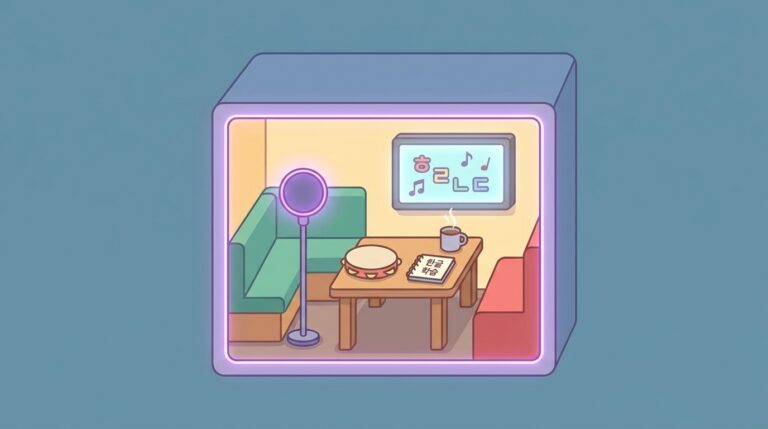
In K-dramas, you often see characters running to a dimly lit room, grabbing a neon-colored microphone, and belting out power ballads until they cry or laugh. That place isn’t just a drama set—it is the holy grail of Korean stress relief: the 코인 노래방 (koin noraebang), affectionately shortened to 코노 (kono).
Today, we are going to learn how to express our stress, navigate a Korean coin karaoke booth, and sing your heart out using authentic B1-level Korean phrases. This guide was born from real-life tutoring sessions with students like Sarah, an exchange student who thought she could only go to karaoke in huge, expensive groups. Once she discovered “kono,” it became her weekly mental health ritual. Let’s get you ready to sing like no one is listening!
Core Expressions: Let It All Out
Here are the three most important phrases you will need to talk about your karaoke escape.
1. 스트레스를 풀다 (seuteureseureul pulda)
- Pronunciation: seu-teu-re-seu-reul pool-da (Sounds like “stress-ul pool-da”)
- Meaning: To relieve stress (Literally: “to untie or unravel stress”)
- K-Culture Moment: This is the ultimate post-work or post-exam phrase. When a group of office workers finishes a brutal shift in a office drama, they loosen their ties and say, “스트레스 풀러 가자!” (Let’s go relieve some stress!)
- Editor’s Insight: Think of stress in Korean as a tight knot inside your chest. You don’t just ‘reduce’ it; you physically “풀다” (untie) it.
- Situation Spectrum:
- Friends & Casual: ✅
- Coworkers & Semi-formal: ✅ (Use: 스트레스를 풀어요)
- Bosses & Formal: ⚠️ (Use: 스트레스를 해소합니다)
- 🤔 Think About It: Why do you think Korean culture uses physical verbs like “untie” (풀다) for emotional states? How do you describe releasing tension in your own language?
2. 소리 지르다 (sori jireuda)
- Pronunciation: so-ri jee-reu-da (Sounds like “sorry jee-roo-da”)
- Meaning: To scream, shout, or belt out a song
- K-Culture Moment: When you are in a tiny coin noraebang booth, nobody cares if you hit the high notes perfectly. It’s all about “소리 지르기” (screaming/belting) to empty your lungs of worry.
- Editor’s Insight: While “소리 지르다” can mean screaming in fear or anger, in the context of noraebang, it means singing with passionate abandon.
- Situation Spectrum:
- Friends & Casual: ✅
- Coworkers & Semi-formal: ✅
- Bosses & Formal: 🚫 (Too informal/raw for a formal business presentation!)
3. 목이 쉬다 (mogi swida)
- Pronunciation: mok-ee schwee-da (Sounds like “moggy shee-da”)
- Meaning: To go hoarse / lose one’s voice
- K-Culture Moment: The true badge of honor after a successful session. You walk out of the booth, your neck is warm, and your voice sounds like a gravel road.
- Editor’s Insight: This phrase literally means “the throat rests/has gone stale.” It is used when you’ve talked, screamed, or sung too much.
- Situation Spectrum:
- Friends & Casual: ✅
- Coworkers & Semi-formal: ✅
- Bosses & Formal: ✅ (Use: 목이 쉬었습니다)
Textbook Korean vs. Real-World Korean
Let’s look at how textbooks teach these situations versus how young Koreans actually talk in the streets of Sinchon or Hongdae.
Situation 1: Suggesting a karaoke session
- 📖 Textbook: “오늘 노래방에 같이 가겠습니까?” (Oneul noraebange gachi gagesseumnika? – “Would you like to go to the karaoke room together today?”)
- 🗣️ Real Korean: “오늘 코노 고?” (Oneul kono go? – “Kono today? Let’s go!”) or “오늘 코노 각인데?” (Oneul kono gak-inde? – “Today feels like a perfect angle/moment for Kono.”)
- 💡 Why the difference? Koreans love efficiency and rhythm. “코인 노래방” is too long, so it became “코노” (Kono). Adding “고” (Go) at the end turns any noun into a fun, immediate invitation.
Situation 2: Talking about your throat after singing
- 📖 Textbook: “노래를 너무 많이 불러서 목이 아픕니다.” (Noraereul neomu mani bulleoseo mogi apeumnida. – “My throat hurts because I sang too many songs.”)
- 🗣️ Real Korean: “나 목 완전히 나갔어.” (Na mok wanjeonhi nagasseo. – “My voice is completely gone / checked out.”)
- 💡 Why the difference? Saying “나갔어” (left/gone out) is a colorful, colloquial way of saying your voice took a vacation because you pushed it to the limit. It sounds incredibly natural and fluent.
K-Culture Deep Dive & Non-Verbal Manners
1. The “Nunchi” (눈치) of Kono
When you enter a coin noraebang, you are sharing a highly compact space with dozens of other passionate singers. Here is how to keep the peace:
* The Mic Cover is Sacred: Always grab a sterile plastic microphone cover (마이크 덮개 – ma-i-keu deop-gae) from the front desk or the vending machine. Slipping it over the mic is essential hygiene etiquette.
* Keep the Door Shut: Yes, we love your high-note attempts on a BTS track, but keep the heavy glass door closed so the entire hallway doesn’t share your performance.
2. The Cultural Value of “Heung” (흥)
To understand why Koreans sing so passionately, you must understand 흥 (Heung). It’s an untranslatable word representing collective joy, excitement, and high spirits. Noraebang is not a performance where you get judged; it’s a safe zone to unleash your “Heung” and shake off the heavy energy of the day.
Interactive Roleplay: A Rainy Friday Night in Hongdae
Imagine you are standing outside under the neon signs of Hongdae. The rain is dripping, and you just finished a tough week. Your Korean friend, Minjun, spots a glowing sign that reads “코인 노래방.”
- Setting: A cozy, neon-purple hallway lined with small glass booths. The heavy beat of bass echoes through the walls.
- Cast: You (feeling tired) and Minjun (an energetic local who knows every K-pop song by heart).
1. 민jun: (Sighing with a smile) 아, 이번 주 과제 진짜 힘들었다. 스트레스 대박이야.
   (Ah, ibeon ju gwaje jinjja himdeoreotda. Seuteureseu daebakiya.)
   "Ah, this week's assignment was so hard. The stress is huge."

2. You: (Nodding sympathetically) 맞아요. 저도 오늘 스트레스 풀고 싶어요.
   (Majayo. Jeodo oneul seuteureseu pulgo sipeoyo.)
   "I know. I want to relieve some stress today too."

3. 민jun: (Pointing at a glowing purple sign) 어! 여기 코노 있다. 들어가자!
   (Eo! Yeogi kono itda. Deoreogaja!)
   "Oh! There's a Kono here. Let's go in!"

4. You: (Curious but hesitant) 코노요? 몇 곡 부를 수 있어요?
   (Konoyo? Myeot gok bureul su isseoyo?)
   "Kono? How many songs can we sing?"

5. 민jun: (Entering the booth) 천 원에 네 곡이야! 완전 가성비 최고지. 자, 마이크 덮개 씌우고.
   (Cheon wone ne gogiya! Wanjeon gaseongbi choegoji. Ja, ma-i-keu deop-gae sswi-ugo.)
   "It's four songs for 1,000 won! Absolute best value. Here, put the mic cover on."

6. You: (Taking the mic) 노래 먼저 고르세요. 뭐 부를 거예요?
   (Norae meonjeo goreuseyo. Mwo bureul geoyeyo?)
   "You choose a song first. What are you going to sing?"

7. 민jun: (Selecting an intense dance track) 당연히 신나는 노래지! 우리 소리 한번 지르자!
   (Dang-yeonhi sinnaneun noraeji! Uri sori hanbeon jireuja!)
   "An exciting song, of course! Let's scream/belt it out!"

8. You: (Laughing) 좋아요! 저도 신나게 부를래요.
   (Joayo! Jeodo sinnage bulleolaeyo.)
   "Great! I'll sing excitingly too."

[After 30 minutes of singing and shaking the tambourine...]

9. 민jun: (In a raspy voice) 아... 나 목 완전히 나갔어. 목이 너무 쉬었다.
   (Ah... na mok wanjeonhi nagasseo. Mogi neomu swieotda.)
   "Ah... my voice is completely gone. My throat is so hoarse."

10. You: (Smiling) 저도요! 근데 스트레스는 진짜 다 풀렸어요!
    (Jeodoyo! Geunde seuteureseuneun jinjja da pullyeosseo.)
    "Me too! But the stress is completely gone!"
🔀 Decision Point!
Minjun turns to you and hands you the remote control: “마지막 곡 뭐 부를래?” (What do you want to sing for the last song?)
- Option A: “잔잔한 발라드 부를래.” (I want to sing a quiet ballad.)
- Editor’s Feedback: Nice and cozy, but it might lower the high energy you just built up. Good if you want to cool down before leaving!
- Option B: “춤추면서 부르는 신나는 K-Pop!” (An exciting K-Pop song while dancing!)
- Editor’s Feedback: Best Choice! This matches the absolute spirit of “스트레스 풀기” (stress relief). Your friend will grab the tambourine and join you instantly!
- Option C: “이제 목 아프니까 안 부를래.” (My throat hurts now, so I won’t sing.)
- Editor’s Feedback: A bit of a mood dampener. Even if your throat is tired, you can whisper-sing or just let Minjun take the lead without fully checking out!
10-Second Shadowing Drill
Let’s train your emotional intonation. Try to mimic the rhythm and feel the pauses marked by the slash /.
- [😤 Frustrated but eager to escape]
“아, 오늘 / 스트레스 대박인데 / 코노 가자!”
(Ah, oneul / seuteureseu daebak-inde / kono gaja!)
“Ah, today / my stress is crazy / let’s hit Kono!” -
[🥱 Exhausted but completely happy]
“소리 질렀더니 / 목이 완전히 / 쉬었어.”
(Sori jilleotdeoni / mogi wanjeonhi / swieosseo.)
“Because I belted it out / my throat is completely / hoarse.”
K-Culture Mini Dictionary
| Word | English Meaning | Cultural Insight |
|---|---|---|
| 코노 (Kono) | Coin Karaoke | A compound of “Coin” and “Noraebang.” It democratized singing by letting people pay per song rather than per hour. |
| 서비스 (Seobiseu) | Freebies / Bonus | In traditional hourly noraebangs, the owner will often magically add 20–30 free minutes to your screen. This generous gesture is called “서비스.” |
| 템버린 (Tembeorin) | Tambourine | No Korean karaoke room is complete without plastic tambourines that light up. Shaking them violently is a mandatory mood-maker skill. |
| 취향 저격 (Chwihyang jeogyeok) | Sniping one’s taste | Used when someone selects a song that perfectly matches your mood or musical preference. |
Traveler’s Survival Kit
Top 3 Survival Phrases
- “지폐 교환기 어디 있어요?” (Jipye gyohwangi eodi isseoyo?)
- Meaning: Where is the bill changer? (Essential if you only have 10,000 won bills and need 1,000 won bills for the coin slot).
- “마이크 덮개 주세요.” (Ma-i-keu deop-gae juseyo.)
- Meaning: Please give me a microphone cover.
- “신곡 책자 어디 있어요?” (Singok chaekja eodi isseoyo?)
- Meaning: Where is the new song booklet?
📌 Editor’s Travel Note: To locate the closest and cleanest spots, open the Naver Map App and search for “코인노래방” (Coin Noraebang). Most modern booths in tourist areas accept card payments right at the machine, but keeping a few physical 1,000 won bills in your pocket is a safe backup plan!
Deep Reflection: “Unwrapping” the Mind
In Western cultures, karaoke is often a social performance done in front of a whole bar of strangers, usually accompanied by liquid courage. In contrast, Korea’s noraebang culture is deeply personal or small-group focused. By stepping into a tiny booth, closing the door, and paying just 500 won, Koreans create a private sanctuary.
It shows how Korean society, which is highly communal and high-pressure, has developed clever micro-spaces to let individuals release accumulated tension (“Han”) and rediscover joy (“Heung”) without disrupting the public harmony around them.
💬 Your Turn: How do people in your country typically blow off steam when they are stressed? Do you have spaces similar to
Frequently Asked Questions (FAQ)
Q: What does "스트레스를 풀다 (seuteureseureul pulda)" mean in Korean and how do you pronounce it?
A: In Korean, "스트레스를 풀다 (seuteureseureul pulda)" is pronounced [seu-teu-re-seu-reul pool-da (Sounds like "stress-ul pool-da"] and means: To relieve stress (Literally: "to untie or unravel stress")
Q: What does "소리 지르다 (sori jireuda)" mean in Korean and how do you pronounce it?
A: In Korean, "소리 지르다 (sori jireuda)" is pronounced [so-ri jee-reu-da (Sounds like "sorry jee-roo-da"] and means: To scream, shout, or belt out a song
Q: What does "목이 쉬다 (mogi swida)" mean in Korean and how do you pronounce it?
A: In Korean, "목이 쉬다 (mogi swida)" is pronounced [mok-ee schwee-da (Sounds like "moggy shee-da"] and means: To go hoarse / lose one's voice







