

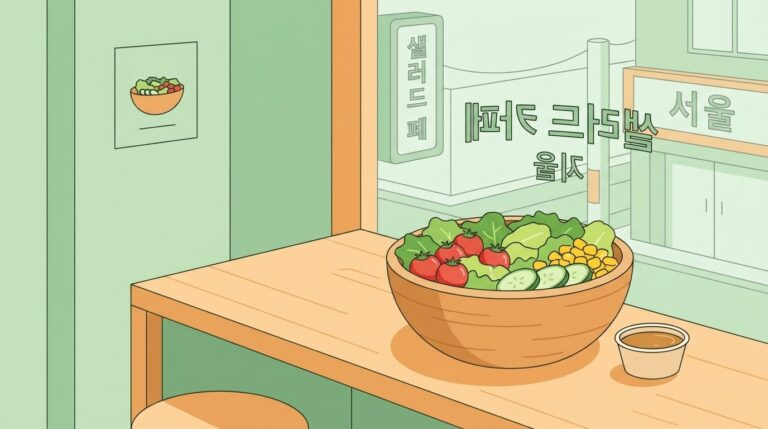
Stay Fit in Seoul: How to Order Salad and Explain Your Diet in Korean (A1 Guide)
Phase 1: Empathy (Welcome to the K-Diet Journey!)
안녕하세요! (An-nyeong-ha-se-yo!) Hello! I am your lead editor and friendly neighborhood Korean tutor from Daily Hangul.
Imagine this: You are walking through the trendy streets of Hongdae or Gangnam. Everywhere you look, there are delicious sights and smells—crispy Korean fried chicken, sizzling Korean BBQ, and sweet brown sugar tteokbokki. Your friends want to go out for a big meal, but you are currently focusing on your health and trying to eat clean.
You step into a beautiful, minimalist salad cafe, but the kiosk screen is flashing in Korean, and the staff is waiting for your order. Your palms sweat. How do you say “dressing on the side”? How do you explain to your Korean friends that you are on a diet without sounding rude?
Don’t worry! Dieting (or eating light) is a huge trend in Korea right now, and learning just a few simple phrases will make you look incredibly chic and culturally savvy. Today, we will learn how to confidently navigate a Korean salad cafe and share your diet goals like a local!
This guide is based on real-world questions from my lovely beginner students who successfully managed to stay healthy while enjoying their Seoul adventures. Let’s dive in!
Phase 2: Core 3 Expressions Deep Dive
Here are the top three magic phrases you need to survive and thrive when eating light in Korea.
1. 다이어트 중이에요 (da-i-eo-teu jung-i-e-yo)
- Pronunciation: [da-ee-uh-teu joong-ee-eh-yo] / Sounds like: “Die-it-teu” + “Jung” + “E-yo”
- Meaning: I am on a diet.
- K-Culture Moment: You will hear this in almost every modern K-Drama when characters are preparing for a photoshoot, a wedding, or simply trying to stay healthy before summer.
- Editor’s Insight: The word “다이어트” comes from the English word “diet,” but in Korea, it specifically means “losing weight” or “eating clean to stay fit,” rather than just your general daily food intake.
- Situation Spectrum:
- Friends & Casual: ✅
- Coworkers & Semi-formal: ✅
- Boss & Formal: ✅ (Very polite and safe to use anywhere!)
- 🤔 Think About It: Notice how English words are adopted into Korean with unique Korean nuances. Why do you think Korea adopted the English word “diet” instead of using a traditional Sino-Korean word?
2. 드레싱은 따로 주세요 (deu-re-sing-eun tta-ro ju-se-yo)
- Pronunciation: [deu-reh-sing-eun ttha-ro joo-seh-yo] / Sounds like: “Dressing-eun” + “Tah-ro” (with a crisp ‘T’ sound) + “Ju-se-yo”
- Meaning: Please give me the dressing on the side.
- K-Culture Moment: Perfect at premium salad bars in Seoul where they sometimes pour a generous amount of sweet sauce over your beautiful greens.
- Editor’s Insight: “따로” (tta-ro) means “separately.” You can use this word in other food situations too! For example, “국밥 따로 주세요” (Please serve the soup and rice separately).
- Situation Spectrum:
- Friends & Casual: ✅
- Cafe Staff & Semi-formal: ✅
- Formal: ✅
- 🤔 Think About It: In many Western countries, “dressing on the side” is a standard option on menus. In Korea, asking for things “separately” shows you care about the precise taste and control of your food. How do you customize your food in your country?
3. 이거 칼로리 낮아요? (i-geo kal-lo-ri na-ja-yo?)
- Pronunciation: [ee-guh kahl-lo-ree nah-jah-yo] / Sounds like: “E-guh” + “Cal-lo-ree” + “Nah-ja-yo?”
- Meaning: Is this low in calories?
- K-Culture Moment: Commonly heard in convenience stores when trying to choose between a light chicken breast sausage or a heavy instant ramen.
- Editor’s Insight: “낮아요” comes from the verb “낮다” (naj-da), which means “to be low.” Keep your voice slightly rising at the end to make it a friendly question.
- Situation Spectrum:
- Friends & Casual: ✅
- Staff & Semi-formal: ✅
- Formal: ⚠️ (A bit too casual for formal meetings, but perfect for daily shopping.)
- 🤔 Think About It: Many Korean food packages now display the calorie count in big, bold numbers. It shows how health-conscious modern Korean society has become!
Phase 3: Textbook Korean vs. Real Korean
Let’s look at how textbooks teach these situations versus how real Koreans actually talk!
Situation 1: Deciding what to eat
- 📖 Textbook Korean: “저는 샐러드를 원합니다.” (Jeo-neun sael-leo-deu-reul won-hap-ni-da.) – “I want a salad.” (Too stiff and robotic!)
- 🗣️ Real Korean: “샐러드로 할게요.” (Sael-leo-deu-ro hal-ge-yo.) – “I will go with the salad.”
- 💡 Why the difference?: Real Koreans rarely use the verb “원하다” (to want) in daily life. Instead, they use “~로 할게요” (~ro hal-ge-yo), which means “I will make the choice of…” It sounds much more natural and active!
Situation 2: Declining a heavy high-calorie treat
- 📖 Textbook Korean: “저는 음식을 먹지 않겠습니다.” (Jeo-neun eum-sig-eul meog-ji an-get-seub-ni-da.) – “I will not eat food.” (Sounds way too dramatic, like a hunger strike!)
- 🗣️ Real Korean: “저 지금 관리 중이에요.” (Jeo ji-geum gwan-ri jung-i-e-yo.) – “I am managing myself right now.” / “I’m watching what I eat.”
- 💡 Why the difference?: Instead of saying “I am on a diet” directly, Koreans love using the word “관리” (gwan-ri), which means “management” or “self-care.” It sounds sophisticated and covers diet, exercise, and skin care all in one chic word!
Phase 4: K-Culture Deep Dive & Non-verbal Manners
4-1. The Art of “Nunchi” (눈치) at the Dining Table
In Korea, eating is a highly communal activity. If you are dining with Korean friends or coworkers, ordering a salad while everyone else is eating pork belly (samgyeopsal) can sometimes make others feel self-conscious. This is where Nunchi (tact/mindfulness) comes in.
- Tip: If you must eat light, don’t just sit there with empty hands. Say, “제가 고기 맛있게 구워 드릴게요!” (Je-ga go-gi ma-sit-ge gu-wo deu-ril-ge-yo! – “I will grill the meat deliciously for you!”). Your friends will love you, and they won’t mind that you are only eating the lettuce wraps!
4-2. The Salad Trend in Seoul
Salad is no longer considered “boring food” in Korea. It is a premium lifestyle choice. Neighborhoods like Garosu-gil and Yeouido are packed with luxury salad boutiques where local office workers queue up to get their daily “green fix.” It is heavily associated with the healthy lifestyle of K-Pop idols and actors.
Phase 5: Real-World Roleplay Scenario
Setting: A hip, bustling salad cafe called “Green Day” in Gangnam, Seoul.
Cast: You (A health-conscious traveler) and Minjun (Your super-fit Korean friend).
- Minjun: (🎭 Smiling warmly and pointing at the digital kiosk) “여기 샐러드 진짜 맛있어요. 뭐 먹을래요?” (Yeo-gi sael-leo-deu jin-jja ma-sit-eo-yo. Mwo meog-eul-rae-yo? / “The salads here are really delicious. What do you want to eat?”)
- You: (🎭 Looking at the colorful menu) “음… 저 다이어트 중이에요.” (Eum… jeo da-i-eo-teu jung-i-e-yo. / “Hmm… I am on a diet.”)
- Minjun: (🎭 Nodding supportively) “아, 정말요? 멋지네요! 그럼 연어 샐러드 어때요?” (Ah, jeong-mal-yo? Meot-ji-ne-yo! Geureom yeon-eo sael-leo-deu eo-ttae-yo? / “Oh, really? Cool! Then how about the salmon salad?”)
- You: (🎭 Smiling) “좋아요! 연어 샐러드로 할게요.” (Jo-ha-yo! Yeon-eo sael-leo-deu-ro hal-ge-yo. / “Great! I will go with the salmon salad.”)
- Minjun: (🎭 Pointing at the screen options) “소스는 어떤 걸로 선택할래요?” (So-seu-neun eo-tteon geol-ro seon-taek-hal-rae-yo? / “Which sauce do you want to choose?”)
- You: (🎭 Politely requesting) “드레싱은 따로 주세요.” (Deu-re-sing-eun tta-ro ju-se-yo. / “Please give me the dressing on the side.”)
- Minjun: (🎭 Impressed by your Korean) “와, 한국어 진짜 잘하시네요!” (Wa, han-gug-eo jin-jja jal-ha-si-ne-yo! / “Wow, your Korean is really good!”)
- You: (🎭 Shyly smiling) “아니에요, 아직 초보예요.” (A-ni-e-yo, a-jik cho-bo-ye-o. / “No, I am still a beginner.”)
- Minjun: (🎭 Laughing softly) “아주 자연스러워요! 음료도 주문할까요?” (A-ju ja-yeon-seu-reo-wo-yo! Eum-ryo-do ju-mun-hal-kka-yo? / “It’s very natural! Shall we order drinks too?”)
- You: (🎭 Checking the calories) “이거 칼로리 낮아요?” (I-geo kal-lo-ri na-ja-yo? / “Is this low in calories?”)
- Minjun: (🎭 Nudging you playfully) “네, 제로 콜라예요! 괜찮아요.” (Ne, je-ro kol-ra-ye-yo! Gwaen-chan-ha-yo. / “Yes, it’s Coke Zero! It’s totally fine.”)
🔀 Decision Point!
Minjun asks if you want to add crispy fried onions as a topping. What do you say?
- A) “안 먹어!” (An meog-eo!)
- Feedback: Too aggressive! This sounds like “I won’t eat!” in a rude, informal tone to a child. Avoid this.
- B) “토핑은 빼 주세요.” (To-ping-eun pae ju-se-yo.)
- Feedback: Excellent Choice! This means “Please exclude the toppings.” It is polite, clear, and perfectly natural.
- C) “샐러드는 위험해요.” (Sael-leo-deu-neun wi-heom-hae-yo.)
- Feedback: This means “Salad is dangerous.” Unless the salad is plotting to take over the world, this is grammatically correct but culturally very confusing!
Phase 6: 10-Second Emotion Shadowing Drill
Let’s practice speaking with real Korean emotion! Use the pauses (/) and follow the emotional guides.
- [😊 Proudly and confidently]
- 저 / 다이어트 / 중이에요!
- (Jeo / da-i-eo-teu / jung-i-e-yo!)
- Pause briefly after ‘Jeo’ to emphasize that YOU are the one on a diet!
- [🥺 Softly and politely]
- 드레싱은 / 따로 / 주세요~
- (Deu-re-sing-eun / tta-ro / ju-se-yo~)
- Lengthen the ‘yo~’ at the end slightly to sound super friendly to the cafe staff.
- [🧐 Curiously peering at the menu]
- 이거 / 칼로리 / 낮아요?
- (I-geo / kal-lo-ri / na-ja-yo?)
- Keep the ‘na’ short and raise ‘ja-yo?’ high at the end like a cute question.
Phase 7: K-Culture Mini Dictionary
| Word (한글) | Romanization | English Translation | Real-World Context |
|---|---|---|---|
| 식단 | Sik-dan | Diet menu / Meal plan | Koreans say “식단 조절” (sik-dan jo-jeol) to mean controlling food intake for a diet. |
| 맛집 | Mat-jib | Delicious restaurant | You will see “샐러드 맛집” (sael-leo-deu mat-jib) all over Instagram for trending healthy cafes. |
| 치팅데이 | Chi-ting de-i | Cheat day | Used exactly like in English when you reward yourself with delicious tteokbokki after a hard week. |
| 몸짱 | Mom-jjang | Great body | A popular slang word combining “몸” (body) and “짱” (best). |
Phase 8: Traveler’s Survival Kit
Top 3 Salad Cafe Expressions
- 포장해 주세요 (Po-jang-hae ju-se-yo)
- “Please wrap it up / To-go, please.” (Essential for taking your salad bowl to Han River park!)
- 수저 빼 주세요 (Su-jeo pae ju-se-yo)
- “Please exclude utensils.” (Great for eco-friendly ordering on food apps.)
- 물 한 잔 주세요 (Mul han jan ju-se-yo)
- “Please give me a glass of water.”
📌 Editor’s Travel Note
When looking for salad shops, don’t use Google Maps—it doesn’t work well in Korea! Instead, download the Naver Map App Download Page to find hidden “salad mat-jibs” (delicious salad places) nearby. Most cafes in Seoul use self-service kiosks which accept all major international credit cards.
Note: Self-service kiosks in Korea are highly digitized and usually have an English language option at the bottom corner of the screen!
Phase 9: Deep Reflection — “One Step Deeper”
Historically, Korean food culture is built around communal sharing. A traditional Korean meal features many shared side dishes (banchan) placed in the center of the table. Ordering an individual salad dish was once considered highly unusual.
However, the rise of the “me-economy” and a massive wave of health consciousness among younger Koreans have transformed the country’s dining landscape. Choosing to eat a clean, solo meal is now respected as a sign of great self-discipline and healthy self-care.
💬 Your Turn: How is dieting or eating light viewed in your home country? Do people prefer eating alone or sharing healthy meals? Let us know in the comments below!
Phase 10: FAQ & Mistake Prevention
Q: Can I ask for extra free toppings at a Korean salad cafe?
A: Generally, No. Unlike traditional Korean restaurants where side dishes (banchan) are refilled for free, modern salad cafes treat toppings like premium additions. You should select and pay for “추가” (chu-ga – additions) at the kiosk.
Q: Does “다이어트” mean I am sick?
A: No. In some languages, saying you are on a diet might sound like you have a medical issue. In Korea, “다이어트 중이에요” simply means you are proactively looking after your body and fitness!
Q: Is there sugar in Korean salad dressings?
A: Yes, often. Korean salads often feature sweeter dressings like Yuja (citron) or Sesame. If you are strictly keto or low-carb, always ask “드레싱 따로 주세요” (dressing on the side) to control your intake!
🚨 Common Mistakes Alert!
- Mistake 1: Saying “다이어트 원해요” (I want a diet).
- Correction: Use “다이어트 중이에요” (I am in the middle of a diet).
- Mistake 2: Saying “따로 드레싱” (Separately dressing).
- Correction: Place the noun first: “드레싱은 따로 주세요” (As for dressing, give separately please).
- Mistake 3: Saying “이것은 작은 칼로리입니까?” (Is this a tiny calorie?).
- Correction: Use the natural phrase: “이거 칼로리 낮아요?” (Is this calorie low?).
Phase 11: Action Mission & Challenge
Let’s put your new knowledge into action! Complete these challenges and level up your Korean.
- 🥉 Bronze Mission: Stand in front of your mirror and repeat “드레싱은 따로 주세요!” three times with a confident smile.
- 🥈 Silver Mission: Go to Instagram or Twitter, find a picture of a delicious salad, and comment “여기 샐러드 맛집이네요!” (This is a salad hotspot!).
- 🥇 Gold Mission: Walk into a real Korean cafe or Asian salad shop and order your food while successfully requesting: “드레싱은 따로 주세요!”
- 🎮 K-Culture Mission: Watch your favorite modern K-Drama today and spot the moment a character mentions “다이어트” (diet) or “관리” (self-management)!
Phase 12: Interactive Quiz Challenge
Test your skills and reveal the answers below!
1. Which phrase should you say to ask for the dressing on the side?
- A) 따로 드레싱 원해요
- B) 드레싱은 따로 주세요
- C) 드레싱은 많이 주세요
👉 Click here for the Answer & Explanation
Correct Answer: B
“드레싱은 따로 주세요” is the polite and perfect way to ask for dressing on the side. Option A is unnatural, and Option C means “Please give me a lot of dressing!” (the opposite of a diet!).
2. Fill in the blank: “저 요즘
______ 중이에요.” (I am on a diet lately.)
* A) 요리 (Cooking)
* B) 식사 (Meal)
* C) 다이어트 (Diet)
👉 Click here for the Answer & Explanation
Correct Answer: C
“저 요즘 다이어트 중이에요” means “I am on a diet lately.” (요리 means cooking, and 식사 means meal).
3. True or False: Asking for “수저 빼 주세요” means you want extra large spoons.
👉 Click here for the Answer & Explanation
Correct Answer: False!
“수저 빼 주세요” actually means “Please exclude the spoon and chopsticks” (eco-friendly option for take-out).







