

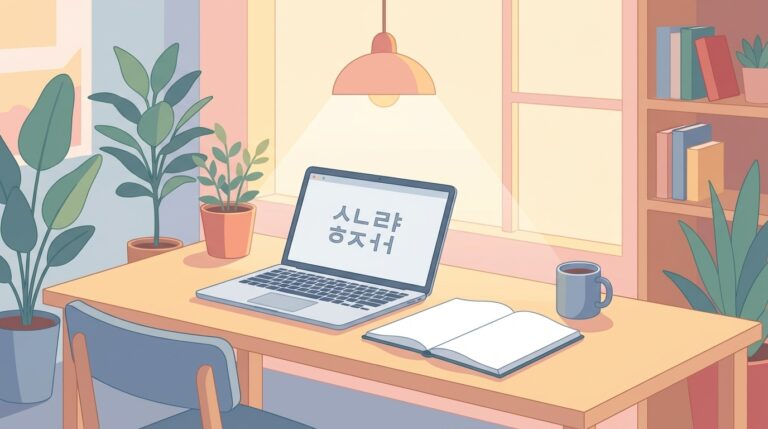
How to Blend In at a Korean Library: Essential Phrases for Going to Study
Phase 1: Welcome to the Ultimate Korean Study Vibe!
안녕하세요! (An-nyeong-ha-se-yo!) Hello there, beautiful souls! It is your favorite Seoul-mate and chief editor at Daily Hangul.
Have you ever watched a K-Drama where the main characters study late into the night in those sleek, ultra-quiet, cozy cubicles? Or maybe you have seen your favorite K-Pop idols posting pictures of their study notes during exam season with the caption “열공” (yeol-gong – studying hard)?
If you are planning to visit Korea, or if you just want to experience the daily routine of a real Korean student, heading out to study is a massive part of the youth culture here. But let’s be honest: walking into a silent Korean library or a futuristic “study cafe” (스카 – seu-ka) can feel incredibly intimidating. Where do you sit? What do you say to the person next to you?
Don’t worry! In this guide, we will unpack the exact, natural phrases you need to transition from a nervous tourist to a confident local heading out to “yeol-gong.” Let’s dive in!
Phase 2: Core Expressions for Your Study Day
Let’s look at the three most important phrases you need when you are ready to study in Korea.
1. 공부하러 가요 (Gong-bu-ha-reo ga-yo)
- Pronunciation: [gong-boo-hah-ruh gah-yo]
- Meaning: “I am going to study.”
- K-Culture Moment: You will hear this constantly in high-school or university K-Dramas like True Beauty or Cheese in the Trap when friends pack up their backpacks after class.
- Editor’s Insight: The grammar point here is -러 가다 (-reo ga-da), which means “to go in order to do something.” It is the perfect, soft, and natural way to tell your friends why you are leaving.
- Situation Spectrum:
- Friends/Casual: ✅ (Just say “공부하러 가” – gong-bu-ha-reo ga)
- Semi-formal (Polite): ✅
- Formal/Business: ⚠️ (A bit too casual for a strict business boss, but fine with close colleagues)
- 🤔 Think About It: In many Western cultures, people might say “I have to do homework” or “I’m busy.” Why do you think Koreans specifically use “I am going in order to study” as a common daily update? It reflects how highly valued active, focused self-improvement is in Korean society!
2. 여기 자리 있어요? (Yeo-gi ja-ri it-seo-yo?)
- Pronunciation: [yuh-gee jah-ree eet-suh-yo]
- Meaning: “Is this seat taken?” (Literally: “Is there a seat here?”)
- K-Culture Moment: Finding a spot in a crowded university library during midterms is like a sport in Korea. This is the magic phrase you whisper politely to the person next to an empty chair.
- Editor’s Insight: This is incredibly polite and shows great manners. Even if a seat looks empty, always ask first because someone might have just stepped out for a quick snack.
- Situation Spectrum:
- Friends/Casual: ✅
- Semi-formal (Polite): ✅
- Formal/Business: ✅
- 🤔 Think About It: Korea has an incredible culture of trust where people leave expensive laptops and bags on tables to reserve spots. Despite this, asking “여기 자리 있어요?” before sitting down is a golden rule of social etiquette.
3. 조금만 조용히 해 주세요 (Jo-geum-man jo-yong-hi hae ju-se-yo)
- Pronunciation: [joh-geum-mahn joh-yong-hee hae joo-seh-yo]
- Meaning: “Please be a little quiet.”
- K-Culture Moment: While libraries are usually pin-drop silent, sometimes someone’s headphones leak sound, or they whisper too loudly. This is the ultimate gentle way to protect your study peace.
- Editor’s Insight: Adding “조금만” (jo-geum-man – just a little) softs the blow. Without it, the phrase can sound slightly demanding. With it, it sounds like a very polite favor.
- Situation Spectrum:
- Friends/Casual: ✅
- Semi-formal (Polite): ✅
- Formal/Business: ⚠️ (Use with caution; try to avoid direct confrontation in highly formal environments if possible)
- 🤔 Think About It: How does your culture handle noisy neighbors in a quiet study space? Do you leave a sticky note, look at them pointedly, or ask them directly?
Phase 3: Textbook Korean vs. Real-World Korean
Sometimes, what you learn in a standard classroom sounds super awkward in the streets of Seoul. Let’s look at the differences!
Situation 1: Asking if you can study in a space
- 📖 Textbook Korean: 여기서 공부해도 됩니까? (Yeo-gi-seo gong-bu-hae-do doep-ni-ka? – “Is studying permitted here?”)
- 🗣️ Real-World Korean: 여기서 공부해도 돼요? (Yeo-gi-seo gong-bu-hae-do dwae-yo? – “Can I study here?”)
- 💡 Why the difference? The textbook version uses the ultra-formal “-니까” ending, which sounds like you are asking a military commander. The real-world version is friendly, polite, and perfect for cafes or public study lounges.
Situation 2: Saying you are going to a Study Cafe
- 📖 Textbook Korean: 저는 오늘 스터디 카페에 가겠습니다. (Jeo-neun o-neul seu-teo-di ka-pe-e ga-get-seum-ni-da. – “I shall go to the study cafe today.”)
- 🗣️ Real-World Korean: 오늘 스카 가요! (O-neul seu-ka ga-yo! – “Going to the study cafe today!”)
- 💡 Why the difference? Koreans absolutely love shortening long words! “스터디 카페” (Study Cafe) becomes 스카 (Seu-ka). It is punchy, fun, and exactly what locals text each other.
Phase 4: K-Culture Deep Dive & Library Manners
4-1. The Art of “Nunchi” (눈치) in Korean Study Spaces
If you want to look like a seasoned Seoul resident, you need 눈치 (Nunchi)—the art of reading the room.
* The Keyboard Silent Rule: In many Korean study zones, people use silicone covers on their keyboards and mouse click-mufflers. If you are typing loudly on a mechanical keyboard, you might receive some polite but intense stares!
* Leaving Your Valuables: Yes, it is true! You can leave your phone, laptop, and iPad on the desk while you go grab lunch. It is a unique aspect of Korean social trust. Just don’t forget to ask “여기 자리 있어요?” if you are setting up next to someone else.
4-2. The Evolution of Study Culture: From Dokseosil to “Seu-ka”
Historically, Korean students studied in dark, solo cubicles called 독서실 (dok-seo-sil). However, the younger generation paved the way for modern 스카 (study cafes). These are high-tech, beautifully designed spaces with free coffee, white noise machines, and cozy lighting. Visiting one is a must-do K-travel experience!
Phase 5: Interactive Roleplay Scenario
The Setting: A gorgeous, warm-lit study cafe near Yonsei University in Sinchon. Soft lo-fi piano music plays in the lounge area, but the main study hall is perfectly quiet.
The Cast:
* You (A curious student holding a heavy backpack)
* Min-jun (민준) (A friendly Korean college student sitting at a long wooden table)
- You: (🎭 Standing nervously next to an empty seat with a laptop on the table next to it)
저… 혹시 여기 자리 있어요?
Jeo… hok-si yeo-gi ja-ri it-seo-yo?
(Excuse me… by any chance, is this seat taken?) -
Min-jun: (🎭 Looking up from his tablet and smiling warmly)
아, 아니요! 비어 있어요. 앉으셔도 돼요.
A, a-ni-yo! Bi-eo it-seo-yo. An-jeu-syeo-do dwae-yo.
(Ah, no! It’s empty. You can sit down.) -
You: (🎭 Placing your bag down gently and whispering)
감사합니다!
Gam-sa-ham-ni-da!
(Thank you!) -
Min-jun: (🎭 Pointing quietly at the power outlet under the table)
여기에 콘센트도 있어요. 편하게 쓰세요.
Yeo-gi-e kon-sen-teu-do it-seo-yo. Pyeon-ha-ge sseu-se-yo.
(There’s a power outlet here too. Feel free to use it.) -
You: (🎭 Surprised and grateful)
우와, 정말 고맙습니다. 혹시… 스터디 카페 이용은 처음인데, 와이파이는 어떻게 써요?
U-wa, jeong-mal go-map-seum-ni-da. Hok-si… seu-teo-di ka-pe i-yong-eun cheo-eum-in-de, wa-i-pa-i-neun eo-tteo-ge sseo-yo?
(Wow, thank you so much. By any chance… it’s my first time using a study cafe, how do I use the Wi-Fi?) -
Min-jun: (🎭 Pointing to a small sticker on the corner of the table)
테이블마다 비밀번호가 적혀 있어요. 이거 보시면 돼요.
Te-i-beul-ma-da bi-mil-beon-ho-ga jeok-hyeo it-seo-yo. I-geo bo-si-myeon dwae-yo.
(The password is written on every table. You can just look at this.) -
You: (🎭 Looking at the table sticker and typing on your phone)
아! 찾았어요! 정말 감사합니다. 오늘 열공하세요!
A! Cha-jat-seo-yo! Jeong-mal gam-sa-ham-ni-da. O-neul yeol-gong-ha-se-yo!
(Ah! I found it! Thank you so much. Study hard today!) -
Min-jun: (🎭 Laughing softly at your great use of slang)
와, 한국어 진짜 잘하시네요! 그쪽도 열공하세요!
Wa, han-gug-eo jin-짜 jal-ha-si-ne-yo! Geu-jjok-do yeol-gong-ha-se-yo!
(Wow, your Korean is really good! You study hard too!)
🔀 Decision Point: What do you say next?
- Choice A: “네, 저 한국어 공부하러 왔어요!” (Ne, jeo han-gug-eo gong-bu-ha-reo wat-seo-yo! – Yes, I came to study Korean!)
- Choice B: “조용히 해 주세요.” (Jo-yong-hi hae ju-se-yo. – Please be quiet.)
- Choice C: “밥 먹었어요?” (Bap meok-at-seo-yo? – Have you eaten rice?)
Best Choice: A
This is exceptionally warm and directly explains what you are doing, keeping the conversation naturally friendly and validating his compliment on your Korean!
Risk/Awkward Choice: B or C
- Choice B is very rude because Min-jun was just being helpful and speaking quietly!
- Choice C is a very common Korean greeting, but randomly asking a stranger if they have eaten right in the middle of a study cafe introduction might startle them.
Phase 6: 10-Second Emotion Shadowing Drill
Let’s practice speaking with real Korean emotion! Focus on the pauses (marked by /) and match the feeling in the brackets.
저 / 이제 / 공부하러 가요!- Pronunciation: [Jeo / i-je / gong-bu-ha-reo ga-yo!]
- Emotion: [😊 Bright, determined, and excited to learn!]
혹시 / 여기 / 자리 있어요?- Pronunciation: [Hok-si / yeo-gi / ja-ri it-seo-yo?]
- Emotion: [🥺 Polite, soft-spoken, and respectful of the quiet space]
우리 / 오늘 / 열공해요!- Pronunciation: [U-ri / o-neul / yeol-gong-hae-yo!]
- Emotion: [😤 Cheerful and high-energy encouragement to your study buddy]
Phase 7: K-Culture Mini Dictionary
| Word (Hangeul) | Romanization | English Translation & Real-World Context |
|---|---|---|
| 스카 | Seu-ka | Short for “Study Cafe.” Premium places where students and remote workers go for focused work. |
| 열공 | Yeol-gong | Short for “열심히 공부” (studying hard). A very popular slang word used to encourage friends. |
| 카공족 | Ka-gong-jok | Cafe + Study + Tribe. Refers to people who love studying in ordinary coffee shops like Starbucks. |
| 독서실 | Dok-seo-sil | Traditional, quiet library-style study rooms. More vintage and strictly silent. |
Phase 8: Traveler’s Survival Kit
If you find yourself in a beautiful library like the stunning Starfield Library in Seoul or any local study spot, keep these three phrases in your back pocket:
💡 Survival Phrases
- 와이파이 비밀번호가 뭐예요? (Wa-i-pa-i bi-mil-beon-ho-ga mwo-yeo-yo?)
- “What is the Wi-Fi password?”
- 콘센트 어디에 있어요? (Kon-sen-teu eo-di-e it-seo-yo?)
- “Where is the power outlet?”
- 화장실 비밀번호 있어요? (Hwa-jang-sil bi-mil-beon-ho it-seo-yo?)
- “Is there a password for the restroom?” (Many Korean study cafes keep restroom doors locked with keypad codes).
📌 Editor’s Travel Note: To locate the absolute best local study cafes near you, search “스터디카페” on the Naver Map App Download Page instead of Google Maps, as Naver Map provides incredibly accurate, real-time reviews and interior photos of study spaces in Korea!
Phase 9: Deep Reflection — “Yeol-gong” Culture
In many parts of the world, studying is often viewed as a solitary, sometimes painful task. But in Korea, study culture has a highly social element. Students go together to study cafes, share premium snacks, and motivate each other silently. This quiet sense of shared struggle and community is a powerful force in Korean society. It turns an individual duty into a collective, supportive journey.
💬 Your Turn: How do people study in your home country? Do you prefer dead silence, or do you study best in busy, bustling coffee shops? Let us know in the comments below!
Phase 10: FAQ & Avoiding Misunderstandings
Q: Can I talk or take phone calls inside the study area of a study cafe?
A: No. You must step out into the hallway, lounge, or locker area to take any phone calls or have extended conversations. Most study zones are strictly silent zones.
Q: Can I bring my own food and drinks to a Korean study cafe?
A: Depends. Most study cafes provide free coffee, tea, and small snacks. You can bring your own closed water bottle or coffee cup, but hot meals or smelly food must only be eaten in the designated snack lounge.
Q: Do I need a Korean phone number to register at a kiosk?
A: Yes, sometimes. Many automatic kiosks require a phone number to send you a barcode. If you don’t have a local SIM, look for libraries that have an desk attendant or ask a friendly student nearby for help!
🚨 Common Mistakes to Avoid
- Mistake 1: Speaking loudly to your friend inside.
- Correct Action: Keep your voice to a quiet whisper or step outside.
- Mistake 2: Saying “조용히 해!” (Jo-yong-hi hae!) to someone making noise.
- Correct Action: This is casual and rude to strangers. Always say “조금만 조용히 해 주세요” (Jo-geum-man jo-yong-hi hae ju-se-yo).
- Mistake 3: Sitting down at an empty desk that has a notebook or water bottle on it.
- Correct Action: That seat is taken! In Korea, personal items act as official place markers.
Phase 11: Action Missions
- 🥉 Bronze (Mirror Challenge): Look in the mirror and confidently say “오늘 스카에서 열공해요!” (O-neul seu-ka-e-seo yeol-gong-hae-yo! – Today I am studying hard at the study cafe!)
- 🥈 Silver (Social Challenge): Take a photo of your current book, laptop, or study setup and post it on social media with the hashtag
#DailyHanguland the caption공부하러 가요! - 🥇 Gold (Real-world Challenge): Next time you enter a study space, library, or coffee shop, find a seat and mentally practice asking, “여기 자리 있어요?”
Phase 12: Interactive Quiz Challenge
Test your knowledge to see if you are ready to study like a true Seoulite!
1. Situation Judgement
You want to use the empty seat next to someone in a quiet study lounge. What should you say?
* A) 비켜 주세요 (Bi-kyeo ju-se-yo – Step aside)
* B) 여기 자리 있어요? (Yeo-gi ja-ri it-seo-yo? – Is this seat taken?)
* C) 안녕! (An-nyeong! – Hi!)
Reveal Answer & Explanation
Correct Answer: B
Asking “여기 자리 있어요?” is the most polite, natural, and socially standard way to check if a seat is available in any Korean public space.
2. Fill-in-the-Blank
“I am going to study” in polite, natural Korean is:
공부____ 가요.
Reveal Answer & Explanation
Correct Answer: 하러 (-ha-reo)
Combining “공부하다” (to study) with the movement particle “-러 가요” creates “공부하러 가요” (I am going to study).
3. True or False
True or False: In Korea, it is considered normal to leave your laptop and wallet on a library table while you go to the restroom.
Reveal Answer & Explanation
Correct Answer: True
While you should always be safe, Korea’s low theft rate means locals routinely leave high-value electronics on tables when stepping away briefly.
See you in the next lesson, and as always—열공하세요!






