

Hold On Tight! How to Survive Korean Roller Coasters Like a Real Local
안녕하세요! (Annyeonghaseyo!) Welcome back to Daily Hangul, your premium Korean tutoring spot. I’m your friendly senior editor and your local guide to everything fun in Korea!
Imagine this: You are standing in line at Everland (에버랜드), Korea’s biggest theme park. Above you, the famous wooden roller coaster, T-Express, roars down a steep 77-degree drop. Your Korean friends are super excited, shouting words you didn’t learn in your standard textbook. Suddenly, it’s your turn to strap in. Your heart is racing. What do you say? Do you freeze, or do you shout something that makes your Korean friends laugh and say, “Wow, your Korean is so natural!”?
Today, we are diving into the thrilling world of Korean amusement parks (놀이공원 – nori-gongwon). We’ll learn the real, lived expressions that will make you sound like a local, not a robot!
Phase 2: Deep Dive into 3 Core Expressions
Let’s learn the top 3 expressions you need when walking up to the roller coaster platform.
1. 진짜 무서워요! (Jinjja museoweoyo!)
- Pronunciation: Jin-ja moo-suh-wo-yo.
- Meaning: It’s really scary!
- K-Culture Moment: This is the exact phrase you hear in K-Pop reality shows (like Run BTS! or NCT Life) when idols are forced to ride scary attractions. It’s cute, honest, and natural.
- Editor’s Insight: It uses “진짜” (jinjja – really) instead of the more formal “매우” (maeu). It shows vulnerability in a cute way!
- Situation Spectrum:
- Friends & Casual: ✅ (Perfect! Just drop the “요” -> 진짜 무서워!)
- Co-workers: ✅ (Polite and natural)
- Boss / Elders: ⚠️ (A bit too casual, but okay if you are sharing a fun team day out)
- 🤔 Think About It: Why do Koreans love saying “진짜” so much? It adds emotional emphasis that makes you feel instantly closer to the person you are talking to. How do you emphasize fear in your language?
2. 한 번 더 타요! (Han beon deo tayo!)
- Pronunciation: Han bun duh tah-yo.
- Meaning: Let’s ride it one more time!
- K-Culture Moment: In K-Dramas, the energetic female lead always drags the shy male lead back to the queue line, shouting this phrase with a big smile.
- Editor’s Insight: “한 번” (han beon) means “once,” “더” (deo) means “more,” and “타요” (tayo) comes from the verb “타다” (tada – to ride). Put them together, and you have the perfect peer-pressure phrase!
- Situation Spectrum:
- Friends & Casual: ✅ (Just say: 한 번 더 타!)
- Co-workers: ✅
- Boss / Elders: ⚠️
- 🤔 Think About It: Korean culture is highly communal. Saying “Let’s ride together again” is a great way to bond!
3. 손 흔들어 주세요! (Son heundeureo juseyo!)
- Pronunciation: Son heun-deul-uh joo-seh-yo.
- Meaning: Please wave your hands!
- K-Culture Moment: Before the roller coaster launches, the enthusiastic park staff (famous for their high-energy dances at Lotte World and Everland) will shout this into the microphone to pump up the crowd.
- Editor’s Insight: “손” (son) means hand, and “흔들다” (heundeulda) means to wave/shake. It’s a fun interactive phrase!
- Situation Spectrum:
- Friends & Casual: ✅ (손 흔들어 줘!)
- Co-workers: ✅
- Boss / Elders: ✅
Phase 3: Textbook Korean vs. Real Korean
Let’s compare what textbooks teach you versus what Koreans actually say in real life!
Situation 1: Expressing extreme excitement or fear
- 📖 Textbook Korean: “저는 지금 매우 긴장됩니다.” (Jeoneun jigeum maeu ginjang-doemnida. / “I am very nervous right now.”)
- 🗣️ Real Korean: “심장 터질 것 같아요!” (Simjang teojil geot gat-ayo! / “My heart is going to explode!”)
- 💡 Why is it different? Koreans love sensory and dramatic expressions to show true emotion. Saying your heart is “exploding” (터지다) sounds much more alive and funny!
Situation 2: Ready to start the ride
- 📖 Textbook Korean: “이제 출발해 주십시오.” (Ije chulbalhae jusipsio. / “Please depart now.”)
- 🗣️ Real Korean: “가자! 출발!” (Gaja! Chulbal! / “Let’s go! Depart!”)
- 💡 Why is it different? Roller coasters are fast-paced! Short, punchy, action-oriented words like “출발” (chulbal) match the high-speed thrill of the park.
Phase 4: K-Culture Deep Dive & Non-verbal Manners
4-1. Queue Line Etiquette & The “Cute Headband” Culture
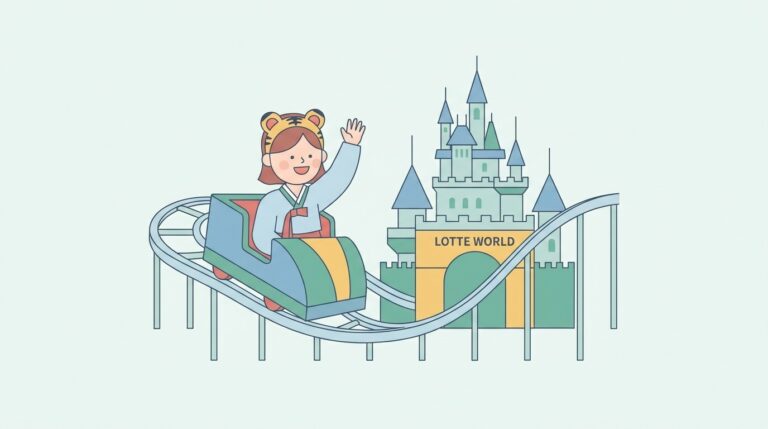
If you visit Lotte World (롯데월드) in Seoul, you will notice something unique: almost 90% of visitors, including adults and couples, wear cute animal headbands called 머리띠 (meoritti)! It’s not just for kids. It shows that you are ready to leave your serious everyday life behind and have pure fun. Not wearing one might actually make you stand out!
Also, pay attention to Nunchi (눈치 – emotional wit). When waiting in long lines (sometimes up to 2 hours for T-Express!), keep your voice at a friendly level and avoid bumping into the group in front of you. Sharing snacks in line is a wonderful way to pass the time with your friends!
Phase 5: Interactive Roleplay Scenario
Setting: You are standing on the boarding platform for the “French Revolution” roller coaster at Lotte World. The air smells of popcorn, and the coaster lights are flashing.
Characters:
* You (A brave learner)
* Minjun (민준 – Your energetic Korean friend)
The Dialogue
- Minjun: (🎭 Pointing excitedly at the loop) 대박! 우리 드디어 다음 차례야! 진짜 재미있겠다!
(Daebak! Uri deudieo daeum charyeya! Jinjja jaemi-itgetda! / Awesome! It’s finally our turn next! It’s going to be so fun!) -
You: (🎭 Looking up at the tracks nervously) 저기… 민준아, 이거 진짜 안 무서워?
(Jeogi… Minjuna, igeo jinjja an museoweo? / Excuse me… Minjun, is this really not scary?) -
Minjun: (🎭 Laughing warmly) 에이, 걱정하지 마! 그냥 소리 지르면 스트레스 다 풀려!
(Ei, geokjeonghaji ma! Geunyang sori jireumyeon seuteureseu da pullyeo! / Hey, don’t worry! If you just scream, all your stress will fly away!) -
You: (🎭 Gulping as the coaster seats open) 심장 터질 것 같아! 나 먼저 탈까, 네가 먼저 탈까?
(Simjang teojil geot gata! Na meonjeo talkka, nega meonjeo talkka? / My heart is going to explode! Should I ride first, or you?) -
Minjun: (🎭 Pulling you into the front seat) 당연히 같이 타야지! 자, 빨리 앉아!
(Dang-yeonhi gati tayaji! Ja, ppalli anja! / Of course we ride together! Come on, sit down quickly!) -
You: (🎭 Buckling the seatbelt) 안전벨트 꼭 확인해 줘!
(Anjeonbelteu kkok hwaginhae jwo! / Please make sure to check the seatbelt!) -
Minjun: (🎭 Giving a thumbs-up to the staff) 오케이! 이제 준비 끝!
(Okei! Ije junbi kkeut! / Okay! Ready now!) -
Staff: (🎭 Shouting cheerfully into the mic) 자, 출발합니다! 손 흔들어 주세요!
(Ja, chulbalhamnida! Son heundeureo juseyo! / Now, departing! Please wave your hands!) -
You: (🎭 Waving hands frantically as the car moves) 우와, 출발한다! 진짜 무서워!
(Uwa, chulbalhanda! Jinjja museoweo! / Woah, it’s starting! It’s really scary!) -
Minjun: (🎭 Cheering loudly) 소리 질러~!
(Sori jilleo~! / Scream~!)
🔀 Decision Point: What do you say right after the ride ends?
- Choice A: “너무 지루했어요.” (Neomu jirueosseoyo. / It was so boring.)
- Choice B: “진짜 대박! 우리 한 번 더 타요!” (Jinjja daebak! Uri han beon deo tayo! / Seriously awesome! Let’s ride it one more time!)
- Choice C: “살려 주세요…” (Sallyeo juseyo… / Please save me…)
🏆 Best Choice: Choice B!
Saying “한 번 더 타요!” shows you loved the ride and matched Minjun’s high energy. Your friend will be thrilled to line up again with you!
⚠️ Risk/Bad Choice: Choice A or C
- Choice A might kill the fun mood. Even if you were bored, “지루하다” is too negative for a theme park date.
- Choice C is funny! It means “Save me!” and is great if you say it with a dramatic, tired smile. But Choice B is the ultimate social winner!
Phase 6: 10-Second Emotion Shadowing Drill
Practice saying these out loud with the correct feeling! The slashes (/) mean short pauses.
- [🥺 Terrified but cute]
“진짜 / 무서워요! / 심장 / 터질 것 / 같아요!”
(Jinjja / museoweo-yo! / Sim-jang / teo-jil geot / gat-a-yo!) - [😊 Super excited & energetic]
“대박! / 진짜 / 재밌어요! / 한 번 / 더 / 타요!”
(Daebak! / Jinjja / jae-mit-eo-yo! / Han beon / deo / ta-yo!)
Phase 7: K-Culture Mini Dictionary
- 머리띠 (meoritti) – Headband / Hairband
- Essential item at Korean parks. Usually shaped like animal ears (bears, rabbits, or foxes).
- 스릴 (seuril) – Thrill
- Loanword from English. Koreans use this to describe rides that make your stomach drop.
- 대기 시간 (daegi sigan) – Waiting Time
- Keep an eye on the screens for this! High-popularity rides can have 120-minute waiting times.
- 인생샷 (insaeng-syat) – Life-Shot (The photo of your life)
- The perfect photo you take with Lotte World’s fairy tale castle in the background.
Phase 8: Traveler’s Survival Kit
Top 3 Survival Phrases
- 물품 보관함 어디에 있어요? (Mulpum gogwanham eodie isseoyo?)
> “Where are the luggage lockers?” (Crucial if you have heavy bags before riding a roller coaster!) - 이거 대기 시간 얼마나 걸려요? (Igeo daegi sigan eolmana geollyeoyo?)
> “How long is the wait time for this?” - 사진 좀 찍어 주실 수 있나요? (Sajin jom jjigeo jusil su innayo?)
> “Could you please take a photo of us?” (Use this near the castle for your 인생샷!)
📌 Editor’s Travel Note:
To make your trip smooth, download the Naver Map App instead of Google Maps, as it is much more accurate in Korea. Also, download the official Lotte World or Everland apps to check wait times in real-time!
Phase 9: Deep Reflection — “One Step Deeper”
In Western theme parks, people often wear casual clothes and focus individually on the rides. In Korea, theme parks are highly social “stages” where couples wear matching school uniforms (교복 – gyobok) and groups wear matching animal headbands. This reflects Korea’s beautiful 우리의 문화 (uri-ui munhwa – “We” culture), where sharing the exact same experience with loved ones visually and emotionally creates a deep feeling of belonging.
💬 Your Turn: Does your country have a unique theme park fashion or culture like Korea’s “matching school uniforms”? Let us know in the comments below!
Phase 10: FAQ & Common Mistakes
Q: Can I wear school uniforms at Lotte World even if I am not a student?
A: Yes, absolutely! In fact, renting high school uniforms from shops right next to Lotte World is one of the most popular activities for young adults and tourists alike.
Q: What is the scariest roller coaster in Korea?
A: T-Express at Everland. It is a wooden roller coaster with a terrifying drop. If you survive that, you can survive anything!
Q: Should I say “엄마야!” (Eommaya!) when I get scared on the ride?
A: Yes! “엄마야!” means “Oh my mother!” and is the natural Korean equivalent of “Oh my gosh!” or “Yikes!” when startled.
🚨 Common Mistakes Alert!
- Don’t say “무서워해요” about yourself. “무서워하다” is only used for third persons (e.g., “Minjun is scared”). For yourself, always say “무서워요” (I am scared).
- Confusing “타다” (to ride) with “타다” (to burn). Yes, they sound the same, but context is king! If you are at Lotte World, “타요” always means “let’s ride.”
Phase 11: Action Mission
- 🥉 Bronze: Record yourself saying “진짜 무서워요!” in a cute, shaking voice.
- 🥈 Silver: Go to Instagram or TikTok, find a video of Everland’s T-Express, and write a comment using “한 번 더 타요!”
- 🥇 Gold: When you visit Korea, wear a 머리띠 (headband) and shout “출발!” (Depart!) right as the coaster moves!
Phase 12: Interactive Quiz Challenge
1. Match the Phrase
What is the natural way to say “My heart is going to explode” when waiting in line?
* A) 심장이 무서워요. (Simjang-i museoweoyo.)
* B) 심장 터질 것 같아요! (Simjang teojil geot gat-ayo!)
2. True or False?
Koreans only wear animal headbands (머리띠) if they are under 10 years old.
* True / False
🔍 Click here to reveal the Answers and Explanations!
- Answer: B. “심장 터질 것 같아요!” is the correct natural expression meaning your heart is about to explode from excitement/fear.
- Answer: False. People of all ages, especially couples and friends in their 20s and 30s, wear cute headbands in Korea!







