

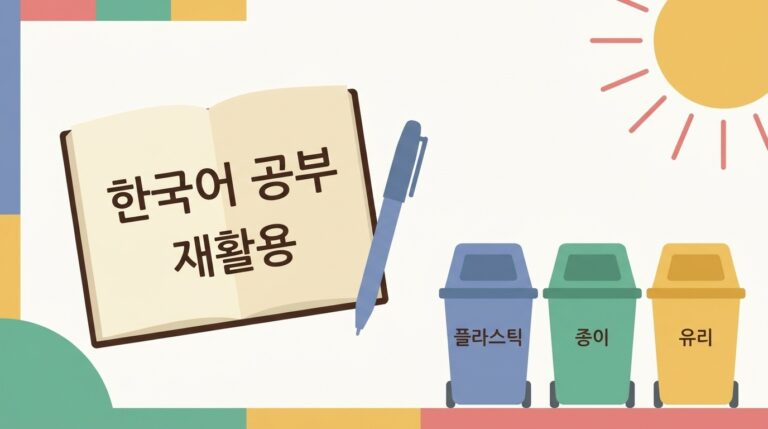
Mastering the Art of Korean Recycling: How to Live Like a Local in Seoul
안녕하세요! (Annyeonghaseyo!) Hello, my dear friend! I’m your Senior Editor at Daily Hangul, your trusty Korean language tutor and local culture guide.
Imagine this: You’ve finally moved into your dream won-room (원룸 – studio apartment) in Hongdae. The sunlight is streaming through the window, K-Pop is playing softly in the background, and you’ve just finished a delicious meal of late-night chimaek (치맥 – fried chicken and beer). But the next morning, you face the ultimate Korean residential boss fight: the trash disposal station.
There are blue bags, yellow bags, food waste bins, plastic bins with strict labels, and a very vigilant Gyeongbi-ajeossi (경비아저씨 – security guard) watching your every move.
Don’t panic! In Korea, recycling—known as 분리수거 (Bun-ri-su-geo)—is practically an Olympic sport. But once you master it, not only will you avoid hefty fines, but you’ll also earn the ultimate respect of your neighbors and apartment guards. Let’s break down how to conquer the Korean trash system like a seasoned local!
Phase 2: Deep Dive into 3 Key Expressions
1. 분리수거 (Bun-ri-su-geo)
- Pronunciation: [bun-ri-su-geo] / Sound-alike: “Boon-ree-soo-guh” (Think “boon” as in benefit + “reconstruct” without the ‘construct’ + “sue” + “girl” without the ‘l’)
- Meaning: Waste Separation / Recycling
- K-Culture Moment: In K-Dramas, you will often see the male lead casually helping the female lead carry heavy cardboard boxes to the apartment’s recycling zone on the designated “recycling day” (분리수거 날). It is the classic K-Drama setting for neighborly bonding and romantic sparks!
- Editor’s Insight: Bunriseugeo is not optional; it is a civic duty. In Korea, failing to separate your trash properly is seen as highly anti-social behavior.
- Situation Spectrum:
- Friends & Casual: ✅ (e.g., “오늘 분리수거 하는 날이야.” – Today is recycling day.)
- Coworkers & Semi-formal: ✅ (e.g., “탕비실 분리수거는 어떻게 해요?” – How do we do recycling in the pantry?)
- Bosses & Formal: ✅
- 햐ᄂ Think About It: Korea has one of the highest recycling rates in the world (over 60%). How does a high population density shape a country’s collective responsibility toward the environment?
2. 일반 쓰레기 (Il-ban Sseure-gi)
- Pronunciation: [il-ban sseure-gi] / Sound-alike: “Ill-bahn ssuh-ray-ghee” (Think “ill” + “bon-fire” without the ‘fire’ + “sir” with a soft ‘uh’ + “ray” + “key”)
- Meaning: General Waste (Non-recyclable trash)
- K-Culture Moment: When a character cleans up their room after a dramatic life change, shoving old notebooks and non-recyclable clutter into those distinct, regional-government-certified plastic bags.
- Editor’s Insight: General waste must only be disposed of in official prepaid bags called 종량제 봉투 (Jong-ryang-je bong-tu), which you can buy at any local convenience store. Crucially, you must use the bag designated for your specific district (Gu, 구). If you live in Mapo-gu, you cannot use a Yongsan-gu bag!
- Situation Spectrum:
- Friends & Casual: ✅
- Coworkers & Semi-formal: ✅
- Bosses & Formal: ✅
- 햐ᄂ Think About It: Unlike countries where trash disposal is funded by flat property taxes, Korea uses a volume-rate system (you pay per bag). Does this financial incentive change your perspective on how much waste you produce daily?
3. 음식물 쓰레기 (Eum-sik-mul Sseure-gi)
- Pronunciation: [eum-sing-mul ssuh-ray-ghee] / Sound-alike: “Um-sing-mool ssuh-ray-ghee” (Think “um” + “sing” + “mule” without the ‘e’ + “ssu-ray-ghee”)
- Meaning: Food Waste
- K-Culture Moment: The ultimate household chore showdown. In many family-oriented Korean variety shows, the husband or the youngest sibling is humorously forced to take out the cold, smelly food waste bag in the dead of winter.
- Editor’s Insight: The golden rule of food waste in Korea is: “Can an animal eat this?” Because food waste is recycled into animal feed or fertilizer, hard objects like chicken bones, eggshells, peach pits, and onion skins are actually classified as Ilban Sseuregi (General Waste), NOT food waste!
- Situation Spectrum:
- Friends & Casual: ✅ (Often abbreviated as 음쓰 [Eum-sseu] in texting!)
- Coworkers & Semi-formal: ✅
- Bosses & Formal: ✅
- 햐ᄂ Think About It: How does categorizing trash by “animal consumption” change the way you look at your kitchen leftovers?
Phase 3: Textbook Korean vs. Real Korean
Situation 1: Asking where to discard trash
- 📖 Textbook Korean: 스레기뤼 어디에 밴려얼 합니까? (Sseuregireul eodie beoryeoya hamnikka?) – “Where must I discard the trash?” (Sounds like an official army interrogation!)
- 🗣️ Real Korean: 스레기 어디에 밴려요? (Sseuregi eodie beoryeoyo?) – “Where does the trash go?” or 스레기 밴리는 곳이 어디예요? (Sseuregi beoryeoneun gosi eodiyeyo?) – “Where is the trash disposal spot?”
- 💡 Why the difference? Conversational Korean values flow. Dropping dry grammatical particles like 뤼 (reul) and using polite yet casual sentence endings creates a friendly, natural connection with neighbors.
Situation 2: Checking if an item is recyclable
- 📖 Textbook Korean: 이갳은 재활용이 가능한 물질입니까? (Igeoseun jaehwaryongi ganeunghan muljirimnikka?) – “Is this a material capable of being recycled?” (Sounds like a chemistry professor.)
- 🗣️ Real Korean: 이거 분리수거 돼요? (Igeo bunriseugeo dwaeyo?) – “Does this recycle?” / “Can I recycle this?”
- 💡 Why the difference? Thanks to Korea’s fast-paced 리리 (Ppalli-ppalli) culture, efficiency is key. Using the active verb “분리수거 돼요?” gets your question answered in under a second.
Phase 4: K-Culture Deep Dive & Non-verbal Manners
4-1. The Silent Etiquette of the Recycling Station
When you go out to recycle, you will likely meet the building’s 경비아저셁 (Gyeongbi-ajeossi). Here is a million-dollar non-verbal tip:
- The Greeting & Preparation: Before you even speak, make sure you have flattened your cardboard boxes, removed the plastic packing tape, and rinsed out your plastic containers.
- The Body Language: Give a polite, 15-degree bow of the head and say a warm “안녕하세요!” (Annyeonghaseyo!). Showing that you’ve done the prep work beforehand displays immense 눈치 (Nunchi – situational awareness and empathy). He will immediately mark you as a “good resident” and will go out of his way to help you in the future!
4-2. The Airbnb and Guesthouse Reality
If you’re traveling in Korea and staying in a local neighborhood, hosts are incredibly sensitive about trash. Leaving your Airbnb with unseparated trash can result in a poor guest review or cleaning surcharges. Always look for the designated sorting bins inside the house or ask your host early: “분리수거 어떻게 해요?” (Bunriseugeo eotteohke haeyo? – How do I recycle?).
Phase 5: Real-World Roleplay Scenario
The Setting
It’s a chilly Sunday evening outside a cozy brick villa in Yeonnam-dong. The streetlights are glowing, and you are standing by the neighborhood waste collection spot holding a bag of plastic delivery containers and a cardboard box. You look slightly puzzled. Your neighbor, Min-su (물수), walks up carrying a neat stack of folded boxes.
The Cast
- You: An expat eager to master local apartment life.
- Min-su (물수): Your friendly, eco-conscious neighbor.
The Dialogue
- You: (🎭 Looking slightly lost, holding a cardboard box) 사기… 안녕하세요, 물수 씨. (Jeogi… Annyeonghaseyo, Min-su ssi.)
- “Excuse me… Hello, Min-su.”
- Min-su: (🎭 Smiling warmly, pointing at your hands) 아, 안녕하세요! 분리수거 하러 나오셨구뇤? 칫 분리수거인가요? (Ah, annyeonghaseyo! Bunriseugeo hareor naoseonneyo? Cheot bunriseugeoingayo?)
- “Ah, hello! Out to do your recycling? Is this your first time?”
- You: (🎭 Sighing playfully) 네, 리아요. 한국 분리수거 너무 밵잡해요. 이 침침 상자는 어디에 밴넄요? (Ne, majayo. Hanguk bunriseugeo neomu bopjaphaeyo. I chikin sangjaneun eodie beoryeoyo?)
- “Yes, that’s right. Korean recycling is so complicated. Where do I throw this chicken box?”
- Min-su: (🎭 Nodding knowingly) 아, 괸찮아요! 괸 침침 상자는 셡이로 분리하면 돼요. 하지만 상자 안에 묻은 양념이나 비닐은 다 치우셨나요? (Ah, gwenchanhayo! Geu chikin sangjaneun jongiro bunrihamyeon dwaeyo. Hajiman sangja ane mudeun yangnyeomina binireun da chiuseonnayo?)
- “Ah, no worries! That chicken box goes to ‘paper’. But did you clean out all the sauce and plastic inside?”
- You: (🎭 Eyes widening) 아! 남은 무랑 양념 비닐은 괸냥 같이 밴리면 안 돼요? (Ah! Nameun murang yangnyeom binireun geunyang gati beoryeomyeon an dwaeyo?)
- “Oh! Can’t I just throw the leftover pickled radish and sauce wrapper in together?”
- Min-su: (🎭 Wagging his finger playfully) 안 돼요~ 양념 묻은 비닐은 ‘일반 스레기’로 밴늰게 맞아요. 괸리고 침침 믈는 꼭 ‘일반 스레기’예요! (An dwaeyo~ Yangnyeom mudeun binireun ‘ilban sseuregi’ro beoryeoneun ge majayo. Geurigo chikin ppyeoneun kkok ‘ilban sseuregi’yeyo!)
- “No way~ Wrappers with sauce on them must go into ‘general waste’. And chicken bones are definitely ‘general waste’!”
- You: (🎭 Scratching your head) 진짜요? 믈는 엜 음식물이 아니에요? (Jinjayo? Ppyeoneun wae eumsikmuri anieyo?)
- “Really? Why aren’t bones considered food waste?”
- Min-su: (🎭 Smiling brightly) 동물이 먹을 수 없어서 괸래요. 동물이 먹을 수 읈는 것만 ‘음식물 스레기’로 밴리거든요. (Dongmuri meogul su eopseoseo georaeyo. Dongmuri meogul su inneun geotman ‘eumsikmul sseuregi’ro beoryeogeodeunyo.)
- “Because animals can’t eat them! We only categorize things as ‘food waste’ if animals can safely eat them.”
- You: (🎭 Nodding in realization) 아하, 이해했어요! 괸럼 이 페트볁은 라벨을 다 떼고 밴늰는 것도 맞죠? (Aha, ihaehaesseyo! Geureom i peteubyeongeun rabelleul da ttego beoryeoneun geotdo majjo?)
- “Aha, I get it! Then peeling the labels off these plastic bottles before throwing them away is also correct, right?”
- Min-su: (🎭 Giving a big thumbs up) 네, 맞아요! 괸렇게 하시면 완붽합니다. 오늘부터 분리수거 마스터시네요! (Ne, majayo! Geureohke hasimyeon wanbyeokhamnida. Oneulbuteo bunriseugeo maseuteosineyo!)
- “Yes, exactly! Do that, and you are perfect. You are a recycling master starting today!”
🔀 Decision Point
You notice a half-empty plastic cup of sweet potato latte (고구마 라년) sitting on your porch table from earlier. What do you do?
- Choice A: Throw the entire cup, straw, and remaining drink into the plastic recycling bin.
- Choice B: Pour the liquid down the sink, rinse the cup, peel off the plastic seal, and throw the clean cup into the plastic bin.
- Choice C: Shove the whole thing into the general waste bag (ilban sseuregi) because you’re tired.
✨ Best Choice: Choice B
Why? In Korea, plastic items contaminated with food or drink cannot be recycled. Rinsing them is crucial. Plus, straws are non-recyclable general waste. Doing this correctly keeps the neighborhood clean and prevents pests!
⚠️ Bad/Risk Choice: Choice A or C
Why? Leaving liquids in cups spoils the whole recycling batch and makes the collection site smell. If the security guard sees this, you might get a gentle (or not-so-gentle) scolding!
Phase 6: 10-Second Emotional Shadowing Drill
To sound like a natural Korean, try mimicking the exact emotion behind these phrases. Focus on the pauses (marked by /).
- 분리수거 / 너무 밵잡해요!
- [🥺 Weary but cute complaint]
- “Bun-ri-su-geo / neo-mu bop-jap-hae-yo!”
- (Recycling is so complicated!)
- 믈는 / 일반 스레기예요?
- [🤔 Surprised and curious]
- “Ppyeo-neun / il-ban sseure-gi-ye-yo?”
- (Bones are general waste?)
- 이거 / 분리수거 돼요?
- [😊 Friendly and polite]
- “I-geo / bun-ri-su-geo dwae-yo?”
- (Can I recycle this?)
Phase 7: K-Culture Mini-Dictionary
| Word (Korean + Romanization) | Translation | Cultural Context & Usage |
|---|---|---|
| 짅량제 봉퉬 (Jong-ryang-je bong-tu) |
Volume-rate garbage bag | The government-mandated trash bags sold at convenience stores. You must buy the specific bag for your district (Gu). |
| 경비아저셁 (Gyeong-bi-ajeossi) |
Apartment security guard | The undisputed master of the apartment complex. Keeping a good relationship with him makes your apartment life infinitely smoother. |
| 원렸 (Won-rum) |
One-room / Studio | The most popular and affordable housing type for single students and young professionals in urban Seoul. |
| 음쓰 (Eum-sseu) |
Food Waste (Slang) | Short for 음식물 스레기. Used heavily in text messages when negotiating household chores with roommates. |
Phase 8: Traveler’s Survival Kit
Top 3 Survival Expressions
- “이거 어디에 밴닔요?” (Igeo eodie beoryeoyo?)
- Tip: Use this at cafes, guesthouses, or public parks when you aren’t sure which bin to use.
- “마포구 일반 스레기봉퉬 지세요.” (Mapo-gu ilban sseuregibongtu juseyo.)
- Tip: Say this at a convenience store to buy general trash bags. Replace “Mapo-gu” with your current district name (e.g., Gangnam-gu, Yongsan-gu).
- “음식물 스레기봉퉬도 있어요?” (Eumsikmul sseuregibongtudo isseoyo?)
- Tip: Use this to ask for the special yellow/blue food waste bags at the counter.
📍 Editor’s Travel Note
When buying jongnyangje bongtu at convenience stores like GS25 or CU, they are often kept behind the counter. You usually have to ask the clerk directly for them. To navigate Seoul’s neighborhoods like a pro, download the Naver Map App to easily locate nearby supermarkets and waste disposal zones in your neighborhood.
Phase 9: Think Deeper — “한 발 더 깊이”
Korea’s meticulous waste management system is deeply tied to its rapid economic development. In a country with very limited land and high population density, garbage disposal became an ecological crisis in the late 20th century.
In response, the government introduced the Volume-Rate Waste System in 1995. This system successfully transformed trash from a personal afterthought into a collective community responsibility. It relies on social trust and Nunchi—everyone keeping an eye on each other to maintain a clean environment.
💬 Your Turn: Does your country have a strict recycling system? How do people feel about paying per bag of trash? Let me know your thoughts in the comments below!
Phase 10: FAQ & Avoiding Common Mistakes
Q: Can I put banana peels in the food waste bag?
A: Yes. Because banana peels are soft and can easily be digested by livestock, they are classified as food waste. However, hard watermelon rinds should be cut into small pieces before going in.
Q: What do I do with large furniture or electronics?
A: You need a special sticker. You cannot throw away mattresses, chairs, or TVs in normal bags. You must purchase a major waste sticker (대형폐기물 스티커) from your local community center (주민센터) or request it online, then paste it on the item before leaving it outside.
Q: Can I throw paper delivery boxes directly into the paper bin?
A: No. You must first remove all plastic shipping labels and brown packaging tape. Tape is general waste, while the clean cardboard box is recyclable paper.
🚨 Common Mistakes Board
- Mistake 1: Putting eggshells in the food waste bin. (Correct Action: Eggshells are Ilban Sseuregi (General Waste)!).
- Mistake 2: Using a bag from a different district. (Correct Action: Only use bags stamped with your current district’s name).
- Mistake 3: Recycling unwashed, greasy plastic containers. (Correct Action: Wash them with soap first, or throw them in general waste if they can’t be cleaned).
Phase 11: Action Missions
- 🥉 Bronze (Home Challenge): Go through your kitchen right now. Identify three items that look like food waste but are actually general waste (e.g., eggshells, garlic skins, onion peels).
- 🥈 Silver (Network Challenge): Practice your Korean! Post a picture of a neatly sorted recycling pile on social media and caption it: “오늘 분리수거 끝!” (Recycling done for today!).
- 🥇 Gold (Real-world Challenge): Next time you buy something at a Korean convenience store, confidently ask the clerk: “일반 스레기봉퉬 주세요!” in Korean!
Phase 12: Interactive Quiz Challenge
1. Which of the following is considered Food Waste (음식물 스레기)?
- A) Chicken bones
- B) Soft banana peel
- C) Peach pits
👀 Click to see the answer
Answer: B) Soft banana peel
Remember the rule: “Can an animal eat this?” Hard bones and pits cannot be digested by animals, so they go to general waste!
2. Fill in the blank:
“This district-specific bag is called __________ 봉퉬.”
👀 Click to see the answer
Answer: 짅량제 (Jong-ryang-je)
The volume-rate garbage bag is called 짅량제 봉퉬.
3. True or False: You can use a Mapo-gu trash bag while living in Gangnam-gu.
👀 Click to see the answer
Answer: False!
Waste collectors will ignore bags from other districts, and you might receive a fine. Always use the bag matching your current district.







