

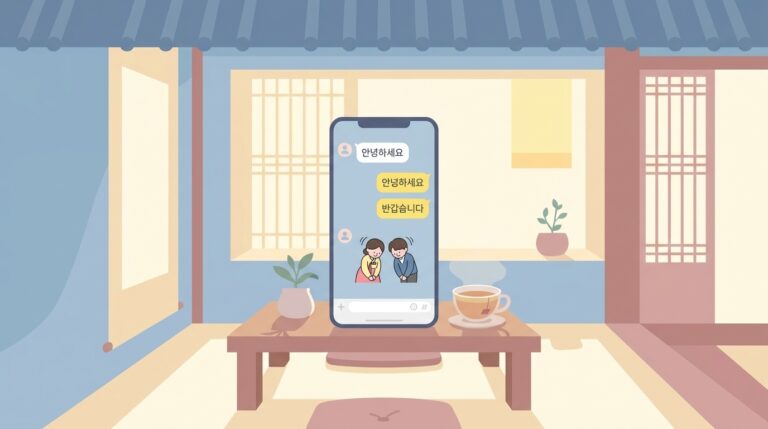
Changing Plans Without the Stress: How to Politely Say “Can We Meet Tomorrow?” in Korean
안녕하세요! (An-nyeong-ha-se-yo! – Hello!) It’s your favorite Korean tutor and cultural guide from Daily Hangul.
Imagine this: You’ve planned an exciting evening in Hongdae with a new Korean friend. You’re supposed to eat mouth-watering 삼겹살 (Samgyeopsal – pork belly) and enjoy the vibrant street performances. But after a long day of sightseeing at Gyeongbokgung Palace, your feet are sore, and your energy is at absolute zero.
Your phone buzzes. Your friend texts: “Are we still on for today?”
You want to ask, “Can we push our meeting to tomorrow?” but you worry you might sound rude or cold. Don’t panic! In Korea, changing plans politely is an art of showing respect, and today, you’ll learn how to do it perfectly—even if you are a complete beginner (A1)!
This guide is packed with real-life tips based on years of helping learners just like you turn awkward plan changes into moments of warm, polite bonding.
1. Three Magic Phrases to Change Plans Politely
Let’s dive into the three most common and polite ways to ask to meet tomorrow instead. Choose the one that fits your comfort level!
① 내일 만나도 될까요? (Can we meet tomorrow?)
- Pronunciation: Nae-il man-na-do doel-kka-yo?
- Sound-alike Guide: “Nay-il mahn-nah-doh dwell-kah-yo?”
- Meaning:
- Literal: Is meeting tomorrow also okay?
- Real-world Nuance: A very polite, safe, and standard way to ask for a reschedule. It’s perfect for beginners!
- K-Culture Moment: You will hear this phrase in almost every office-themed K-Drama (like Business Proposal) when a character gets stuck working late and needs to reschedule a dinner date.
- Editor’s Insight: The ending -도 될까요? (-do doel-kka-yo?) is the Korean equivalent of “Is it okay if…?” It shows you respect the other person’s schedule.
- Situation Spectrum:
- Casual (Friends): ⚠️ (A bit polite, but perfectly fine!)
- Semi-formal (Coworkers): ✅
- Formal (Boss/Elder): ✅
🤔 Think About It: Notice how Korean doesn’t use the direct command “Let’s meet tomorrow” (내일 만납시다). Instead, it asks for permission: “Is it okay if we meet tomorrow?” Why do you think Korean culture values asking for the other person’s comfort so highly?
② 내일로 미뤄도 될까요? (Can we push it to tomorrow?)
- Pronunciation: Nae-il-lo mi-rwo-do doel-kka-yo?
- Sound-alike Guide: “Nay-il-loh mee-rwuh-doh dwell-kah-yo?”
- Meaning:
- Literal: Can we postpone it to tomorrow?
- Real-world Nuance: Slightly more active. You are specifically suggesting to postpone (미루다 – mi-ru-da) today’s appointment.
- K-Culture Moment: Used often in lifestyle K-Dramas when close friends realize they are both too tired to head out but still want to see each other soon.
- Editor’s Insight: The particle -로 (-lo) means “to” or “towards.” So, “내일로” literally means “to tomorrow.”
- Situation Spectrum:
- Casual (Friends): ✅
- Semi-formal (Coworkers): ✅
- Formal (Boss/Elder): ⚠️ (Try to explain a valid reason first before asking this!)
③ 내일 보면 안 될까요? (Can’t we meet tomorrow instead?)
- Pronunciation: Nae-il bo-myeon an doel-kka-yo?
- Sound-alike Guide: “Nay-il boh-myuhn ahn dwell-kah-yo?”
- Meaning:
- Literal: If we see each other tomorrow, would it not work?
- Real-world Nuance: A softer, slightly cute, and gentle way of pleading to reschedule.
- K-Culture Moment: Think of a sweet scene in a romance drama where the main character asks their partner for a favor with big, hopeful eyes.
- Editor’s Insight: Negative questions like -면 안 될까요? (-myeon an doel-kka-yo? – Can’t we…?) sound much softer and less demanding in Korean than direct requests.
- Situation Spectrum:
- Casual (Friends): ✅
- Semi-formal (Coworkers): ⚠️ (Only if you are quite close!)
- Formal (Boss/Elder): 🚫 (Too casual and subjective.)
2. Textbook Korean vs. Real Korean
Textbooks often teach very stiff, dictionary-perfect sentences that can make you sound like a robot in real life. Let’s look at the difference!
Situation 1: Letting a friend know you are too tired
- 📖 Textbook Korean: 저는 오늘 매우 피곤하므로 내일 약속을 변경하고 싶습니다. (Jeo-neun o-neul mae-u pi-gon-ha-meu-ro nae-il yak-sok-eul byeon-gyeong-ha-go sip-seup-ni-da. – “Because I am very tired today, I want to change tomorrow’s appointment.”)
- 🗣️ Real Korean: 오늘 너무 피곤해서요. 내일 만나도 될까요? (O-neul neo-mu pi-gon-hae-seo-yo. Nae-il man-na-do doel-kka-yo? – “I’m so tired today… Is it okay if we meet tomorrow?”)
- 💡 Why is it different? Koreans prefer short, conversational connectors like -해서요 (-hae-seo-yo – because…) to soften explanations naturally.
Situation 2: Rescheduling with a language partner
- 📖 Textbook Korean: 오늘 약속은 취소하고 내일로 연기합시다. (O-neul yak-sok-eun chwi-so-ha-go nae-il-lo yeon-gi-hap-si-da. – “Let’s cancel today’s appointment and delay it to tomorrow.”)
- 🗣️ Real Korean: 미안해요, 오늘 말고 내일 봐요! (Mi-an-hae-yo, o-neul mal-go nae-il bwa-yo! – “Sorry, not today, let’s see each other tomorrow!”)
- 💡 Why is it different? Words like “취소” (cancellation) and “연기” (postponement) sound highly formal—like a business contract. In daily life, “오늘 말고 내일 봐요” (not today, let’s see tomorrow) is much warmer and friendlier.
3. The Cultural Deep Dive: Nunchi & Rescheduling Manners
3-1. 눈치 (Nunchi) & Body Language Tips
In Korea, 눈치 (Nunchi)—the art of reading the room and sensing others’ feelings—is everything. When rescheduling a plan, your non-verbal cues matter just as much as your words.
* On Text: Always use polite, soft particles. Do not just say “내일 만나도 될까요?” alone. Start with 정말 미안해요 (Jeong-mal mi-an-hae-yo – I am truly sorry). You can also add a cute, bowing or apologetic emoji (like 🙇♂️ or 😭) to show you genuinely feel bad.
* In Person: If you must reschedule in person, lean slightly forward, make soft eye contact, and place your hands together in front of you (like a gentle pray gesture) as you apologize.
3-2. K-Time & The Golden Rule of “Dang-il Chwi-so”
Korea runs on a very fast-paced lifestyle. While people are generally understanding, 당일 취소 (Dang-il chwi-so – Same-day cancellation) is considered quite impolite unless there’s an emergency. If you must reschedule:
* Let them know at least 3 to 4 hours in advance.
* The Sweetener Rule: If you are the one changing the plan, it is a warm cultural custom to say, “제가 다음 번에 맛있는 거 살게요!” (Je-ga da-eum beon-e mas-it-neun geo sal-ge-yo! – “Next time, I’ll buy you something delicious!”). This immediately erases any awkwardness!
4. Interactive Roleplay Scenario: A Cozy Cafe in Insadong
Your Role: You are Ji-woo, an international student. You promised to meet your Korean language partner, Min-jun, at a beautiful Hanok cafe. However, you caught a cold.
Min-jun’s Role: A friendly Korean university student who is looking forward to meeting you.
Let’s play out the scene! Read the lines aloud to practice your flow.
- Min-jun: 지우 씨, 오늘 2시에 종로에서 만나는 거 맞죠? ㅎㅎ
(Ji-woo, we’re meeting at 2 PM in Jongno today, right? haha) - Ji-woo (You): 🎭 (Typing with a worried expression) 민준 씨, 정말 미안해요. 😭
(Min-jun, I am really sorry.) - Min-jun: 어라? 무슨 일 있어요? 아파요?
(Oh? Is something wrong? Are you sick?) - Ji-woo (You): 🎭 (Sighing gently) 네, 감기에 걸려서 오늘 나가기 조금 힘들어요.
(Yes, I caught a cold, so it’s a bit hard to go out today.) - Min-jun: 아, 요즘 감기가 유행이더라고요. 무리하지 마세요!
(Ah, the cold has been going around lately. Don’t push yourself!) - Ji-woo (You): 🎭 (Relieved, asking politely) 고마워요. 혹시 약속을 내일로 미뤄도 될까요?
(Thank you. By any chance, can we push our plans to tomorrow?) - Min-jun: 네, 전 내일도 괜찮아요! 푹 쉬고 내일 만나요.
(Yes, tomorrow works for me too! Get some good rest and let’s meet tomorrow.) - Ji-woo (You): 🎭 (Smiling warmly) 정말 고마워요. 내일 제가 따뜻한 티 살게요!
(Thank you so much. I’ll buy you a warm tea tomorrow!) - Min-jun: 와, 좋아요! 감기 조심하고 내일 봐요!
(Wow, sounds great! Watch out for your cold and see you tomorrow!) - Ji-woo (You): 🎭 (Sending a cute waving sticker) 네, 내일 봐요!
(Yes, see you tomorrow!)
🔀 Decision Point: How would you react if Min-jun said “Oh, tomorrow I am busy…”?
- Choice A: “아, 네. 알겠습니다.” (Ah, ne. Al-get-seup-ni-da. – Ah, yes. Understood.)
- Tutor’s Feedback: Too cold! It sounds like you are shutting down the conversation.
- Choice B: “그럼 다음 주에 만날까요? 편한 시간 알려주세요!” (Geu-reom da-eum ju-e man-nal-kka-yo? Pyeon-han si-gan al-ryeo-ju-se-yo! – Then shall we meet next week? Please let me know your comfortable time!)
- Tutor’s Feedback: Best Choice! Extremely polite, takes the initiative, and shows you still genuinely want to meet.
- Choice C: “왜 바빠요?” (Wae ba-ppa-yo? – Why are you busy?)
- Tutor’s Feedback: Too direct and invasive for Korean cultural standards!
5. 10-Second Emotion Shadowing Drill
To speak Korean naturally, you need to inject emotion into your words. Let’s practice shadowing. Speak the phrases when you see the emotion cues, and pause slightly at the / marks!
- [🥺 Deeply Apologetic and Sweet]
“정말 미안해요… / 내일 / 만나도 될까요?”
(Jeong-mal mi-an-hae-yo… / nae-il / man-na-do doel-kka-yo?) - [😊 Bright, Relieved, and Friendly]
“고마워요! / 그럼 / 내일 봐요!”
(Go-ma-wo-yo! / geu-reom / nae-il bwa-yo!)
6. K-Culture Mini Dictionary
Here are 4 key lifestyle words to help you sound like an insider:
- 약속 (Yaksok): Promise, plan, or appointment. In Korea, “yaksok” is a very important social contract among friends.
- 미루다 (Miruda): To postpone or delay. A very common everyday verb.
- 당일 취소 (Dang-il chwi-so): Same-day cancellation. The ultimate social taboo unless you have a great excuse!
- 내일 (Naeil): Tomorrow. (Fun fact: “내” (nae) means coming, and “일” (il) means day. The coming day!)
7. Traveler’s Survival Kit
Are you currently exploring South Korea? Save these 3 emergency phrases on your phone!
| Korean | Pronunciation | Pro-Tip |
|---|---|---|
| 시간 괜찮으세요? | Si-gan gwan-chan-eu-se-yo? | “Do you have time?” Use this before asking to reschedule. |
| 다음에 만나요. | Da-eum-e man-na-yo. | “Let’s meet next time.” Great if you can’t make it tomorrow either. |
| 제가 살게요! | Je-ga sal-ge-yo! | “I’ll pay!” The magic phrase that fixes any minor scheduling mistake. |
📌 Editor’s Travel Note: When navigating appointments in Korea, download the Naver Map App Download Page to calculate your travel times accurately. Traffic in Seoul during rush hour (6 PM – 8 PM) can be intense, so always check your route beforehand!
8. Deep Thinking: “Yaksok” and Trust in Korean Society
In Korea, relationships are built on mutual respect and shared energy. When someone makes a 약속 (Yaksok), they are reserving their time specifically for you. Asking to reschedule isn’t just about changing a slot on a calendar; it’s about letting the other person know that you still value their presence and time. That is why Koreans use soft, permission-seeking grammar like “-도 될까요?” (is it okay if…?) rather than direct assertions.
💬 Your Turn: how do people in your country politely change plans? Do you prefer a direct explanation, or do you soften the news with polite phrases like Koreans do? Let me know in the comments below!
9. FAQ & Avoiding Common Mistakes
Q: Can I use “내일로 미뤄도 될까요?” with my Korean university professor?
A: Depends. It’s polite, but with professors or formal bosses, it’s much safer to say, “혹시 일정을 내일로 조정할 수 있을까요?” (Hok-si il-jeong-eul nae-il-lo jo-jeong-hal su is-seul-kka-yo? – “By any chance, could we adjust the schedule to tomorrow?”). Adjusting (조정하다) sounds more professional than postponing (미루다).
Q: What if I am running only 10 minutes late?
A: Don’t postpone the whole meeting! Just text: “10분 정도 늦을 것 같아요. 미안해요!” (Sip-bun jeong-do neuj-eul geot gat-ah-yo. Mi-an-hae-yo! – “I think I’ll be about 10 minutes late. Sorry!”).
🚨 Top 3 Mistakes to Avoid:
- Using “연기해요” (Yeon-gi-hae-yo – Let’s delay) with friends: It sounds like you are hosting a formal press conference. Stick to “미뤄요” (mi-rwo-yo).
- Saying “미안” (Mian) to a coworker: “Mian” is highly casual (반말 – banmal). Always add “-해요” to make it 미안해요 (Mianhaeyo).
- Canceling without offering an alternative date: This makes the other person think you don’t want to meet them at all. Always propose “Tomorrow?” or “Next week?”.
10. Daily Hangul Action Missions
- 🥉 Bronze Mission: Record yourself saying “내일 만나도 될까요?” with your phone recorder, focusing on the soft, questioning tone at the end.
- 🥈 Silver Mission: Write a mock text in Korean to a friend apologizing for being tired and proposing to meet tomorrow. Use at least one cute emoji!
- 🥇 Gold Mission: The next time you have a language exchange partner or a Korean classmate, try to suggest a minor time change using the phrases you learned today!
11. Interactive Quiz Challenge
Test your cultural and language skills! Click the boxes below to check the answers.
1. Which phrase is the most natural way to ask a friend to reschedule to tomorrow?
- A) 내일을 연기하세요.
- B) 내일 만나도 될까요?
- C) 오늘 약속을 취소합니다.
🔍 Click to reveal the Answer!
Correct Answer: B!
“내일 만나도 될까요?” is natural, polite, and perfect for daily situations. Option A sounds like a weird command, and Option C is way too formal and cold.
2. True or False: If you cancel plans on the same day in Korea, it is polite to offer to buy coffee or food next time.
- A) True
- B) False
🔍 Click to reveal the Answer!
Correct Answer: A (True)!
Offering to treat your friend to coffee (“제가 커피 살게요!”) is a great way to show you are genuinely sorry for the same-day change.
Great job today! You’re now ready to change plans like a polite, culturally-savvy local. Until next time, 다음에 또 만나요! (Dae-um-e tto man-na-yo! – See you again next time!)”,







