

Welcome to My Home! 🏠 How to Give and Enjoy a Korean House Tour Like a Native
안녕하세요! Welcome back to Daily Hangul. I’m your lead editor and your friendly neighborhood guide to all things Korean language and culture.
Have you ever watched a K-Drama where the main characters walk into a cozy 원룸 (won-rum / studio apartment) or a scenic 옥탑방 (ok-tap-bang / rooftop room)? Before they even step past the entryway, there’s this beautiful, slightly awkward dance of hospitality. The host sheepishly says, “Oh, it’s a mess!” while the guest immediately marvels at how clean it actually is.
Inviting someone into your home in Korea is a huge milestone. It means you are transitioning from “acquaintances” to “real friends.” Today, we are going to learn how to guide someone through a Korean home, and how to be the perfect guest if you are invited to a 집들이 (jip-deuri / housewarming party). This lesson is tailor-made for A2 (Elementary) learners, so we’ll keep the grammar light and the cultural vibes high!
💡 Core Expressions Deep Dive
Here are the top three expressions you absolutely need to know when hosting a house tour or visiting a Korean home.
1. 들어오세요!
- Pronunciation: Deureo-oseyo! (Sounds like: Deuh-ruh-oh-seh-yo!)
- Meaning: “Please come in!”
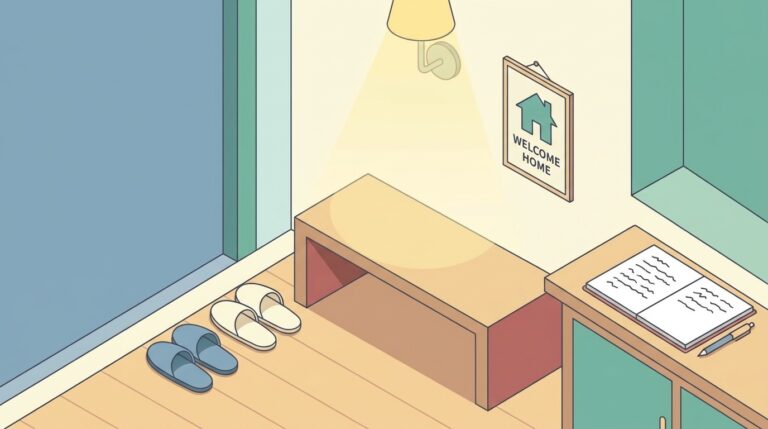
- K-Culture Moment: You will hear this the exact second the host opens the front door. But wait! Do not cross that threshold with your shoes on. In Korea, the 현관 (hyeongwan / entryway) is the sacred border. You step down, take off your shoes, turn them to face the door, and then step up into the living space when you hear “들어오세요!”
- Situation Spectrum:
- Friends (Casual): ✅ (You can say “들어와!” – Deureo-wa!)
- Coworkers (Semi-formal): ✅
- Bosses/Elders (Formal): ✅
🤔 Think About It (No.1):
Why is the act of removing shoes so strictly preserved in modern high-rise Korean apartments? How does changing into house slippers change the “vibe” of entering someone’s private life?
2. 집이 참 좋네요!
- Pronunciation: Jibi cham jonneyo! (Sounds like: Ji-bi cham johm-neh-yo—note that ‘joh-neyo’ flows naturally as jonneyo due to Korean sound blending!)
- Meaning: “Your house is really nice!”
- Editor’s Insight: Even if the apartment is tiny, saying this is the ultimate form of politeness. It acknowledges the host’s effort in preparing the space. If you want to sound even more natural, you can say “집이 정말 깔끔해요!” (Jibi jeong-mal kkal-kkeum-hae-yo!), which means “Your house is so neat and clean!”
- Situation Spectrum:
- Friends (Casual): ✅
- Coworkers (Semi-formal): ✅
- Bosses/Elders (Formal): ✅
🤔 Think About It (No.2):
In Korean culture, complimenting the cleanliness (깔끔하다) of a home is often preferred over complimenting its size or expensive furniture. Why do you think humility and neatness are valued more than showing off wealth?
3. 별거 없지만 편하게 쉬세요.
- Pronunciation: Byeol-geo eop-ji-man pyeon-ha-ge swi-seyo.
- Meaning: “There isn’t much to see/eat, but please make yourself comfortable.”
- Editor’s Insight: This is classic Korean modesty! Even if the host spent five hours preparing a feast and cleaning every corner with a toothbrush, they will say “별거 없지만…” (There’s not much…). It lowers expectations to make the guest feel zero pressure.
- Situation Spectrum:
- Friends (Casual): ✅ (편하게 쉬어! – Pyeon-ha-ge swi-eoh!)
- Coworkers (Semi-formal): ✅
- Bosses/Elders (Formal): ⚠️ (Better to use “편히 쉬십시오.”)
📖 Textbook vs. 🗣️ Real Korean
Let’s look at how textbooks teach home tours versus how real Koreans actually talk.
Situation 1: Showing your bedroom
- 📖 Textbook Korean: “이곳은 저의 방입니다.” (I-goteun jeo-ui bang-im-ni-da. / “This location is my room.”)
- 🗣️ Real Korean: “여기가 제 방이에요!” (Yeo-gi-ga je bang-i-e-yo! / “Here is my room!”)
- 💡 Why is it different? The textbook version sounds like a museum tour guide speaking. In real life, “여기가 제 방이에요” is warm, cozy, and perfectly natural for an A2 level speaker.
Situation 2: Pointing out the bathroom
- 📖 Textbook Korean: “화장실은 저기에 있습니다.” (Hwa-jang-si-reun jeo-gi-e is-sim-ni-da. / “The restroom is over there.”)
- 🗣️ Real Korean: “화장실은 이쪽이에요.” (Hwa-jang-si-reun i-jjok-i-e-yo. / “The bathroom is this way.”)
- 💡 Why is it different? Saying “이쪽이에요” (It’s this way) while gesturing with an open palm feels highly hospitable and guides your guest’s eyes naturally, rather than statically pointing “over there” (저기).
🇰🇷 K-Culture Deep Dive
⚠️ The Non-Verbal Art of “Nunchi” (눈치)
When you tour a Korean home, your eyes should be working just as hard as your tongue!
* Check the slippers: If the host places indoor slippers in front of you, wear them immediately. It means they prefer to keep floor dust minimal.
* Don’t sit on the bed without asking: In many Korean studio apartments (원룸), the bed doubles as a couch during social hours, but always wait for the host to say “여기 앉으세요” (Sit here) before plumping down!
📺 The K-Drama Connection
Have you ever noticed that in K-Dramas, when someone visits a friend’s house, they never arrive empty-handed? They usually carry a pack of rollable toilet paper (두루마리 휴지) or laundry detergent (세제).
Why? Because the bubbles from the detergent symbolize wealth and success bubbling up, and the rolling toilet paper symbolizes everything in life rolling out smoothly! If you bring these to a Korean housewarming, you will instantly be crowned the ultimate “insider” (인싸).
🎭 Real-Life Roleplay Scenario
Scenario A: Visiting Min-ho’s New Apartment
- Setting: Friday night, 7:00 PM. You are standing outside Min-ho’s brand new studio apartment in Mapo, Seoul. You hear the digital door lock beep open.
- Characters:
- YOU (A2 Korean learner): Excited but polite guest.
- Min-ho (민호): Your friendly Korean coworker who just moved in.
민호: 어, 왔어요? 어서 들어오세요! 🚪
(Eo, wass-eo-yo? Eo-seo deureo-oseyo!)
[Oh, you’re here? Please come on in!]
(🎭 Stage Direction: Min-ho opens the door wide and points to the shoe rack)
YOU: 안녕하세요! 실례하겠습니다. 🙇
(An-nyeong-ha-se-yo! Sil-rye-ha-gess-sum-ni-da.)
[Hello! Excuse me for entering (polite entry phrase).]
(🎭 Stage Direction: You step into the entryway and slip off your outdoor shoes)
민호: 여기 실내화 신으세요.
(Yeo-gi sil-nae-hwa sin-eu-se-yo.)
[Please wear these indoor slippers here.]
🔀 Your Turn! How do you respond?
- Choice A: “아, 고맙습니다!” (Ah, go-map-sum-ni-da! / Oh, thank you!)
- Choice B: “어? 신발 신고 들어가면 안 돼요?” (Eo? Sin-bal sin-go deureo-ga-myeon an dwae-yo? / Oh? Can’t I wear shoes inside?)
✅ Best Choice: Choice A! Saying thank you and putting on the slippers shows you respect their home boundaries. Choice B is quite rude, as wearing shoes inside a Korean home is a major taboo!
YOU: 아, 고맙습니다! (Puts on slippers) 와, 민호 씨, 집이 참 좋네요! ✨
(Ah, go-map-sum-ni-da! Wa, Min-ho ssi, jibi cham jonneyo!)
[Oh, thank you! Wow, Min-ho, your house is really nice!]
민호: 에이, 별거 없어요. 아직 정리가 다 안 됐어요.
(Ei, byeol-geo eops-eo-yo. A-jik jeong-ri-ga da an dwess-eo-yo.)
[Oh, it’s nothing special. It’s not fully organized yet.]
(🎭 Stage Direction: Min-ho smiles modestly and waves his hand)
YOU: 아니에요, 정말 깔끔하고 예뻐요!
(A-ni-e-yo, jeong-mal kkal-kkeum-ha-go ye-ppeo-yo!)
[No, it’s really neat and pretty!]
민호: 그렇게 봐주니 고맙네요. 화장실은 이쪽이에요. 편하게 쓰세요.
(Geu-reoh-ge bwa-ju-ni go-map-neyo. Hwa-jang-si-reun i-jjok-i-e-yo. Pyeon-ha-ge sseu-se-yo.)
[Thank you for seeing it that way. The bathroom is this way. Feel free to use it.]
🗣️ 10-Second Shadowing Drill
Let’s practice saying a compliment naturally! Pay attention to the pauses (/).
😊 “집이 / 진짜 / 깔끔하고 / 예뻐요!”
* Ji-bi / jin-jja / kkal-kkeum-ha-go / ye-ppeo-yo!
* [Your house is / really / neat and / pretty!]
Say this with a big, bright smile! Express your genuine admiration.
📖 K-Culture Mini Dictionary
- 현관 (Hyeongwan): The sunken entryway of a Korean house where you leave your shoes.
- 집들이 (Jipdeuri): A traditional housewarming party. Guests bring symbolic gifts like toilet paper or detergent.
- 실내화 (Silnaehwa): Indoor slippers worn to keep the floors clean.
- 원룸 (Won-rum): A studio apartment (literally “one room”), very popular among young adults in Seoul.
🆘 Traveler’s Survival Kit
If you ever visit a friend’s place in Korea, memorize these three phrases:
- “화장실 어디예요?” (Hwa-jang-sil eo-di-ye-yo?)
- 🗣️ Hwa-jang-sil uh-di-yeh-yo?
- 📍 Where is the bathroom?
- “손 어디서 씻어요?” (Son eo-di-seo ssi-seo-yo?)
- 🗣️ Sohn uh-di-suh sshi-suh-yo?
- 📍 Where can I wash my hands?
- “이거 집들이 선물이에요!” (I-geo jip-deu-ri seon-mul-i-e-yo!)
- 🗣️ Ee-guh jip-deuh-ree suhn-mool-ee-eh-yo!
- 📍 This is a housewarming gift for you!
📌 Editor’s Travel Note:
If you are bringing a housewarming gift, present it with both hands while slightly bowing. It shows supreme respect!
🧠 Think Deeper: “Our” Home vs. “My” Home
In English, we usually say “This is my house.” But in Korean, you will almost always hear “우리 집” (Uri jip / Our house), even if the person lives completely alone!
This stems from Korea’s deep-rooted collectivist culture. Historically, sharing living spaces and community resources was vital. Calling it “our house” makes the guest feel like they are welcome to belong to that shared warmth.
💬 Your Turn: Does your native language use “my” or “our” when talking about your home? Let us know in the comments below!
❓ FAQ & Common Mistakes
- Q: Is it okay to arrive empty-handed?
- A: Generally, no. Even if it’s just a small pack of juice, a candle, or some fruit, bringing a small gift is highly expected.
- Q: Can I walk on the floor socks-free?
- A: While barefoot is okay in the summer, wearing clean socks is considered polite when visiting someone else’s house to avoid leaving footprint oil on their floor.
❌ Common Mistake: Forgetting to step down into the entryway to put your shoes back on.
✅ Do this: Stand on the wooden/tiled floor, step into your shoes inside the sunken entryway (현관), and tie your laces there. Never let your dirty shoes touch the clean indoor floor!
🏆 Action Mission
- 🥉 Bronze: Say “들어오세요!” out loud 5 times in front of your mirror.
- 🥈 Silver: Imagine your dream apartment. Write down three sentences describing it using “여기가 제 [room name]이에요.”
- 🥇 Gold: Watch a K-Drama scene where a character enters a home and spot whether they bring toilet paper or detergent!
✏️ Interactive Quiz
1. What is the most appropriate gift to bring to a Korean 집들이 (housewarming)?
* A) Black coffee
* B) Toilet paper & Detergent
* C) Scented soap
2. Fill in the blank: “화장실은 ___________이에요.” (The bathroom is this way.)
* A) 저기
* B) 이쪽
* C) 들어와
3. True or False: You should only compliment a Korean home if it is exceptionally large.
* (True / False)
🔑 Answer Key
- B (Symbolizes wealth and smooth-running life!)
- B (이쪽 means “this way/direction”)
- False (Complimenting a clean, neat home is polite, regardless of size!)
Frequently Asked Questions (FAQ)
Q: What does "들어오세요!" mean in Korean and how do you pronounce it?
A: In Korean, "들어오세요!" is pronounced [Deureo-oseyo! (Sounds like: Deuh-ruh-oh-seh-yo!] and means: "Please come in!"
Q: What does "집이 참 좋네요!" mean in Korean and how do you pronounce it?
A: In Korean, "집이 참 좋네요!" is pronounced [Jibi cham jonneyo! (Sounds like: Ji-bi cham johm-neh-yo—note that 'joh-neyo' flows naturally as jonneyo due to Korean sound blending!] and means: "Your house is really nice!"
Q: What does "별거 없지만 편하게 쉬세요." mean in Korean and how do you pronounce it?
A: In Korean, "별거 없지만 편하게 쉬세요." is pronounced [Byeol-geo eop-ji-man pyeon-ha-ge swi-seyo.] and means: "There isn't much to see/eat, but please make yourself comfortable."







