

Master Your Korean Class Timetable: A Beginner’s Survival Guide to School Life
안녕하세요! (Annyeonghaseyo!) I’m your Senior Editor at Daily Hangul, your trusty partner in navigating the beautiful, exciting, and sometimes confusing world of Korean language and culture.
If you have ever watched a school K-Drama like True Beauty or Extraordinary You, you have probably seen the classic scene: the main characters bumping into each other in a bustling school hallway, dropping their books, and frantically staring at a sheet of paper.
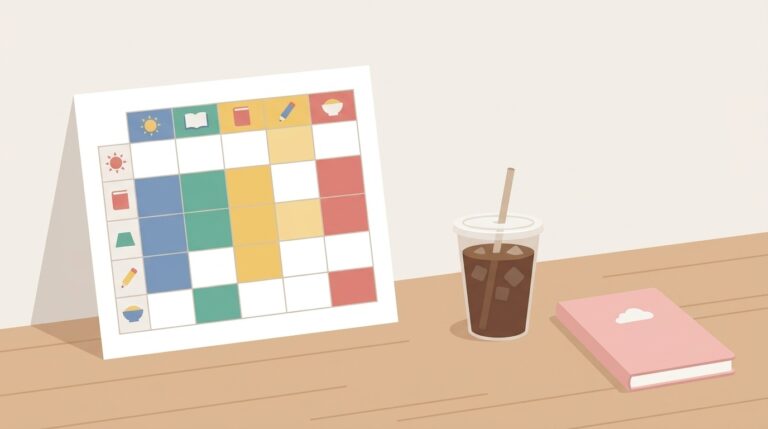
That magical sheet of paper is the 시간표 (siganpyo) — the school timetable.
Whether you are planning to study abroad at a gorgeous campus in Seoul, or you simply want to understand what your favorite K-Drama characters are stressing about, mastering basic school timetable vocabulary is your golden ticket. Let’s make sure you never walk into the wrong classroom!
Deep Dive: Core Timetable Expressions
Here are three essential words every beginner must know to understand a Korean school schedule.
1. 수업 (Class / Lesson)
- Pronunciation: [sueop] — Sounds like “soo-up”.
- Meaning: Class, lecture, or lesson.
- K-Culture Moment: In K-Dramas, you often hear a student whisper “수업 시작해!” (sueop sijakae!) which means “Class is starting!” as they scramble to sit down before the professor walks in.
- Editor’s Insight: This word refers to the active state of being taught. If you want to say “I have class,” you say “수업이 있어요” (sueobi isseoyo). Do not confuse this with “공부” (gongbu), which means the act of self-studying!
- Situation Spectrum:
- Friends (Casual): ✅
- Colleagues (Semi-formal): ✅
- Teachers/Seniors (Formal): ✅
- 🤔 Think About It: In Korea, showing up even a minute after the class starts is considered quite rude. Why do you think punctuality is so deeply tied to showing respect to your instructors in Korean society?
2. 시간표 (Timetable / Schedule)
- Pronunciation: [siganpyo] — “She-gan” (rhymes with lawn) + “pyo” (like piano without ‘ano’).
- Meaning: Timetable or class schedule.
- K-Culture Moment: Korean university students take great pride in customizing their digital timetables with cute pastel colors using apps like Everytime (에브리타임) and sharing them with friends online.
- Editor’s Insight: This word is a compound of 시간 (sigan – time) and 표 (pyo – chart/table). Literally, it is a “time chart.”
- Situation Spectrum:
- Friends (Casual): ✅
- Colleagues (Semi-formal): ✅
- Teachers/Seniors (Formal): ✅
- 🤔 Think About It: Many languages use words like “schedule” or “timetable.” How does your native language structure this word? Is it also a combination of “time” and “table”?
3. 교시 (Period / Class Hour)
- Pronunciation: [gyosi] — “Gyo” (rhymes with yo) + “she”.
- Meaning: Class period (e.g., 1st period, 2nd period).
- K-Culture Moment: The dreaded 1교시 (il-gyosi) is the first class of the day, usually starting at 9:00 AM. Korean college students talk about 1교시 the same way adults talk about Monday mornings—with a lot of coffee and deep sighs!
- Editor’s Insight: To say a specific period, just put a Sino-Korean number in front of it: 1교시 (il-gyosi – 1st period), 2교시 (i-gyosi – 2nd period), etc.
- Situation Spectrum:
- Friends (Casual): ✅
- Colleagues (Semi-formal): ✅
- Teachers/Seniors (Formal): ✅
- 🤔 Think About It: Why do you think Korean schools count classes by numbered “periods” rather than just by clock times?
Textbook vs. Real Korean
Let’s look at how textbooks teach school life compared to how actual Korean students speak in real life.
Asking if someone has class today
- 📖 Textbook Korean: “오늘 수업이 있습니까?” (oneul sueobi isseumnikka? – Do you have class today?)
- 🗣️ Real Korean: “오늘 수업 있어?” (oneul sueop isseo? – Casual, to friends) or “오늘 수업 있어요?” (oneul sueop isseoyo? – Polite)
- 💡 Why is it different?: Textbook forms ending in ~습니까 are extremely formal and make you sound like a news reporter on campus. Stick to ~요 or casual speech (반말) with friends!
Talking about a free/empty block in your schedule
- 📖 Textbook Korean: “쉬는 시간입니다.” (swineun sigan-imnida. – It is recess/break time.)
- 🗣️ Real Korean: “나 오늘 공강이야!” (na oneul gonggang-iya! – I have an empty/free period today!)
- 💡 Why is it different?: 공강 (gonggang) is the ultimate campus slang. It literally means “empty lecture” and is used when you have a big gap between classes or an entire day off!
Cultural Context: K-Campus Insights
Non-Verbal Etiquette
If you happen to walk into a classroom late, do not make a big scene. Enter quietly, make eye contact with the professor, and give a polite, slight bow of the head before taking the nearest seat. When handing your homework or student ID to a teacher, always use two hands—this is a non-negotiable sign of respect in Korea!
The “Sugang Sincheong” War
At the start of every semester, Korean university students participate in 수강신청 (sugangsincheong – class registration). It is a digital battleground. Students literally run to PC Bangs (internet cafes) because the internet speed is faster there, waiting for the clock to strike exactly 10:00 AM to click “register” for their preferred timetable classes. If you click a second too late, your dream schedule is gone!
Interactive Roleplay Scenario
Scenario A: Chatting over Coffee at a Campus Cafe
- Setting: A lively cafe near a university in Seoul. You are sitting with Minjun, a friendly senior student (선배).
- Characters:
- YOU: An international exchange student.
- Minjun (민준): Your friendly Korean classmate.
민jun: 오늘 수업 몇 교시까지 있어?
(Oneul sueop myeot gyosikkaji isseo?)
[How many periods of class do you have today?]
(🎭 Stage Direction: Minjun sips his iced Americano and looks at your printed schedule)

YOU: 저는 오늘 3교시까지 있어요. 선배는요?
(Jeoneun oneul sam-gyosikkaji isseoyo. Seonbaeneun-yo?)
[I have classes until 3rd period today. How about you, senior?]

민jun: 나는 오늘 공강이야! 부럽지? 😋
(Naneun oneul gonggang-iya! Bureopji?)
[Today is my free day! Aren't you jealous?]
🔀 Your Turn! How will you respond to Minjun?
* A) “아, 진짜요? 대박!” (Ah, jinjjayo? Daebak! — “Oh, really? Awesome!”)
* B) “수업이 없어요? 부러워요!” (Sueobi eopseoyo? Bureowoyo! — “You don’t have class? I’m jealous!”)✅ Best Choice: B is perfect! It uses polite, natural Korean while matching Minjun’s friendly tone. A is also fun and very natural among close friends, but B is safer if you want to keep a polite boundary with a senior (선배).
10-Second Shadowing Drill
Let’s practice speaking with real-life natural rhythm!
😊 월요일 / 1교시 수업은 / 정말 힘들어요!
(woryoil / il-gyosi sueobeun / jeongmal himdeureoyo!)
Translation: Monday first-period class is really tough!
(Practice tip: Pause slightly at each / and try to say “정말” with an exaggerated sigh to express how tired you are!)
K-Culture Mini Dictionary
- 공강 (gonggang)
- Romanization: gonggang
- English: An empty period/day with no classes on your schedule.
- 선배 (seonbae)
- Romanization: seonbae
- English: A senior student or mentor at school or work.
- 학식 (haksik)
- Romanization: haksik
- English: School cafeteria food (cheap, quick, and surprisingly tasty!).
- 출석 (chulseok)
- Romanization: chulseok
- English: Attendance. In Korea, missing classes can heavily lower your grade, regardless of exam scores!
Traveler’s Survival Kit
Even if you are just visiting a beautiful campus like Yonsei or Ewha University as a traveler, these phrases will save your day:
🆘 Survival Phrase #1
* 🇰🇷 “학생식당이 어디예요?” (haksaeng-sikdangi eodiyeyo?)
* 🗣️ Pronunciation guide: Hak-saeng seek-dang-ee uh-dee-yeh-yo?
* 📍 Where to use: Asking campus security or students for the cheap student cafeteria.🆘 Survival Phrase #2
* 🇰🇷 “이거 대학생 할인 돼요?” (igeo daehaksaeng harin dwaeyo?)
* 🗣️ Pronunciation guide: Ee-guh dae-hak-saeng ha-rin dwae-yo?
* 📍 Where to use: At cafes or museums near universities to ask for a student discount.
- 📌 Editor’s Travel Note: Always use Naver Map or KakaoMap when exploring Korean campuses. Google Maps often gets lost inside massive university grounds!
Critical Thinking Corner — “One Step Deeper”
In Korean school life, the way you speak changes dramatically depending on whether you are talking to a classmate of the same age, a senior (선배), or a professor. This hierarchical speech system is not just about grammar; it reflects the deep Confucian roots of respect for age and experience in Korean society.
💬 Your Turn: How does your culture or language show respect to teachers or senior students? Do you change your words, or is it more about body language? Share your thoughts in the comments below!
FAQ & Common Mistakes
- Q: Can I use “반말” (casual language) with classmate students right away?
- A: No! Even if they look your age, always start with polite language (존댓말). You can ask, “말 놓아도 돼요?” (mal noado dwaeyo? – May I speak casually?) once you become close.
- ❌ Common Mistake: Saying “공부가 있어요” (gongbuga isseoyo) to mean “I have class.”
- ✅ Correct Way: Say “수업이 있어요” (sueobi isseoyo). 공부 is the act of studying on your own, while 수업 is the scheduled class.
Summary & Action Items
- One-Liner Summary: Mastering words like 수업 (class), 시간표 (timetable), and 공강 (free period) makes navigating Korean campus culture effortless!
- Action Mission:
- 🥉 Bronze: Say “오늘 수업 있어요” out loud 3 times in front of a mirror.
- 🥈 Silver: Try creating your imaginary 3-class Korean timetable using Korean words!
- 🥇 Gold: Find a K-drama campus scene and try to spot if they are running late for a class.
Quick Quiz: Test Yourself!
1. What is the Korean word for a “free day” or “empty period” in your schedule?
* A) 수업 (sueop)
* B) 시간표 (siganpyo)
* C) 공강 (gonggang)
2. True or False: You should say “공부가 있어요” to tell someone you have a class starting.
* (True / False)
(Answers: 1. C | 2. False. You should say “수업이 있어요”!)
Frequently Asked Questions (FAQ)
Q: What does "수업 (Class / Lesson)" mean in Korean and how do you pronounce it?
A: In Korean, "수업 (Class / Lesson)" is pronounced [sueop] and means: Class, lecture, or lesson.
Q: What does "시간표 (Timetable / Schedule)" mean in Korean and how do you pronounce it?
A: In Korean, "시간표 (Timetable / Schedule)" is pronounced [siganpyo] and means: Timetable or class schedule.
Q: What does "교시 (Period / Class Hour)" mean in Korean and how do you pronounce it?
A: In Korean, "교시 (Period / Class Hour)" is pronounced [gyosi] and means: Class period (e.g., 1st period, 2nd period).







