

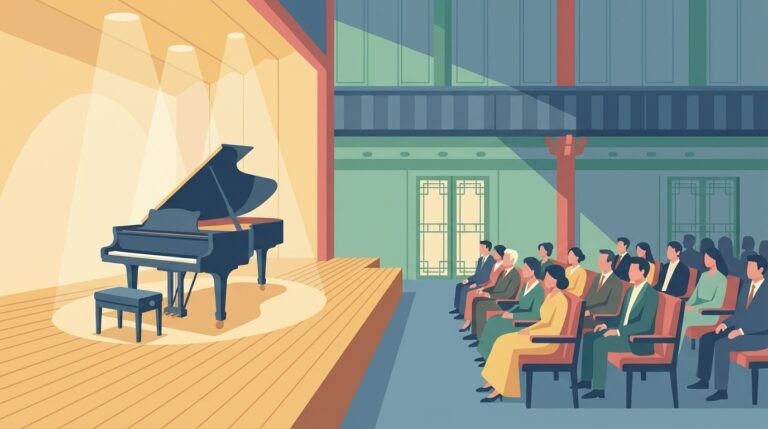
The Art of Silence: How to Survive a Classical Concert in Seoul Without Breaking the Spell
안녕하세요! Welcome back to Daily Hangul. It’s your favorite editor and local cultural navigator.
Have you ever watched the K-Drama Do You Like Brahms? (브람스를 좋아하세요?) and found yourself swooning over the intense, emotional silence between the piano notes? Classical music has a massive, highly dedicated following in South Korea. From world-class concert halls like the Seoul Arts Center (예술의전당) to cozy chamber music halls in Hanok villages, Koreans take their performing arts very seriously.
But here is the catch: Korean classical concert etiquette is legendary for its strictness. If you drop a phone, cough too loudly, or—heaven forbid—clap at the wrong moment, you might feel a dozen laser-like stares burning into your back. This isn’t just about being polite; it’s about 눈치 (nunchi), the art of reading the room and keeping the collective harmony.
Today, we are going to dive into the essential Korean phrases and unwritten cultural rules of classical concerts, so you can enjoy the music like a true Seoul insider! This is tailored for our B2 (Intermediate) learners, so expect some beautifully nuanced expressions.
Phase 2: Core Expressions Deep Dive
Let’s look at the absolute essential phrases you need to know (and understand when you hear them) inside a Korean concert hall.
1. 악장 사이에는 박수를 치지 않아요.
- Pronunciation: [Ak-jang sa-i-e-neun bak-su-reul chi-ji a-na-yo]
- Meaning: We don’t clap between movements (literal and real nuance).
- K-Culture Moment: Picture a tense scene in a melodrama where the prodigy pianist finishes a grueling first movement. The hall is dead silent, holding its collective breath. Suddenly, an unsuspecting tourist claps. The spell is broken, and the protagonist’s eyes flash with mild annoyance. That’s why this rule is golden!
- Editor’s Insight: In Korea, clapping between movements is considered a major faux pas. Even if you are deeply moved, wait until the conductor completely lowers their baton and turns to face the audience.
- Situation Spectrum:
- Friends (Casual): ✅
- Colleagues (Semi-formal): ✅
- Seniors/Formal: ✅ (This is a general rule of thumb for everyone!)
- 🤔 Think About It: Why does Korean culture value collective silence so deeply during performances? In a society that is often fast-paced and loud, the concert hall is treated as a sacred sanctuary of shared focus.
2. 소음이 나지 않게 조심해 주세요.
- Pronunciation: [So-eu-mi na-ji an-ge jo-sim-hae ju-se-yo]
- Meaning: Please be careful not to make any noise.
- K-Culture Moment: You are sitting in the grand hall. You want to unwrap a cough drop. In Korea, the slow, agonizing crinkle-crinkle of a plastic wrapper is considered worse than a loud sneeze because it drags on. Your neighbor might lean over and whisper this politely.
- Editor’s Insight: The word 소음 (so-eum) means “noise” or “discordant sound.” By adding “조심해 주세요” (please be careful/mindful), it softens the request while still conveying a firm expectation of absolute silence.
- Situation Spectrum:
- Friends (Casual): ✅
- Colleagues (Semi-formal): ✅
- Seniors/Formal: ✅
- 🤔 Think About It: Notice how the subject “you” is omitted in this Korean sentence. Instead of saying “You are being noisy,” Koreans focus on the noise itself (“Please be careful so noise doesn’t happen”). How does this indirectness help preserve harmony in public spaces?
3. 휴대폰은 무음이나 전원을 꺼 주시기 바랍니다.
- Pronunciation: [Hyu-dae-po-neun mu-eum-i-na jeon-wo-neul kkeo ju-si-gi ba-ram-ni-da]
- Meaning: Please set your phone to silent or turn it off.
- K-Culture Moment: Before the orchestra starts, a gentle voice over the PA system reminds the audience of this. In Korea, even “vibrate” mode is considered too loud because the wooden floors of concert halls amplify the buzzing sound!
- Editor’s Insight: This uses the formal grammatical structure -기 바랍니다 (I hope/request that you…), which is the standard polite tone for public announcements.
- Situation Spectrum:
- Friends (Casual): 🚫 (Too formal for friends)
- Colleagues (Semi-formal): ⚠️
- Public Announcements/Formal: ✅
- 🤔 Think About It: In your home country, is “vibrate” mode acceptable during a classical concert, or do people turn their devices completely off?
Phase 3: Textbook vs. Real Korean
Let’s compare the dry, stiff language of textbooks with the living, breathing Korean you’ll actually hear and use.
Requesting Silence
* 📖 Textbook: “정숙히 해 주십시오.” (Please maintain silence – sounds like a library sign from the 1980s)
* 🗣️ Real Korean: “조금만 조용히 해 주세요.” (Please be a little quiet.) or simply whispering “쉿!” (Shh!)
* 💡 Why the difference?: Koreans prefer soft, indirect requests in person to avoid direct confrontation, saving the super-formal textbook terms for printed signs.
Discussing an Annoyance (The dreaded ‘Gwan-keu’)
* 📖 Textbook: “관객의 행동이 방해됩니다.” (The audience’s behavior is disruptive.)
* 🗣️ Real Korean: “오늘 완전 관크 당했어요.” (I totally got ‘gwan-keued’ today.)
* 💡 Why the difference?: 관크 (Gwan-keu) is a modern slang portmanteau of 관객 (gwan-gaek – audience) and ‘Critical Hit’ (from gaming). It refers to anyone who ruins a performance for others by whispering, using their phone, or coughing excessively.
Phase 4: Cultural Context — K-Culture Deep Dive
4-1. The Non-Verbal Art of Concert Hall Nunchi (눈치)
If you must cough during a performance, do not simply cough. There is an art to it! Koreans will bury their face into their sleeve, or wait until a loud tutti (the whole orchestra playing passionately) to cough or blow their nose. If you accidentally make a sound, the correct non-verbal response is a quick, apologetic bow of the head (고개 숙여 사과하기) to those immediately around you when the lights go up.
4-2. K-Drama Connection: Penthouse and the Drama of Classical Music
In dramas like The Penthouse: War in Life, classical music concerts are arenas of intense social warfare. Characters dress in high-end luxury fashion and maintain a flawless, cold exterior. In reality, classical music in Seoul is highly appreciated by young adults, not just the wealthy elite. Going to a concert at the Lotte Concert Hall is a popular, romantic date-night activity. Dressing smartly (business casual) is highly recommended to match this elegant vibe!
Phase 5: Real-Life Roleplay Scenario
Scenario A: Surviving the Intermission at Seoul Arts Center
- Setting: Friday night, 8:30 PM. Intermission during a Chopin piano concerto. The lobby is bustling with people buying program books and sipping espresso.
- Characters:
- YOU: An intermediate learner enjoying their first classical concert in Seoul.
- Ji-woo (지우): Your classical music-loving Korean friend (28, sophisticated and helpful).
**지우:** 오늘 연주 정말 대단하지 않아요? 🎹
(Oneul yeon-ju jeong-mal dae-dan-ha-ji a-na-yo?)
[Translation: Isn't today's performance truly amazing?]
(🎭 Stage Direction: Ji-woo holds a program book with shining eyes)

**YOU:** 네, 진짜 소름 돋았어요! 그런데 아까 연주 중에 옆 사람 때문에 조금 집중이 안 됐어요.
(Ne, jin-짜 so-reum do-da-sseo-yo! Geon-de a-kka yeon-ju jung-e yeop sa-ram ttae-mu-ne jo-geum jip-jung-i an dwae-sseo-yo.)
[Translation: Yes, I literally got goosebumps! But during the performance earlier, I couldn't focus well because of the person next to me.]

**지우:** 아, 진짜요? 왜요? 무슨 일 있었어요?
(A, jin-jja-yo? Wae-yo? Mu-sun il i-sseo-sseo-yo?)
[Translation: Oh, really? Why? What happened?]

**YOU:** 휴대폰을 진동으로 해 두셨는데 계속 웅웅 울리더라고요.
(Hyu-dae-po-neun jin-dong-eu-ro hae du-syeon-neun-de gye-sok ung-ung ul-li-deo-ra-go-yo.)
[Translation: They put their phone on vibrate, but it kept buzzing over and over.]

**지우:** 아... 진짜 '관크' 제대로 당하셨네요. 한국 공연장에서는 진동 소리도 엄청 크게 들리거든요.
(A... jin-jja 'gwan-keu' jeo-dae-ro dang-ha-syeon-ne-yo. Han-guk gong-yeon-jang-e-seo-neun jin-dong so-ri-do eom-cheong keu-ge deul-li-geo-deun-yo.)
[Translation: Oh... you got hit with a major 'gwan-keu'. In Korean concert halls, even the vibration sound is heard incredibly loudly.]
🔀 YOUR TURN! How do you reply?
* A) “그 사람한테 조용히 하라고 말할 걸 그랬어요.” (I should have told them to be quiet.)
* B) “그래도 2부 때는 괜찮겠죠?” (But the second half will be okay, right?)
* C) “경찰에 신고해야 했어요!” (I should have called the police!)✅ Best Choice: B — It naturally continues the flow of conversation with an optimistic tone, which matches the polite, conflict-avoidant nature of intermediate Korean social dynamics.
⚠️ Choice A Analysis: While natural, saying you should have directly confronted them might sound slightly aggressive in a polite classical concert setting. Usually, people let the usher (어셔) handle it.
Phase 6: 10-Second Shadowing Drill
Practice saying this naturally to show off your B2-level nuance. Focus on the flow!
😊 악장 사이에는 / 박수를 치지 않는 것이 / 기본 예의예요.(Ak-jang sa-i-e-neun / bak-su-reul chi-ji an-neun geo-si / gi-bon ye-ui-yeo-yo.)
Emotion: 😊 Informative, warm, and helpful.
Translation: “Not clapping between movements is basic etiquette.”
Phase 7: K-Culture Mini Dictionary
- 관크 (Gwan-keu)
- Romanization: gwan-keu
- Meaning: Audience spoiler / performance disruption.
- Context: Used widely online and offline by theater and concertgoers to describe bad etiquette.
- 어셔 (Eosyeo)
- Romanization: eo-syeo
- Meaning: Concert hall usher.
- Context: If someone is disrupting you, don’t argue. Wave down an ‘eosyeo’ during intermission; they are highly trained to handle disputes quietly.
- 기립박수 (Girip-baksu)
- Romanization: gi-rip-bak-su
- Meaning: Standing ovation.
- Context: Reserved for truly legendary performances in Korea. If the crowd stands up and claps, you know it was a masterpiece.
- 예술의전당 (Yesul-ui Jeondang)
- Romanization: ye-sul-ui jeon-dang
- Meaning: Seoul Arts Center.
- Context: The absolute mecca of performing arts in South Korea, located in Seocho-dong, Seoul.
Phase 8: Traveler’s Survival Kit
If you are planning to catch a concert in Seoul, pack these three phrases in your linguistic suitcase!
🆘 Survival Expression #1
* 🇰🇷 “물품보관소는 어디에 있나요?”
* 🗣️ Pronunciation Guide: [Mul-pum-bo-gwan-so-neun eo-di-e in-na-yo?]
* 📍 Where to use: At the lobby, to store heavy coats, shopping bags, or backpacks (bulky items are not allowed at your seat!).🆘 Survival Expression #2
* 🇰🇷 “프로그램북 하나 주세요.”
* 🗣️ Pronunciation Guide: [Peu-ro-geu-raem-buk ha-na ju-se-yo.]
* 📍 Where to use: At the merchandise desk to buy the concert booklet (usually around 3,000 to 5,000 KRW).📌 Editor’s Travel Note
* Ticket Booking: Use Interpark Ticket (Global site) or Yes24 to book classical performances.
* Late Arrival: If you are late, you cannot enter immediately. You will be held at the doors until a designated ‘latecomer entry time’ (지각 관객 입장 시간), usually after the first piece or movement.
Phase 9: Critical Thinking — “Going Deeper”
Silence vs. Shouting: The Dual Nature of Korean Audience Culture
Have you noticed the fascinating contrast in Korean performance spaces? At a K-Pop concert or a sporting match, the crowd is encouraged to scream, sing along (떼창 – ttechang), and shake lightsticks. Yet, steps away in a classical concert hall, the absolute absence of sound is demanded.
This duality shows that Korean etiquette is not about rules for the sake of rules; it is about respecting the genre and the performers. In K-Pop, showing energy is respect. In classical music, offering absolute silence is the ultimate form of devotion.
💬 Your Turn: “In your country, how do audience behaviors differ between a rock concert and an opera or orchestra show? Let me know in the comments below!”
Phase 10: FAQ & Common Mistakes
- Q: Can I take photos of the empty stage before the show starts?
- A: Maybe/Usually No. While some venues allow it, many strict halls in Korea forbid taking photos inside the hall entirely, even of just the empty seats. Look out for the ushers holding signs that say “No Photography.”
- Q: What if I have a sudden coughing fit?
- A: Quietly slip out of the hall if you are near an aisle, or bury your face in a thick scarf. Ushers sometimes distribute small candies in wrappers to help, but unwrap them quickly before the movement starts!
❌ Common Mistake: Whispering to your friend during the music because “it’s not full-volume speaking.”
✅ How to fix it: In Korean concert acoustics, even whispers carry exceptionally well. Save all commentary for the intermission (인터미션)!
Phase 11: Summary & Action Items
One-Liner Summary
Respect the silence, wait for the conductor’s hands to drop before clapping, and keep your phone completely silent to master Korean concert etiquette!
Action Mission
- 🥉 Bronze: Say “악장 사이에는 박수를 치지 않아요” out loud three times to practice your pronunciation flow.
- 🥈 Silver: Search “예술의전당” (Seoul Arts Center) on Instagram or Naver and look at the gorgeous architecture.
- 🥇 Gold: Next time you listen to classical music, practice waiting for the complete silence at the end of a piece before you ‘mentally’ clap!
Phase 12: Interactive Challenge Quiz
1. What is the modern Korean slang for someone who disrupts a performance?
* A) 관객 (Gwan-gaek)
* B) 관크 (Gwan-keu)
* C) 어셔 (Eo-syeo)
2. True or False: Putting your phone on vibrate is completely acceptable in Korean classical concert halls.
3. Fill in the blank: “소음이 나지 않게 ________ 주세요.” (Please be careful not to make noise.)
* A) 먹어 (meogeo)
* B) 조심해 (josimhae)
* C) 가 (ga)
🔑 Quiz Answers
- B (Gwan-keu is the slang combining ‘audience’ and ‘critical hit’)
- False (The vibration noise can resonate on the wooden floors; silent or power off is expected!)
- B (조심해 – Please be careful/mindful)
Frequently Asked Questions (FAQ)
Q: What does "악장 사이에는 박수를 치지 않아요." mean in Korean and how do you pronounce it?
A: In Korean, "악장 사이에는 박수를 치지 않아요." is pronounced [Ak-jang sa-i-e-neun bak-su-reul chi-ji a-na-yo] and means: We don't clap between movements (literal and real nuance).
Q: What does "소음이 나지 않게 조심해 주세요." mean in Korean and how do you pronounce it?
A: In Korean, "소음이 나지 않게 조심해 주세요." is pronounced [So-eu-mi na-ji an-ge jo-sim-hae ju-se-yo] and means: Please be careful not to make any noise.
Q: What does "휴대폰은 무음이나 전원을 꺼 주시기 바랍니다." mean in Korean and how do you pronounce it?
A: In Korean, "휴대폰은 무음이나 전원을 꺼 주시기 바랍니다." is pronounced [Hyu-dae-po-neun mu-eum-i-na jeon-wo-neul kkeo ju-si-gi ba-ram-ni-da] and means: Please set your phone to silent or turn it off.







