

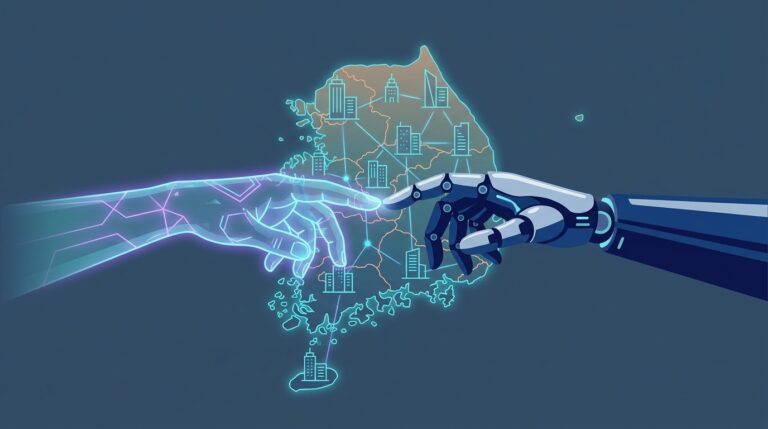
Playing God in Pangyo? Navigating the Ethical Boundaries of Human Augmentation in Korean
안녕하세요! Welcome back to Daily Hangul, your premium window into the soul of the Korean language and culture. I’m your senior editor and resident cultural navigator.
Imagine this: You’re sitting in a sleek, glass-walled cafe in Pangyo Techno Valley (판교테크노밸리)—Korea’s Silicon Valley. To your left, a group of young developers are debating over iced Americanos. To your right, a tech startup founder is sketching neural interface designs on his iPad. The atmosphere is electric with innovation. But beneath the surface, a heavy philosophical question looms: Where do we draw the line when technology begins to alter what it means to be human?
If you’ve watched futuristic K-Dramas like SF8 or Rugal, you know that Korea is obsessed with the intersection of cutting-edge technology and human emotion. For a C2-level learner like you, discussing basic tech terms isn’t enough. To truly engage in high-level intellectual discourse with Korean academics, tech leaders, or colleagues, you need to master the nuanced, socio-ethical lexicon of Human Augmentation (인간 증강) and Tech Ethics (과학 기술 윤리).
Today, we’re going deep. Let’s explore how to articulate complex ethical standpoints in Korean with the sophistication of a native intellectual.
Phase 2: Deep Dive into Key Expressions
To debate tech ethics at a C2 level, you need vocabulary that transcends textbook definitions and taps into deep societal values. Here are three crucial expressions.
1. 인간의 존엄성을 해치다
- Pronunciation: [in-gan-ui jon-eom-seong-eul hae-chi-da]
- Meaning: To infringe upon/violate human dignity.
- K-Culture Moment: In K-Dramas exploring cloning or cybernetic replacement, this phrase is the ultimate weapon of resistance. When a scientist tries to justify replacing human limbs with superior cybernetics, the opposing ethicist will inevitably use this phrase to bring the room to a solemn silence.
- Editor’s Insight: The word 존엄성 (dignity) is sacred in Korean discourse. Unlike “human rights” (인권), which has political and legal connotations, “존엄성” carries an almost spiritual, existential weight.
- Situation Spectrum:
- Casual: ⚠️ (Slightly heavy for casual chit-chat, but great for deep late-night talks)
- Semi-formal: ✅
- Formal: ✅
- 🤔 Think About It: Why does Korean public discourse prioritize “존엄성” (dignity) over individual absolute autonomy when discussing biotechnology? How does this reflect the Confucian foundations of societal harmony?
2. 빈익빈 부익부 현상을 심화시키다
- Pronunciation: [bin-ik-bin bu-ik-bu hyeon-sang-eul sim-hwa-si-ki-da]
- Meaning: To exacerbate the phenomenon of “the rich getting richer and the poor getting poorer” (polarization).
- K-Culture Moment: Think of Squid Game (오징어 게임) or Parasite (기생충). If cognitive or physical augmentation becomes a commodity, only the ultra-wealthy will afford “super-human” upgrades, creating a literal biological class divide.
- Editor’s Insight: 빈익빈 부익부 is a classic four-character idiom (사자성어) that translates to “the poor get poorer, the rich get richer.” Using this in a debate instantly elevates your fluency from “highly fluent foreigner” to “intellectual elite.”
- Situation Spectrum:
- Casual: ⚠️
- Semi-formal: ✅
- Formal: ✅
- 🤔 Think About It: How does the extreme competitiveness of Korean society (competitive education, career ladders) amplify the fear of technological polarization compared to Western societies?
3. 사회적 합의를 도출하다
- Pronunciation: [sa-hoe-jeok hap-ui-reul do-chul-ha-da]
- Meaning: To derive/reach a social consensus.
- K-Culture Moment: Korea’s regulatory environment moves lightning-fast, but it is heavily guided by public sentiment. Before any radical technology is deployed, the media and government constantly call for a “사회적 합의.”
- Editor’s Insight: The verb 도출하다 (to derive/draw out) is much more sophisticated than simply “만들다” (to make) or “이루다” (to achieve). It implies a rigorous, collaborative process of extracting agreement from diverse viewpoints.
- Situation Spectrum:
- Casual: 🚫
- Semi-formal: ✅
- Formal: ✅
- 🤔 Think About It: In a highly collectivist society, does “social consensus” sometimes stifle individual pioneering technological spirits, or does it protect the vulnerable?
Phase 3: Textbook vs. Real Korean
When debating at a C2 level, textbooks often make you sound like a written legal document. Real-life high-level debates are dynamic, metaphorical, and sharp.
[Situation 1: Discussing the limits of genetic modification]
* 📖 Textbook Korean: 인간 유전자 편집 기술에 대해 우려가 제기되고 있습니다. (Concerns are being raised regarding human gene editing technology.)
* 🗣️ Real Korean: 유전자 편집은 인류가 결코 넘어서는 안 될 선을 넘는 일일지도 모릅니다. (Gene editing might be crossing a line that humanity should absolutely never cross.)
* 💡 Why the difference?: C2 mastery means using the vivid metaphor of “선을 넘다” (to cross the line). It shifts the tone from a dry academic report to a powerful, engaging moral warning.
[Situation 2: Proposing regulatory speed]
* 📖 Textbook Korean: 기술이 발전하기 전에 법률적인 규제를 빨리 만들어야 합니다. (We must quickly make legal regulations before technology develops.)
* 🗣️ Real Korean: 기술의 폭주를 막기 위해 선제적인 제도적 장치 마련이 시급합니다. (To prevent technology from running wild, establishing preemptive institutional mechanisms is of utmost urgency.)
* 💡 Why the difference?: Words like 폭주 (running wild/out of control) and 선제적 제도적 장치 (preemptive institutional mechanisms) demonstrate that you possess the advanced vocabulary needed to write policy briefs or columns in major Korean newspapers.
Phase 4: Cultural Context — K-Culture Deep Dive
4-1. The Role of “눈치” (Nunchi) in Tech Ethics
In Korea, ethics are rarely discussed in a vacuum. They are deeply tied to 눈치 (Nunchi)—the art of sensing others’ feelings and the collective atmosphere. When discussing human augmentation, Koreans naturally apply “collective Nunchi.” There is a strong social pressure not to stand out too aggressively through artificial enhancement if it disrupts the harmony or fairness of the community. If you augment your brain to pass the Suneung (college entrance exam), you aren’t just “improving yourself”; you are viewed as disrupting the communal playing field.
4-2. The K-Drama Connection
Consider the K-Drama anthology SF8, particularly the episode “Baby It’s Over Outside.” It deals with the end of the world and technological choices. Korean sci-fi often focuses not on the cool spaceships, but on 정 (Jeong – affection/bonding) and family structures. If a human becomes 90% machine, can they still feel Jeong? This is the core philosophical dilemma that worries Korean audiences.
Phase 5: Practical Roleplay Scenario
Scenario A: The Late-Night Debate in Sinchon
Setting: 10:30 PM. A cozy, intellectual craft beer bar near Yonsei University. You are discussing tech ethics with Minsu (a bio-ethics researcher) and Sujin (a robotic engineer).
Characters:
* YOU: An international tech ethicist visiting Seoul.
* 민수 (Minsu): Analytical, deeply ethical, believes in human dignity over profits.
* 수진 (Sujin): Pragmatic, progress-oriented, fears Korea will fall behind globally.
Dialogue:
수진: 결국 글로벌 경쟁에서 뒤처지지 않으려면 인간 증강 연구에 대한 규제를 대폭 완화해야 해요. 미국이랑 중국은 이미 저만치 앞서가고 있잖아요.
(Su-jin: Gyeol-guk geul-lo-beol gyeong-jaeng-e-seo dwi-cheo-ji-ji a-nyeol-ryeo-myeon in-gan jeung-gang yeon-gu-e dae-han gyu-je-reul dae-pok wan-hwa-hae-ya hae-yo. Mi-guk-i-rang jung-guk-eun i-mi jeo-man-chi ap-seo-ga-go it-ja-na-yo.)
Sujin: In the end, if we don’t want to fall behind in global competition, we must drastically ease regulations on human augmentation research. The US and China are already so far ahead.
(🎭 Stage Direction: Sujin takes a sip of her IPA, looking intensely at Minsu)
민수: 하지만 수진 씨, 경쟁 논리만 앞세우다가 인간의 존엄성마저 훼손된다면 그 기술이 무슨 가치가 있겠습니까?
(Min-su: Ha-ji-man Su-jin ssi, gyeong-jaeng nol-ri-man ap-se-u-da-ga in-gan-ui jon-eom-seong-ma-jeo hwe-son-daen-da-myeon geu gi-sul-i mu-seun ga-chi-ga it-get-seup-ni-ka?)
Minsu: But Sujin, if we only prioritize the logic of competition and end up damaging human dignity, what value does that technology even hold?
🔀 YOUR TURN! How do you intervene?
* A) “맞아요. 기술 발전보다는 인간이 먼저죠.” (Too simple for C2, lacks depth.)
* B) “두 분 말씀 다 일리가 있어요. 하지만 저는 기술 강국인 한국이 이 문제에서 오히려 전 세계에 윤리적 이정표를 제시할 수 있다고 봐요. 무조건적인 규제 완화나 금지보다는, 촘촘한 사회적 합의를 통해 균형을 잡는 것이 시급하지 않을까요?”
* C) “저는 솔직히 인간 증강 기술이 빈익빈 부익부 현상을 심화시킬까 봐 그게 제일 걱정돼요.”
✅ Best Choice: B
Reasoning: Choice B perfectly weaves advanced vocabulary (윤리적 이정표 – ethical milestone, 촘촘한 사회적 합의 – tight social consensus) and acknowledges the complex duality of the argument. It positions you as an diplomatic intellectual who understands Korea’s global technological status.
Phase 6: 10-Second Shadowing Drill
Let’s practice speaking with authority and emotional nuance.
😤 인간의 / 존엄성을 지키면서도 / 기술 발전을 도모하는 것은 / 결코 쉬운 과제가 아닙니다.
(in-gan-ui / jon-eom-seong-eul ji-ki-myeon-seo-do / gi-sul bal-jeon-eul do-mo-ha-neun geo-seun / gyeol-ko swi-un gwa-jae-ga ap-nip-ni-da.)
Emotion Tag: 😤 Resolute and Serious. Deliver this with a slow, deliberate pace to show that you are speaking on a profound matter.
Phase 7: K-Culture Mini Dictionary
- 판교 테크노밸리 (Pangyo Techno Valley)
- Romanization: pang-gyo te-keu-no-bael-ri
- English: Korea’s Silicon Valley located in Seongnam, south of Seoul.
- Context: The epicenter of Korea’s IT revolution and bio-tech startups.
- 선 넘다 (Seon neomda)
- Romanization: seon neom-da
- English: To cross the line.
- Context: Originally a slang, now widely used in professional settings to describe actions that violate social, moral, or ethical boundaries.
- 부작용 (Bujagyong)
- Romanization: bu-ja-gyong
- English: Side effects / Adverse effects.
- Context: In ethical debates, this refers to the negative societal or psychological consequences of rapid technological deployment.
- 우려의 목소리 (Uryeoui moksori)
- Romanization: u-ryeo-ui mok-so-ri
- English: Voices of concern.
- Context: A highly sophisticated, journalistic phrase used to describe public or academic anxiety over an issue.
Phase 8: Traveler’s Survival Kit (Intellectual/Business Edition)
If you are visiting Korea for a tech conference, academic seminar, or networking event in Pangyo, pack these phrases in your mental suitcase:
🆘 Survival Phrase #1
– 🇰🇷 “이 기술의 윤리적 가이드라인은 어떻게 마련되어 있나요?”
– Pronunciation: i gi-sul-ui yun-ri-jeok ga-i-deu-ra-in-eun eo-tteo-ke ma-ryeon-doe-eo it-na-yo?
– English: What ethical guidelines are in place for this technology?
– Usage: Perfect for Q&A sessions at tech summits or panel discussions.🆘 Survival Phrase #2
– 🇰🇷 “기술의 공공성에 대해 더 깊이 고민해봐야 합니다.”
– Pronunciation: gi-sul-ui gong-gong-seong-e dae-hae deo gip-i go-min-hae-bwa-ya hap-ni-da.
– English: We must deeply contemplate the public interest and social responsibility of technology.
📌 Editor’s Note: If you are presenting at a Korean institution, hand out your business card (명함) with both hands, and keep your eye contact respectful—do not stare down your debaters; instead, nod thoughtfully (끄덕이기) to show you are processing their perspective.
Phase 9: Critical Thinking — “One Step Deeper”
🧠 Think Deeper:
Korea transitioned from a war-torn, agrarian society to a global technological superpower in less than half a century—a phenomenon known as the Miracle on the Han River (한강의 기적). This hyper-rapid growth created a unique psychological trait in Korean society: 빨리빨리 (Palli-Palli – Hurry, Hurry) culture.When applied to tech ethics, this creates a fascinating paradox. On one hand, Korea wants to be the first to commercialize revolutionary human augmentation tools. On the other hand, the deep-seated fear of social collapse and polarization makes society highly sensitive to ethical oversight. As a C2 learner, you must realize that when Koreans debate tech ethics, they are not just discussing science—they are grappling with the trauma and triumphs of their own modern history.
💬 Your Turn: How does your home country’s historical trajectory shape its current ethical boundaries regarding biotechnology? Let us know in the comments below!
Phase 10: FAQ & Common Mistakes
- Q: Can I use the term “인체 개조” (body modification) interchangeably with “인간 증강” (human augmentation)?
- A: Absolutely not. 인체 개조 sounds like science fiction body horror or extreme body modification (like heavy tattooing/piercing). For academic and ethical discussions, always use 인간 증강 (Human Augmentation) or 신체 기능 향상 (Enhancement of physical functions).
- ❌ Common Mistake: Saying “기술이 너무 위험해서 안 돼요” (It’s not allowed because the technology is too dangerous).
- ✅ Better Alternative: “기술의 오남용 우려가 있으므로, 엄격한 법적 규제 장치가 선행되어야 합니다.” (Because of concerns regarding technology abuse, strict legal regulatory mechanisms must precede its release.)
Phase 11: Summary & Action Items
-
One-Liner Summary: True C2 fluency in Korean tech ethics requires balancing the rapid drive for innovation with deep vocabulary regarding human dignity and social consensus.
-
Action Mission:
- 🥉 Bronze: Read an editorial on Korean portal Naver News using the keyword “인간 증강 윤리” (Human augmentation ethics).
- 🥈 Silver: Write a 5-sentence paragraph in Korean stating your opinion on whether neural links should be legally allowed for students.
- 🥇 Gold: Use our shadowing drill sentence in a conversation or language exchange session this week!
Phase 12: Interactive Challenge Quiz
- Which phrase is the most sophisticated way to say “to reach a social agreement”?
- A) 대화를 많이 하다
- B) 사회적 합의를 도출하다
- C) 사람들의 조언을 듣다
- Fill in the blank:
“기술이 발전할수록 자본이 있는 사람만 혜택을 받는 ( ) 현상이 심화될 수 있다.”- Hint: The rich get richer, the poor get poorer.
[Answers]
- B. “사회적 합의를 도출하다” is the gold standard for formal and analytical discussions.
- 빈익빈 부익부 (bin-ik-bin bu-ik-bu).
Frequently Asked Questions (FAQ)
Q: What does "인간의 존엄성을 해치다" mean in Korean and how do you pronounce it?
A: In Korean, "인간의 존엄성을 해치다" is pronounced [in-gan-ui jon-eom-seong-eul hae-chi-da] and means: To infringe upon/violate human dignity.
Q: What does "빈익빈 부익부 현상을 심화시키다" mean in Korean and how do you pronounce it?
A: In Korean, "빈익빈 부익부 현상을 심화시키다" is pronounced [bin-ik-bin bu-ik-bu hyeon-sang-eul sim-hwa-si-ki-da] and means: To exacerbate the phenomenon of "the rich getting richer and the poor getting poorer" (polarization).
Q: What does "사회적 합의를 도출하다" mean in Korean and how do you pronounce it?
A: In Korean, "사회적 합의를 도출하다" is pronounced [sa-hoe-jeok hap-ui-reul do-chul-ha-da] and means: To derive/reach a social consensus.






