

안녕하세요! Welcome Back to Daily Hangul! 👋
Have you ever watched a K-Drama where the main characters walk into a cozy apartment, and right at the entryway, there is this dramatic, collective pause? They slip off their shoes, slide into soft slippers, and only then does the dialogue resume.
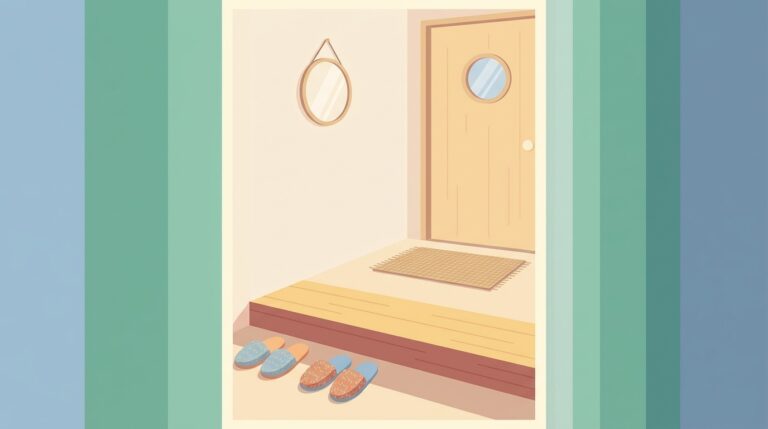
In Korea, that small transition zone at the front door is called the 현관 (hyeongwan – entrance). It’s not just a place to leave your dirty sneakers; it is a sacred boundary between the public outside world and the private, clean sanctuary of a Korean home.
If you keep your shoes on inside a Korean home, you might see your host’s eyes widen in sheer horror! Today, we are going to learn how to navigate this cultural transition like a seasoned local, using natural B1-level Korean phrases that will make your Korean friends say, “Wow, you really know our culture!”
🔑 Core Expressions: Step-by-Step at the Entrance
Let’s break down the essential phrases you will hear and use at the threshold.
1. 신발 벗고 들어오세요
- Pronunciation: Sinbal beotgo deureo-oseyo.
- Sound-alike guide: “Seen-bal but-go deu-ruh-oh-seh-yo”
- Meaning: Literal: “Take off shoes and come in.” | Real Nuance: “Please take off your shoes and come on inside.”
- K-Culture Moment: This is the ultimate warm greeting you’ll hear from any Korean host the second they open the door. The grammatical connector -고 (-go) physically binds the act of removing shoes to the act of entering—showing how inseparable these two concepts are in Korea.
- Situation Spectrum:
- Friends (Casual): ✅
- Coworkers (Semi-formal): ✅
- Bosses / Elders (Formal): ⚠️ (In very formal situations, they might use the highly polite “신발을 벗고 들어오시기 바랍니다”)
- 🤔 Think About It: Why does Korean grammar structurally bind “taking off shoes” and “entering” together? What does this say about how Koreans perceive the boundary of a home?
2. 실례합니다
- Pronunciation: Sillyehamnida.
- Sound-alike guide: “Sheel-lyeh-ham-nee-dah”
- Meaning: Literal: “I commit a discourtesy.” | Real Nuance: “Excuse me for entering your space.”
- K-Culture Moment: In K-Dramas, even when invited, characters always say this right as they cross the threshold. It’s a verbal sign of humility, acknowledging that you are stepping into someone’s personal sanctuary.
- Situation Spectrum:
- Friends (Casual): ⚠️ (With close friends, a simple “들어갈게!” [I’m coming in!] is better)
- Coworkers (Semi-formal): ✅
- Bosses / Elders (Formal): ✅
- 🤔 Think About It: How does acknowledging your presence as a slight “intrusion” (실례) reflect the core Korean value of showing respect to another person’s space?
3. 슬리퍼 신으세요
- Pronunciation: Seulli-peo sineuseyo.
- Sound-alike guide: “Seul-lee-puh shee-neu-seh-yo”
- Meaning: Literal: “Wear slippers.” | Real Nuance: “Here are some slippers for you to wear.”
- K-Culture Moment: Most Korean households keep a neat line of guest slippers near the entrance. Slipping into them is the final step of officially becoming a guest inside a Korean home.
- Situation Spectrum:
- Friends (Casual): ✅
- Coworkers (Semi-formal): ✅
- Bosses / Elders (Formal): ✅
- 🤔 Think About It: In many Western countries, slippers are deeply personal. Why do Korean homes keep specialized, clean slippers specifically reserved for guests?
🗣️ Textbook Korean vs. Real-Life Korean
When you study from a standard textbook, the language can sound a bit like a robot instruction manual. Let’s see how Koreans actually speak at the front door:
- Entering a friend’s house
- 📖 Textbook: 들어오십시오. (Deureo-osipsio – Extremely formal, sounds like a hotel lobby)
- 🗣️ Real Life: 어서 와! 편하게 있어~ (Eoseo wa! Pyeonhage isseo~ – Come on in! Make yourself at home!)
- 💡 Why the difference?: Korean friends prioritize building intimacy and comfort. Using stiff textbook honorifics can feel like you’re putting up a wall between you and your host.
- Asking if you should remove your shoes
- 📖 Textbook: 신발을 벗어야 합니까? (Sinbaleul beoseoya hamnikka? – Highly interrogative)
- 🗣️ Real Life: 신발 벗고 들어가요? (Sinbal beotgo deureogayo? – Soft, polite, conversational)
- 💡 Why the difference?: The soft ending -아요/어요 makes the question sound gentle and natural, rather than sounding like you are filling out an official form.
🇰🇷 K-Culture Deep Dive: The Art of the Hyeongwan
4-1. The Unwritten Rules of Non-Verbal Manners (Nunchi)
- Step Out First, Step Up Second: Never step onto the raised clean floor with your shoes still on, even for a second to unlace them. Balance yourself, step out of your shoes onto the lower tiled area of the hyeongwan, and then step onto the clean floor.
- The Spin Move (Pro Tip): After taking off your shoes, turn them around so the toes face the door. This makes it easy to slip them back on when you leave and signals to your host: “I am a thoughtful guest who doesn’t leave a mess behind.”
- Sock Check: Always wear clean, presentable socks! Walking barefoot on a clean Korean floor can sometimes be seen as slightly impolite, especially if you are visiting elders.
4-2. The Dramatic Meaning of the Entryway
In K-Dramas, the hyeongwan is often the setting for highly emotional scenes—confessions, tense goodbyes, or dramatic reunions. It represents the psychological line of intimacy. When a character invites someone past the shoe line, they are letting them into their heart.
🎭 Real-Life Roleplay: Dinner at Ji-su’s Place
- Setting: Friday evening, 7:00 PM. Outside Ji-su’s apartment. You can smell delicious food cooking inside. You press the doorbell.*
- Characters:
- YOU: An intermediate Korean learner visiting a friend’s home for dinner.
- JI-SU (지수): Your warm, welcoming Korean friend.
지수: 어, 왔어? 어서 들어와! 🚪
(Eo, wasseo? Eoseo deureowa!)
[Oh, you're here? Come on in!]
(🎭 Stage Direction: Ji-su opens the door with a bright smile, wearing a home apron.)

YOU: 안녕하세요, 지수 씨! 초대해 주셔서 감사합니다. 🎁
(Annyeonghaseyo, Ji-su ssi! Chodaehae jusyeoseo gamsahamnida.)
[Hello, Ji-su! Thank you so much for inviting me.]

지수: 에이, 뭘 그런 말을 해. 현관에서 신발 벗고 들어와.
(Ei, mwol geureon mareul hae. Hyeongwaneseo sinbal beotgo deureowa.)
[Oh, don't mention it! Take off your shoes at the entrance and come on in.]

YOU: 아, 네! 신발은 그냥 여기 벗어두면 돼요?
(Ah, ne! Sinbareun geunyang yeogi beoseodumyeon dwaeyo?)
[Ah, yes! Can I just leave my shoes here?]

지수: 응, 그냥 편하게 벗어놔.
(Eung, geunyang pyeonhage beoseonwa.)
[Yeah, just leave them comfortably.]
🔀 Your Turn! What do you do with your shoes?
– A) Leave them pointing toward the inside of the house and rush in.
– B) Turn them around so the toes face the exit door.
– C) Put them directly in your bag to be safe.✅ Best Choice: B — Turning your shoes around shows amazing cultural sense (센스) and respect for the household.
지수: 와, 신발 돌려놓은 것 봐! 한국 문화 잘 아네, 대박! 👍
(Wa, sinbal dollyeonon geot bwa! Hanguk munhwa jal ane, daebak!)
[Wow, look at you turning your shoes around! You know Korean culture so well, awesome!]

YOU: 하하, 매일한글에서 배웠어요. 여기 슬리퍼 신을까요?
(Haha, Maeil Hangul-eseo baewasseoyo. Yeogi seulli-peo sineulkkayo?)
[Haha, I learned it from Daily Hangul. Should I wear these slippers?]

지수: 응, 그거 신고 들어와. 편하게 있어!
(Eung, geugeo singo deureowa. Pyeonhage isseo!)
[Yeah, put those on and come in. Make yourself at home!]
⏱️ 10-Second Shadowing Drill
Practice saying these out loud to perfect your intonation! / indicates a natural pausing point.
😊 신발은 / 벗고 / 들어오세요! (sin-ba-reun / beot-go / deu-reo-o-se-yo!)
(Expression of warm welcome with a friendly, bright tone)🥺 실례지만 / 신발 / 벗어야 해요? (sil-lye-ji-man / sin-bal / beo-seo-ya hae-yo?)
(Polite, soft tone for when you are unsure of the rules)
📖 K-Culture Mini Dictionary
- 현관 (hyeongwan)
- Romanization: hyeongwan
- English: Entrance / Foyer
- Context: The designated step-down area inside a Korean front door where shoes are removed.
- 온돌 (ondol)
- Romanization: ondol
- English: Korean floor heating system
- Context: The reason why Korean floors are kept spotlessly clean; historically, people lived, ate, and slept directly on the warm floor.
- 센스 (sense)
- Romanization: senseu
- English: Social tact / Savvy
- Context: Having the quick intuition to do polite things (like turning your shoes) without being asked.
- 맨발 (maenbal)
- Romanization: maenbal
- English: Barefoot
- Context: Walking without socks; generally avoided when visiting someone’s house for the first time.
🆘 Traveler’s Survival Kit
Did you know you have to take off your shoes in some traditional restaurants, historical sites, and guesthouses too? Here are your survival phrases:
- Survival Phrase #1: “여기 신발 벗고 들어가요?” (Do I take off my shoes here?)
- Survival Phrase #2: “실내화 슬리퍼 있어요?” (Are there indoor slippers?)
📌 Editor’s Travel Note
– Useful App: Use Naver Map to search for authentic Hanok (traditional Korean house) stays where you can experience genuine floor living.
– Tipping Culture: There is absolutely no tipping in Korea. Showing good manners at the door is the best way to say “thank you” to your host!
🧠 Step Deeper: The Philosophy of Cleanliness
In many Western cultures, the floor is just a surface to walk on. But in Korea, the floor is an extension of furniture. Because of 온돌 (ondol), the floor is warm, comfortable, and central to life. Leaving your shoes at the entrance is a beautiful way of saying, “I respect your living space, and I want to keep your sanctuary clean.”
💬 Your Turn: “Does your culture have a transition area like the hyeongwan? How do you welcome guests into your home? Let us know in the comments below!”
🚫 FAQ & Common Mistakes
- Q: Can I wear my shoes inside if I’m just grabbing something I forgot?
- A: Absolutely not! Even walking a few inches past the hyeongwan line with shoes on is considered highly impolite. Crawl or stretch your hand instead!
- ❌ Common Mistake: Stepping on the 문지방 (munjibang – door threshold).
- ✅ What to do instead: Always step completely over the threshold. In old Korean folklore, stepping on the threshold is said to bring bad luck to the household!
🏆 Today’s Action Mission!
- 🥉 Bronze: Say “신발 벗고 들어오세요” aloud 3 times in front of your mirror.
- 🥈 Silver: Next time you go home, practice turning your shoes around so the toes face your front door.
- 🥇 Gold: Find a K-Drama home-visit scene and spot the hyeongwan etiquette in action!
🧩 Interactive Challenge Quiz
1. What does “신발 벗고 들어오세요” mean?
– A) Please buy some new shoes.
– B) Please take off your shoes and come in.
– C) Please wait outside for a minute.
2. True or False: You should step onto the clean indoor floor while taking off your shoes.
– (True / False)
3. Why do Koreans turn their shoes around facing the door?
– A) To prevent dust from entering.
– B) To make leaving easy and show respect.
– C) To show off the brand of the shoes.
(Answers: 1-B, 2-False [you must keep your feet in the hyeongwan until shoes are off], 3-B)
Frequently Asked Questions (FAQ)
Q: What does "신발 벗고 들어오세요" mean in Korean and how do you pronounce it?
A: In Korean, "신발 벗고 들어오세요" is pronounced [Sinbal beotgo deureo-oseyo.] and means: Literal: "Take off shoes and come in." | Real Nuance: "Please take off your shoes and come on inside."
Q: What does "실례합니다" mean in Korean and how do you pronounce it?
A: In Korean, "실례합니다" is pronounced [Sillyehamnida.] and means: Literal: "I commit a discourtesy." | Real Nuance: "Excuse me for entering your space."
Q: What does "슬리퍼 신으세요" mean in Korean and how do you pronounce it?
A: In Korean, "슬리퍼 신으세요" is pronounced [Seulli-peo sineuseyo.] and means: Literal: "Wear slippers." | Real Nuance: "Here are some slippers for you to wear."







