

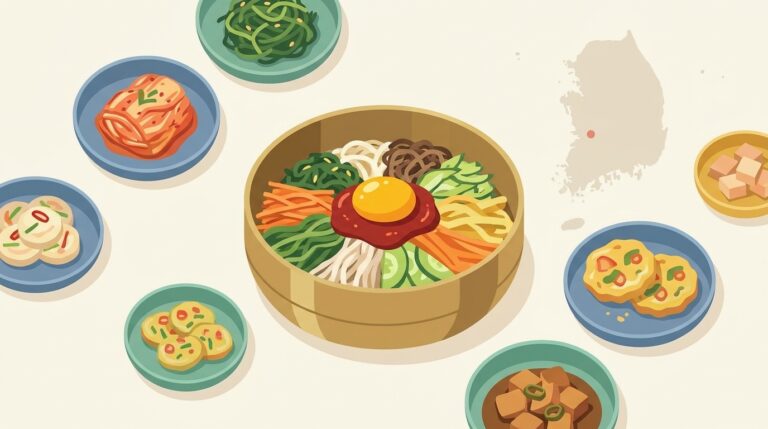
Phase 1: The Foodie’s Awakening
Hello! This is your Daily Hangul Editor.
Picture this: You are on the KTX bullet train, zooming south towards Jeonju, the undisputed food capital of South Korea. You’ve seen it in countless K-Dramas—the characters mixing a giant, colorful bowl of Bibimbap, taking a massive bite, and letting out a deep sigh of pure satisfaction. But when you finally sit down at a famous 50-year-old traditional restaurant (노포, Nopo) in the Hanok Village, reality hits. The menu is a wall of Hangul, 12 different side dishes (banchan) just landed on your table, and the restaurant auntie (이모님, Imo-nim) is speaking to you in a rapid-fire regional dialect. Your translation app is buffering. Panic sets in.
But what if you didn’t need the app? What if you knew exactly how to order the regional specialty, ask for side dish refills like a local, and eat the Bibimbap exactly how it was meant to be eaten?
Mastering how to talk about food in Korea won’t just fill your stomach—it transforms you from a passing tourist into an honorary local. Food is the very heartbeat of Korean culture, and speaking the ‘foodie language’ is your VIP pass. This guide is built directly from the experiences of my B2-level students who wanted to eat their way through Korea without sounding like a textbook. Let’s dive in!
Phase 2: Core Expressions Deep Dive
Here are the top three expressions you need to navigate regional specialty restaurants like a true K-Foodie.
1. 여기 제일 잘나가는 게 뭐예요?
- Pronunciation: yeogi jeil jallaganeun ge mwoyeyo? / [yuh-gee jeh-il jal-la-ga-neun geh mwo-yeh-yo?]
(Tip: ‘잘나가는’ sounds like ‘jal-la-ga-noon’ — it literally means ‘going out well’)- Meaning:
- Literal: What is the thing that goes out the best here?
- Real Nuance: What is your most popular/signature dish?
- K-Culture Moment: You walk into a bustling local spot famous for Jeonju Kongnamul Gukbap (Bean Sprout Soup). The menu has 10 variations. Instead of awkwardly staring at the menu, you ask the staff this question. It instantly shows you are looking for the crowd favorite, bypassing the ‘tourist traps.’
- Editor’s Insight: This phrase sounds so much more natural and ‘street-smart’ than the textbook “무엇을 추천하시나요? (What do you recommend?)”. It implies, “Give me what the locals are eating.”
- Situation Spectrum:
- Casual with friends/staff: ✅
- Semi-formal (colleagues): ✅
- Highly Formal (Business Dinner): ⚠️ (Use ‘대표 메뉴가 무엇입니까?’ instead)
- 🤔 Think About It: Why do Koreans prefer asking “what sells the best” rather than “what tastes the best”? Does this reflect Korea’s fast-paced, trend-sensitive, and community-driven culture?
2. 비벼 먹게 대접 좀 주실래요?
- Pronunciation: bibyeo meokge daejeop jom jusillaeyo? / [bee-byuh muk-geh dae-jup jom joo-shil-lae-yo?]
(Tip: ‘대접’ sounds like ‘dae-jup’, with a sharp ‘p’ at the end)- Meaning:
- Literal: Can you give me a large bowl to rub/mix and eat?
- Real Nuance: Could I get a large mixing bowl to make Bibimbap with my food?
- K-Culture Moment: Have you seen those K-Drama scenes where a stressed character throws leftover rice, gochujang, and side dishes into a huge metal bowl and aggressively mixes it? That bowl is a ‘대접’ (daejeop). Mixing (비빔, Bibim) is a core Korean culinary philosophy.
- Editor’s Insight: When you order certain stews or side dishes, they might just give you a small bowl of rice. Asking for a ‘대접’ signals you intend to mix the rice with the side dishes and sesame oil. The restaurant owner will instantly respect your eating skills.
- Situation Spectrum:
- Casual restaurant/Diner: ✅
- Semi-formal: ✅
- Fancy Michelin Restaurant: 🚫 (They usually plate everything perfectly for you)
- 🤔 Think About It: “Bibim” (mixing) destroys the original shape of the individual ingredients to create a new, unified harmony. How might this reflect the Korean concept of “We” (우리)?
3. 이모님, 여기 반찬 리필 되나요?
- Pronunciation: imonim, yeogi banchan ripil doenayo? / [ee-mo-neem, yuh-gee ban-chan ree-peel dweh-na-yo?]
- Meaning:
- Literal: Auntie, does a side dish refill work here?
- Real Nuance: Excuse me, can we get some more side dishes over here?
- K-Culture Moment: The Jeolla province (where Jeonju is located) is legendary for its generous portions and countless side dishes. You finish your favorite spicy cucumber salad. You don’t have to pay for more! You just raise your hand, catch the auntie’s eye, and use this magic phrase.
- Editor’s Insight: ‘이모님’ (Auntie) is an affectionate term for female restaurant staff. ‘리필’ (Refill – Konglish) is universally understood. Use a polite but bright tone!
- Situation Spectrum:
- Casual traditional restaurant: ✅
- Modern/Franchise restaurant: ⚠️ (Say ‘사장님’ [Boss/Owner] or ‘저기요’ [Excuse me] instead)
- 🤔 Think About It: Free side dish refills are a massive part of Korean food culture, stemming from “Jeong” (정, warm-heartedness). In your culture, do restaurants charge for every extra item?
Phase 3: Textbook vs. Real Korean
Let’s upgrade your vocabulary from “Classroom” to “Jeonju Hanok Village.”
[Situation 1: Asking for a Recommendation]
* 📖 Textbook Korean: 무엇을 추천하시나요? (What do you recommend?)
* 🗣️ Real Korean: 여기 시그니처가 뭐예요? or 제일 잘나가는 게 뭐예요?
* 💡 Why is it different?: Koreans love efficiency. Asking “what sells the best” is the fastest way to find a guaranteed delicious dish without making the staff think too hard.
[Situation 2: Expressing the food is delicious]
* 📖 Textbook Korean: 아주 맛있습니다. (It is very delicious.)
* 🗣️ Real Korean: 와, 이거 진짜 미쳤다! (Wow, this is literally crazy!) or 너무 맛있어서 기절 (Fainting because it’s so good)
* 💡 Why is it different?: Dramatic expressions are highly favored in Korean foodie culture, heavily influenced by Mukbang and YouTube review aesthetics.
[Situation 3: Calling the waiter for more water]
* 📖 Textbook Korean: 웨이터, 물 좀 주세요. (Waiter, please give me some water.)
* 🗣️ Real Korean: 사장님~ 여기 물 좀 더 주세요! (Boss~ please give us more water here!)
* 💡 Why is it different?: The word “웨이터” (waiter) is rarely used in normal restaurants (it’s mostly for nightclubs!). Koreans use “사장님” (Boss) or “이모님” (Auntie) to show respect and build quick rapport.
Bottom Note: For B2 level, using ‘미쳤다’ (It’s crazy good) with your friends is great, but stick to “정말 맛있어요” when speaking to the restaurant owner!
Phase 4: Cultural Context — K-Culture Deep Dive
4-1. Non-Verbal Cues at the Table
- The Scissors: Do not be alarmed when the staff brings giant scissors to the table. We use scissors for everything from cutting cold noodles (Naengmyeon) to slicing kimchi and pork belly. It’s the ultimate tool for culinary efficiency.
- The Rice Bowl Rule: In Korea, unlike in Japan or China, we do not lift our rice bowls off the table to eat. Keep the bowl on the table and use your spoon for rice and soup, and chopsticks for side dishes.
- The Nunchi of Refills: While refills are free, use your Nunchi (눈치, situational awareness). Don’t ask for a refill of an expensive meat side dish three times during a busy lunch rush.
4-2. The “Han-sang” (한상) K-Food Culture
If you travel to Jeonju, you will experience the “Han-sang cha-rim” (한상차림) — a table completely covered with food.
* The Culinary Philosophy: Traditional Korean dining isn’t served in courses; everything is laid out at once. It’s an interactive experience. You design your own perfect bite: a little rice, a piece of meat, a dab of ssamjang, all wrapped in a lettuce leaf.
* K-Drama Connection: Think of the classic drama dinner scenes. People are reaching across the table, putting a delicious piece of fish on each other’s rice bowls. This isn’t poor etiquette; it’s the ultimate expression of affection. Food equals love in Korea.
Phase 5: Real-Life Roleplay Scenario
Setting: Friday at 1 PM. A famous, heavily packed Bibimbap Nopo (traditional restaurant) in Jeonju Hanok Village. The scent of roasted sesame oil fills the air.
Characters:
– YOU: A foodie traveler hungry for authentic Bibimbap.
– Min-su (30s): Your Korean local friend. Loves food, very loud.
– Imo-nim (50s): The restaurant auntie. Friendly, moves at the speed of light.
Dialogue:
Min-su: 와, 여기 냄새부터 장난 아니다. 배고파 죽겠어! 🤤
(wa, yeogi naemsaebuteo jangnan anida. baegopa jukgesseo!)
[Wow, the smell here is no joke. I’m starving to death!]
YOU: 진짜요! 이모님~ 여기 주문할게요!
(jinjjayo! imonim~ yeogi jumunhalgeyo!)
[For real! Auntie~ we’d like to order here!]
Imo-nim: 네~ 뭐 드릴까? 육회 비빔밥이 제일 잘나가요.
(ne~ mwo deurilkka? yukhoe bibimbabi jeil jallagayo.)
[Yes~ what can I get you? The Beef Tartare (Yukhoe) Bibimbap sells the best.]
YOU: 아, 그럼 육회 비빔밥 두 그릇 주세요.
(a, geureom yukhoe bibimbap du geureut juseyo.)
[Ah, then please give us two bowls of Beef Tartare Bibimbap.]
(🎭 Stage Direction: 5 minutes later, Imo-nim brings a massive spread of 12 side dishes and two golden brass bowls of Bibimbap)
Imo-nim: 고추장 모자라면 더 넣고, 참기름 팍팍 둘러서 먹어!
(gochujang mojaramyeon deo neoko, chamgireum pakpak dulleoseo meogeo!)
[If you lack red pepper paste, add more, and drizzle plenty of sesame oil!]
Min-su: 잘 먹겠습니다! 야, 넌 비빔밥 젓가락으로 비비는 거 알지?
(jal meokgetseumnida! ya, neon bibimbap jeotgarageuro bibineun geo alji?)
[Thanks for the food! Hey, you know you’re supposed to mix Bibimbap with chopsticks, right?]
🔀 Your Turn! How do you reply?
– A) “아니요, 저는 숟가락으로 비빌게요.” (No, I’ll mix it with my spoon.)
– B) “당연하지! 그래야 밥알이 안 으깨지잖아.” (Of course! That way the rice grains don’t get crushed.)
– C) “대박! 젓가락으로 먹어?” (Awesome! You eat it with chopsticks?)✅ Best Choice: B — Showing you know the “chopstick mixing” trick proves you are an absolute K-Food pro! Mixing with chopsticks keeps the ingredients fluffy.
⚠️ Choice A Analysis: It’s fine, many people use spoons out of convenience, but you miss the chance to impress your local friend.
Min-su: 오~ 한국인 다 됐는데? 빨리 먹자!
(o~ hangugin da dwaenneunde? ppalli meokja!)
[Oh~ you’ve practically become Korean! Let’s eat fast!]
YOU: 흠~ 진짜 맛있다. 이모님, 여기 반찬 리필 좀 해주세요!
(heum~ jinjja masitda. imonim, yeogi banchan ripil jom haejuseyo!)
[Mmm~ it’s really delicious. Auntie, side dish refill here please!]
(🎭 Stage Direction: Imo-nim smiles warmly and brings a mountain of extra kimchi)
🎭 Scenario B: K-Culture Bonus (Street Food Edition)
Walking through Jeonju Hanok Village after the meal, you spot a famous street food vendor selling grilled cheese skewers.
Vendor: 치즈 꼬치 하나 드릴까요?
(chijeu kkochi hana deurilkkayo?)
[Shall I give you one cheese skewer?]
YOU: 네! 이거 덜 맵게 해 주실 수 있나요?
(ne! igeo deol maepge hae jusil su innayo?)
[Yes! Can you make this less spicy?]
Vendor: 그럼 칠리소스 빼고 연유만 뿌려 줄게요. 걸어가면서 드실 거죠?
(geureom chillisoseu ppaego yeonyuman ppuryeo julgeyo. georeogamyeonseo deusil geojyo?)
[Then I’ll leave out the chili sauce and just put condensed milk. You’re going to eat it while walking, right?]
YOU: 네, 휴지도 한 장만 주세요!
(ne, hyujido han jangman juseyo!)
[Yes, please give me one tissue as well!]
Phase 6: 10-Second Shadowing Drill
Practice your tone and intonation! Follow the slashes (/) for brief pauses.
- 🥺 애교 섞어서 (Polite but friendly):
이모님~ / 여기 / 반찬 리필 좀 / 해주세요! (i-mo-nim~ / yeo-gi / ban-chan ri-pil jom / hae-ju-se-yo!) - 😊 밝게 (Bright & Excited):
여기서 / 제일 잘나가는 게 / 뭐예요? (yeo-gi-seo / je-il jal-la-ga-neun ge / mwo-ye-yo?) - 😋 기대하며 (Anticipating the food):
비벼 먹게 / 큰 대접 좀 / 주실래요? (bi-byeo meok-ge / keun dae-jeop jom / ju-sil-lae-yo?)
Phase 7: K-Culture Mini Dictionary
1. 노포 (Nopo)
* Romanization: nopo
* English: A long-established, traditional, often rustic restaurant.
* Context: True foodies seek out Nopo. They might look old on the outside, but they hold decades of secret recipes.
2. 비빔 (Bibim)
* Romanization: bibim
* English: Mixed / Mixing.
* Context: Seen in Bibimbap (mixed rice) and Bibim Naengmyeon (mixed cold noodles). It represents the harmony of combining different flavors into one.
3. 한상차림 (Hansang-charim)
* Romanization: hansang-charim
* English: A table full of food / Traditional full-course table setting.
* Context: Rather than eating courses one by one, all rice, soup, and side dishes are served at the exact same time.
4. 이모님 (Imo-nim)
* Romanization: imo-nim
* English: Auntie (Respectful).
* Context: The quintessential term to call middle-aged female staff in traditional restaurants. It builds an instant sense of familial warmth.
Phase 8: Traveler Survival Kit
🆘 Survival Expression #1: 포장
– 🇰🇷 “남은 거 포장해 주실 수 있나요?” (nameun geo pojanghae jusil su innayo?)
– 🗣️ Pronunciation: [na-meun guh po-jang-hae joo-shil soo een-na-yo?]
– 📍 Where to use: Any restaurant with large portions.
– 💡 Pro Tip: Korea has an amazing takeout culture. Never feel shy about asking for a doggy bag for your leftovers!🆘 Survival Expression #2: 앞치마
– 🇰🇷 “앞치마 하나만 주세요.” (apchima hanaman juseyo.)
– 🗣️ Pronunciation: [ap-chee-ma ha-na-man joo-seh-yo.]
– 📍 Where to use: When eating anything with red soup or noodles.
– 💡 Pro Tip: If you are wearing a white shirt in Korea, an apron is mandatory to survive the inevitable red pepper paste splash.📌 Editor’s Travel Note
– Navigation Apps: Google Maps lacks walking directions in Korea. Download Naver Map or KakaoMap for your foodie tour in Jeonju.
– No Tipping!: Tipping is not a part of Korean culture. If you leave money on the table, the restaurant owner might chase you down the street thinking you forgot your change!
– Paying the Bill: At most traditional Korean restaurants, you don’t wait for the check. You bring your bill to the front counter to pay on your way out.
Phase 9: Critical Thinking — “One Step Deeper”
🧠 Think Deeper: Food & Identity (음식과 정체성)
In Korea, you rarely eat alone if you can help it. The phrase for family in Korean is Sikgu (식구), which literally means “mouths that eat together.” Sharing a giant bubbling pot of stew, tearing kimchi with your chopsticks for someone else, and the culture of free, limitless side dishes—all of this stems from a profound communal identity. The food isn’t just fuel; it’s the physical manifestation of “Jeong” (정), a deep, unspoken bond and affection between people. When the restaurant auntie gives you extra food without you asking, she isn’t upselling you; she is sharing her Jeong.💬 Your Turn: In your culture, is food meant to be shared communally from the center of the table, or is it strictly individual? How does that change the dining atmosphere? Share in the comments!
Phase 10: FAQ & Common Mistakes
Q: “Can I use ‘이모님’ (Auntie) at a fancy cafe or a high-end restaurant?”
No! ‘이모님’ is reserved for traditional, casual, or family-owned Korean food spots (like Gukbap or BBQ joints). In a modern cafe or fine dining, say “저기요” (Excuse me) or make eye contact.
Q: “Is it rude to ask for a lot of side dish refills?”
Not at all, as long as you actually eat them! Korean owners love seeing you enjoy their food. However, leaving a mountain of refilled side dishes uneaten is considered bad manners.
❌ Common Mistake #1: Sticking your chopsticks vertically into your rice bowl.
✅ Do this instead: Lay your chopsticks flat on the table or on top of your bowl. Vertical chopsticks resemble incense sticks burned at funerals for the dead!❌ Common Mistake #2: Tipping for good service.
✅ Do this instead: Simply say, “정말 잘 먹었습니다!” (I really ate well / Thank you for the meal) with a bright smile. That is the best tip you can give.
Phase 11: Summary & Action Items
One-Liner Summary: Navigate regional Korean restaurants with confidence by asking for signature dishes (“제일 잘나가는 거”), mixing bowls (“대접”), and endless side dish refills (“반찬 리필”) like a true local.
Your Action Missions:
– 🥉 Bronze (Solo): Stand in front of a mirror and ask for a side dish refill out loud 3 times using today’s shadowing drill.
– 🥈 Silver (Online): Comment below with your favorite Korean dish you want to try in Korea, using “~ 먹고 싶어요” (I want to eat ~).
– 🥇 Gold (Real Life): Next time you visit a local Korean restaurant in your city, ask the staff “여기 제일 잘나가는 게 뭐예요?” in Korean!
K-Culture Mission 🎥:
Go to YouTube, search “Jeonju Bibimbap Mukbang” (전주 비빔밥 먹방). Watch how they use chopsticks to mix the rice, and see if you can spot the massive ‘Han-sang’ table setting!
Engagement: What regional Korean food are you dying to try? Jeonju Bibimbap, Busan Seafood, or Jeju Black Pork? Let me know below!
Phase 12: Quiz — Interactive Challenge
1. Situational Judgment:
You are at a famous traditional Gukbap restaurant. You want to know what the locals order. What is the most natural thing to say to the owner?
– A) 대표 메뉴가 무엇입니까? (What is the representative menu?)
– B) 여기 제일 잘나가는 게 뭐예요? (What sells the best here?)
– C) 메뉴판 주세요. (Give me the menu.)
(Answer: B. It’s the most natural, street-smart way to ask for a recommendation in a casual restaurant setting. A is too formal.)
2. Fill in the Blank:
To properly mix your rice and side dishes, you need a large bowl.
“비벼 먹게 _____ 좀 주실래요?”
(Answer: 대접 – daejeop)
3. True or False — K-Culture Edition:
In a traditional Jeonju restaurant, you must pay extra if you want more Kimchi and bean sprouts. (True / False)
(Answer: False. Side dishes (banchan) are generally free to refill in Korea!)
4. Roleplay Consequence:
If you successfully use chopsticks (젓가락) instead of a spoon to mix your Bibimbap in front of a Korean friend, what will likely happen?
– A) They will think you are weird.
– B) They will be highly impressed because chopsticks keep the rice fluffy.
– C) The restaurant owner will yell at you.
(Answer: B. Mixing with chopsticks is considered a pro-level foodie move in Korea!)
Frequently Asked Questions (FAQ)
Q: What does "여기 제일 잘나가는 게 뭐예요?" mean in Korean and how do you pronounce it?
A: In Korean, "여기 제일 잘나가는 게 뭐예요?" is pronounced [yeogi jeil jallaganeun ge mwoyeyo? / [yuh-gee jeh-il jal-la-ga-neun geh mwo-yeh-yo?] and means: Literal: What is the thing that goes out the best here?
Q: What does "비벼 먹게 대접 좀 주실래요?" mean in Korean and how do you pronounce it?
A: In Korean, "비벼 먹게 대접 좀 주실래요?" is pronounced [bibyeo meokge daejeop jom jusillaeyo? / [bee-byuh muk-geh dae-jup jom joo-shil-lae-yo?] and means: Literal: Can you give me a large bowl to rub/mix and eat?
Q: What does "이모님, 여기 반찬 리필 되나요?" mean in Korean and how do you pronounce it?
A: In Korean, "이모님, 여기 반찬 리필 되나요?" is pronounced [imonim, yeogi banchan ripil doenayo? / [ee-mo-neem, yuh-gee ban-chan ree-peel dweh-na-yo?] and means: Literal: Auntie, does a side dish refill work here?







