

Phase 1: Empathy & The K-Culture Cold Open
Hello! I’m the Lead Editor of Daily Hangul.
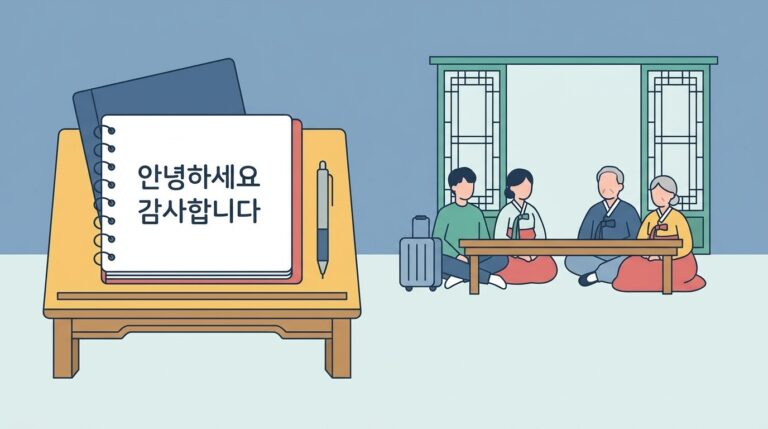
Picture this: You are watching a classic K-Drama. The main couple walks into a highly exclusive, traditional Korean restaurant with sliding wooden doors. Inside, both sets of parents are sitting in awkward silence. The air is so thick you could cut it with a knife. The rich, imposing mother is wearing an elegant Hanbok and sipping tea, while the nervous protagonist is sweating buckets.
Welcome to the ultimate boss fight of Korean relationships: 상견례 (Sanggyeollye), the formal meeting between the families of the bride and groom.
Even if you aren’t getting married anytime soon, you will eventually find yourself in a heavily formal situation in Korea—whether it’s meeting your Korean partner’s parents, having dinner with the company’s CEO, or attending a traditional gathering. If you don’t know how to navigate the tension and use the correct honorifics, a simple “I’m sorry” might come off completely wrong.
This guide is crafted from the real, sweaty-palmed experiences of my students who had to meet Korean elders. Let’s learn how to turn that nervous energy into the perfect polite impression!
Phase 2: Deep Dive into Key Expressions
Here are the lifesaver phrases you need when the stakes are high.
1. 너무 긴장했어요 (I was so nervous)
- Pronunciation: Neomu ginjanghaesseoyo [Neo-moo gin-jang-hae-sseo-yo]
- Meaning: Literal: I was very nervous. / Real nuance: I am a bit overwhelmed but taking this situation very seriously.
- K-Culture Moment: In a K-Drama, when the female lead accidentally drops her chopsticks in front of her terrifying future mother-in-law, she smiles awkwardly and says, “아유, 제가 오늘 너무 긴장해서…” (Oh, because I was so nervous today…).
- Editor’s Insight: Admitting you are nervous is actually a great strategy in Korea! It shows the elders that you respect their authority and care deeply about making a good impression. It melts the ice.
- Situation Spectrum:
- Friends (Casual): ✅ (Though ‘떨려요’ is more common here)
- Co-workers (Semi-formal): ✅
- Elders/Boss (Formal): ✅ (Perfect for showing humble respect)
- 🤔 Think About It: Why does showing a little vulnerability (like admitting you’re nervous) often yield a warmer reaction from Korean elders than acting overly confident?
2. 말씀 많이 들었습니다 (I’ve heard a lot about you)
- Pronunciation: Malsseum mani deureotseumnida [Mal-sseum ma-ni deu-reot-seum-ni-da]
- Meaning: Literal: I have heard a lot of words (about you). / Real nuance: It’s an honor to finally meet you; I’ve heard great things.
- K-Culture Moment: This is the ultimate “golden key” greeting. Whether you are meeting your partner’s parents or your boss’s boss at a company dinner (회식), bowing 45 degrees while saying this instantly marks you as a cultured, well-mannered person.
- Editor’s Insight: Notice we use ‘말씀’ (the honorific form of ‘말’ – words/speech). You are elevating the mere mention of their existence.
- Situation Spectrum:
- Friends (Casual): 🚫 (Too stiff! Just say “얘기 많이 들었어”)
- Co-workers (Semi-formal): ⚠️ (Only for introductions to higher-ups)
- Elders/Boss (Formal): ✅ (Absolute perfection)
- 🤔 Think About It: Korean culture highly values reputation. How does saying “I’ve heard a lot about you” instantly validate someone’s social standing?
3. 예쁘게 봐주세요 (Please look upon me favorably)
- Pronunciation: Yeppeuge bwajuseyo [Yep-peu-ge bwa-joo-se-yo]
- Meaning: Literal: Please look at me prettily. / Real nuance: Please overlook my flaws and accept me warmly.
- K-Culture Moment: You will hear K-Pop idols say this ALL the time when they debut or make a comeback. “우리 팬 여러분, 이번 앨범도 예쁘게 봐주세요!” (Fans, please look favorably upon this album too!)
- Editor’s Insight: It doesn’t mean “think I am physically beautiful.” It means “please be generous and kind to me, even if I make mistakes.” It’s a humble, slightly endearing way to ask for someone’s grace.
- Situation Spectrum:
- Friends (Casual): 🚫
- Co-workers (Semi-formal): ✅ (When joining a new team)
- Elders/Boss (Formal): ✅ (Very common to say to future in-laws)
- 🤔 Think About It: How does this phrase reflect the Korean concept of “Jeong” (정 – deep emotional connection) over strict rule-following?
Phase 3: Textbook vs. Real Korean
[Situation 1: Expressing your nervousness]
* 📖 Textbook Korean: 저는 매우 긴장했습니다. (Jeoneun maeu ginjanghaetseumnida.)
* 🗣️ Real Korean: 아유, 제가 너무 떨려서요. (Ayu, jaega neomu tteollyeoseoyo. – Oh, it’s because I’m trembling so much.)
* 💡 Why the difference?: “떨리다” (to tremble/shake) is much more physical and conversational. Adding “아유” (Ayu – Oh my) softens the sentence and makes you sound much more native!
[Situation 2: Addressing the parents]
* 📖 Textbook Korean: 민수 씨의 어머니, 아버지 (Minsu ssi-ui eomeoni, abeoji – Minsu’s mother and father)
* 🗣️ Real Korean: 어머님, 아버님 (Eomeonim, Abeonim – Honored Mother, Honored Father)
* 💡 Why the difference?: In Korea, when you are in a serious relationship, you immediately upgrade your partner’s parents to “Eomeonim” and “Abeonim” (adding the respectful ‘-nim’). Calling them “Minsu’s mother” sounds too distant!
Phase 4: Cultural Context — K-Culture Deep Dive
4-1. The Non-Verbal Survival Guide
Language is only 30% of the battle in a Sanggyeollye or formal meeting. The rest is 눈치 (Nunchi) and body language.
– The Two-Hand Rule: If a parent hands you a cup of tea, water, or a menu, you MUST receive it with both hands.
– The Drinking Turn: If alcohol (like Soju or Baekseju) is served, never drink facing the elders directly. Turn your head slightly to the side, cover your mouth with one hand, and drink.
– The Seating Arrangement: The elders always sit at the “head” of the table (usually the seat furthest from the door, facing the entrance). Never sit there!
4-2. The K-Drama Reality Check
In K-Dramas, Sanggyeollye scenes are designed for maximum drama. A mother might toss an envelope of money at the poor protagonist and say, “Break up with my son!”
Critical View: Fortunately, this rarely happens in real life. Most Korean parents are just as nervous as you are! They want their children to be happy. However, the extreme politeness you see in dramas—the 45-degree bows, the hushed tones, the expensive Hanjeongsik (Korean table d’hôte) restaurants—is 100% accurate. Food is the medium through which respect is traded.
Phase 5: Interactive Roleplay Scenario
Setting: Saturday, 12:00 PM. A private room at “Gadam,” a high-end traditional Hanjeongsik restaurant in Jongno, Seoul. The table is filled with 15 different side dishes. You are sitting next to your partner, Jihoon. Across from you are Jihoon’s parents.
Characters:
– YOU: An expat living in Seoul for 2 years, meeting the future in-laws for the first time.
– Jihoon (30): Your supportive Korean partner.
– Abeonim (60s): Jihoon’s father. Seems stern, but actually has a warm heart.
Dialogue:
Abeonim: 우리 지훈이 만나느라 고생이 많아요. (Clears throat)
(Uri Jihuni mannaneura gosaengi manayo.)
[Translation: You go through a lot of trouble dating our Jihoon.]
YOU: 아유, 아닙니다. 아버님, 어머님. 말씀 많이 들었습니다.
(Ayu, animnida. Abeonim, eomeonim. Malsseum mani deureotseumnida.)
[Translation: Oh, not at all. Father, Mother. I’ve heard a lot about you.]
Abeonim: (Smiling slightly) 한국 음식은 입에 좀 맞아요?
(Hanguk eumshigeun ibe jom majayo?)
[Translation: Does Korean food suit your taste?]
(🎭 Stage Direction: The father picks up a piece of precious Galbijjim (braised short ribs) and places it on your rice bowl.)
🔀 YOUR TURN! How do you respond?
– A) “아, 괜찮아요. 제가 알아서 먹을게요.” (Ah, it’s okay. I’ll eat on my own.)
– B) “우와, 대박! 진짜 맛있겠다!” (Wow, daebak! Looks so delicious!)
– C) “감사합니다. 잘 먹겠습니다! (Bows slightly)” (Thank you. I will enjoy the meal!)✅ Best Choice: C.
⚠️ Analysis of A & B:
Choice A sounds independent in Western culture, but in Korea, rejecting food placed on your bowl by an elder is a rejection of their affection (정).
Choice B uses “대박” (daebak), which is way too slangy for future in-laws!
Abeonim: 긴장하지 말고 많이 먹어요.
(Ginjanghaji malgo mani meogeoyo.)
[Translation: Don’t be nervous and eat a lot.]
YOU: 네, 사실 상견례 자리라 너무 긴장했는데, 챙겨주셔서 감사합니다.
(Ne, sashil sanggyeolrye jarira neomu ginjanghaetneunde, chaenggyeojushyeoseo gamsahamnida.)
[Translation: Yes, honestly I was so nervous because it’s the official family meeting, but thank you for taking care of me.]
Phase 6: 10-Second Shadowing Drill
Practice this until it flows naturally out of your mouth. Pay attention to the pauses!
😊 아버님, / 어머님, / 말씀 / 많~이 들었습니다.
(Abeonim, / Eomeonim, / Malsseum / ma~ni deureotseumnida.)
(Honored Father, / Honored Mother, / I’ve heard a lo~t about you.)
🥺 제가 / 오늘 너무 긴장해서... / 예쁘게 / 봐주세요!
(Jega / oneul neomu ginjanghaeseo… / Yeppeuge / bwajuseyo!)
(Because I am so nervous today… / please look upon me favorably!)
Phase 7: K-Culture Mini Dictionary
1. 상견례 (Sanggyeollye)
* Romanization: sang-gyeol-lye
* English: Formal meeting between the families of the bride and groom.
* Context: The official first step toward marriage in Korea. If this goes wrong, the wedding might be called off!
2. 한정식 (Hanjeongsik)
* Romanization: han-jeong-sik
* English: Korean table d’hôte / full-course Korean meal.
* Context: The standard menu for formal gatherings. It features an array of beautifully plated side dishes, soup, and main meats.
3. 예단 / 예물 (Yedan / Yemul)
* Romanization: ye-dan / ye-mul
* English: Wedding gifts / Dowry exchanged between families.
* Context: Traditionally, families exchange silk, jewelry, and sometimes cash as a sign of respect and preparation for the new household.
4. 눈치 (Nunchi)
* Romanization: nun-chi
* English: The subtle art of gauging others’ moods.
* Context: Crucial in formal meetings. Having “fast nunchi” means knowing when to pour a drink, when to laugh, and when to stay quiet.
Phase 8: Traveler Survival Kit (The Formal Edition)
Even if you’re just traveling to Korea, you might be invited to a formal dinner by a Korean friend’s parents, a business partner, or a professor. Here is how you survive high-stakes dining!
🆘 Survival Phrases for Formal Dining
– 🇰🇷 “잘 먹겠습니다.” (Jal meokgetseumnida)
– 🗣️ Pronunciation: [Jal meok-get-seum-ni-da]
– 📍 When to use: MUST be said loudly and clearly right before taking your first bite.
- 🇰🇷 “정말 맛있게 잘 먹었습니다.” (Jeongmal masitge jal meogeotseumnida)
- 🗣️ Pronunciation: [Jeong-mal ma-sit-ge jal meo-geot-seum-ni-da]
- 📍 When to use: Right after the meal ends. It means “I really enjoyed the meal.”
📌 Editor’s Travel Note: Table Manners 101
– The Rice Rule: NEVER stick your chopsticks vertically into your bowl of rice. This resembles incense burned at funerals and will deeply shock Korean elders.
– The Bill: In Korea, going “Dutch” (splitting the bill) with elders is almost offensive. The oldest person or the host will pay. Simply say “감사히 잘 먹었습니다!” (Thank you for the delicious meal!) and offer to buy the coffee afterward.
Phase 9: Critical Thinking — “One Step Deeper”
Language & Power (언어와 권력)
🧠 Think Deeper:
Why is Korean so strictly divided into casual (반말) and formal (존댓말) language? In a Sanggyeollye, the language used immediately establishes a hierarchy. Even if the parents from both families are the exact same age, they will use the highest form of polite language (하십시오체) to maintain a respectful distance. In Korea, language isn’t just about transmitting information; it’s the architecture of social harmony. By using the right honorifics, you are essentially saying, “I acknowledge my place in this relationship, and I respect yours.”💬 Your Turn: Does your native language change depending on the age or status of the person you are speaking to? How do you show respect to elders in your culture? Let us know in the comments!
Phase 10: FAQ & Common Mistakes
Q: Can I call my partner’s parents “당신 (Dangsin – You)” or “너 (Neo – You)”?
NO! NEVER! “너” is only for close friends. “당신” translates to “you” in dictionaries, but in real life, it’s either used between married couples or when you want to start a street fight. Always use their titles: “어머님 (Eomeonim)” and “아버님 (Abeonim).”
Q: Should I pour my own drink at a formal dinner?
No. In Korea, pouring your own drink is a faux pas (and an old superstition says it brings bad luck!). Wait for someone to pour it for you, and make sure to pour for the elders when their glasses are empty.
❌ Common Mistake #1: Saying “수고하셨습니다” (Good job / You worked hard) to elders after the meeting.
✅ Do this instead: Say “조심히 들어가세요” (Please go home safely). “수고하셨습니다” is a top-down phrase. A younger person should rarely say it to a senior!
Phase 11: Summary & Action Items
- One-Liner Summary: In high-stakes Korean meetings, showing polite nervousness and mastering standard honorifics will instantly win over any elder’s heart.
-
Action Mission 3 Steps:
- 🥉 Bronze (Solo): Stand in front of a mirror, bow slightly, and practice saying “아버님, 어머님, 말씀 많이 들었습니다” three times.
- 🥈 Silver (Online): Go to a K-Drama YouTube clip of a family meeting, and try to catch if they say “긴장했어요” or “예쁘게 봐주세요.”
- 🥇 Gold (Real Life): The next time a Korean elder or senior treats you to a meal, use “잘 먹겠습니다” before eating and “잘 먹었습니다” after!
- K-Culture Mission: Watch an episode of a family K-Drama (like Queen of Tears or Reply 1988). Spot the dining table scenes and observe who starts eating first. (Hint: It’s always the oldest person!)
Phase 12: Interactive Quiz
1. Situational Judgment:
You are meeting your Korean partner’s grandmother for the first time. You want to say, “I’ve heard a lot of good things about you.” Which is the best choice?
– A) 할머니, 얘기 많이 들었어!
– B) 할머님, 말씀 많이 들었습니다.
– C) 할머니, 나 너무 긴장했어.
2. True or False — K-Culture Edition:
It is considered polite to split the bill 50/50 when you eat dinner with your Korean partner’s parents for the first time. (True / False)
3. Fill in the Blank:
You drop your spoon out of nervousness. You want to humbly ask them to look favorably upon you despite your clumsiness.
“아유, 제가 오늘 좀 긴장해서… ___________ 봐주세요!”
(Check your answers by highlighting the invisible text below!)
[Answers: 1. B (A and C use informal language!). 2. False (The elders will almost always pay, just thank them politely!). 3. 예쁘게 (Yeppeuge)]
Frequently Asked Questions (FAQ)
Q: What does "너무 긴장했어요 (I was so nervous)" mean in Korean and how do you pronounce it?
A: In Korean, "너무 긴장했어요 (I was so nervous)" is pronounced [Neomu ginjanghaesseoyo [Neo-moo gin-jang-hae-sseo-yo] and means: Literal: I was very nervous. / Real nuance: I am a bit overwhelmed but taking this situation very seriously.
Q: What does "말씀 많이 들었습니다 (I've heard a lot about you)" mean in Korean and how do you pronounce it?
A: In Korean, "말씀 많이 들었습니다 (I've heard a lot about you)" is pronounced [Malsseum mani deureotseumnida [Mal-sseum ma-ni deu-reot-seum-ni-da] and means: Literal: I have heard a lot of words (about you). / Real nuance: It's an honor to finally meet you; I've heard great things.
Q: What does "예쁘게 봐주세요 (Please look upon me favorably)" mean in Korean and how do you pronounce it?
A: In Korean, "예쁘게 봐주세요 (Please look upon me favorably)" is pronounced [Yeppeuge bwajuseyo [Yep-peu-ge bwa-joo-se-yo] and means: Literal: Please look at me prettily. / Real nuance: Please overlook my flaws and accept me warmly.







