

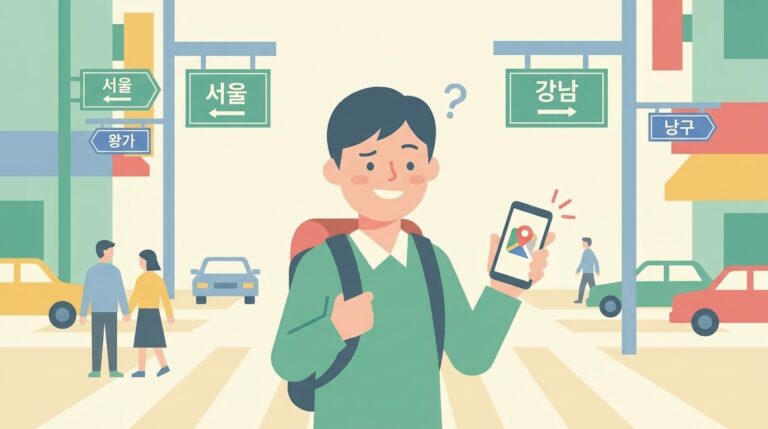
Lost in Korea? 3 Magical Phrases to Find Your Way Like a Local
Phase 1: Empathy (The K-Culture Cold Open)
Hello! This is your editor from Daily Hangul.
Picture this: You are standing in the middle of Myeongdong. Your map app says “You have arrived,” but all you see is an endless maze of cosmetic shops and street food stalls. You remember that K-Drama scene where the main character gets lost, bumps into a handsome stranger, and they magically end up at a beautiful hidden cafe.
In reality? You are just tired, hungry, and sweating profusely. 😅
Getting lost (길을 잃었어요) in a foreign country can be terrifying, especially when you are a beginner (A1 level). But what if I told you that getting lost in Korea is actually the best way to discover the real local spots? You just need to know how to ask for help! This guide is created based on real panic moments from my tutoring students. Let’s turn your “lost” moment into a perfect K-Travel memory!
Phase 2: Core Expressions Deep Dive
1. 저기요… 길을 잃었어요. (Excuse me… I’m lost.)
- Pronunciation: jeo-gi-yo… gi-reul i-reo-sseo-yo. [Chuh-gee-yo… geel-eul eel-uh-ssuh-yo] (Note: The ‘eo’ sounds like the ‘u’ in ‘cup’.)
- Meaning: Literal: Over there… I lost the road. / Real nuance: Excuse me… I’m lost.
- K-Culture Moment: You’ll hear “Jeogiyo!” everywhere in Korea—from calling a waiter at a busy BBQ restaurant to getting someone’s attention on the street. It’s the universal “Hey, excuse me!”
- Editor’s Insight: Saying just “I’m lost” can sound a bit abrupt. Starting with “저기요 (Jeogiyo)” politely taps into the Korean Nunchi (social awareness), signaling that you need their attention before dropping your problem.
- Situation Spectrum:
- Casual (Friends): 🚫 (Friends don’t say Jeogiyo to each other!)
- Semi-formal (Strangers on street): ✅
- Formal (Police/Elders): ⚠️ (Use “실례합니다” Sil-lye-ham-ni-da instead for highly formal situations)
- 🤔 Think About It: Why do Koreans say “Over there” (저기) to call someone? It comes from a culture of indirectness. Calling someone directly (“Hey you!”) feels too aggressive, so pointing to the space “over there” creates a polite buffer!
2. [Place] 어디에 있어요? (Where is [Place]?)
- Pronunciation: [Place] eo-di-e isseo-yo? [oh-dee-eh ees-uh-yo?]
- Meaning: Literal: Where does [Place] exist? / Real nuance: Where is [Place]?
- K-Culture Moment: In K-Pop reality shows, when idols are sent on survival missions in unfamiliar neighborhoods, they are constantly running around asking locals, “지하철역 어디에 있어요?” (Where is the subway station?).
- Editor’s Insight: Just put the place you want at the front! You don’t need complex grammar. “Toilet eodie isseoyo?” works like a charm.
- Situation Spectrum:
- Casual: ⚠️ (Drop the ‘yo’: 어디에 있어? eodie isseo?)
- Semi-formal: ✅
- Formal: ✅
- 🤔 Think About It: Korean uses the verb “있어요” (to exist) rather than “is” for locations. How does your native language describe where a building is?
3. 여기 어디예요? (Where is this place?)
- Pronunciation: yeo-gi eo-di-ye-yo? [yuh-gee oh-dee-yeh-yo?]
- Meaning: Literal: Here, where is it? / Real nuance: Where am I? / Where is this?
- K-Culture Moment: Perfect for when you are sitting in a taxi, completely disoriented, and need to know where the driver brought you!
- Editor’s Insight: If you have a map on your phone but can’t read the Hangul, point to your screen and ask a local “여기 어디예요?”. They will gladly point to your current location.
- Situation Spectrum:
- Casual: ⚠️ (여기 어디야? yeogi eodiya?)
- Semi-formal: ✅
- Formal: ✅
Phase 3: Textbook vs Real Korean
[Getting a stranger’s attention]
* 📖 Textbook Korean: 실례합니다. (Sil-lye-ham-ni-da / Excuse me – very formal)
* 🗣️ Real Korean: 저기요! (Jeo-gi-yo! / Over there!)
* 💡 Why is it different?: “Sil-lye-ham-ni-da” is great for official settings (like talking to police), but on busy Seoul streets, a friendly and slightly loud “Jeogiyo!” is much more effective and natural.
[Admitting you don’t know the way]
* 📖 Textbook Korean: 저는 길을 잘 모릅니다. (Jeo-neun gi-reul jal mo-reum-ni-da / I do not know the way well.)
* 🗣️ Real Korean: 아, 길을 잃었어요. (Ah, gi-reul i-reo-sseo-yo / Ah, I’m lost.)
* 💡 Why is it different?: Textbooks focus on stating facts. Real Korean relies on expressing your current vulnerable state so the other person feels empathetic and wants to help you!
Phase 4: Cultural Context — K-Culture Deep Dive
4-1. Non-verbal Communication
When asking for directions, never physically tap or grab a stranger on the street—it’s considered quite startling! Instead, step into their line of sight, give a slight head bow, make eye contact, and say “저기요” (Jeogiyo). Show your phone screen (with the map); Koreans love visual aids and are extremely tech-savvy.
4-2. K-Travel Connection
If you travel to Korea, you will get lost in the subway stations. Places like Gangnam Station or Jamsil Station are massive underground cities with over 15 exits! But here is a K-Travel survival secret: Look for convenience stores (편의점 – pyeon-ui-jeom). They are everywhere. If you are totally lost, walk into a CU, GS25, or 7-Eleven, buy a cheap bottle of water, and ask the part-time worker for directions. It’s safer and less intimidating than stopping a fast-walking salaryman!
Phase 5: Real-world Roleplay Scenario
Setting: Friday afternoon, Exit 11 of Gangnam Station. The street is packed with people. You are trying to find a famous K-Pop pop-up store, but the map app is confusing. You decide to ask a friendly-looking university student.
Characters:
– YOU: A beginner Korean learner, slightly flustered but determined.
– Jihoon (21): A local university student waiting for his friends. Friendly, slightly shy about his English.
Dialogue:
YOU: 저기요… (Jeo-gi-yo…)
[Excuse me…]
(🎭 Stage Direction: You approach Jihoon and do a slight head bow.)
Jihoon: 네? (Ne?)
[Yes?]
YOU: 한국어를 잘 못해요. 길을 잃었어요. (Han-gu-geo-reul jal mo-tae-yo. Gi-reul i-reo-sseo-yo.)
[I can’t speak Korean well. I’m lost.]
Jihoon: 아, 괜찮아요. 어디 가세요? (Ah, gwaen-cha-na-yo. Eo-di ga-se-yo?)
[Ah, it’s okay. Where are you going?]
YOU: 팝업스토어… 어디에 있어요? (Pap-eop-seu-to-eo… eo-di-e isseo-yo?)
[The pop-up store… where is it?]
Jihoon: 아~ 그 아이돌 팝업스토어요? (Ah~ geu a-i-dol pap-eop-seu-to-eo-yo?)
[Ah~ that idol pop-up store?]
YOU: 네! 맞아요! (Ne! Ma-ja-yo!)
[Yes! That’s right!]
Jihoon: 저쪽으로 쭉 가서, 오른쪽으로 가세요. (Jeo-jjogeuro jjuk gaseo, oreunjjogeuro gaseyo.)
[Go straight that way, and turn right.]
(🎭 Stage Direction: Jihoon points quickly down the street and uses a lot of hand gestures.)
🔀 Your Turn! How do you respond?
– A) “네, 감사합니다!” (Just say thank you and pretend you understood.)
– B) “여기 어디예요?” (Point to your phone map to confirm the visual route.)
– C) “한국어 너무 빨라요!” (Your Korean is too fast!)✅ Best Choice: B — Reason: Koreans are incredibly helpful with map apps. If you show them your phone, they will often physically type the address for you or show you the exact route on the screen.
⚠️ Choice A Analysis: It’s polite, but you’ll still be lost! Don’t be afraid to ask for clarification.
[Bonus K-Culture Roleplay: The Taxi Rescue]
(🎭 Stage Direction: You are in a taxi, but the driver missed the turn.)
YOU: 기사님, 저기요! (Gi-sa-nim, jeo-gi-yo!) [Driver, excuse me!]
Taxi Driver: 네, 손님? (Ne, son-nim?) [Yes, customer?]
YOU: 여기 어디예요? (Yeo-gi eo-di-ye-yo?) [Where are we?]
Taxi Driver: 아, 길을 잘못 들었어요. 금방 갈게요! (Ah, gi-reul jal-mot deu-reo-sseo-yo. Geum-bang gal-ge-yo!) [Ah, I took the wrong road. We will be there soon!]
Phase 6: 10-Second Shadowing Drill
Read this out loud and practice the rhythm! Pay attention to the pauses (/) and emotions!
🥺 저기요… / (jeo-gi-yo…)
😢 길을 / 잃었어요. / (gi-reul / i-reo-sseo-yo.)
😊 강남역이 / 어디에 있어요? / (gang-nam-yeogi / eo-di-e isseo-yo?)
Tip: Make your voice slightly soft on “Jeogiyo” to sound polite and approachable.
Phase 7: K-Culture Mini Dictionary
1. 눈치
* Romanization: nun-chi
* English: Social awareness / tact
* Context: The quintessential Korean social skill. When you are lost, using your “nunchi” means finding someone who isn’t rushing or wearing earphones to ask for directions.
2. 길치
* Romanization: gil-chi
* English: Someone who is terrible with directions
* Context: A fun slang word combining ‘gil’ (road) and ‘chi’ (lack of ability). If you get lost often, you can jokingly tell Korean friends, “저 길치예요” (I am a gilchi!).
3. 편의점
* Romanization: pyeon-ui-jeom
* English: Convenience Store
* Context: Your safe havens in Korea. Open 24/7, brightly lit, and the perfect place to ask for directions or recharge your phone.
4. 기사님
* Romanization: gi-sa-nim
* English: Driver (Respectful title)
* Context: How you must address a taxi or bus driver in Korea. Never just say “Mister” or “Ahjussi”—”Gisanim” is much more polite!
Phase 8: Traveler Survival Kit
🆘 Survival Phrase #1: 화장실 어디에 있어요?
– 🇰🇷 화장실 어디에 있어요? (Hwa-jang-sil eo-di-e isseo-yo?)
– 🗣️ Pronunciation: Hwah-jahng-sheel oh-dee-eh ees-uh-yo?
– 📍 Where to use: Cafes, subway stations, restaurants.
– 💡 Pro Tip: In Korea, many cafes share a restroom with the building, and you might need a passcode or a physical key!🆘 Survival Phrase #2: 지도 앱에 쳐주세요.
– 🇰🇷 지도 앱에 쳐주세요. (Ji-do aeb-e chyeo-ju-se-yo.)
– 🗣️ Pronunciation: Jee-doh ep-eh chuh-joo-seh-yo.
– 📍 Where to use: When someone tries to explain directions, but you can’t understand.
– 💡 Pro Tip: Hand them your phone and ask them to type it in the map app!📌 Editor’s Travel Note: The Google Maps Illusion
Did you know? Google Maps cannot provide walking or driving directions in South Korea due to national security laws! If you use it, you will get lost. You MUST download Naver Map or KakaoMap before your trip. Both have English settings!
Phase 9: Critical Thinking Corner — “One Step Deeper”
🧠 Think Deeper: Media vs Reality — The K-Drama Rescue vs. Real Life
In K-Dramas, if a foreigner looks lost, a handsome local immediately stops, speaks perfect English, and walks them to their destination. In reality, Seoul is a mega-city driven by “빨리빨리” (Pali-pali / Hurry-hurry) culture. People walk incredibly fast and might seem intimidating. However, this is just their ‘walking face.’ Korean culture values hospitality towards guests (Jeong – 정). If you break the ice with a polite “Jeogiyo,” that fast-walking, serious-looking local will often stop, pull out their own Naver Map, and spend 5 minutes making sure you know exactly where to go. The exterior is fast, but the interior is incredibly warm.💬 Your Turn: Have you ever helped a lost tourist in your home country? How do people in your culture usually react to strangers asking for directions? Let us know in the comments!
Phase 10: FAQ & Avoiding Common Mistakes
Q: Can I ask a police officer for directions?
Yes! Korean police officers (경찰 – gyeongchal) are very friendly and used to helping lost tourists. Look for the small neighborhood police stations called 파출소 (Pachulso).
Q: Should I speak in English first or Korean?
Start with “저기요” (Jeogiyo) and a basic Korean phrase! Even if your pronunciation isn’t perfect, showing effort in their language instantly wins the heart of a Korean local. They will likely reply in English if they can!
❌ Common Mistake #1: Asking “Where are you?” instead of “Where is this place?”
Many beginners translate “Where are we?” directly and say “우리 어디예요?” (Where are we?). While understandable, it sounds a bit poetic or philosophical. Stick to “여기 어디예요?” (Where is this place?).❌ Common Mistake #2: Tapping someone’s shoulder from behind.
✅ Do this instead: Walk around to their front or side, make eye contact, and politely say “Jeogiyo.”
Phase 11: Summary & Action Items
- One-Liner Summary: When you are lost in Korea, get a local’s attention with “Jeogiyo,” state your problem with “Gireul ireosseoyo,” and ask for your destination with “Eodie isseoyo?”!
-
Action Mission:
- 🥉 Bronze (Solo): Say “저기요… 길을 잃었어요” out loud 3 times while looking at a mirror.
- 🥈 Silver (Online): Open Naver Map on your phone, change the language to English, and find the route from Incheon Airport to your favorite K-Pop agency!
- 🥇 Gold (Real World): Next time you visit a Korean restaurant or grocery store, ask the staff: “화장실 어디에 있어요?” (Where is the restroom?).
- K-Culture Mission: Watch an episode of a Korean reality show (like Running Man or a travel vlog). Count how many times you hear “저기요” (Jeogiyo) or “어디에 있어요?” (Eodie isseoyo?). You’ll be surprised!
Phase 12: Quiz — Interactive Challenge
1. Situational Judgment: You are exiting a subway station in Seoul and completely lost. You see a woman walking very fast looking at her phone. What is the BEST way to ask her for help?
A) Tap her shoulder and say “Excuse me!”
B) Stand in front of her and say “여기 어디예요?”
C) Make slight eye contact and say “저기요…”
Correct Answer: C. Getting attention politely with “Jeogiyo” without physical contact is the Korean way!
2. Fill in the Blank: “홍대역 (Hongdae Station) ______________?” (Where is Hongdae Station?)
A) 길을 잃었어요
B) 어디에 있어요
C) 저기요
Correct Answer: B. 어디에 있어요 (Eodie isseoyo)
3. True or False – K-Culture Edition: “You should use Google Maps to find walking directions in Seoul.”
Correct Answer: False! Google Maps walking directions do not work in Korea. You must use Naver Map or KakaoMap.
Frequently Asked Questions (FAQ)
Q: What does "저기요... 길을 잃었어요. (Excuse me... I'm lost.)" mean in Korean and how do you pronounce it?
A: In Korean, "저기요... 길을 잃었어요. (Excuse me... I'm lost.)" is pronounced [jeo-gi-yo... gi-reul i-reo-sseo-yo. [Chuh-gee-yo... geel-eul eel-uh-ssuh-yo] and means: Literal: Over there... I lost the road. / Real nuance: Excuse me... I'm lost.
Q: What does "[Place] 어디에 있어요? (Where is [Place]?)" mean in Korean and how do you pronounce it?
A: In Korean, "[Place] 어디에 있어요? (Where is [Place]?)" is pronounced [Place] and means: Literal: Where does [Place] exist? / Real nuance: Where is [Place]?
Q: What does "여기 어디예요? (Where is this place?)" mean in Korean and how do you pronounce it?
A: In Korean, "여기 어디예요? (Where is this place?)" is pronounced [yeo-gi eo-di-ye-yo? [yuh-gee oh-dee-yeh-yo?] and means: Literal: Here, where is it? / Real nuance: Where am I? / Where is this?







