

Phase 1: Empathy
Hello! This is your Daily Hangul Editor.
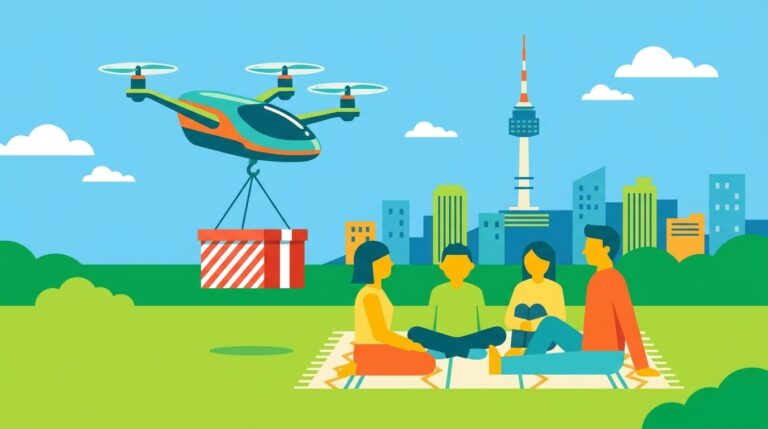
Picture this: It’s a breezy Friday evening at Hangang Park. You and your friends are sitting on a picnic mat, the Seoul skyline glittering in the background. Someone says the magic words, ‘Should we order Chimaek (chicken and beer)?’ You open your delivery app, but instead of walking 15 minutes to a crowded ‘Delivery Zone’ to meet a motorcycle rider, you select ‘Drone Drop-off.’ Ten minutes later, a drone silently hovers down from the sky, lowering a box of perfectly crispy fried chicken right into your hands.
Sounds like a sci-fi K-Drama scene, right? But here in Korea, this isn’t just imagination anymore. Test flights for commercial drone deliveries have already begun in places like Jeju Island, Gapyeong, and even parts of Seoul.
At a C1 level, you already know how to say ‘배달해 주세요’ (Please deliver this). But can you discuss the future of this culture? Can you express your concerns about delivery fees, or debate whether Korea’s ‘pali-pali’ (hurry up) culture will embrace this new tech? Today, we are diving deep into the advanced vocabulary and cultural nuances surrounding the commercialization of drone delivery in Korea. Let’s upgrade your Korean from ‘textbook survival’ to ‘native-level trendsetter.’
Phase 2: Core Expressions Deep Dive
Here are three advanced expressions you absolutely need when discussing tech trends and delivery culture with Korean locals.
1. 상용화되다
- Pronunciation: [sang-yong-hwa-doe-da] + [Sang-yong-hwa-dway-da]
- Meaning: (Literal) To become commercialized / (Real Nuance) To be available for everyday public use.
- K-Culture Moment: You’ll hear this constantly on Korean news programs, tech YouTube channels, and even among office workers discussing stocks. When a new tech (like AI, flying cars, or drone delivery) goes from ‘testing phase’ to ‘anyone can buy it,’ Koreans use this word.
- Editor’s Insight: This is a fantastic C1 vocabulary word. Using ‘상용화되다’ instantly makes you sound like an educated professional who understands Korean industry trends.
- Situation Spectrum:
- Casual with friends: ✅ (e.g., ‘드론 배달 언제 상용화되냐? / When is drone delivery getting commercialized?’)
- Semi-formal (Colleagues): ✅
- Formal (Boss/Elders): ✅
- 🤔 Think About It: Korea adopts new technologies faster than almost any other country. Why do you think ‘상용화’ (commercialization) is such a hot topic in daily Korean conversations?
2. 배달비 폭탄
- Pronunciation: [bae-dal-bi pok-tan] + [Bae-dal-bee pok-tan]
- Meaning: (Literal) Delivery fee bomb / (Real Nuance) Outrageously expensive delivery fees.
- K-Culture Moment: Imagine scrolling through a delivery app, adding a 15,000 won meal, and seeing the delivery fee is 8,000 won due to rain and peak hours. You toss your phone on the bed and sigh. This is the ‘delivery bomb.’
- Editor’s Insight: Koreans love adding ‘폭탄’ (bomb) to things that suddenly cost too much or overwhelm them (e.g., 요금 폭탄 – bill bomb, 과제 폭탄 – homework bomb). The rising ‘배달비 폭탄’ is exactly why people are desperately hoping drone delivery will lower costs!
- Situation Spectrum:
- Casual with friends: ✅
- Semi-formal (Colleagues): ✅
- Formal (Boss/Elders): ⚠️ (A bit too colloquial for an official presentation, but fine for small talk).
- 🤔 Think About It: How does the concept of paying for delivery differ between Korea and your home country? Did it change after the pandemic?
3. 시기상조다
- Pronunciation: [si-gi-sang-jo-da] + [Shee-gee-sang-jo-da]
- Meaning: (Literal) Early timing / (Real Nuance) It’s premature; it’s too early for that.
- K-Culture Moment: In a meeting room, a junior marketer excitedly pitches an idea to use drone delivery for their next PR campaign. The senior manager rubs their chin, frowns slightly, and says, ‘음… 아직은 시기상조 아닐까요?’ (Hmm… isn’t it a bit premature for that?)
- Editor’s Insight: This is a high-level Hanja (Chinese character) idiom. It is the perfect, polite way to shoot down an idea or express skepticism about a new trend (like drones navigating Seoul’s dense apartment buildings) without sounding aggressive.
- Situation Spectrum:
- Casual with friends: ✅ (Sounds a bit intellectual but totally fine)
- Semi-formal (Colleagues): ✅
- Formal (Boss/Elders): ✅
- 🤔 Think About It: Why do Koreans prefer using a four-character idiom like ‘시기상조’ instead of directly saying ‘That’s a bad idea right now’? What does this say about indirect communication in Korea?
Phase 3: Textbook vs. Real Korean
When discussing tech and daily frustrations, standard Korean can sound incredibly stiff. Let’s loosen it up.
[Situation 1: Complaining about high delivery fees]
* 📖 Textbook Korean: 배달 요금이 너무 비싸서 부담스럽습니다. (The delivery fee is too expensive, so it is burdensome.)
* 🗣️ Real Korean: 아, 배달비 선 넘네. 차라리 포장해 올게. (Ah, the delivery fee is crossing the line. I’ll just go pick it up.)
* 💡 Why the difference?: ‘선 넘다’ (crossing the line) is a wildly popular slang phrase from internet culture used when something goes beyond acceptable boundaries—perfect for insane delivery fees.
[Situation 2: Discussing the future of drones]
* 📖 Textbook Korean: 드론으로 음식을 배달하는 날이 곧 올 것입니다. (The day when food is delivered by drones will come soon.)
* 🗣️ Real Korean: 조만간 하늘에서 치킨 떨어지는 거 아니야? (Aren’t we gonna have chicken falling from the sky pretty soon?)
* 💡 Why the difference?: Real Korean heavily relies on situational humor and vivid imagery (like chicken falling from the sky) rather than dry, objective statements.
[Situation 3: Expressing doubt about the new tech]
* 📖 Textbook Korean: 서울에서는 아직 위험할 것 같습니다.
* 🗣️ Real Korean: 서울 아파트 숲에서 드론 배달? 아직은 무리죠.
* 💡 Why the difference?: ‘무리다’ (it’s too much / impossible) is a highly versatile, natural way to express that something is unfeasible, replacing the literal translation of ‘dangerous’ or ‘difficult.’
Phase 4: Cultural Context — K-Culture Deep Dive
4-1. Non-verbal Element: The ‘App Stare’
In Korea, delivery isn’t just a service; it’s an interactive experience. When you order on ‘Baedal Minjok’ (Baemin), you don’t just put your phone away. You continuously check the GPS tracker. Is the rider at the restaurant? Are they at the intersection? If drone delivery is commercialized, the non-verbal culture of ‘looking out the window’ or tracking the exact altitude of your dinner will become the new norm. When discussing this, mimic scrolling and pointing up at the sky to add a natural, comedic touch to your conversation.
4-2. K-Culture Link: The ‘Pali-pali’ Engine of Tech
Why is Korea pushing so hard for drone delivery? It’s deeply rooted in the Pali-pali (빨리빨리) culture. Koreans expect things to be done yesterday. During peak hours, a 60-minute wait for food is considered a tragedy. Drone delivery promises to bypass Seoul’s notorious traffic jams and deliver food in under 15 minutes.
Furthermore, think about Hangang Park culture. In K-Dramas, you see couples ordering food right to the riverbank. Currently, you have to walk far to a designated ‘Delivery Zone 1 or 2’ to meet the rider. The prospect of a drone dropping a picnic basket directly at your specific coordinates on the grass is the ultimate evolution of K-Leisure.
Phase 5: Real-Life Roleplay Scenario
Setting: Saturday afternoon at Yeouido Hangang Park. You and your Korean friend, Minji, are sitting on a picnic mat. You just opened a delivery app to order pizza, but the estimated time is 70 minutes and the delivery fee is shocking.
Characters:
– YOU: An expat working in tech/marketing in Seoul. You love Korean delivery but hate the rising fees.
– Minji (29): Your Korean friend. She’s a tech enthusiast, always up to date with the latest apps and news.
Dialogue:
Minji: 배고프다! 우리 피자 시켜 먹을까? 🍕
(Baegopeuda! Uri pija sikyeo meogeulkka?)
[I’m hungry! Should we order pizza?]
YOU: 좋아요. 제가 앱으로 볼게요… 헉, 배달비 실화예요? 6,000원인데요?
(Joayo. Jaega aebeuro bolgeyo… heok, baedalbi silhwayeyo? Yuk-cheon-won-indeyo?)
[Sounds good. Let me check the app… Gasp, is this delivery fee for real? It’s 6,000 won?]
Minji: 아, 주말이라 할증 붙었나 보다. 진짜 배달비 폭탄이네.
(Ah, jumal-ira haljeung buteonna boda. Jinjja baedalbi poktan-ine.)
[Ah, they must have added a weekend surcharge. It’s a real delivery fee bomb.]
YOU: 차라리 드론 배달이 빨리 상용화됐으면 좋겠어요. 하늘엔 차가 안 막히잖아요.
(Charari deuron baedali ppalli sang-yong-hwa-dwaesseumyeon jokesseoyo. Haneul-en chaga an makhijanayo.)
[I’d rather drone delivery get commercialized quickly. There’s no traffic in the sky, you know.]
Minji: 맞아요! 제주도에서는 이미 드론 배달 테스트하고 있다던데?
(Majayo! Jeju-do-eseoneun imi deuron baedal teseuteu-hago itdadeonde?)
[Right! I heard they are already testing drone delivery in Jeju Island?]
YOU: 진짜요? 서울은 아직 시기상조일까요?
(Jinjja-yo? Seoul-eun ajik sigisangjo-ilkkayo?)
[Really? Do you think it’s still premature for Seoul?]
Minji: 아무래도 고층 아파트가 너무 많아서 위험하지 않을까요? 프라이버시 문제도 있고.
(Amu-raedo gocheung apateu-ga neomu manaseo wiheomhaji aneulkkayo? Peuraibeosi munje-do itgo.)
[Probably, since there are so many high-rise apartments, wouldn’t it be dangerous? There are privacy issues too.]
YOU: 하긴… 아파트 베란다로 치킨이 배달 오면 좀 웃기긴 하겠네요.
(Hagin… apateu beranda-ro chikin-i baedal omyeon jom utgigin hagenneyo.)
[True… It would be a bit funny if chicken was delivered to an apartment balcony.]
Minji: 그나저나 피자 어떻게 해? 그냥 포장하러 갔다 올까?
(Geunajeona pija eotteoke hae? Geunyang pojang-hareo gatda olkka?)
[Anyway, what about the pizza? Should we just go pick it up for takeout?]
🔀 Your Turn! How will you respond to Minji?
– A) 네, 걸어서 갔다 오죠. (Ne, georeoseo gatda ojo.) – “Yes, let’s walk and get it.”
– B) 에이~ 제가 그냥 배달비 낼게요. 오늘 제가 쏩니다! (Ei~ jega geunyang baedalbi naelgeyo. Oneul jega ssomnida!) – “Hey~ I’ll just pay the delivery fee. It’s my treat today!”
– C) 드론이 올 때까지 굶을래요. (Deuron-i ol ttaekkaji gulmeullaeyo.) – “I’ll starve until a drone comes.”✅ Best Choice: B — Why? Offering to treat (‘쏜다’) is a huge part of Korean socializing. It shifts the mood from complaining about money to a generous, fun vibe. (Choice C is a funny, sarcastic joke, but Minji might actually get too hungry!)
Scenario B: Bonus K-Culture Roleplay
You are visiting a special ‘Drone Delivery Zone’ in a remote park in Korea.
Staff: 손님, 10분 뒤에 드론 착륙장에 물품이 도착합니다. 물러서 계셔주세요.
(Sonnim, sip-bun dwie deuron changnyuk-jang-e mulpum-i dochak-hamnida. Mulleoseo gyesyeo-juseyo.)
[Customer, your item will arrive at the drone landing pad in 10 minutes. Please step back.]
YOU: 우와, 진짜 신기해요. QR코드 찍고 물건 가져가면 되나요?
(Uwa, jinjja singihaeyo. Kyu-al kodeu jjikgo mulgeon gajeogamyen doenayo?)
[Wow, that’s really fascinating. Do I just scan the QR code and take the item?]
Staff: 네, 맞습니다. 안전선 밖에서 대기 부탁드립니다.
(Ne, matseumnida. Anjeon-seon bakkeseo daegi butak-deurimnida.)
[Yes, that’s correct. Please wait outside the safety line.]
Phase 6: 10-Second Shadowing Drill
Let’s practice your flow. At the C1 level, natural pausing and intonation are what separate a learner from a fluent speaker.
😤 솔직히 / 요즘 배달비 / 너무 선 넘은 거 아니에요?
(Soljiki / yojeum baedalbi / neomu seon neomeun geo anieyo?)
Honestly, aren’t delivery fees crossing the line these days?
🤔 서울에서 / 드론 배달이 되려면 / 아직은 시기상조인 것 같아요.
(Seoul-eseo / deuron baedal-i doeryeomyeon / ajigeun sigisangjo-in geot gatayo.)
For drone delivery to work in Seoul, I think it’s still a bit premature.
Phase 7: K-Culture Mini Dictionary
1. 배달의 민족 (Baemin)
* Romanization: baedal-ui minjok
* English: ‘Nation of Delivery’ (Also the name of Korea’s #1 delivery app)
* Context: Often shortened to ‘배민’ (Baemin). The name cheekily plays on a historical term for Koreans, showing how deeply delivery culture is tied to modern Korean identity.
2. 규제 샌드박스
* Romanization: gyuje saendeu-bakseu
* English: Regulatory Sandbox
* Context: A crucial C1 business term. The Korean government uses this system to exempt new tech (like drones and autonomous driving) from existing laws for a temporary period to test their viability.
3. 한강공원 배달존
* Romanization: hangang-gongwon baedal-jon
* English: Hangang Park Delivery Zone
* Context: Because Hangang Park is so huge, you can’t just give an address. You must meet your rider at designated pickup zones (e.g., ‘Yeouido Delivery Zone 2’). This is the exact pain point drones aim to fix!
4. 포장 할인
* Romanization: pojang harin
* English: Takeout Discount
* Context: With ‘delivery fee bombs’ (배달비 폭탄), many restaurants now offer discounts if you come pick up the food yourself. A very common phrase to look out for on apps.
Phase 8: Traveler’s Survival Kit
Even if you aren’t debating drone logistics, you need to survive ordering food in Korea. Here are your advanced survival phrases:
🆘 Survival Phrases for Delivery & Takeout
– 🇰🇷 ‘여기 혹시 배달 팁이 얼마예요?’ (yeogi hoksi baedal tip-i eolmayeyo?) – How much is the delivery tip here?
– 🇰🇷 ‘포장하면 할인되나요?’ (pojang-hamyeon harin-doenayo?) – Is there a discount for takeout?
– 🇰🇷 ‘라이더분 위치가 안 움직이는데, 출발하셨나요?’ (raideo-bun wichi-ga an umjigineunde, chulbal-hasyeon-nayo?) – The rider’s location isn’t moving, have they left yet?📌 Editor’s Travel Note
– Useful Apps: Baedal Minjok (배달의 민족), Yogiyo (요기요), Coupang Eats (쿠팡이츠).
– Payment: Most delivery apps require a Korean card or phone number for verification. If you are a traveler without an ARC (Alien Registration Card), use the ‘만나서 결제’ (pay upon meeting) option, though some apps are phasing this out!
– Tipping: Never tip the delivery rider in cash. The ‘배달 팁’ (delivery fee) is already included in your app total. Handing them cash will only cause confusion.
Phase 9: Critical Thinking Corner — “One Step Deeper”
🧠 Think Deeper: Tech Advancement vs. Gig Workers (Media vs Reality)
While Korean media often paints a utopian picture of drones dropping coffee onto your office desk, the reality is far more complex. Korea has a massive gig economy of delivery riders (라이더). The commercialization of drone delivery isn’t just a technological leap; it’s a social issue that threatens the livelihood of thousands of workers. Furthermore, Korea’s dense urban landscape—composed of ‘apartment forests’ (아파트 숲)—makes GPS accuracy and privacy (drones looking into windows) massive regulatory hurdles. So, when discussing this topic in Korean, acknowledging both the convenience and the social impact shows a profound understanding of modern Korean society, moving you far beyond textbook language.
💬 Your Turn: Does your home country use drone deliveries yet? How does your culture balance the speed of technology with the protection of human jobs? Share your thoughts in the comments!
Phase 10: FAQ & Avoiding Mistakes
Q: Can I actually use drone delivery in Seoul right now?
A: Only in very specific, limited test zones (like certain parks or outskirt areas). It is not yet ‘상용화’ (commercialized) for everyday apartments.
Q: Should I use ‘배달비’ or ‘배달 팁’?
A: They are used interchangeably. ‘배달비’ (Delivery fee) is the traditional word, while ‘배달 팁’ (Delivery tip) was introduced by apps. Note: It is NOT a voluntary tip; it is a mandatory fee.
❌ Common Mistake #1: Using formal writing vocabulary in speech.
Say you want to complain about the delivery fee.
Don’t say: ‘배달 비용이 증가하여 매우 유감입니다.’ (This sounds like a robot or a news anchor.)
✅ Say instead: ‘요즘 배달비 너무 비싸지 않아요? 진짜 폭탄이에요.’ (Natural and relatable!)
Phase 11: Summary & Action Items
One-Liner Summary: To discuss Korea’s future delivery tech like a native, master expressions like 상용화되다 (commercialized), 배달비 폭탄 (delivery fee bomb), and 시기상조다 (premature).
Action Mission:
– 🥉 Bronze (Solo): Say ‘아, 배달비 선 넘네’ out loud with real frustration in front of a mirror 3 times.
– 🥈 Silver (Online): Write a short post in a Korean learning forum: ‘우리 동네도 드론 배달이 상용화되면 좋겠어요!’
– 🥇 Gold (Real Life): Next time you are with a Korean friend and looking at a delivery app, use ‘아직은 시기상조 아닐까요?’ when discussing a new trend.
K-Culture Mission:
Open a Korean delivery app (like Baemin) or go to their website. Check the ‘배달 팁’ for three different restaurants. Imagine if a drone could cut that fee in half!
Engage: What’s the craziest thing you’ve ever had delivered? Let me know below!
Phase 12: Quiz — Interactive Challenge
1. Situational Judgment:
Your boss suggests that your company should start delivering all documents via drone by next month. You think it’s way too early for that. What is the most polite and natural C1 response?
– A) 대표님, 그건 미친 생각입니다.
– B) 대표님, 아직은 좀 시기상조인 것 같습니다.
– C) 대표님, 배달비 폭탄입니다.
2. Fill in the Blank:
요즘 치킨 배달비가 7천 원이래. 진짜 배달비 (______ )이네!
3. True or False – K-Culture Edition:
In Korea, you should prepare a small cash tip of 1,000~2,000 won to hand to the delivery rider when they arrive. (T/F)
🚨 Click to reveal answers!
1. B (It’s a bit premature). ‘A’ is too aggressive (‘crazy idea’), and ‘C’ doesn’t fit the context of document delivery.
2. 폭탄 (Bomb – referring to the shockingly high price).
3. False. Korea does not have a tipping culture. The ‘delivery tip’ is paid within the app itself. Trying to hand cash to a rider will confuse them!
Frequently Asked Questions (FAQ)
Q: What does "상용화되다" mean in Korean and how do you pronounce it?
A: In Korean, "상용화되다" is pronounced [sang-yong-hwa-doe-da] and means: (Literal) To become commercialized / (Real Nuance) To be available for everyday public use.
Q: What does "배달비 폭탄" mean in Korean and how do you pronounce it?
A: In Korean, "배달비 폭탄" is pronounced [bae-dal-bi pok-tan] and means: (Literal) Delivery fee bomb / (Real Nuance) Outrageously expensive delivery fees.
Q: What does "시기상조다" mean in Korean and how do you pronounce it?
A: In Korean, "시기상조다" is pronounced [si-gi-sang-jo-da] and means: (Literal) Early timing / (Real Nuance) It's premature; it's too early for that.







