

Phase 1: Empathy (Immersion Open)
Hello! This is your Daily Hangul Editor. 👋
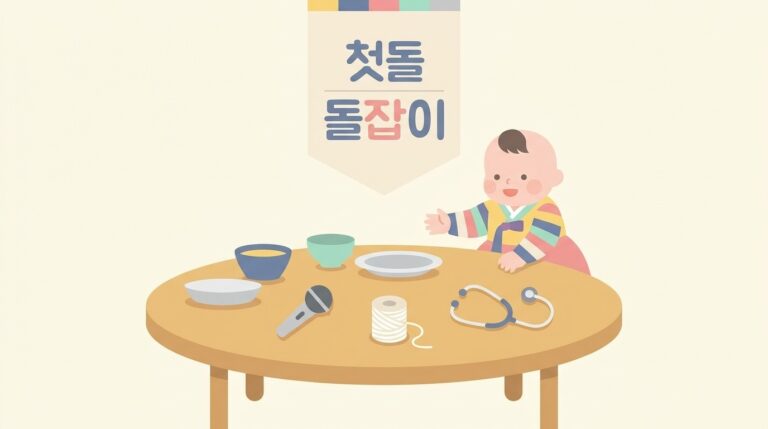
Picture this K-Drama scene: A grand banquet hall. A baby dressed in a stunning, colorful Hanbok sits in front of a table loaded with random objects—a bundle of string, a gavel, a microphone, a stethoscope, and… a crisp 50,000-won bill? The parents are sweating, the guests are cheering like it’s the World Cup finals, and the baby’s chubby hand slowly reaches out. The crowd erupts!
Did the baby just secure their future as a millionaire? What on earth is happening?
Welcome to the high-stakes, heartwarming world of Doljanchi (돌잔치), the Korean first birthday, and its main event, Doljabi (돌잡이).
If you live in Korea or work with Koreans, you might eventually receive an invitation to a Doljanchi. It’s a huge honor! But if you don’t know the etiquette, you might show up empty-handed or completely miss the cultural significance of what’s happening. Don’t worry! As your veteran tutor, I’m here to give you the ultimate insider’s guide to surviving—and thriving—at a Korean 1st birthday party. Let’s dive in!
Phase 2: Core Expression Deep Dive
Here are the 3 essential expressions you need to know when celebrating a Korean baby’s first birthday.
1. 첫돌을 축하합니다!
- Pronunciation: [cheot-do-reul chu-ka-ham-ni-da!]
(Sound analogy: ‘cheot’ sounds like the ‘chut’ in chutney, and ‘dol’ sounds like ‘dole’.)- Meaning: Happy 1st birthday! (Literal: Congratulations on the first ‘Dol’.)
- K-Culture Moment: You’ll see this phrase printed in beautiful gold letters on K-Drama banners. In real life, it’s the standard phrase you write on the envelope containing your monetary gift (축의금).
- Editor’s Insight: We don’t just say ‘Happy Birthday’ (생일 축하합니다) for a first birthday. The word 돌 (Dol) specifically means the 365th day since birth. Using this specific word shows you truly understand Korean culture.
- Situation Spectrum:
- Casual (to the baby/close friend): 첫돌 축하해! ✅
- Semi-formal (to coworkers): 첫돌을 축하합니다! ✅
- Formal (to boss’s baby): 아기의 첫돌을 진심으로 축하드립니다. ⚠️ (Better to use polite forms!)
- 🤔 Think About It: Why does Korean have a completely different word just for the first birthday? How important do you think turning one was in traditional Korean society?
2. 돌잡이 뭐 잡았어요?
- Pronunciation: [dol-ja-bi mwo ja-ba-sseo-yo?]
(Sound analogy: ‘mwo’ sounds like ‘mwoah’, like a quick kiss sound.)- Meaning: What did they grab for Doljabi? (Literal: Doljabi, what did [they] catch?)
- K-Culture Moment: It’s the Monday morning after the weekend party. You bump into your coworker at the office pantry. This is the ultimate icebreaker!
- Editor’s Insight: This isn’t just a question; it’s a conversation starter that shows you care. Parents love bragging about whether their baby grabbed the stethoscope (future doctor) or the money (future billionaire).
- Situation Spectrum:
- Casual: 돌잡이 뭐 잡았어? ✅
- Semi-formal: 돌잡이 때 뭐 잡았어요? ✅
- Formal: 아기가 돌잡이에서 어떤 걸 잡았나요? ⚠️
- 🤔 Think About It: In modern Korea, new items like a computer mouse (IT genius) or a microphone (K-Pop Idol) are added to the table. If you were a Korean parent, what item would you secretly hope your baby grabs?
3. 건강하게만 자라다오
- Pronunciation: [geon-gang-ha-ge-man ja-ra-da-o]
(Sound analogy: ‘geon’ sounds like ‘gun’, ‘gang’ like ‘gang’.)- Meaning: Just grow up healthy.
- K-Culture Moment: At the end of the party, the MC will usually ask the parents to say a few words. The dad will take the mic, get a little teary-eyed, and say this exact phrase.
- Editor’s Insight: It carries a deep, emotional nuance. Despite the pressure of Korean society (good grades, good jobs), a parent’s true ultimate wish is just for their child’s health.
- Situation Spectrum:
- Casual: 건강하게 자라렴! ✅ (Said by aunts/uncles)
- Semi-formal: 건강하게 자라길 바랍니다. ✅ (Written on a card)
- Formal/Direct to Boss: 🚫 (You don’t command your boss’s baby to grow up; use the semi-formal written version instead.)
- 🤔 Think About It: Does your culture have a specific blessing you give to babies? How does it compare to wishing for health above all else?
Phase 3: Textbook vs. Real Korean
Let’s upgrade your textbook Korean to real-world, natural Korean.
[Greeting the Parents at the Party]
* 📖 Textbook Korean: 아기의 첫 번째 생일을 축하합니다. (Congratulations on the baby’s first birthday.)
* 🗣️ Real Korean: 돌 축하드려요! 너무 예뻐요~ (Happy Dol! He/She is so pretty~)
* 💡 Why the difference?: Koreans love efficiency. We shorten ‘첫 번째 생일’ to ‘돌’. Also, adding a compliment about the baby’s looks or outfit is an unwritten rule of Nunchi!
[Asking about the Baby’s Future]
* 📖 Textbook Korean: 아이가 커서 어떤 직업을 가지면 좋겠어요? (What job do you want the child to have when they grow up?)
* 🗣️ Real Korean: 돌잡이 때 뭐 잡았으면 좋겠어요? (What do you hope they grab for Doljabi?)
* 💡 Why the difference?: Asking directly about future jobs sounds like a college interview. Asking about the Doljabi item is a culturally playful and indirect way to ask the exact same thing.
Phase 4: Cultural Context — K-Culture Deep Dive
4-1. Non-Verbal Nunchi (눈치) at the Party
When you hand over your gift envelope (축의금) at the entrance, hand it over with two hands and a slight bow. Also, the unwritten rule of a Doljanchi buffet: Don’t pile your plate too high on the first round! It’s better to make multiple trips. It shows refined manners (and frankly, Korean buffets have too much good food to mix it all on one plate).
4-2. K-Food Connection: The Buffet Feast (뷔페)
Most modern Doljanchi events are held in premium buffet restaurants. Why? Because sharing food is sharing blessings in Korea. You’ll often find traditional Korean foods mixed with modern K-Food.
* 미역국 (Seaweed Soup): Essential for any Korean birthday. It’s actually what mothers eat for a month after giving birth for recovery.
* 잔치국수 (Banquet Noodles): The long noodles symbolize a long, healthy life for the baby.
* 백설기 (Baekseolgi): A pure white rice cake representing a pure and clean start to life.
Phase 5: Real-Life Roleplay Scenario
Setting: Saturday afternoon, 12:30 PM. A bright, bustling buffet hall in Gangnam. There’s a giant photo zone with balloons. You’ve been invited to your coworker Minsu’s baby’s Doljanchi.
Characters:
– YOU: An expat working in Seoul, attending your very first Doljanchi.
– Minsu (34): Your friendly Korean coworker, wearing a sharp suit, holding a very distracted baby.
Dialogue:
Minsu: 오! 와주셔서 감사합니다! 주말인데 쉬지도 못하고…
(o! wa-ju-syeo-seo gam-sa-ham-ni-da! ju-ma-rin-de swi-ji-do mot-ha-go…)
[Translation] Oh! Thank you for coming! It’s the weekend, you couldn’t even rest…
(🎭 Stage Direction: Minsu bows slightly, trying to balance the baby in his arms.)
YOU: 초대해 주셔서 감사해요. 민수 대리님, 첫돌 축하드립니다!
(cho-dae-hae ju-syeo-seo gam-sa-hae-yo. min-su dae-ri-nim, cheot-dol chu-ka-deu-rim-ni-da!)
[Translation] Thank you for inviting me. Assistant Manager Minsu, congratulations on the first birthday!
Minsu: 하하, 감사합니다. 아기한테 인사해! 삼촌/이모 오셨네~
(ha-ha, gam-sa-ham-ni-da. a-gi-han-te in-sa-hae! sam-chon/i-mo o-syeot-ne~)
[Translation] Haha, thank you. Say hi to the baby! Your uncle/aunt is here~
(🎭 Stage Direction: Minsu waves the baby’s little hand at you.)
🔀 Your Turn! How do you hand over your congratulatory envelope?
– A) “여기요. 돈이에요!” (Here you go. It’s money!)
– B) “이거 축의금이에요. 아기 장난감이라도 사주세요.” (This is the congratulatory money. Please buy the baby a toy or something.)
– C) “돌잡이 뭐 잡았어요?” (What did they grab for Doljabi?)✅ Best Choice: B — It’s humble, polite, and giving a reason (“buy a toy”) softens the directness of giving cash.
⚠️ Choice A Analysis: Way too direct! Never just say “It’s money.”
⚠️ Choice C Analysis: It’s too early! The Doljabi event usually happens after everyone finishes eating.
(Continuing with Choice B)
Minsu: 아이고, 뭘 이런 걸 다… 정말 감사합니다. 식사 맛있게 하세요!
(a-i-go, mwol i-reon geol da… jeong-mal gam-sa-ham-ni-da. sik-sa ma-sit-ge ha-se-yo!)
[Translation] Oh my, you didn’t have to… Thank you so much. Please enjoy the meal!
YOU: 네! 아, 이따가 돌잡이 때 뭐 잡았으면 좋겠어요?
(ne! a, i-tta-ga dol-ja-bi ttae mwo ja-bat-seu-myeon jo-ke-sseo-yo?)
[Translation] Yes! Ah, later during the Doljabi, what do you hope they grab?
Minsu: 저는 무조건 돈이요! 하하, 농담이고요. 그냥 건강하게만 자라다오, 이거죠.
(jeo-neun mu-jo-geon do-ni-yo! ha-ha, nong-da-mi-go-yo. geu-nyang geon-gang-ha-ge-man ja-ra-da-o, i-geo-jyo.)
[Translation] For me, unconditionally money! Haha, just joking. Just “grow up healthy,” that’s it.
YOU: 하하, 맞아요. 돈도 좋지만 건강이 최고죠.
(ha-ha, ma-ja-yo. don-do jot-ji-man geon-gang-i choe-go-jyo.)
[Translation] Haha, right. Money is good, but health is the best.
🎁 Bonus K-Culture Roleplay: The Jewelry Shop
You want to be extra traditional and buy a Dolbanji (돌반지 – 24k gold baby ring).
Clerk: 찾으시는 물건 있으세요?
[Translation] Are you looking for anything in particular?
YOU: 네, 아기 돌반지 보러 왔어요. 한 돈짜리 보여주세요.
[Translation] Yes, I’m here to look at baby gold rings. Please show me the 1-don (approx. 3.75g) ones.
Clerk: 요즘은 왕관 모양이 제일 잘 나가요~
[Translation] Crown shapes are the best sellers these days~
Phase 6: 10-Second Shadowing Drill
Practice out loud! Pay attention to the pauses (/) and the emotional tags.
- 😊 Brightly: 첫돌을 / 진~심으로 / 축하합니다!
(cheot-do-reul / jin~si-meu-ro / chu-ka-ham-ni-da!) - 🤩 Curiously: 우와~ / 돌잡이 때 / 뭐 잡았어요?
(u-wa~ / dol-ja-bi ttae / mwo ja-ba-sseo-yo?) - 🥺 Warmly: 아프지 말고 / 건강하게만 / 자라렴.
(a-peu-ji mal-go / geon-gang-ha-ge-man / ja-ra-ryeom.)
Phase 7: K-Culture Mini Dictionary
1. 돌잔치
* Romanization: doljanchi
* English: 1st birthday party
* Context: A grand celebration marking a baby’s first year. It used to be held at home, but now it’s usually at buffets or hotels.
2. 돌잡이
* Romanization: doljabi
* English: The fortune-telling grab
* Context: The highlight of the party where the baby chooses an item that predicts their future. (Thread = long life, Money = wealth, Pencil = scholar).
3. 축의금
* Romanization: chuguigeum
* English: Congratulatory money
* Context: Given in a white envelope. For coworkers, 50,000 KRW is standard; for close friends, 100,000 KRW or more.
4. 돌반지
* Romanization: dolbanji
* English: 24k Gold baby ring
* Context: A traditional gift. It was given as a financial safety net for the baby’s future. It’s very expensive now!
Phase 8: Traveler Survival Kit
Even if you’re just traveling, you might need to buy a congratulatory card or a small gift for a Korean friend’s baby!
🆘 Survival Phrase #1
– 🇰🇷 “아기 백일/돌 선물로 뭐가 좋아요?” (a-gi baek-il/dol seon-mul-lo mwo-ga jo-a-yo?)
– 🗣️ Pronunciation Guide: [ah-gee baek-il/dol sun-mool-lo mwo-gah jo-ah-yo?]
– 📍 Where to use: Department stores, baby clothing shops.
– 💡 Pro Tip: If gold rings are too expensive, baby clothes (especially cute organic ones) or a gift card to a department store are highly appreciated!📌 Editor’s Travel Note
– Finding an ATM: You need crisp cash for 축의금 (Congratulatory money). Convenience store ATMs are everywhere!
– Envelopes: You can buy beautifully decorated envelopes (봉투) at Daiso or Artbox for just 1,000 won. Look for ones that say ‘축 첫돌’ (Congratulations on the first Dol).
Phase 9: Critical Thinking Corner — “한 발 더 깊이”
🧠 Think Deeper: Media vs. Reality
If you watch K-Dramas, you might think every Korean baby gets a Doljanchi at a 5-star hotel with hundreds of guests. In reality, modern parenting culture is shifting! Because of the high cost of living and changing values, many young Korean parents now opt for a “직계가족 돌잔치” (Immediate family-only Doljanchi). They rent a small, beautiful traditional studio, take professional Hanbok photos, do the Doljabi privately, and eat a nice meal together. The media often amplifies the extravagance, but real Koreans value intimacy and practicality just as much.💬 Your Turn: Does your culture have a big celebration for babies? Do you prefer a huge 100-guest party or a quiet family dinner? Share in the comments!
Phase 10: FAQ & Common Mistakes
Q: “Can I bring a plus-one to a Doljanchi?”
A: Maybe, but check first. If you bring your partner, you are expected to double the amount of your 축의금 (congratulatory money) because you are eating two expensive buffet meals!
Q: “Do I have to participate in the Doljabi betting?”
A: Yes, it’s fun! Usually, there are cups with labels (Money, Thread, Mic) at the entrance. You put a numbered ticket into the cup of the item you guess the baby will grab. If you win, you might get a prize (like a coffee gift card)!
❌ Common Mistake #1: Writing your name in Red Ink on the money envelope. In Korea, writing a living person’s name in red signifies death or bad luck.
✅ Do this instead: Always use a black pen to write your name on the back left corner of the envelope.
Phase 11: Summary & Action Items
- One-Liner Summary: A Doljanchi is a monumental celebration of life where the “Doljabi” predicts the baby’s future, and offering your heartfelt congratulations (첫돌을 축하합니다) makes you a culturally savvy friend.
-
Action Mission 3 Steps:
- 🥉 Bronze (Solo): Stand in front of a mirror and practice saying “첫돌을 축하합니다!” with a big smile.
- 🥈 Silver (Online): Go to YouTube, search “돌잡이 브이로그” (Doljabi Vlog), and leave a comment saying “건강하게 자라렴!” (Grow up healthy!).
- 🥇 Gold (Real-Life): Next time a Korean friend mentions their baby, ask them: “돌잡이 때 뭐 잡았어요?” and watch their face light up!
- K-Culture Mission:
Watch an episode of a Korean family drama (like Reply 1988 or Hospital Playlist). Can you spot a scene with seaweed soup (미역국) or a family gathering for a birthday? Pay attention to how they talk to the elders vs. the kids!
Let me know in the comments: If you had a Doljabi right now, what item would YOU grab? A plane ticket? A gold bar? Let’s chat! 👇
Frequently Asked Questions (FAQ)
Q: What does "첫돌을 축하합니다!" mean in Korean and how do you pronounce it?
A: In Korean, "첫돌을 축하합니다!" is pronounced [cheot-do-reul chu-ka-ham-ni-da!] and means: Happy 1st birthday! (Literal: Congratulations on the first 'Dol'.)
Q: What does "돌잡이 뭐 잡았어요?" mean in Korean and how do you pronounce it?
A: In Korean, "돌잡이 뭐 잡았어요?" is pronounced [dol-ja-bi mwo ja-ba-sseo-yo?] and means: What did they grab for Doljabi? (Literal: Doljabi, what did [they] catch?)
Q: What does "건강하게만 자라다오" mean in Korean and how do you pronounce it?
A: In Korean, "건강하게만 자라다오" is pronounced [geon-gang-ha-ge-man ja-ra-da-o] and means: Just grow up healthy.







