

Phase 1: Empathy & K-Culture Cold Open
Greeting: Hello! This is your Daily Hangul Editor.
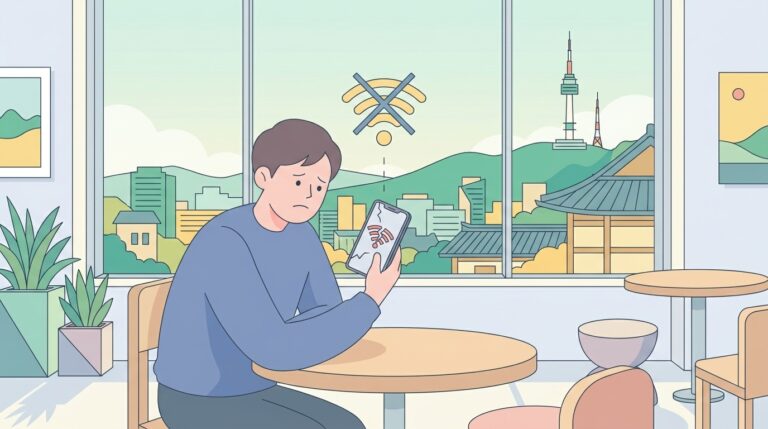
Picture this K-Drama moment: The main character is sitting in a crowded, aesthetic cafe in Seongsu-dong. They just received a shocking text message and need to reply immediately to stop their love interest from getting on a plane. They type furiously, hit ‘send’, and… the loading circle just spins. And spins. They shake their phone, hold it up to the sky, and let out a deep sigh, muttering something under their breath.
They aren’t just saying “It’s broken.” They are experiencing a very specific, deeply Korean emotion: absolute frustration at slow technology.
If you’re traveling in Korea—the land of lightning-fast internet and the Ppalli-ppalli (hurry up) culture—a dead Wi-Fi zone isn’t just an inconvenience; it’s practically a national emergency! Knowing how to express this specific frustration will not only help you get your connection back but will also make locals nod in deep sympathy.
This guide is based on real SOS messages I’ve received from students standing helplessly in the middle of Seoul. Let’s dive in!
Phase 2: Core Expressions Deep Dive
1. 와이파이가 안 터져요. (The Wi-Fi isn’t working/connecting.)
- Pronunciation: wa-i-pa-i-ga an teo-jyeo-yo. [Sound-alike guide: ‘teo’ sounds like ‘toe’ but with a more open mouth. ‘jyeo’ sounds like the ‘jyo’ in ‘Go-jyo’.]
- Meaning: Literal: The Wi-Fi isn’t bursting. / Real Nuance: The Wi-Fi signal is dead/isn’t connecting.
- K-Culture Moment: You’ll hear this exact phrase at a K-Pop concert when 10,000 fans are trying to upload a video of their bias at the same time, and the network completely jams.
- Editor’s Insight: Koreans use the verb 터지다 (to burst/explode) for signals. Imagine the radio waves literally needing to ‘burst’ out of your phone to connect. If it doesn’t ‘burst,’ you have no signal.
- Situation Spectrum:
- Friends (Casual): ✅ (와이파이 안 터져!)
- Coworkers (Semi-formal): ✅ (와이파이가 안 터지네요.)
- Boss/Elders (Formal): ✅ (Just make sure to use the ‘요’ at the end. The subject is the Wi-Fi, so it’s perfectly polite.)
- 🤔 Think About It: Why do you think Koreans use such an active, almost violent word like “explode/burst” to describe an internet connection? How does your native language describe a lost signal?
2. 데이터가 안 터져서 너무 답답해요. (My data isn’t working, so I’m so frustrated.)
- Pronunciation: de-i-teo-ga an teo-jyeo-seo neo-mu dap-dap-hae-yo. [‘dap-dap’ sounds like tapping a table twice: tap-tap!]
- Meaning: Literal: The data isn’t bursting so I feel suffocated. / Real Nuance: I’m so frustrated because the internet is slow.
- K-Culture Moment: When a Korean gamer is playing League of Legends at a PC Bang and the ping drops for even one second, you will hear a loud “Ah, dap-dap-hae!”
- Editor’s Insight: 답답하다 originally describes a room with no air, making you feel suffocated. Metaphorically, it means feeling utterly frustrated because a situation isn’t progressing fast enough.
- Situation Spectrum:
- Friends (Casual): ✅
- Coworkers (Semi-formal): ⚠️ (Okay to use to express your own frustration, but don’t direct it at a person.)
- Boss/Elders (Formal): ⚠️
- 🤔 Think About It: Is there a word in your language that bridges physical suffocation and emotional frustration?
3. 여기 와이파이 비번 뭐예요? (What’s the Wi-Fi password here?)
- Pronunciation: yeo-gi wa-i-pa-i bi-beon mwo-ye-yo? [‘bi-beon’ sounds like ‘bee-bun’.]
- Meaning: Literal: Here Wi-Fi password what is it? / Real Nuance: Could you tell me the Wi-Fi password?
- K-Culture Moment: The very first thing a Korean does after sitting down at a cafe with their iced Americano. Before taking a sip, they look for the Wi-Fi password.
- Editor’s Insight: 비밀번호 (bi-mil-beon-ho) is the full word for password, but in daily spoken Korean, everyone shortens it to 비번 (bi-beon). It makes you sound instantly like a local.
- Situation Spectrum:
- Friends (Casual): ✅
- Coworkers (Semi-formal): ✅
- Boss/Elders (Formal): 🚫 (Use the full word ‘비밀번호’ when asking an elder or a very formal store owner.)
- 🤔 Think About It: Koreans love shortening words (like bi-beon). Does your culture also abbreviate tech terms?
Phase 3: Textbook vs. Real Korean
[Situation 1: Telling someone your internet is broken]
* 📖 Textbook Korean: 인터넷 연결이 안 됩니다. (The internet connection is not working.)
* 🗣️ Real Korean: 아, 와이파이 안 터져. (Ah, the Wi-Fi isn’t bursting.)
* 💡 Why the difference?: Textbooks teach the technical state (연결/connection), but locals focus on the physical sensation of the signal failing (안 터지다).
[Situation 2: Asking for the password at a cafe]
* 📖 Textbook Korean: 비밀번호를 알려주시겠어요? (Could you please inform me of the password?)
* 🗣️ Real Korean: 사장님, 여기 비번 뭐예요? (Boss, what’s the pw here?)
* 💡 Why the difference?: Shortening words like 비번 matches Korea’s fast-paced lifestyle, making interactions quick and efficient.
Bottom Note: At a B1 (Low-Intermediate) level, swapping out textbook vocabulary for widely accepted abbreviations like ‘비번’ or idiomatic verbs like ‘터지다’ is the easiest way to sound fluent without needing complex grammar!
Phase 4: Cultural Context — K-Culture Deep Dive
4-1. Non-verbal Elements & Nunchi
When asking for the Wi-Fi password in a busy cafe, practice your Nunchi (눈치 – the ability to read the room). If the barista is frantically making six lattes at once, do not interrupt them to ask for the Wi-Fi. In Korea, the password is almost always printed at the bottom of your receipt (영수증). Checking the receipt before bothering a busy worker is top-tier Nunchi!
4-2. K-Travel Connection: The “Ppalli-Ppalli” Infrastructure
Korea’s internet is famously fast, and this has shaped the society’s temperament. Because Koreans are so used to instant web pages and zero buffering, their tolerance for slow technology is incredibly low. If a map app takes 5 seconds to load in the middle of Myeongdong, you will feel the collective “답답하다” aura around you. Also, public spaces like subways, buses, and museums almost always have “Public WiFi Free”—so knowing how to connect and complain when it “안 터져요” is a true survival skill for travelers.
Phase 5: Real-Life Roleplay Scenario
Setting: A trendy, underground cafe in Yeonnam-dong. The aesthetic is concrete and minimalist. You just took a great photo of your croffle (croissant-waffle) and want to post it on SNS, but because you are in a basement, your phone has zero bars.
Characters:
– YOU: A foreign student exploring Seoul on a weekend.
– Min-ji: (25, your Korean language exchange partner, practically lives on Instagram).
Dialogue:
YOU: 민지야, 나 인스타그램 스토리가 안 올라가. 📱
(Min-ji-ya, na in-seu-ta-geu-raem seu-to-ri-ga an ol-la-ga.)
[Min-ji, my Instagram story isn’t uploading.]
(🎭 Stage Direction: You wave your phone in the air trying to catch a signal)
Min-ji: 어? 지하라 그런가? 데이터 안 터져?
(Eo? Ji-ha-ra geu-reon-ga? De-i-teo an teo-jyeo?)
[Huh? Maybe because it’s a basement? Is your data not working?]
YOU: 응, 아예 안 터져. 로딩만 계속 돌아가.
(Eung, a-ye an teo-jyeo. Ro-ding-man gye-sok do-ra-ga.)
[Yeah, completely dead. The loading icon just keeps spinning.]
Min-ji: 아, 진짜 답답하네! 여기 와이파이 잡아서 해봐.
(Ah, jin-jja dap-dap-ha-ne! Yeo-gi wa-i-pa-i ja-ba-seo hae-bwa.)
[Ah, that’s so frustrating! Try catching the Wi-Fi here.]
(🎭 Stage Direction: Min-ji points to a small sign by the counter)
YOU: 근데 여기 비번이 뭐지?
(Geun-de yeo-gi bi-beo-ni mwo-ji?)
[But what’s the password here?]
Min-ji: 아까 영수증 받았어?
(A-kka yeong-su-jeung ba-da-sseo?)
[Did you get the receipt earlier?]
🔀 Your Turn! How do you respond?
– A) “영수증? 왜? 환불하게?” (Receipt? Why? To get a refund?)
– B) “응, 여기 있어. 아! 맨 아래에 비번 있네!” (Yeah, here it is. Ah! The password is at the very bottom!)
– C) “아니, 나 영수증 버려달라고 했어.” (No, I asked them to throw it away.)✅ Best Choice: B — Reason: In Korean cafes, the Wi-Fi password and the bathroom code are almost always printed at the bottom of the receipt.
⚠️ Choice C Analysis: If you threw it away (which is common, many say “영수증 버려주세요”), you’ll have to walk back up to the counter and ask: “사장님, 여기 비번 뭐예요?”
Min-ji: 거봐, 영수증에 있지? 빨리 연결해봐.
(Geo-bwa, yeong-su-jeung-e it-ji? Ppal-li yeon-gyeol-hae-bwa.)
[See, it’s on the receipt, right? Hurry and connect.]
YOU: 오, 연결됐어! 이제 빵빵하게 터진다!
(Oh, yeon-gyeol-dwae-sseo! I-je ppang-ppang-ha-ge teo-jin-da!)
[Oh, it connected! It’s bursting with full bars now!]
Min-ji: 다행이다. 나도 태그해 줘!
(Da-haeng-i-da. Na-do tae-geu-hae jwo!)
[Thank goodness. Tag me too!]
Phase 6: 10-Second Shadowing Drill
Practice reading these out loud. Pay attention to the pauses (/) and the emotion tags!
- 😤 답답하게:
아휴 / 데이터가 / 왜 이렇게 / 안 터져? (a-hyu / de-i-teo-ga / wae i-reo-ke / an teo-jyeo?) - 😊 밝게:
사장님 / 여기 / 와이파이 비번 / 뭐예요? (sa-jang-nim / yeo-gi / wa-i-pa-i bi-beon / mwo-ye-yo?) - 🥺 애절하게:
제발 / 스토리 좀 / 올라가라 / 너무 답답해! (je-bal / seu-to-ri jom / ol-la-ga-ra / neo-mu dap-dap-hae!)
Phase 7: K-Culture Mini Dictionary
1. 터지다
* Romanization: teojida
* English: To burst / explode / (for a signal) to connect
* Context: Used to describe network signals, hot spots, or even someone’s temper exploding. “빵빵 터진다” means the signal is exceptionally strong.
2. 비번
* Romanization: bibeon
* English: Password (abbreviation of 비밀번호)
* Context: Used everywhere from cafe Wi-Fi to digital door locks on Korean apartments.
3. 답답하다
* Romanization: dapdaphada
* English: Stifling / Frustrating
* Context: A core Korean emotion. It describes the physical feeling of tightness in your chest when things aren’t going your way or people are acting slow.
4. 영수증
* Romanization: yeongsujeung
* English: Receipt
* Context: The Holy Grail of Korean cafes. It contains your order number, the Wi-Fi password, and the code to use the restroom!
Phase 8: Traveler Survival Kit
🆘 Survival Phrases for the Cafe/Subway
– 🇰🇷 “여기 와이파이 돼요?” (yeo-gi wa-i-pa-i dwae-yo?)
– 🗣️ Meaning: Is there Wi-Fi here?
– 📍 Where to use: Small restaurants, cafes, or Airbnbs.
– 💡 Pro Tip: Look for signs that say “무선 인터넷” (Wireless Internet) or a small router logo near the counter.📌 Editor’s Travel Note
– Free Wi-Fi Everywhere: In Seoul, you’ll see networks called “Public WiFi Free” on buses and subways. You just connect, open a browser, and click the giant circle button on the splash page.
– Hotspot Rescue: If you are with a Korean friend and your Wi-Fi is dead, just ask: “핫스팟 좀 켜줄 수 있어?” (Can you turn on your hotspot for a bit?). Thanks to unlimited data plans, Koreans are very generous with their hotspots!
Phase 9: Critical Thinking Corner — “A Step Deeper”
🧠 Think Deeper: Media vs Reality (Hyper-connectivity)
K-Dramas often portray Seoul as a futuristic tech utopia where hackers can access CCTVs in seconds and everyone has 5G on top of a mountain. While Korea’s digital infrastructure is indeed world-class, this creates a high-pressure reality. The feeling of “답답하다” (frustration) when a signal drops for even a minute reflects how deeply dependent Korean society has become on hyper-connectivity. Being offline, even briefly, feels like being isolated from society.💬 Your Turn: Does your culture expect 24/7 internet connectivity? How do people react in your country when the Wi-Fi goes down at a coffee shop? Share in the comments!
Phase 10: FAQ & Avoiding Misunderstandings
Q: Can I use “안 터져요” to an older person or my boss?
Yes! Because the subject of the sentence is the phone/internet (not the person), it is not rude. Just remember to add ‘요’ at the end: “와이파이가 안 터져요.”
Q: How do I say “My phone is broken” vs “My internet is broken”?
If the physical phone is broken, say “핸드폰이 고장났어요” (My phone is broken). If it’s just the signal, say “데이터가 안 터져요”. Don’t mix them up!
❌ Common Mistake #1: Translating “My Wi-Fi doesn’t work” literally as “와이파이가 일 안 해요” (Wi-Fi doesn’t do labor).
✅ Do this instead: Use “안 터져요” (doesn’t burst) or “안 돼요” (doesn’t function).❌ Common Mistake #2: Asking the cafe staff “비밀번호 주세요” (Give me the password).
✅ Do this instead: “비번 뭐예요?” (What is the password?) sounds much more natural and polite.
Phase 11: Summary & Action Items
- One-Liner Summary: When your internet fails in Korea, don’t say it’s “broken”—say the signal isn’t “bursting” (안 터져요) and express your “frustration” (답답하다)!
-
Action Mission 3 Steps:
- 🥉 Bronze (Solo): Look at your phone right now, turn off your Wi-Fi, and dramatically sigh: “아, 와이파이 안 터져!”
- 🥈 Silver (Online): Change your phone’s language to Korean for one hour today and try to navigate your settings!
- 🥇 Gold (Real-world): Next time you go to a cafe, ask the barista in Korean: “여기 와이파이 비번 뭐예요?”
- K-Culture Mission:
Next time you buy a coffee or a meal in Korea (or look at a photo of a Korean receipt online), try to spot the abbreviation “PW” or “비번” at the bottom of the paper!
Phase 12: Quiz — Interactive Challenge
1. Situational Judgment: You are at a PC Bang with your Korean friend. The game suddenly lags heavily. What is the most natural thing to shout?
A) 컴퓨터가 일 안 해요!
B) 아, 너무 답답해! 인터넷 안 터져!
C) 비밀번호 뭐예요?
2. Fill in the Blank:
A: “I need to use my laptop, but I don’t have internet.”
B: “Do you want me to turn on my _______?”
(Hint: Koreans use the English word for this feature on smartphones.)
3. True or False – K-Culture Edition:
If you need the cafe’s Wi-Fi password, you should always walk straight up to the barista and interrupt them to ask, even if it’s busy. (T / F)
Answers (Click to reveal)
1. B (Expressing frustration with ‘답답해’ and saying the internet ‘안 터져’ is the perfect local reaction.)
2. 핫스팟 (Hotspot)
3. False (Use your ‘Nunchi’! Check the bottom of your receipt first before asking.)
Frequently Asked Questions (FAQ)
Q: What does "와이파이가 안 터져요. (The Wi-Fi isn't working/connecting.)" mean in Korean and how do you pronounce it?
A: In Korean, "와이파이가 안 터져요. (The Wi-Fi isn't working/connecting.)" is pronounced [wa-i-pa-i-ga an teo-jyeo-yo. [Sound-alike guide: 'teo' sounds like 'toe' but with a more open mouth. 'jyeo' sounds like the 'jyo' in 'Go-jyo'.] and means: Literal: The Wi-Fi isn't bursting. / Real Nuance: The Wi-Fi signal is dead/isn't connecting.
Q: What does "데이터가 안 터져서 너무 답답해요. (My data isn't working, so I'm so frustrated.)" mean in Korean and how do you pronounce it?
A: In Korean, "데이터가 안 터져서 너무 답답해요. (My data isn't working, so I'm so frustrated.)" is pronounced [de-i-teo-ga an teo-jyeo-seo neo-mu dap-dap-hae-yo. ['dap-dap' sounds like tapping a table twice: tap-tap!] and means: Literal: The data isn't bursting so I feel suffocated. / Real Nuance: I'm so frustrated because the internet is slow.
Q: What does "여기 와이파이 비번 뭐예요? (What's the Wi-Fi password here?)" mean in Korean and how do you pronounce it?
A: In Korean, "여기 와이파이 비번 뭐예요? (What's the Wi-Fi password here?)" is pronounced [yeo-gi wa-i-pa-i bi-beon mwo-ye-yo? ['bi-beon' sounds like 'bee-bun'.] and means: Literal: Here Wi-Fi password what is it? / Real Nuance: Could you tell me the Wi-Fi password?







