

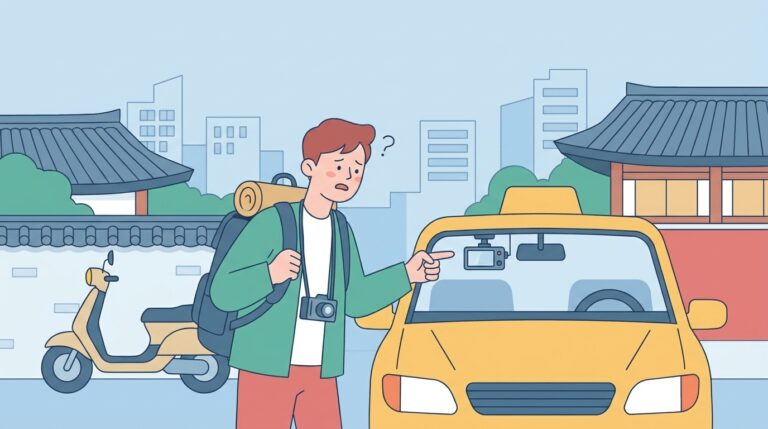
Phase 1: Empathy & Immersion
Hello! I’m the Lead Editor of Daily Hangul.
Picture this: You are watching a K-Drama. The chaebol heir is driving a sleek sports car, and suddenly… BAM! The infamous ‘White Truck of Doom’ strikes, or there’s a minor fender-bender, and the driver steps out dramatically clutching the back of their neck.
But what if you are the one in a taxi or driving a rental car in Seoul, and a real accident happens? Your heart is pounding, the traffic is honking, and the driver is speaking rapid-fire Korean. Panic mode, right?
While we sincerely hope you never have to use the phrases in this lesson, knowing how to navigate a traffic accident (교통사고) in a foreign country is the ultimate survival skill. It changes you from a panicked tourist into someone who can handle the situation safely and smoothly.
Note: This guide is crafted from the real, heart-pounding experiences of expats and travelers in Korea. Let’s make sure you are prepared!
Phase 2: Core Expressions Deep Dive
1. 교통사고 났어요 (I got into a traffic accident)
- Pronunciation: gyo-tong-sa-go na-sseo-yo [gyo-tong sounds like ‘go-tongue’, sa-go sounds like ‘sah-go’]
- Meaning: (Literal) A traffic accident occurred. / (Real Nuance) I’ve been in a car accident.
- K-Culture Moment: This is the exact phrase a K-Drama lead yells into their phone while standing in the rain next to a dented bumper. It’s the standard, universal way to report an accident to 119 (Emergency) or a friend.
- Editor’s Insight: You don’t need to say “I” (저는). In emergencies, Koreans drop the subject. Just saying the event occurred is enough!
- Situation Spectrum:
- Casual (Friends): ✅ (교통사고 났어!)
- Semi-formal (Coworkers): ✅
- Formal (Police/119): ✅
- 🤔 Think About It: Why do Koreans often omit “I” in sentences? It’s because the focus is on the shared situation rather than the individual. Does your native language require you to always state who is involved?
2. 119 좀 불러주세요 (Please call 119)
- Pronunciation: il-il-gu jom bul-leo-ju-se-yo [il-il-gu sounds like ‘ill-ill-goo’]
- Meaning: (Literal) Please call 119 a little. / (Real Nuance) Please call an ambulance/rescue!
- K-Culture Moment: You’ll hear this in every action or medical K-Drama. ‘좀’ (a little) is added to soften the request, even in emergencies!
- Editor’s Insight: In Korea, 112 is for Police, and 119 is for Fire/Ambulance. But if you are panicked, 119 is your best universal bet.
- Situation Spectrum:
- Casual (Friends): ⚠️ (Say ‘119 불러!’)
- Semi-formal/Strangers: ✅
- Formal (Elders): ✅
- 🤔 Think About It: Even when bleeding, Koreans add ‘좀’ (a little/please) to requests. How does politeness survive even in panic?
3. 다친 데는 없어요? (Are you hurt anywhere?)
- Pronunciation: da-chin de-neun eop-seo-yo? [da-chin sounds like ‘dah-chin’]
- Meaning: (Literal) Is there no hurt place? / (Real Nuance) Are you okay? Are you injured?
- K-Culture Moment: When a scooter bumps into a taxi, the driver’s first reaction (after a heavy sigh) will usually be to ask the passenger this question to ensure safety.
- Editor’s Insight: Instead of a simple “Are you okay?” (괜찮아요?), asking “Are there no hurt places?” shows a deeper, specific concern for physical injury.
- Situation Spectrum:
- Casual (Friends): ✅ (다친 데 없어?)
- Semi-formal (Strangers): ✅
- Formal (Elders): ✅ (다치신 데는 없으세요?)
- 🤔 Think About It: Korean focuses heavily on physical well-being. Think about how Koreans use “Have you eaten?” as a greeting. Care is often expressed physically.
Phase 3: Textbook vs Real Korean
[Reporting a Minor Bump]
* 📖 Textbook Korean: 자동차 사고가 발생했습니다. (A car accident has occurred – very robotic)
* 🗣️ Real Korean: 접촉사고 났어요. (jeop-chok-sa-go na-sseo-yo – A minor collision happened)
* 💡 Why is it different?: In crowded Seoul, massive crashes are rare, but minor fender-benders (접촉사고) are daily events. Being specific helps the listener gauge the severity.
[Asking for Police]
* 📖 Textbook Korean: 경찰을 호출해 주시겠습니까? (Would you summon the police?)
* 🗣️ Real Korean: 112(일일이) 불러주세요! (il-il-i bul-leo-ju-se-yo! – Call 112!)
* 💡 Why is it different?: In emergencies, efficiency wins. Nobody uses complex honorific verbs when a bumper is flying off.
Bottom Note: For A2 (Beginner) learners, short and loud is better than grammatically perfect. Memorize the numbers: 112 (Police) and 119 (Ambulance).
Phase 4: Cultural Context — K-Culture Deep Dive
4-1. Non-verbal Cue: The ‘Neck Grab’ (뒷목 잡기)
If you watch K-Dramas, you’ve seen it: after a rear-end collision, a character steps out of the car, grabs the back of their neck (뒷목), and groans. This is so common that it’s practically a national meme! Why the neck? Whiplash! Culturally, showing immediate physical discomfort is the first step in the insurance claim dance.
4-2. The Magic Word: 블랙박스 (Black Box / Dashcam)
In Korea, 99.9% of cars, taxis, and even delivery scooters have a dashcam, called a ‘블랙박스’ (Black Box). If an accident happens, there is no need to argue aggressively on the street like they do in movies. Everyone just says, “블랙박스 확인합시다” (Let’s check the black box). The camera never lies, and Korean insurance agents arrive on scooters within 10 minutes to review the footage!
Phase 5: Real-Life Roleplay Scenario
Scenario A: The Fender-Bender
- Setting: Friday night, 8 PM. You are in a taxi heading to Hongdae for a dinner date. Traffic is brutal. Suddenly, a delivery scooter tries to squeeze past and thump—hits the taxi’s side mirror.
- Characters:
- YOU: A traveler trying to use basic Korean.
- Driver (기사님): A 50-something taxi driver who is stressed but wants to make sure you’re okay.
기사님: 아이고! 참나, 어디로 운전을 하는 거야!
(A-i-go! cham-na, eo-di-ro un-jeon-eul ha-neun geo-ya!)
[Oh my! Seriously, where is he driving!]
(🎭 Stage Direction: The driver puts the car in park and sighs heavily.)
YOU: 헉, 기사님. 교통사고 났어요?
(Heok, gi-sa-nim. gyo-tong-sa-go na-sseo-yo?)
[Gasp, driver. Did we get in an accident?]
기사님: 네, 접촉사고예요. 손님, 다친 데는 없어요?
(Ne, jeop-chok-sa-go-ye-yo. son-nim, da-chin de-neun eop-seo-yo?)
[Yes, it’s a minor bump. Passenger, are you hurt anywhere?]
🔀 Your Turn! How do you reply?
– A) “아파요! 119 불러주세요!” (I’m hurt! Call 119!)
– B) “네, 괜찮아요. 다친 데 없어요.” (Yes, I’m okay. I’m not hurt.)
– C) “아저씨 운전 진짜 못하네요.” (Mister, you’re really bad at driving.)✅ Best Choice: B — Reason: If you are genuinely unharmed, reassure the driver quickly so he can deal with the scooter driver.
⚠️ Choice C Analysis: Never say this! It’s incredibly rude and in this scenario, it wasn’t even the taxi driver’s fault!
YOU: 네, 괜찮아요. 다친 데 없어요.
(Ne, gwaen-cha-na-yo. da-chin de eop-seo-yo.)
[Yes, I’m okay. I’m not hurt.]
기사님: 다행이네요. 잠시만요, 보험사 좀 부를게요.
(Da-haeng-i-ne-yo. jam-si-man-yo, bo-heom-sa jom bu-reul-ge-yo.)
[That’s a relief. Wait a moment, I’ll call the insurance company.]
Scenario B: Bonus – Texting Your Friend
You need to tell the friend waiting in Hongdae that you’ll be late.
YOU: 지훈아! 나 타고 있는 택시가 교통사고 났어.
(Ji-hun-a! na ta-go it-neun taek-si-ga gyo-tong-sa-go na-sseo.)
[Jihun! The taxi I’m riding got into an accident.]
Jihun: 헐! 대박. 너 괜찮아?? 다친 데 없어?
(Heol! dae-bak. neo gwaen-cha-na?? da-chin de eop-seo?)
[OMG! Crazy. Are you okay?? Are you hurt?]
YOU: 응, 단순 접촉사고야. 조금 늦을 것 같아 ㅠㅠ
(Eung, dan-sun jeop-chok-sa-go-ya. jo-geum neu-jeul geot ga-ta ㅠㅠ)
[Yeah, it’s just a simple minor bump. I think I’ll be a little late ㅠㅠ]
Phase 6: 10-Second Shadowing Drill
Let’s practice the intonation! Remember, in an emergency, speak clearly and slightly louder.
- 😨 저기요, / 교통사고 / 났어요.
(jeo-gi-yo, / gyo-tong-sa-go / na-sseo-yo.) - 🚑 여기 / 119 좀 / 불러주세요!
(yeo-gi / il-il-gu jom / bul-leo-ju-se-yo!) - 😊 저는 / 괜찮아요. / 다친 데 / 없어요.
(jeo-neun / gwaen-cha-na-yo. / da-chin de / eop-seo-yo.)
Phase 7: K-Culture Mini Dictionary
1. 접촉사고
* Romanization: jeop-chok-sa-go
* English: Minor collision / Fender-bender
* Context: Literally “contact accident.” This is the most common type of accident in Seoul’s tight alleys.
2. 보험사
* Romanization: bo-heom-sa
* English: Insurance company
* Context: In Korea, insurance agents often act as the police for minor accidents. They arrive quickly on motorcycles.
3. 블랙박스
* Romanization: beul-laek-bak-seu
* English: Dashcam (Black box)
* Context: The absolute judge of all traffic disputes in Korea. Every car has one.
4. 뒷목 잡기
* Romanization: dwin-mok jap-gi
* English: Grabbing the back of the neck
* Context: The classic, slightly dramatic K-Drama pose showing someone has suffered whiplash (or extreme stress) from an accident.
Phase 8: Traveler Survival Kit
If you get into an accident as a pedestrian or a driver, memorize these!
🆘 Survival Expression #1: Calling Help
– 🇰🇷 “경찰 불러주세요” (gyeong-chal bul-leo-ju-se-yo)
– 🗣️ English: Please call the police.
– 📍 Where to use: Anytime you need official help, especially if a dispute arises.🆘 Survival Expression #2: Language Barrier
– 🇰🇷 “영어 할 줄 아세요?” (yeong-eo hal jul a-se-yo?)
– 🗣️ English: Do you speak English?
– 📍 Where to use: Asking bystanders or the other driver for a translator.🆘 Survival Expression #3: Giving Location
– 🇰🇷 “여기 [장소] 앞이에요” (yeo-gi [Location] ap-i-e-yo)
– 🗣️ English: I’m in front of [Location].
– 💡 Pro Tip: Look for a nearby convenience store (GS25, CU). They have specific branch names written on the door, making it super easy for 119 to find you!📌 Editor’s Travel Note
– Useful Apps: Always have Naver Map or Kakao T. They can show your exact GPS address in Korean to show to emergency dispatchers.
– Medical Bills: Korean healthcare is excellent and affordable, but always get a police report for your travel insurance!
Phase 9: Critical Thinking — “A Step Deeper”
Media vs Reality: The K-Drama Accident Illusion
If your only knowledge of Korea comes from K-Dramas, you might think a car accident leads to dramatic screaming in the rain, a sudden amnesia plotline, or falling in love with a rich CEO.
In reality, Korean traffic accidents are handled with astonishing, sometimes robotic, efficiency. Because of the nationwide prevalence of dashcams (블랙박스) and the “Pali-Pali” (hurry up) culture, drivers rarely scream at each other. They just step out, snap 4 photos of the tires with their smartphones, and wait for the insurance agent who arrives in 5 minutes. The media exaggerates the drama, but the reality is a masterpiece of modern efficiency.
💬 Your Turn: In your home country, how long does it usually take for police or insurance to arrive at a minor accident? Let us know in the comments!
Phase 10: FAQ & Common Mistakes
Q: Should I say “미안해요” (I’m sorry) if I get into a car accident?
Maybe NOT. While culturally polite, saying “I’m sorry” immediately can legally imply that you are admitting 100% fault (과실). It is safer to ask “Are you okay?” (다친 데 없어요?) and wait for the police/insurance.
Q: Can I use ‘교통사고 났어요’ to my boss if I’m late?
Yes! But make sure to add honorifics to apologize for being late. “부장님, 택시가 교통사고가 나서 조금 늦을 것 같습니다. 죄송합니다.” (Boss, my taxi got into an accident so I will be a little late. I’m sorry.)
❌ Common Mistake #1: Calling 911.
✅ Do this instead: In Korea, the number is 119 for medical/fire, and 112 for police.
Phase 11: Summary & Action Items
- One-Liner Summary: In a Korean emergency, forget the complex grammar—just shout “교통사고 났어요! 119 불러주세요!”
-
Action Mission 3 Steps:
- 🥉 Bronze (Solo): Say “일일구 좀 불러주세요” out loud 3 times right now.
- 🥈 Silver (Online): Save the numbers 112 and 119 in your phone contacts under “Korea Emergency.”
- 🥇 Gold (Real Life): Next time you ride a Kakao Taxi or watch a Korean vlog, try to spot the “블랙박스” (Dashcam) on the windshield!
- K-Culture Mission:
Watch one episode of a K-Drama this week. If a car accident happens, look closely—do they grab the back of their neck? Count how many times it happens!
Phase 12: Quiz — Interactive Challenge
1. Situational Judgment:
You are walking in Seoul and a bicycle bumps into you. Your leg hurts slightly. The rider asks: “다친 데 없어요?” (Are you hurt?)
What is the BEST response?
* A) 네, 블랙박스 확인합시다. (Yes, let’s check the dashcam.)
* B) 아니요, 아파요. 병원에 가야겠어요. (No, it hurts. I think I need to go to the hospital.)
* C) 미안해요! (I’m sorry!)
2. True or False – K-Culture Edition:
* If you get into a fender-bender in Korea, you must call 911 immediately. (T/F)
3. Fill in the Blank:
* “Emergency! Please call 119!” -> “______ 좀 불러주세요!”
(Answers: 1. B (A is weird for bikes, C admits fault for no reason) / 2. False (It’s 119 or 112, not 911) / 3. 119 (일일구))
Frequently Asked Questions (FAQ)
Q: What does "교통사고 났어요 (I got into a traffic accident)" mean in Korean and how do you pronounce it?
A: In Korean, "교통사고 났어요 (I got into a traffic accident)" is pronounced [gyo-tong-sa-go na-sseo-yo [gyo-tong sounds like 'go-tongue', sa-go sounds like 'sah-go'] and means: (Literal) A traffic accident occurred. / (Real Nuance) I've been in a car accident.
Q: What does "119 좀 불러주세요 (Please call 119)" mean in Korean and how do you pronounce it?
A: In Korean, "119 좀 불러주세요 (Please call 119)" is pronounced [il-il-gu jom bul-leo-ju-se-yo [il-il-gu sounds like 'ill-ill-goo'] and means: (Literal) Please call 119 a little. / (Real Nuance) Please call an ambulance/rescue!
Q: What does "다친 데는 없어요? (Are you hurt anywhere?)" mean in Korean and how do you pronounce it?
A: In Korean, "다친 데는 없어요? (Are you hurt anywhere?)" is pronounced [da-chin de-neun eop-seo-yo? [da-chin sounds like 'dah-chin'] and means: (Literal) Is there no hurt place? / (Real Nuance) Are you okay? Are you injured?







