

Phase 1: Empathy (Immersive K-Culture Open)
Hello! I am your Daily Hangul Editor.
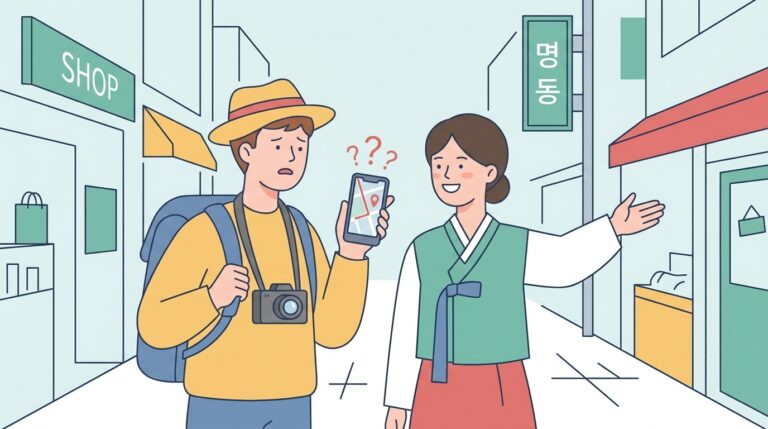
Imagine this: You are standing in the middle of Myeongdong. The map app on your phone cheerfully announces, “You have arrived!” but all you see is an ocean of neon signs and cosmetic shops. Your favorite K-BBQ restaurant is nowhere to be found. You finally gather the courage to stop a passerby. In broken Korean, you ask for directions.
In many countries, people might just point or say, “Take a left, then a right.” But in Korea, something magical often happens. The person might stop, look at your phone, think for a second, and say: “Follow me.” Then, they physically walk you 5 minutes out of their way just to make sure you don’t get lost again.
What is this? Are they an undercover tour guide? No, this is Jeong (정) in action! Jeong is the unique Korean concept of warmth, collective affection, and unspoken connection between people. Today, we are going to learn how to ask for directions, understand the answers, and experience the warmth of Korean Jeong firsthand.
Phase 2: Deep Dive into Core Expressions
1. 저기요, 길 좀 물어볼게요. (Excuse me, let me ask for directions.)
- Pronunciation: jeogiyo, gil jom mureobolgeyo. [juh-gee-yo, geel johm moo-ruh-bol-geh-yo]
- Meaning: Literal: Over there, I will ask a road a little. / Real: Excuse me, can you help me find my way?
- K-Culture Moment: You’ll see this in K-Dramas when the protagonist first arrives in Seoul, clutching a piece of paper with an address, tapping a busy salaryman on the shoulder.
- Editor’s Insight: “저기요” (jeogiyo) is the magic word to get someone’s attention. Adding “좀” (jom – a little) is a cultural buffer; it softens your request so you don’t sound too demanding.
- Situation Spectrum:
- Strangers on the street: ✅
- Store clerks: ✅
- A very formal business meeting: 🚫
- 🤔 Think About It: Why do Koreans use “좀” (a little) even when the favor isn’t little? It reflects the culture of modesty and trying not to burden others.
2. 이쪽으로 쭉 가세요. (Go straight this way.)
- Pronunciation: ijjogeuro jjuk gaseyo. [ee-jjoh-goo-ro jjook gah-seh-yo]
- Meaning: Literal: Go straight toward this direction. / Real: Keep walking straight this way.
- K-Culture Moment: When you ask a convenience store worker where the 2+1 banana milk is, they will point and say “쭉 가세요!” (Go straight!).
- Editor’s Insight: “쭉” (jjuk) is a fun sound! It sounds like the noise you make when you draw a long, straight line on paper. If they say “쭈우우욱” (jjuuuuuk), it means it’s quite far!
- Situation Spectrum:
- Casual / Semi-formal: ✅
- Formal: ✅
- 🤔 Think About It: Koreans love sound words (onomatopoeia). How does adding a sound like “jjuk” make the direction easier to visualize?
3. 제가 데려다줄게요. / 같이 갈까요? (I’ll take you there. / Shall we go together?)
- Pronunciation: jega deryeodajulgeyo. [jeh-gah deh-ryuh-dah-jool-geh-yo] / gachi galkkayo? [gah-chee gal-kkah-yo?]
- Meaning: Literal: I will take you. / Shall we go together? / Real: Let me walk you there.
- K-Culture Moment: This is the ultimate Jeong moment. When a local sees you carrying a huge backpack, looking lost at Seoul Station, they won’t just explain; they will guide you physically.
- Editor’s Insight: This isn’t creepy in Korea; it’s a genuine act of kindness. If a Korean offers this, they are tapping into their cultural duty of being a good host to a guest.
- Situation Spectrum:
- Helping strangers (Jeong): ✅
- 🤔 Think About It: Have you ever experienced a stranger going completely out of their way to help you? How did it make you feel?
Phase 3: Textbook vs. Real Korean
[Getting Someone’s Attention]
* 📖 Textbook Korean: 실례합니다. 길을 잃었습니다. (Excuse me. I am lost.)
* 🗣️ Real Korean: 저기요, 길 좀 물어볼게요! (Excuse me, let me ask for directions!)
* 💡 Why the difference?: “실례합니다” (Sillyehamnida) is perfectly fine, but “저기요” (Jeogiyo) is the actual street-level survival word everyone uses to get attention quickly.
[Asking the Location]
* 📖 Textbook Korean: 서울역이 어디에 있습니까? (Where is Seoul Station located?)
* 🗣️ Real Korean: 서울역 어떻게 가요? (How do I go to Seoul Station?)
* 💡 Why the difference?: Asking “어떻게 가요?” (How do I go?) prompts the person to give you actionable steps, not just a map coordinate.
Phase 4: Cultural Context — K-Culture Deep Dive
4-1. Non-Verbal Communication
- The “Full Hand” Point: In Korea, pointing at a person or even a direction with one index finger can seem a bit rude or aggressive. Notice how Koreans use their whole open hand, palm facing up, to show you the way. It’s an extension of polite body language.
- Looking at the Phone Together: Because of Jeong, personal space bubbles might shrink a bit when helping. Don’t be surprised if the local leans in closely to look at your Google Maps or KakaoMap together.
4-2. K-Travel & K-Food Connection
This situation happens all the time in bustling areas like Hongdae or Bukchon Hanok Village. You are searching for that specific K-Drama filming location or a famous hidden cafe.
Because Korean streets can be winding and many great spots are tucked away in alleys (골목), relying solely on maps is tough. Asking a local is not just about navigation; it’s an opportunity to interact. You might even get a bonus recommendation! (“Oh, you’re going there? The cafe next to it has better croffles!”)
Phase 5: Real-Life Roleplay Scenario
Setting: Friday evening, 6:30 PM. Exit 9 of Hongdae Station. It’s crowded, noisy, and you are trying to find a famous K-BBQ place. You see a friendly-looking Korean student holding an iced Americano.
Characters:
– YOU: A traveler in Seoul who really wants some pork belly (Samgyeopsal).
– Minji (21): A university student, energetic, has strong Jeong.
Dialogue:
YOU: 저기요, 길 좀 물어볼게요.
(jeogiyo, gil jom mureobolgeyo.)
[Excuse me, let me ask for directions.]
Minji: 네? 아, 네! 어디 찾으세요?
(ne? a, ne! eodi chajeuseyo?)
[Yes? Oh, yes! Where are you looking for?]
YOU: (Showing your phone) 여기 식당… 어떻게 가요?
(yeogi sikdang… eotteoke gayo?)
[This restaurant… how do I get there?]
Minji: 아~ 하남돼지집! 여기서 가까워요.
(a~ hanamdwaejijip! yeogiseo gakkawoyo.)
[Ah~ Hanam Pig House! It’s close from here.]
YOU: 오른쪽이에요? 왼쪽이에요?
(oreunjjogieyo? oenjjogieyo?)
[Is it to the right? Or the left?]
Minji: 이쪽으로 쭈우우욱 가세요. 그 다음에 골목으로…
(ijjogeuro jjuuuuuk gaseyo. geu daeume golmogeuro…)
[Go straaaight this way. And then into the alley…]
(🎭 Stage Direction: Minji looks at your confused face. She realizes the alley is hard to find.)
Minji: 음… 길이 좀 복잡해요. 제가 데려다줄게요! 같이 가요!
(eum… giri jom bokjaphaeyo. jega deryeodajulgeyo! gachi gayo!)
[Hmm… the road is a bit complicated. I’ll take you there! Let’s go together!]
🔀 Your Turn! How do you respond?
– A) “아니요, 괜찮아요.” (No, I’m okay.)
– B) “진짜요? 와, 감사합니다!” (Really? Wow, thank you!)
– C) “저기요!” (Excuse me!)✅ Best Choice: B — Embrace the Jeong! A polite and enthusiastic thank you is the best way to accept their kindness.
⚠️ Choice A Analysis: While okay, it might reject their offer of Jeong. If you really want to go alone, you can say it softly.
⚠️ Choice C Analysis: You already got her attention! Saying it again sounds like you are scolding her.
Bonus K-Culture Scenario: At the Restaurant
(You arrive at the K-BBQ place. You want to thank Minji.)
YOU: 너무 감사합니다. 덕분에 잘 왔어요!
(neomu gamsahamnida. deokbune jal wasseoyo!)
[Thank you so much. Thanks to you, I arrived well!]
Minji: 아니에요~ 맛있게 드세요! 한국 여행 잘 하세요!
(anieyo~ masitge deuseyo! hanguk yeohaeng jal haseyo!)
[No worries~ Enjoy your meal! Have a great trip in Korea!]
Phase 6: 10-Second Shadowing Drill
Speak out loud with emotion!
🥺 저기요~ / 길 좀 / 물어볼게요.
(jeogiyo~ / gil jom / mureobolgeyo.)
[Excuse me~ / let me ask / for directions.]
😊 이쪽으로 / 쭈우욱 / 가세요!
(ijjogeuro / jjuuuuuk / gaseyo!)
[Go / straaaight / this way!]
Phase 7: K-Culture Mini Dictionary
1. 정 (Jeong)
* Romanization: jeong
* English: Affection, attachment, collective bond.
* Context: The reason a stranger will walk you to your destination. It’s the emotional glue of Korean society.
2. 핫플 (Hatpeul)
* Romanization: hatpeul
* English: Hot place (Trendy spot).
* Context: A slang combining ‘Hot’ and ‘Place’. If you are looking for a famous cafe, you are looking for a hatpeul!
3. 길치 (Gilchi)
* Romanization: gilchi
* English: A person with no sense of direction.
* Context: “저 길치예요” (I am a gilchi) is a cute and self-deprecating way to explain why you are lost.
4. 오지랖 (Ojirap)
* Romanization: ojirap
* English: Being overly involved or nosy.
* Context: The flip side of Jeong. Sometimes older Koreans might give you directions and then ask why you aren’t wearing a warm jacket. That’s ojirap!
Phase 8: Traveler’s Survival Kit
🆘 Survival Phrases for Getting Lost
– 🇰🇷 “여기 어디예요?” (yeogi eodiyeyo?)
– 🗣️ English: Where am I? / What is this place?
– 📍 Where to use: When you get off a bus at the wrong stop.
- 🇰🇷 “지도 좀 봐주세요.” (jido jom bwajuseyo.)
- 🗣️ English: Please look at the map.
- 📍 Where to use: When showing your phone screen to a local or a taxi driver.
📌 Editor’s Travel Note
– Essential Apps: Do NOT rely solely on Google Maps in Korea; walking directions often don’t work due to security laws. Download KakaoMap or Naver Map!
– Subway Exits: Koreans navigate by subway exits (출구 – chulgu). “Hongdae Exit 9” is a much better reference point than a street name.
Phase 9: Critical Thinking Corner — “One Step Deeper”
Language & Power (The Collective ‘We’)
Have you ever noticed that Koreans often use “우리” (uri – our) instead of “내” (nae – my)? They say “our country,” “our mom,” and even “our house” even if they live alone. This linguistic habit is deeply tied to the culture of Jeong. When you ask for directions and a stranger walks you there, they aren’t just helping an individual; they are acting as a host representing “우리 나라” (our country). The boundary between ‘you’ and ‘me’ blurs to become ‘us’.
💬 Your Turn: Does your culture have a similar concept to Jeong, where strangers feel a sense of collective responsibility for guests? Share in the comments!
Phase 10: FAQ & Avoiding Mistakes
Q: If a stranger offers to walk me to my destination, do I need to tip them?
No! Please do not offer money. Korea is a no-tip culture. Offering money for an act of Jeong can actually be slightly offensive or awkward. A bright smile and a “감사합니다” (Thank you) are all they want!
Q: Can I just point to my phone without speaking?
It’s better to at least say “저기요” (jeogiyo). Shoving a phone in someone’s face silently can be startling.
❌ Common Mistake #1: Asking “You, where is the station?” using the word “당신” (dangsin – you).
✅ Do this instead: Never use “dangsin” to strangers; it sounds aggressive. Just say “저기요” (Excuse me) and ask the question directly without using the word “you.”
Phase 11: Summary & Action Items
- One-Liner Summary: To experience Korean Jeong, start with “저기요” (Excuse me) and don’t be surprised if they offer to walk you there!
-
Action Mission 3 Steps:
- 🥉 Bronze (Solo): Say “저기요, 길 좀 물어볼게요” out loud 3 times while imagining you are in Myeongdong.
- 🥈 Silver (Online): Open Google Street View, drop yourself in Seoul, pick a spot, and type “여기 어떻게 가요?” in your study notes.
- 🥇 Gold (Real-life): Next time you visit a Korean restaurant or grocery store, ask “화장실 어디에 있어요?” (Where is the bathroom?) using the skills you learned!
- K-Culture Mission: Watch a K-Drama today and count how many times you hear the word “저기요” (Jeogiyo) when characters are in a restaurant or on the street!
Phase 12: Quiz — Interactive Challenge
1. Situational Judgment: You are lost near Gyeongbokgung Palace. You want to ask a friendly-looking lady for directions. What is the BEST first word to say?
A) 당신! (Dangsin! – You!)
B) 안녕! (Annyeong! – Hi!)
C) 저기요! (Jeogiyo! – Excuse me!)
2. Fill in the Blank:
To tell a taxi driver to go straight, you say “이쪽으로 ____ 가세요.”
A) 쭉 (jjuk)
B) 좀 (jom)
C) 정 (jeong)
3. True or False – K-Culture Edition:
If a Korean stranger walks you 10 minutes to your destination, you should give them 5,000 won as a tip. (T / F)
Click to see answers!
1. C (A is rude, B is too casual for strangers).
2. A (jjuk means straight!).
3. False (Korea does not have a tipping culture. Just say “정말 감사합니다!”).
Frequently Asked Questions (FAQ)
Q: What does "저기요, 길 좀 물어볼게요. (Excuse me, let me ask for directions.)" mean in Korean and how do you pronounce it?
A: In Korean, "저기요, 길 좀 물어볼게요. (Excuse me, let me ask for directions.)" is pronounced [jeogiyo, gil jom mureobolgeyo. [juh-gee-yo, geel johm moo-ruh-bol-geh-yo] and means: Literal: Over there, I will ask a road a little. / Real: Excuse me, can you help me find my way?
Q: What does "이쪽으로 쭉 가세요. (Go straight this way.)" mean in Korean and how do you pronounce it?
A: In Korean, "이쪽으로 쭉 가세요. (Go straight this way.)" is pronounced [ijjogeuro jjuk gaseyo. [ee-jjoh-goo-ro jjook gah-seh-yo] and means: Literal: Go straight toward this direction. / Real: Keep walking straight this way.
Q: What does "제가 데려다줄게요. / 같이 갈까요? (I'll take you there. / Shall we go together?)" mean in Korean and how do you pronounce it?
A: In Korean, "제가 데려다줄게요. / 같이 갈까요? (I'll take you there. / Shall we go together?)" is pronounced [jega deryeodajulgeyo. [jeh-gah deh-ryuh-dah-jool-geh-yo] and means: Literal: I will take you. / Shall we go together? / Real: Let me walk you there.







