

Phase 1: Empathy – The “No Keys” Panic
Hello! I’m your editor at Daily Hangul.
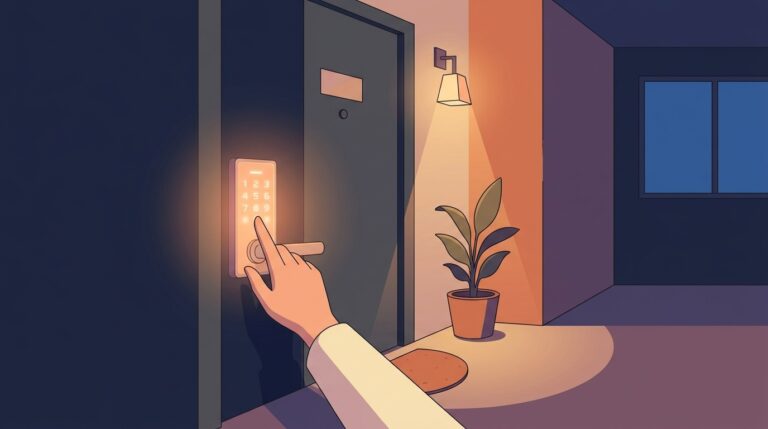
You’ve probably seen it a hundred times in K-Dramas. The main character comes home after a long day (or a dramatic breakup), flips up the cover of their apartment door lock, and types in the passcode—beep-beep-beep-beep, ti-ri-ring! The door swings open. No fumbling with keys, no heavy keychains.
Welcome to Korea, the land where physical keys are practically extinct!
But here’s the reality check: When you rent your first Airbnb in Seoul or visit a Korean friend’s house, you’ll suddenly realize that these high-tech doors can be a little intimidating. The host messages you: “The passcode is 1234, then press the star.” Wait… star? Do I touch the screen first? Why is it making an angry siren noise?!
Don’t worry! This guide is based on real SOS messages from my tutoring students who were locked out of their Korean apartments. By the end of this post, you’ll be entering houses like a true K-Drama lead!
Phase 2: Core Expressions Deep Dive
Let’s look at the absolute must-know words to survive the Korean door lock experience.
1. 비밀번호 (Passcode / Password)
- Pronunciation: bimil-beonho [bee-meel-bun-ho]
- Meaning: Literal: Secret number. / Real nuance: Passcode.
- K-Culture Moment: You’ll hear this everywhere—at the ATM, logging into PC bangs, and of course, getting into houses. In K-Dramas, couples often set their 비밀번호 to their anniversary date!
- Editor’s Insight: While ‘비밀’ means secret and ‘번호’ means number, young Koreans almost always shorten this to 비번 (bibeon) in casual texting.
- Situation Spectrum:
- Casual (Friends): ✅ (비번 뭐야? – What’s the code?)
- Semi-formal (Co-workers): ✅ (비밀번호가 어떻게 되나요?)
- Formal (Elders/Boss): 🚫 (You rarely ask an elder for their house code!)
- 🤔 Think About It: Why do you think Koreans trust digital locks more than physical locks? How does this reflect Korea’s fast-paced, high-tech society?
2. 누르세요 (Please press)
- Pronunciation: nureuseyo [noo-reu-seh-yo]
(Tip: The ‘eu’ sounds like the disgusted groan you make when stepping on gum!)- Meaning: Please press / push.
- K-Culture Moment: When you are in a crowded Korean elevator, you’ll hear people say, “닫힘 버튼 좀 눌러주세요” (Please press the close button). Koreans press buttons FAST!
- Editor’s Insight: This verb (누르다) is used for buttons, keypads, and bells. It’s different from pushing a heavy door (밀다).
- Situation Spectrum:
- Casual: ✅ (눌러! – Press it!)
- Semi-formal: ✅ (누르세요 – Please press)
- Formal: ✅ (눌러주세요 – Please kindly press)
- 🤔 Think About It: In Korea, you “press” a password rather than “type” it. Does your native language differentiate between typing on a keyboard and pressing on a keypad?
3. 별표 (*) / 우물정자 (#)
- Pronunciation: byeolpyo [byul-pyo] / umuljeongja [oo-mool-jung-ja]
- Meaning: Star sign (*) / Pound or Hash sign (#)
- K-Culture Moment: After pressing your passcode, 99% of Korean door locks require you to press the 별표 (*) to confirm. If you don’t, you’ll just be standing outside forever!
- Editor’s Insight: ‘우물’ means ‘water well’. The # symbol looks exactly like the traditional Chinese/Korean character for a well (井)! Fascinating, right?
- Situation Spectrum:
- Casual: ✅
- Semi-formal: ✅
- Formal: ✅
- 🤔 Think About It: Why do digital locks require a finishing symbol like *? (Hint: It prevents strangers from guessing the code length!)
Phase 3: Textbook vs Real Korean
Let’s see how textbook phrases change in the wild streets of Seoul!
[Asking for the Code]
* 📖 Textbook Korean: 비밀번호를 입력하세요. (bimil-beonhoreul imnyeokaseyo – Enter the password.)
* 🗣️ Real Korean: 비밀번호 누르세요. (bimil-beonho nureuseyo – Press the password.)
* 💡 Why different?: ‘입력하다’ (to input) sounds like a computer robot. In daily life, we just say ‘누르다’ (to press) because it focuses on the physical action.
[Texting your friend for the code]
* 📖 Textbook Korean: 집 비밀번호가 무엇입니까? (jip bimil-beonhoga mueosimnikka? – What is your house password?)
* 🗣️ Real Korean: 집 비번 뭐야? (jip bibeon mwoya? – What’s the house code?)
* 💡 Why different?: Koreans love efficiency! 4 syllables (비밀번호) is too long for texting, so it becomes 2 syllables (비번).
Bottom Note: For A2 learners, sticking to “비밀번호가 뭐예요?” (bimil-beonhoga mwoyeyo? – What is the password?) is the perfect, safe middle ground for any situation.
Phase 4: Cultural Context — K-Culture Deep Dive
4-1. Non-verbal Context: The “Keypad Shield”
Even if you are visiting your absolute best friend, you will notice they do something funny when typing their door code: they will naturally use their other hand, or their entire body, to shield the keypad.
It’s not because they don’t trust you! It’s an ingrained Korean Nunchi (눈치 – social awareness) habit. It saves you the awkwardness of having to look away. If someone is typing their code, politely look at your phone or stare at the ceiling!
4-2. K-Drama Connection: The Breakup Trope 💔
You’ve definitely seen this K-Drama trope. The couple breaks up. The very next day, the ex-boyfriend goes to the girl’s house, types the old code (usually their anniversary), and the door lock screams: Beeeep!
“비밀번호가 틀렸습니다” (The password is incorrect).
Changing the door lock code is the ultimate symbol of “we are officially over” in modern Korean romance.
Also, many smart locks in Korea have a “Fake Number” (허수) feature. To prevent fingerprint tracking, you can press random numbers like 9-4-7 before pressing your real code 1-2-3-4. K-Drama villains often use this to hide their codes!
Phase 5: Real-Life Roleplay Scenario
Scenario A: The Housewarming Party
- Setting: Friday night, 7:30 PM. You just arrived at your Korean friend Minho’s new apartment for a housewarming party (집들이 – Jipdeuri). You are standing in the hallway, but the door is locked.
- Characters:
- YOU: An A2 Korean learner, excited but slightly confused by the blank digital door lock.
- Minho (28): Your friendly Korean host.
Dialogue:
YOU: (Calling Minho) 민호야! 나 집 앞이야. 🚪
(Minhoya! Na jip apiya.)
[Minho! I’m in front of your house.]
Minho: 어, 일찍 왔네? 들어와!
(Eo, iljjik wanne? Deureowa!)
[Oh, you’re early? Come in!]
YOU: 문이 잠겨 있어. 비밀번호가 뭐야?
(Muni jamgyeo isseo. Bimil-beonhoga mwoya?)
[The door is locked. What’s the passcode?]
Minho: 아, 맞다! 비번 1004야.
(A, matda! Bibeon cheonsaya.)
[Ah, right! The code is 1004. (1004 sounds like ‘Angel’ in Korean!)]
YOU: 천사? 1004?
(Cheonsa? Il-gong-gong-sa?)
[Angel? 1004?]
Minho: 응! 1004 누르고 별표 눌러.
(Eung! Il-gong-gong-sa nureugo byeolpyo nulleo.)
[Yeah! Press 1004 and the star button.]
(🎭 Stage Direction: You press 1-0-0-4 and the * button, but nothing happens. The screen is dark!)
YOU: 안 열려. 화면이 까매.
(An yeollyeo. Hwamyeoni kkamae.)
[It won’t open. The screen is black.]
Minho: 아! 화면을 먼저 손바닥으로 터치해야 돼.
(A! Hwamyeoneul neonjeo sonbadageuro teochihaeya dwae.)
[Ah! You have to touch the screen with your palm first to wake it up.]
YOU: 아, 불이 켜졌어! 다시 해볼게.
(A, buri kyeojyeosseo! Dasi haebolge.)
[Ah, the light came on! I’ll try again.]
(🎭 Stage Direction: You touch the screen, press 1-0-0-4, then *. The lock plays a happy *Ti-ri-ring! sound!)*
🔀 Your Turn! How should you respond now?
– A) “문 부쉈어!” (I broke the door!)
– B) “열렸어! 들어갈게!” (It opened! I’m coming in!)
– C) “경찰 불러주세요!” (Call the police!)✅ Best Choice: B — Simple, natural, and celebratory!
⚠️ Choice A analysis: Highly dramatic, but unless you actually broke the $300 Samsung smart lock, don’t say this!
Scenario B: Bonus K-Culture Roleplay (The Food Delivery)
In Korea, food delivery drivers often need the code to the building’s lobby (common entrance) to bring food directly to your door.
Driver: 배달입니다. 공동현관 비밀번호가 어떻게 되나요? 🛵
(Baedarimnida. Gongdong-hyeongwan bimil-beonhoga eotteoke doenayo?)
[Delivery. What is the common entrance passcode?]
YOU: 종 누르고 1234 별표 누르시면 돼요.
(Jong nureugo il-i-sam-sa byeolpyo nureusimyeon dwaeyo.)
[Press the bell, then 1234, then star.]
Driver: 네, 알겠습니다. 문 앞에 두고 갈게요.
(Ne, algetseumnida. Mun ape dugo galgeyo.)
[Okay. I’ll leave it in front of the door.]
Phase 6: 10-Second Shadowing Drill
Read this out loud and imagine you are guiding your friend to your house. Pay attention to the pauses!
😊 비밀번호 / 1234 누르고 / 별표 / 누르세요!
(bimil-beonho / il-i-sam-sa nureugo / byeolpyo / nureuseyo!)
[Press the passcode 1234, and press the star!]
Phase 7: K-Culture Mini Dictionary
Here are the top keywords related to getting into a Korean home:
1. 도어록
* Romanization: do-eo-rok
* English: Digital door lock
* Context: The standard lock on 99% of Korean doors. Keys are basically antiques now.
2. 비번
* Romanization: bi-beon
* English: Passcode (Slang)
* Context: Short for 비밀번호. Used mostly in texting or casual speech.
3. 집들이
* Romanization: jip-deu-ri
* English: Housewarming party
* Context: A major event when someone moves. Guests usually bring toilet paper or laundry detergent as gifts to wish them “bubbling” wealth!
4. 공동현관
* Romanization: gong-dong-hyeon-gwan
* English: Common entrance / Lobby
* Context: Large apartment complexes have a main lobby door that also requires a passcode before you can even reach the elevator.
Phase 8: Traveler Survival Kit 🆘
Renting an Airbnb in Korea? Save these phrases to your phone!
🆘 Survival Expression #1
– 🇰🇷 “비밀번호가 안 맞아요.” (bimil-beonhoga an majayo.)
– 🗣️ Meaning: The password is incorrect / isn’t working.
– 📍 Where to use: Texting your Airbnb host or hotel staff.🆘 Survival Expression #2
– 🇰🇷 “문이 안 열려요.” (muni an yeollyeoyo.)
– 🗣️ Meaning: The door won’t open.
– 📍 Where to use: When the lock is out of battery or malfunctioning.📌 Editor’s Travel Note
– Wake up the screen: Most Korean door locks look completely black until you place your entire palm on the screen to “wake it up.” Poking it with one finger won’t work!
– Push-Pull vs Turn: Modern door handles in Korea don’t turn. You simply push the giant handle to go out, and pull it to come in.
Phase 9: Critical Thinking — “One Step Deeper”
Media vs Reality: The Keyless Society
If you watch K-Dramas, it seems like nobody in Korea carries a physical key. This is actually true! Korea transitioned to digital locks rapidly in the early 2000s due to the “Palli-Palli” (hurry up) culture and the massive rise of high-density apartment living. A digital code is standard, efficient, and means you never waste time looking for keys in your bag.
However, this extreme digitalization has a flip side. For the elderly, tiny digital keypads can be hard to see, and forgetting a passcode means paying for a locksmith to completely break and replace the expensive machine.
💬 Your Turn: Does your country use digital locks widely? Do you prefer the convenience of a passcode, or the safety of a physical key? Share your thoughts in the comments!
Phase 10: FAQ & Common Mistakes
Q: Should I ask my Airbnb host for the code in formal Korean?
Yes! Since they are a business host, use formal language: “비밀번호가 어떻게 되나요?” (What is the passcode?) instead of “비번 뭐야?”.
Q: What if the door lock plays a sad melody when I press the code?
If it sounds like Für Elise or a low-battery warning beep, the batteries are dying! You might need to buy a 9-volt battery from a convenience store and hold it to the emergency contact points on the outside of the lock.
❌ Common Mistake #1: Forgetting to press the star ().
✅ Do this instead: Always end your code with the 별표 (). If you just stand there after pressing the numbers, the lock will eventually reset.❌ Common Mistake #2: Staring directly at someone’s hand while they type their code.
✅ Do this instead: Observe proper Nunchi and look away. It’s an unspoken Korean etiquette rule!
Phase 11: Summary & Action Items
One-Liner Summary: To get inside a Korean house, wake up the screen, press the 비밀번호 (passcode), and never forget the 별표 (* star)!
Your Action Missions:
* 🥉 Bronze (Solo): Look at your own phone’s lock screen and practice saying your passcode in Korean out loud.
* 🥈 Silver (Online): Leave a comment using the word “비밀번호” on this post.
* 🥇 Gold (Real Life): If you are in Korea, text your friend or delivery driver using the expression “비번”!
K-Culture Mission:
Next time you watch a modern K-Drama, count how many times you see a digital door lock. Try to catch the ti-ri-ring sound!
Phase 12: Quiz — Interactive Challenge
1. Fill in the Blank:
You are texting your close friend to ask for their apartment door code.
“집 ___ 뭐야?”
(A) 도어록
(B) 비번
(C) 별표
2. True or False — K-Culture Edition:
In Korea, it is considered polite to watch your friend closely to learn their door code so you can let yourself in next time. (T/F)
3. Situational Judgment:
You pressed the code your Airbnb host gave you, but the door is completely black and won’t beep. What is the most likely reason?
(A) You didn’t press the # button.
(B) You need to touch the screen with your whole palm to wake it up first.
(C) You broke it.
(Answers: 1. B, 2. False – Always look away!, 3. B)
Frequently Asked Questions (FAQ)
Q: What does "비밀번호 (Passcode / Password)" mean in Korean and how do you pronounce it?
A: In Korean, "비밀번호 (Passcode / Password)" is pronounced [bimil-beonho [bee-meel-bun-ho] and means: Literal: Secret number. / Real nuance: Passcode.
Q: What does "누르세요 (Please press)" mean in Korean and how do you pronounce it?
A: In Korean, "누르세요 (Please press)" is pronounced [nureuseyo [noo-reu-seh-yo] and means: Please press / push.
Q: What does "별표 (*) / 우물정자 (#)" mean in Korean and how do you pronounce it?
A: In Korean, "별표 (*) / 우물정자 (#)" is pronounced [byeolpyo [byul-pyo] and means: Star sign (*) / Pound or Hash sign (#)







