

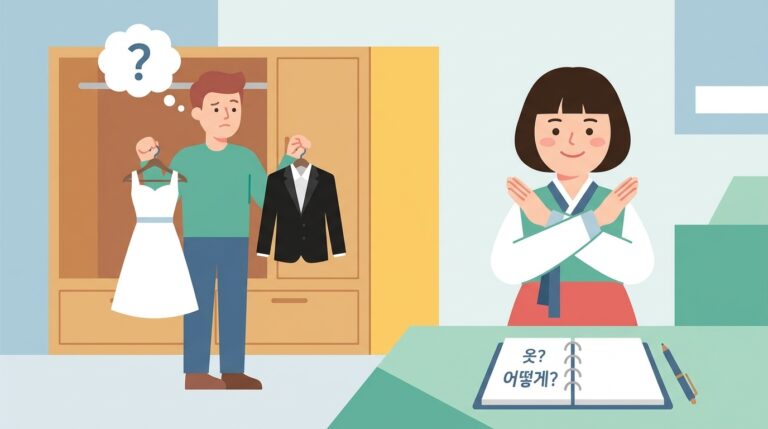
Phase 1: Empathy – The “What Do I Wear?” Panic
Hello! I’m your editor from Daily Hangul, your veteran tutor and local culture navigator.
Picture this: You are sitting in a cozy Korean cafe. Your Korean friend shyly hands you a beautiful, elegant envelope. It’s a Cheongcheopjang (청첩장), a wedding invitation! You are thrilled. You go home, open your closet, and pull out that stunning, elegant white dress or that flashy neon suit you bought last summer. You think, “I’m going to look amazing!”
But wait… If you wear that to a Korean wedding, you might become the main character of a K-Drama—and not in a good way! In Korea, attending a wedding isn’t just about celebrating; it’s a subtle fashion battlefield ruled by unspoken rules and Nunchi (눈치, reading the room).
Today, we are going to dive into the world of 하객룩 (Hagaek-look, Wedding Guest Fashion). If you don’t know these expressions and rules, you might accidentally become the “villain” of the wedding photos. Let’s make sure you look flawless, respectful, and totally like an insider!
Phase 2: Core Expressions Deep Dive
1. 하객룩으로 뭐 입지?
- Pronunciation: hagaengnugeuro mwo ipji? [ha-gaeng-noog-eu-ro mwo ip-jee?]
- Meaning: (Literal) What do I wear as a guest look? / (Real nuance) What on earth should I wear to the wedding so I look good but appropriate?
- K-Culture Moment: You will hear this exact phrase every weekend in spring and autumn (the peak wedding seasons in Korea). Friends will text each other screenshots of online shopping malls asking this question.
- Editor’s Insight: ‘하객’ (Hagaek) means ‘guest (who came to congratulate)’, and ‘룩’ (look) is from English. Together, it forms a massive fashion category in Korea. If you search ‘하객룩’ on Instagram, you’ll see thousands of neat, business-casual outfits.
- Situation Spectrum:
- Casual (Friends): ✅
- Semi-formal (Colleagues): ✅
- Formal (Boss/Elders): ⚠️ (To elders, say: 결혼식에 갈 때 옷을 어떻게 입는 게 좋을까요?)
- 🤔 Think About It: Why did a specific term like “Hagaek-look” become an entire fashion industry in Korea? Does your country have a specific “look” just for attending weddings?
2. 흰색은 무조건 피해야 돼.
- Pronunciation: huinsaegeun mujogeon pihaeya dwae. [hwin-sek-eun moo-jo-geon pee-he-ya dwe]
- Meaning: (Literal) You must unconditionally avoid white. / (Real nuance) DO NOT WEAR WHITE UNDER ANY CIRCUMSTANCES.
- K-Culture Moment: In a K-Drama, if the villain wants to ruin the female lead’s wedding, she shows up in a glowing, lacey white dress. The whole room gasps.
- Editor’s Insight: This is the absolute golden rule of Korean weddings. White is exclusively reserved for the bride. Wearing white means you are trying to outshine her.
- Situation Spectrum:
- Casual (Friends): ✅
- Semi-formal (Colleagues): ✅
- Formal (Boss/Elders): 🚫 (Too direct)
- 🤔 Think About It: Does your culture also reserve certain colors for the bride or the host? How strict is this rule compared to Korea?
3. 민폐 하객
- Pronunciation: minpye hagaek [meen-pye ha-gek]
- Meaning: (Literal) Nuisance guest / (Real nuance) A guest who commits a faux pas (usually fashion-related) and ruins the vibe.
- K-Culture Moment: After a wedding, friends might gather at a cafe and gossip: “Did you see her outfit? Total Min-pye Hagaek!”
- Editor’s Insight: ‘민폐’ (Min-pye) sounds like a harsh word (nuisance/harm), but it’s used casually in pop culture to describe anyone who breaks the unspoken dress code (e.g., wearing white, wearing clubbing clothes, or dressing too casually like in sweatpants).
- Situation Spectrum:
- Casual (Friends): ✅ (Used for gossip or joking)
- Semi-formal (Colleagues): ⚠️
- Formal (Boss/Elders): 🚫
- 🤔 Think About It: The fear of becoming a “Min-pye” drives a lot of social behavior in Korea. How does this reflect the Korean value of prioritizing the group over the individual?
Phase 3: Textbook vs. Real Korean
[Situation 1: Asking for fashion advice]
* 📖 Textbook Korean: 결혼식에 갈 때 어떤 옷을 입어야 합니까? (What kind of clothes should I wear when I go to a wedding?)
* 🗣️ Real Korean: 나 이번 주말에 하객룩 뭐 입지? (What should I wear as a guest look this weekend?)
* 💡 Why the difference?: Koreans love combining Korean words with English fashion terms to create efficient new slang (하객 + Look).
[Situation 2: Warning someone about their outfit]
* 📖 Textbook Korean: 흰색 원피스는 입지 마세요. (Please do not wear a white dress.)
* 🗣️ Real Korean: 헐, 그거 입으면 민폐 하객 돼. 흰색은 진짜 놉! (Whoa, if you wear that, you’ll be a nuisance guest. White is an absolute nope!)
* 💡 Why the difference?: Friends use dramatic internet slang (“헐” – Whoa, “놉” – Nope) to emphasize social taboos in a friendly, urgent way.
Phase 4: Cultural Context — K-Culture Deep Dive
4-1. Non-verbal Elements: The Art of Nunchi
When you ask about your outfit, pay attention to your Korean friend’s eyes. If you show them a dress and they hesitate, tilting their head and saying, “음… 예쁘긴 한데…” (Hmm… it’s pretty, but…), that’s your cue! Nunchi tells you: “Do not wear that.” In Korea, direct rejection is often avoided to save face, so hesitation means “No.”
4-2. K-Drama Connection: The “Revenge Hagaek-look”
Have you noticed this classic K-Drama trope? The protagonist gets invited to her terrible ex-boyfriend’s wedding. She goes to a salon, gets a full makeover, and walks into the wedding hall looking like a supermodel. This is often jokingly called “복수 하객룩” (Revenge guest look). However, in reality, even for revenge, she will usually wear black or navy—never white!
Critical View: While dramas make it seem like weddings are places to show off and be dramatic, real Korean weddings are quite fast-paced and formal. Blending in elegantly (꾸안꾸 – effortlessly chic) is highly preferred over standing out.
Phase 5: Real-world Roleplay Scenario
Setting: A trendy cafe in Hongdae on a Wednesday evening. You are sipping an iced Americano with your Korean friend, Minji. You just received an invitation to your coworker’s wedding.
Characters:
* YOU: An expat in Korea going to your first Korean wedding. You want to look good but don’t know the rules.
* Minji (28): Your fashionable Korean friend who always knows the latest trends.
Dialogue:
Minji: 너 다음 주말에 지훈 씨 결혼식 가지? 하객룩 정했어?
(neo da-eum ju-mare jihun ssi gyeolhonsik gaji? hagaengnuk jeonghaesseo?)
[You’re going to Jihoon’s wedding next weekend, right? Did you decide on your guest look?]
YOU: 아직! 나 예전에 파티 때 입었던 하얀색 실크 드레스 입을까 생각 중이야.
(ajik! na yejeone pati ttae ibeotdeon hayansaek silkeu deureseu ibeulkka saenggak jung-iya.)
[Not yet! I’m thinking of wearing the white silk dress I wore to a party before.]
Minji: (Eyes widen) 헉! 안 돼, 안 돼! 절대 안 돼!
(heok! an dwae, an dwae! jeoldae an dwae!)
[Whoa! No, no! Absolutely not!]
YOU: 왜? 너무 화려해서 그래?
(wae? neomu hwaryeohaeseo geurae?)
[Why? Is it because it’s too flashy?]
Minji: 한국에서는 신부만 흰색을 입을 수 있어. 흰색 입고 가면 완전 민폐 하객 돼!
(hangugeseoneun sinbuman huinsaegeul ibeul su isseo. huinsaek ipgo gamyeon wanjeon minpye hagaek dwae!)
[In Korea, only the bride can wear white. If you go wearing white, you’ll totally be a nuisance guest!]
🔀 Your Turn! How do you respond?
* A) “아, 몰랐어. 그럼 검은색 정장 입어야겠다!” (Ah, I didn’t know. Then I should wear a black suit!)
* B) “그래도 내 옷인데 내 마음대로 입을래!” (But it’s my clothes, I’ll wear what I want!)
* C) “에이~ 사진 찍을 때만 피하면 되잖아.” (Hey~ I just have to avoid being in the photos.)✅ Best Choice: A — Why: A black or navy suit/dress is the safest and most standard choice for a Korean wedding.
⚠️ Choice B & C Analysis: These are massive red flags! Breaking the dress code is seen as disrespecting the bride and groom’s big day, and you must participate in the group photo at the end!
YOU: (Choosing A) 아, 몰랐어. 그럼 검은색 정장 입어야겠다!
(a, mollasseo. geureom geomeunsaek jeongjang ibeoyagetda!)
[Ah, I didn’t know. Then I should wear a black suit!]
Minji: 응, 깔끔한 슬랙스나 네이비 원피스도 좋아. 단정하게 입는 게 최고야.
(eung, kkalkkeumhan seullaekseuna neibi wonpiseudo joa. danjeonghage imneun ge choegoya.)
[Yeah, neat slacks or a navy dress are good too. Dressing neatly is the best.]
YOU: 알겠어! 안 물어봤으면 큰일 날 뻔했네.
(algesseo! an mureobwasseumyeon keunil nal ppeonhaenne.)
[Got it! I would have been in big trouble if I hadn’t asked.]
Minji: 다행이다. 주말에 같이 쇼핑하러 갈래?
(dahaeng-ida. jumare gachi syopinghareo gallae?)
[Thank goodness. Want to go shopping together this weekend?]
Phase 6: 10-Second Shadowing Drill
Read these out loud to sound like a native fashionista!
- 😱 (Panicking) 헉! / 그거 입으면 / 완전 민폐 하객 돼!
(heok! / geugeo ibeumyeon / wanjeon minpye hagaek dwae!) - 🤔 (Pondering) 나 / 하객룩으로 / 뭐 입지?
(na / hagaengnugeuro / mwo ipji?) - 👩💼 (Assertive) 하객은 / 무조건 / 단정하게 입어야 돼.
(hagaegeun / mujogeon / danjeonghage ibeoya dwae.)
Phase 7: K-Culture Mini Dictionary
1. 하객룩 (Hagaek-look)
* Romanization: hagaengnuk
* English: Wedding guest outfit
* Context: A neat, formal, yet stylish outfit worn by wedding guests. Usually consists of muted colors (navy, black, beige, pastel).
2. 민폐 하객 (Min-pye Ha-gaek)
* Romanization: minpye hagaek
* English: Nuisance guest
* Context: Someone who draws negative attention at a wedding, usually by wearing white, dressing too revealingly, or making inappropriate jokes.
3. 청첩장 (Cheongcheopjang)
* Romanization: cheongcheopjang
* English: Wedding invitation
* Context: Often given in person. In Korea, meeting friends to give them the physical Cheongcheopjang (and treating them to a meal) is a big part of wedding preparations.
4. 축의금 (Chuguigeum)
* Romanization: chuguigeum
* English: Congratulatory money
* Context: Instead of wedding gifts, Koreans give cash in a white envelope. The amount depends on how close you are to the person (usually starting from 50,000 KRW to 100,000 KRW or more).
Phase 8: Traveler’s Survival Kit
Are you traveling in Korea and suddenly need to buy a nice outfit for a dinner or a formal event (like a wedding)? Keep these phrases handy!
🆘 Survival Expression #1: Trying on clothes
* 🇰🇷 “이거 입어봐도 돼요?” (igeo ibeobwado dwaeyo?)
* 🗣️ English sound: [Ee-geo ee-buh-bwa-do dwe-yo?]
* 📍 Where to use: Clothing stores, department stores.
* 💡 Pro Tip: In Korean fitting rooms, you MUST take off your shoes before stepping inside the cubicle. Also, women will often be given a “face cover” (페이스 커버) — a thin tissue mask to wear over your head so your makeup doesn’t stain the collar of the clothes!📌 Editor’s Travel Note
* Where to shop for Hagaek-look: Department stores (Hyundai, Shinsegae), or underground shopping malls like Gangnam Station or Goto Mall (Express Bus Terminal) for budget-friendly but stylish options.
* Sizes in Korea: Korean sizes usually run smaller than US/EU sizes. A “Free Size” (프리사이즈) often translates to a US Small or Medium.
Phase 9: Critical Thinking Corner — “A Step Deeper”
Harmony vs. Individualism: Why can’t I stand out?
In Western cultures, weddings can often feel like a grand party where everyone is encouraged to express their personal style, be glamorous, and dance the night away. However, the Korean concept of “not standing out” (튀지 않기) at a wedding deeply reflects the culture’s collective mindset.
A Korean wedding is traditionally seen not just as the union of two individuals, but of two families. The spotlight must rigidly remain on the hosts (the bride, groom, and their parents). By dressing down slightly and avoiding flashy colors, guests are visually showing their respect and putting the harmony of the event above their individual desire to look glamorous.
💬 Your Turn: How do people dress for weddings in your culture? Is there a color that is absolutely forbidden, or is it a free-for-all fashion show? Let us know in the comments!
Phase 10: FAQ & Avoiding Mistakes
- Q: “Can I wear black to a Korean wedding? Isn’t black for funerals?”
- A: Yes, you can! Actually, a neat black suit or black dress is the safest and most popular choice for a Korean wedding. Just don’t wear all-black with a grim expression!
- Q: “What about beige or light pink?”
- A: These are okay, BUT if the beige is so light that it looks white in photographs, you might get side-eyes. If you wear a light top, pair it with a dark skirt or jacket.
- Q: “Can I wear jeans?”
- A: Usually, no. Unless the invitation explicitly says “casual” or it’s a small outdoor indie wedding, jeans are considered too informal.
❌ Common Mistake #1: Wearing a beautiful, bright red dress.
✅ Do this instead: Avoid anything neon, bright red, or overly sparkly. Stick to “business chic”—navy, gray, muted tones, and clean lines.
Phase 11: Summary & Action Items
- One-Liner Summary: For a Korean wedding, dress neatly (단정하게), avoid white at all costs, and don’t be a Min-pye Hagaek!
-
Action Mission:
- 🥉 Bronze (Solo): Look at your closet and pick out one outfit that would make the perfect Korean Hagaek-look. Say “이게 내 하객룩이야!” (This is my guest look!) out loud.
- 🥈 Silver (Online): Go to Instagram, search the hashtag
#하객룩, and see what Korean fashionistas are wearing. - 🥇 Gold (Real World): The next time you buy a nice outfit, show it to a Korean friend and ask, “하객룩으로 어때요?” (How is this for a guest look?)
- K-Culture Mission:
Watch a wedding scene in a K-Drama (like Start-Up or Crash Landing on You). Notice how the guests are dressed compared to the bride. Are they blending into the background?
Phase 12: Quiz — Interactive Challenge
1. Situational Judgment: You are attending a Korean colleague’s wedding. Which outfit is the BEST choice?
* A) A stunning, floor-length white lace dress.
* B) A neat navy-blue blazer with dress pants.
* C) A bright red sequin dress to show your excitement.
* D) Comfortable blue jeans and a white t-shirt.
2. Fill in the blank:
“헉, 결혼식에 흰색 원피스를 입고 간다고? 너 그러다가 완전 ( ____ ) 하객 돼!”
(Whoa, you’re wearing a white dress to the wedding? You’ll totally become a ( ____ ) guest!)
3. True or False – K-Culture Edition:
In Korea, it is completely acceptable to wear an all-black suit to a wedding.
Answers (Click to reveal!)
- B – Navy blue is the ultimate safe and polite choice. A is stealing the bride’s thunder, C is too flashy, and D is too casual.
- 민폐 (min-pye) – A nuisance or inappropriate guest.
- True – Black is very common and considered formal and neat for both men and women, unlike in some Western cultures where it might be seen as mourning attire.
Frequently Asked Questions (FAQ)
Q: What does "하객룩으로 뭐 입지?" mean in Korean and how do you pronounce it?
A: In Korean, "하객룩으로 뭐 입지?" is pronounced [hagaengnugeuro mwo ipji? [ha-gaeng-noog-eu-ro mwo ip-jee?] and means: (Literal) What do I wear as a guest look? / (Real nuance) What on earth should I wear to the wedding so I look good but appropriate?
Q: What does "흰색은 무조건 피해야 돼." mean in Korean and how do you pronounce it?
A: In Korean, "흰색은 무조건 피해야 돼." is pronounced [huinsaegeun mujogeon pihaeya dwae. [hwin-sek-eun moo-jo-geon pee-he-ya dwe] and means: (Literal) You must unconditionally avoid white. / (Real nuance) DO NOT WEAR WHITE UNDER ANY CIRCUMSTANCES.
Q: What does "민폐 하객" mean in Korean and how do you pronounce it?
A: In Korean, "민폐 하객" is pronounced [minpye hagaek [meen-pye ha-gek] and means: (Literal) Nuisance guest / (Real nuance) A guest who commits a faux pas (usually fashion-related) and ruins the vibe.







