

Phase 1: Empathy (Immersive Open)
Hello! I’m your Lead Editor at Daily Hangul.
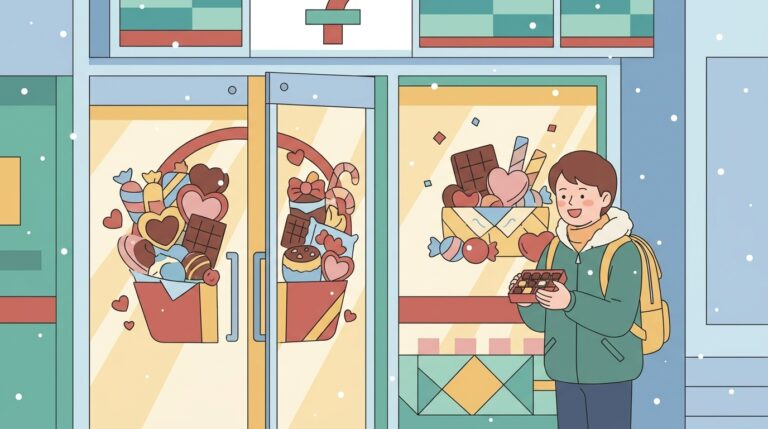
Picture this: It’s a freezing morning in mid-February. You walk into your local CU or GS25 convenience store to grab a hot coffee, but the entrance is suddenly blocked by a massive, sparkling fortress of Ferrero Rochers and Chupa Chups baskets. Fast forward exactly one month to March, and boom—the fortress is back, but this time it’s all about candies.
If you’ve watched K-Dramas, you might think Valentine’s Day and White Day in Korea are purely romantic—the main character shyly handing over a perfectly wrapped box of chocolates to their crush. But what happens when you step into a Korean office? Your coworkers are handing out chocolates to everyone. Wait, are they confessing their love to the entire team? Should you buy something for your boss?
Don’t panic! I’ve been there, and I’ve seen many of my students freeze in confusion during February and March. Today, we’re going to dive deep into the real-life nuances of Korean Valentine’s Day (Feb 14th) and White Day (March 14th). By the end of this, you won’t just survive the holiday season—you’ll navigate it like a true Korean insider!
Phase 2: Core Expressions Deep Dive
1. 의리 초콜릿
- Pronunciation: euiri chokollit [eui-ri cho-kol-lit] (Tip: Say ‘eu’ like the sound of disgust when stepping in gum, plus ‘ri’)
- Meaning: Obligation/Loyalty chocolate (Literal: Loyalty chocolate)
- K-Culture Moment: It’s February 14th. Your team leader walks in, and a junior employee hands him a small, simple chocolate bar saying, “Team Leader, it’s euiri chocolate!” The team laughs, and the boss happily eats it without any awkward romantic tension.
- Editor’s Insight: This is your best friend in a Korean office! Adding the word ‘의리’ (loyalty/friendship) instantly removes any romantic pressure. It’s a fun, lighthearted way to show you care about your colleagues without crossing boundaries.
- Situation Spectrum:
- Casual (Friends): ✅
- Semi-formal (Coworkers): ✅
- Formal (Strict boss/Elders): ⚠️ (Keep it light and professional)
- 🤔 Think About It: Why does Korean society need a specific term like ‘의리’ for giving chocolates? It perfectly reflects the Korean culture of ‘정’ (Jeong – collective affection). Leaving someone out breaks group harmony, so giving small gifts to everyone maintains the peace!
2. 부담 갖지 마세요
- Pronunciation: budam gatji maseyo [boo-dam gat-jee ma-se-yo]
- Meaning: Please don’t feel burdened / No pressure.
- K-Culture Moment: You give your coworker a slightly nice box of chocolates because they helped you with a big project. To make sure they don’t think it’s a romantic ‘confession’ or feel forced to buy you an expensive gift in return on White Day, you quickly add this phrase.
- Editor’s Insight: Koreans are very sensitive to ‘부담’ (the feeling of owing someone or feeling pressured). Using this phrase shows you have excellent ‘눈치’ (Nunchi – social awareness).
- Situation Spectrum:
- Casual (Friends): ✅ (부담 갖지 마!)
- Semi-formal (Coworkers): ✅
- Formal (Strict boss/Elders): ✅
- 🤔 Think About It: Does your native language have a direct translation for feeling a ‘burden’ when receiving a gift? In Korea, gift-giving is often a reciprocal social contract, so verbally breaking that contract is a sign of ultimate consideration.
3. 고백하다
- Pronunciation: gobaekada [go-bae-ka-da]
- Meaning: To confess (feelings/love)
- K-Culture Moment: K-Pop fans know this well. In countless K-Dramas, the protagonist prepares a handmade chocolate on Valentine’s Day to ‘고백하다’ to their crush.
- Editor’s Insight: Unlike in English where you simply ‘ask someone out’, Koreans treat the transition from friends to dating as a formal milestone. ‘Confessing’ your feelings is a big deal and usually requires a clear answer!
- Situation Spectrum:
- Casual (Crush): ✅
- Semi-formal (Coworkers): 🚫 (Please, no HR nightmares!)
- Formal (Strict boss/Elders): 🚫
- 🤔 Think About It: Why is dating framed as a ‘confession’ in Korea? It highlights the serious, almost dramatic importance placed on officially defining a relationship.
Phase 3: Textbook vs. Real Korean
[Situation 1: Giving a gift to a coworker]
* 📖 Textbook Korean: 발렌타인데이 선물입니다. (balleonta indei seonmurimnida. – This is a Valentine’s Day gift.)
* 🗣️ Real Korean: 과장님, 의리 초콜릿이에요! 하나씩 드세요. (gwajangnim, euiri chokollisieyo! hanassik deuseyo. – Manager, it’s obligation chocolate! Please have one.)
* 💡 Why is it different?: The textbook version sounds stiff and slightly too formal, which can accidentally create awkward romantic or bribery undertones. The real Korean version highlights the communal sharing aspect.
[Situation 2: Asking a friend about their White Day plans]
* 📖 Textbook Korean: 화이트데이에 데이트를 합니까? (hwaiteudeie deiteureul hamnikka? – Do you have a date on White Day?)
* 🗣️ Real Korean: 너 화이트데이에 사탕 받을 사람 있어? (neo hwaiteudeie satang badeul saram isseo? – Do you have anyone to get candy from on White Day?)
* 💡 Why is it different?: Friends tease each other. Asking if they have someone to ‘receive candy from’ is a very natural, slightly teasing way to ask if they are dating someone.
Bottom Note: For B2 learners, focusing on smoothly delivering ‘부담 갖지 마세요’ (No pressure) will make you sound incredibly natural and socially intelligent in Korean work or university environments.
Phase 4: Cultural Context — K-Culture Deep Dive
4-1. Non-verbal Nunchi
When giving ‘의리 초콜릿’ (obligation chocolate) in the office, don’t make a big scene. Don’t pull someone aside into a quiet hallway—that signals a romantic confession! Instead, casually leave it on their desk with a bright smile, or hand it to them in front of others. This non-verbal cue signals, “This is just friendly, don’t overthink it.”
4-2. The Convenience Store (K-Travel & Daily Life)
If you travel to Korea in February or March, the real action happens at convenience stores (CU, GS25, 7-Eleven). It’s a massive cultural phenomenon. You’ll see signs for ‘1+1’ (원플러스원 – Buy one get one free) or ‘2+1’ (투플러스원) everywhere.
Because Koreans often buy chocolates for their entire friend group or office team, these bundle deals are essential. You don’t buy one expensive artisanal truffle; you buy 10 Ferrero Rocher packs using a ‘2+1’ deal to share the love (and the Jeong!).
Phase 5: Real-Life Roleplay Scenario
Setting: It’s 1:00 PM on February 14th. You are in the breakroom of your Korean office. You bought a big bag of mini chocolates using a ‘2+1’ deal at the convenience store downstairs.
Characters:
* YOU: An expat working in Seoul, wanting to show appreciation to your team without making it weird.
* Minji (28): Your friendly, helpful coworker.
* Team Leader Choi (45): Your strict but caring boss.
Dialogue:
YOU: 민지 씨, 이거 하나 드세요! 🍫
(minji ssi, igeo hana deuseyo!)
[Minji, please have one of these!]
(🎭 Stage Direction: You hand her a mini chocolate bar)
Minji: 어머, 발렌타인데이라고 챙겨주신 거예요? 감동이에요~
(eomeo, balleonta indeirago chaenggyeojusin geoyeyo? gamdongieyo~)
[Oh my, did you prepare this because it’s Valentine’s Day? I’m touched~]
YOU: 에이, 그냥 편의점에서 투플러스원 하길래 샀어요.
(ei, geunyang pyeonijeomeseo tupeulleoseuwon hagillae sasseyo.)
[Nah, I just bought it because it was 2+1 at the convenience store.]
Minji: 센스 최고! 아, 저기 팀장님 오시네요.
(senseu choego! a, jeogi timjangnim osineyo.)
[Great sense! Oh, here comes the Team Leader.]
(🎭 Stage Direction: Team Leader Choi walks in looking tired with a cup of black coffee)
🔀 Your Turn! How do you give the chocolate to Team Leader Choi?
– A) “팀장님! 저의 마음을 받아주세요!” (Team Leader! Please accept my heart!)
– B) “팀장님, 달달한 거 드시고 힘내세요! 제 의리 초콜릿입니다.”
– C) “팀장님, 해피 발렌타인데이!”✅ Best Choice: B — “Team Leader, have something sweet and cheer up! It’s my obligation chocolate.” It’s respectful, caring, and uses the magic word ‘의리’ to keep it professional.
⚠️ Choice A Analysis: NEVER DO THIS unless you want to be the subject of office gossip for the next three years. It sounds like a romantic confession.
⚠️ Choice C Analysis: It’s okay, but just saying “Happy Valentine’s Day” in English is a bit dry. Choice B shows high-level Korean social skills.
Phase 6: 10-Second Shadowing Drill
Let’s practice handing over that friendly gift! Pay attention to the pauses (/) and the emotion tags.
😊 팀장님! / 이거 / 의리 초콜릿이에요. / 부담 갖지 마시고 / 드세요!
(timjangnim! / igeo / euiri chokollitieyo. / budam gatji masigo / deuseyo!)
[Team Leader! / This / is obligation chocolate. / Don’t feel pressured / and please enjoy!]
Phase 7: K-Culture Mini Dictionary
1. 눈치
* Romanization: nunchi
* English: Social awareness / Reading the room
* Context: The essential skill of knowing when a gift is just a friendly gesture vs. a romantic advance.
2. 의리
* Romanization: euiri
* English: Loyalty / Friendship / Obligation
* Context: A highly valued concept in Korea, often attached to Valentine’s Day gifts to strip away romantic pressure among colleagues.
3. 모태솔로 (모쏠)
* Romanization: motaesollo (mossol)
* English: Someone who has been single since birth
* Context: A popular slang term you’ll hear a lot around Valentine’s Day and White Day, often used playfully among friends. (“Are you going to be a mossol this year too?”)
4. 1+1 / 2+1
* Romanization: won-ppeulleoseu-won / tu-ppeulleoseu-won
* English: Buy 1 get 1 free / Buy 2 get 1 free
* Context: The marketing lifeblood of Korean convenience stores, especially crucial when buying gifts for your entire office.
Phase 8: Traveler Survival Kit
Are you in Seoul this February or March? You’ll definitely want to buy some treats! Here are your survival phrases for the convenience store.
🆘 Survival Phrases at the Convenience Store
– 🇰🇷 “이거 투플러스원 맞아요?” (igeo tupeulleoseuwon majayo?)
– 🗣️ Meaning: Is this really buy 2 get 1 free?
– 🇰🇷 “교차 증정 되나요?” (gyocha jeungjeong doenayo?)
– 🗣️ Meaning: Can I mix and match? (e.g., mixing a Snickers and a Twix for the 2+1 deal)
– 🇰🇷 “봉투 하나 주세요.” (bongtu hana juseyo.)
– 🗣️ Meaning: Please give me a plastic bag.📌 Editor’s Travel Note
– The App Hack: Download the ‘Pocket CU’ or ‘Our Neighborhood GS’ apps. You can literally check the inventory of specific chocolates at stores near you so you don’t wander around in the cold!
– Cash vs. Card: Korean convenience stores accept foreign credit cards perfectly. Don’t worry about cash!
Phase 9: Critical Thinking Corner — “One Step Deeper”
Media vs Reality: The Chocolate Fantasy
If you watch K-Dramas, Valentine’s Day looks like a highly dramatic, individualistic event involving secret lockers, blushing cheeks, and high-end chocolate boutiques. But in reality, it’s deeply tied to Korea’s collective identity and commercialism. It’s less about romantic exclusivity and more about participating in a nationwide social ritual. Buying a massive tub of cheap chocolates to share with every single person in your office is the truest expression of ‘정’ (Jeong). It shows that in Korean society, ensuring nobody feels excluded is often prioritized over individual romance.
💬 Your Turn: Does your culture celebrate Valentine’s Day? Is it strictly for couples, or do you share gifts with coworkers and friends too? Let me know in the comments!
Phase 10: FAQ & Mistake Prevention
Q: Can I give candy on Valentine’s Day instead of chocolate?
A: Yes, but keep the ‘rules’ in mind. In Korea, traditionally, women give chocolates to men on Valentine’s Day (Feb 14), and men give candy to women on White Day (March 14). However, nowadays, ‘의리 초콜릿’ is given by anyone to anyone! (Fun fact: Many Korean women actually prefer chocolate on White Day because hard candy is hard to eat!)
Q: Is it okay to buy an expensive gift for my boss?
A: Maybe… but usually No. Under the Kim Young-ran Act (anti-graft law), expensive gifts to certain superiors (like teachers or public officials) are strictly forbidden. Even in normal companies, an expensive gift causes ‘부담’ (burden). Keep it under $10!
❌ Common Mistake #1: Giving an overly decorated, heart-shaped box to a coworker of the opposite sex.
✅ Do this instead: Buy individually wrapped chocolates (like Ferrero Rocher 3-packs) and hand them out equally to everyone on the team.
Phase 11: Summary & Action Items
One-Liner Summary: To survive Korean Valentine’s Day and White Day at work, use ‘의리 초콜릿’ (loyalty chocolate) and ‘부담 갖지 마세요’ (no pressure) to show affection without the awkwardness!
Action Mission 3 Steps:
* 🥉 Bronze (Solo): Say “부담 갖지 마시고 드세요!” out loud 3 times in front of your mirror.
* 🥈 Silver (Online): Leave a comment in a Korean learning community explaining what ‘의리 초콜릿’ means to someone who doesn’t know!
* 🥇 Gold (Real Life): Go to a Korean market or convenience store, find a 2+1 deal, and buy some snacks to share with your friends or classmates using the phrases you learned!
K-Culture Mission:
Open YouTube and search “한국 편의점 발렌타인데이” (Korean Convenience Store Valentine’s Day). Look at how wild the displays get outside the stores!
Phase 12: Quiz — Interactive Challenge
1. Situational Judgment:
You want to give a friendly Valentine’s gift to a male coworker who helped you fix your computer. You definitely do NOT want to date him. What do you say when handing him the chocolate?
* A) 오빠, 사랑해! (Oppa, I love you!)
* B) 이거 제 의리 초콜릿이에요. (This is my obligation chocolate.)
* C) 화이트데이 때 기대할게요. (I’ll look forward to White Day.)
2. True or False – K-Culture Edition:
* “In Korea, men traditionally give chocolates to women on Valentine’s Day.”
(Answers: 1. B – ‘의리’ is the ultimate friendzone shield! / 2. False! Traditionally, women give chocolate to men on Valentine’s Day, and men return the favor with candy on White Day.)
Frequently Asked Questions (FAQ)
Q: What does "의리 초콜릿" mean in Korean and how do you pronounce it?
A: In Korean, "의리 초콜릿" is pronounced [euiri chokollit [eui-ri cho-kol-lit] and means: Obligation/Loyalty chocolate (Literal: Loyalty chocolate)
Q: What does "부담 갖지 마세요" mean in Korean and how do you pronounce it?
A: In Korean, "부담 갖지 마세요" is pronounced [budam gatji maseyo [boo-dam gat-jee ma-se-yo] and means: Please don't feel burdened / No pressure.
Q: What does "고백하다" mean in Korean and how do you pronounce it?
A: In Korean, "고백하다" is pronounced [gobaekada [go-bae-ka-da] and means: To confess (feelings/love)







