

Phase 1: Empathy & Immersion
Hello! I’m the Lead Editor of Daily Hangul.
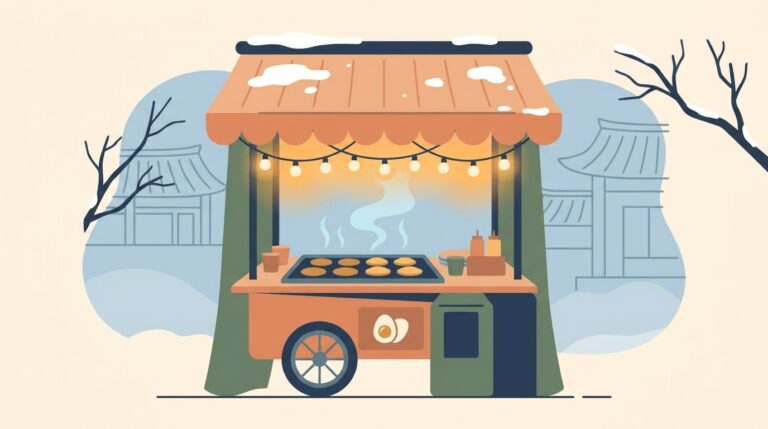
Imagine this: You are walking down the bustling streets of Myeongdong or Hongdae. It is freezing cold, and you are shivering in your padded winter coat. Suddenly, a heavenly aroma hits you—sweet vanilla batter mixed with savory baked egg. You turn your head and see a little street cart enveloped in warm steam. It is 계란빵 (Gyeran-ppang / Egg Bread), the ultimate K-drama winter comfort food.
You want one. Actually, you want three. But as you walk up to the cart, your mind goes blank. How do I order? Do I just point? Do I hold up fingers like a toddler? What if they speak to me?
Trust me, I have watched hundreds of foreign students freeze in this exact moment—and it wasn’t just because of the winter wind! Relying on translation apps with freezing fingers is no fun. Today, I am going to teach you exactly how to order street food like a confident local. No robotic textbook phrases, just the real, natural Korean you need to secure that warm, fluffy egg bread.
Phase 2: Core Expression Deep Dive
Here are the 3 magical phrases that will unlock any street food stall in Korea.
1. 이거 하나 주세요 (I’ll take one of these, please)
- Pronunciation: igeo hana juseyo [ee-guh ha-na joo-seh-yo]
- Meaning: Literal: (This / one / give please) vs. Real: (I’ll take one of these, please.)
- K-Culture Moment: Picture a K-drama where the male lead buys warm street food for the female lead to warm her hands. He casually points to the grill and says, “사장님, 이거 두 개 주세요” (Boss, give me two of these).
- Editor’s Insight: This is your ultimate survival phrase. You don’t even need to know the name of the food! Just point, smile, and say “igeo” (this).
- Situation Spectrum:
- Street vendors (Casual but polite): ✅
- Restaurants (Semi-formal): ✅
- High-end dining (Formal): ⚠️ (Better to use the actual menu name)
- 🤔 Think About It: In English, we often say “Can I have…” or “I would like…”. In Korean, we use “주세요” (give me). Why do you think Korean is so direct with “give me,” yet it still sounds perfectly polite?
2. 얼마예요? (How much is it?)
- Pronunciation: eolmayeyo? [uhl-mah-yeh-yo?]
- Meaning: How much is it?
- K-Culture Moment: You will hear this everywhere—from idol shopping vlogs at Dongdaemun Night Market to your everyday convenience store run.
- Editor’s Insight: Don’t stress if you can’t understand the Korean numbers they reply with! Most vendors will either show you the price on their fingers, point to a sign, or type it on a calculator.
- Situation Spectrum:
- Street vendors (Casual): ✅
- Department stores (Formal): ✅
- 🤔 Think About It: Street food prices in Korea rarely require bargaining. How does this compare to the street markets in your home country?
3. 카드 돼요? (Do you accept cards?)
- Pronunciation: kadeu dwaeyo? [kah-deu dwae-yo?]
- Meaning: Literal: (Card / works?) vs. Real: (Can I pay with a credit card?)
- K-Culture Moment: Korea is a massive “cashless” society. Even for a $2 coffee, everyone uses cards. But street stalls? They are the one exception where cash is still king.
- Editor’s Insight: Say this with an apologetic smile if you only have plastic. The vendor will either nod or say “현금” (hyeon-geum / cash).
- Situation Spectrum:
- Street vendors: ✅
- Taxis: ✅
- Friends: 🚫 (Doesn’t make sense)
Phase 3: Textbook vs. Real Korean
Let’s see how language changes from the classroom to the streets.
[Ordering the Food]
* 📖 Textbook Korean: 계란빵 한 개 주십시오. (Gyeran-ppang han gae jusipsio. – Very rigid and militaristic)
* 🗣️ Real Korean: 사장님, 이거 하나 주세요~ (Sajangnim, igeo hana juseyo~)
* 💡 Why the difference?: Adding “사장님” (Boss/Owner) shows respect to the vendor, and “~주세요” is perfectly polite yet friendly enough for the bustling street vibe.
[Asking the Price]
* 📖 Textbook Korean: 이것의 가격은 얼마입니까? (Igeosui gageogeun eolma-imnikka? – Sounds like a robot auditing the stall)
* 🗣️ Real Korean: 이거 얼마예요? (Igeo eolmayeyo?)
* 💡 Why the difference?: Spoken Korean drops unnecessary particles (like ‘의’ and ‘은’) for speed and efficiency.
Bottom Note: For A1 beginners, always stick to expressions ending in “~요” (~yo). It is the golden shield of politeness that works on everyone from strangers to your grandmother!
Phase 4: Cultural Context — K-Culture Deep Dive
4-1. Non-verbal Communication
When pointing at the delicious Gyeran-ppang, do not point with one stiff index finger like you are accusing someone of a crime! In Korea, gently gesture toward the food with an open hand, or use your index finger but keep your hand relaxed and close to your body. Also, when handing over your cash or card, try to use two hands, or lightly support your right elbow with your left hand. The vendor will immediately recognize your respect for Korean culture!
4-2. The “3,000 Won in Your Chest Pocket” Rule
If you watch K-dramas or follow K-Pop idols on winter variety shows, you will hear a famous Korean joke: “가슴속에 3천 원을 품고 다녀야 하는 계절” (The season where you must carry 3,000 won in your chest pocket).
Why? Because in winter, you never know when you will encounter a Gyeran-ppang, Hotteok (sweet pancake), or Bungeo-ppang (fish-shaped pastry) cart! Since many street vendors only take cash or bank transfers (which is hard for tourists), carrying a few crisp 1,000 won bills is a true local survival tactic.
Phase 5: Real-life Roleplay Scenario
Setting: A brightly lit street stall near Hongdae Station. It’s 7 PM, the wind is howling, and the smell of sweet, baking egg bread is irresistible.
Characters:
* YOU: A traveler visiting Seoul. You have 5,000 won in your pocket and a craving for warmth.
* 사장님 (Sajangnim): The stall owner. A friendly lady wearing a thick winter apron and earmuffs.
Dialogue:
YOU: 저기요, 사장님! 이거 하나 주세요. 🥖
(jeogiyo, sajangnim! igeo hana juseyo.)
[Excuse me, Boss! I’ll take one of these, please.]
사장님: 네~ 계란빵 하나요. 뜨거우니까 조심해요!
(ne~ gyeran-ppang hanayo. tteugeounikka josimhaeyo!)
[Yes~ One egg bread. It’s hot, so be careful!]
(🎭 Stage Direction: The owner wraps the hot bread in a small paper cup so you can hold it without burning your hands)
YOU: 감사합니다. 얼마예요?
(gamsahamnida. eolmayeyo?)
[Thank you. How much is it?]
사장님: 2천 원이에요.
(icheon wonieyo.)
[It’s 2,000 won.]
🔀 Your Turn! How do you pay?
* A) Hand her a 50,000 won bill (Sin Saimdang).
* B) Hand her two 1,000 won bills with both hands.
* C) Leave a 5,000 won bill and say “Keep the change!”✅ Best Choice: B — Using exact (or close) change with both hands is the best street food etiquette!
⚠️ Choice A Analysis: Handing a $40 bill for a $1.50 item will make the busy vendor panic because she might not have enough change.
⚠️ Choice C Analysis: There is NO tipping culture in Korea. If you tell her to keep the change, she will chase you down the street thinking you forgot your money!
Phase 6: 10-Second Shadowing Drill
Let’s practice the rhythm! Pay attention to the pauses (/) and the emotion.
😊 사장님, / 이거 하나 / 주세요!
(sa-jang-nim, / i-geo ha-na / ju-se-yo!)
[Boss, / this one / please give!]
Tip: Don’t mumble! Speak brightly over the street noise so the owner can hear you.
Phase 7: K-Culture Mini Dictionary
1. 사장님
* Romanization: sajangnim
* English: Boss / Owner
* Context: You can use this to politely call the staff or owner at any street stall, restaurant, or taxi. It is the ultimate ice-breaker.
2. 포장마차
* Romanization: pojangmacha
* English: Street food tent / cart
* Context: Literally “covered wagon.” It refers to the orange or red tents selling street food or late-night drinks featured in every romantic K-drama.
3. 현금
* Romanization: hyeongeum
* English: Cash
* Context: The word you will see on handmade signs at street stalls, often written as “현금 부탁드립니다” (Cash please).
4. 붕어빵
* Romanization: bungeo-ppang
* English: Fish-shaped pastry
* Context: The eternal rival of Gyeran-ppang in the winter street food Olympics. Stuffed with sweet red bean or custard.
Phase 8: Traveler Survival Kit
If you are hunting for street food, you MUST know these.
🆘 Survival Expression #1: “진짜 맛있어요!”
* 🇰🇷 “진짜 맛있어요!” (jinjja masisseoyo!)
* 🗣️ Pronunciation Guide: jin-jja mah-shees-uh-yo!
* 📍 Where to use: Eating in front of the stall.
* 💡 Pro Tip: Say this while chewing, with wide eyes. The vendor will love you, and you might even get a free extra piece!📌 Editor’s Travel Note
* App to use: Naver Map or KakaoMap. Google Maps doesn’t work well in Korea for walking directions!
* Cash vs. Card: Korea is 95% cashless, but street stalls are the 5%. Always carry 5,000 to 10,000 won in 1,000 won bills.
* Trash: You won’t find many public trash cans in Korea. It is totally fine to hand your empty cup or skewer back to the vendor you bought it from. Say “이거 버려주세요” (Please throw this away).
Phase 9: Critical Thinking Corner — “A Step Deeper”
Food & Identity: The Concept of “Jeong” (정)
Street food in Korea is more than just a quick bite; it is a physical manifestation of 정 (Jeong)—a uniquely Korean concept of warmth, affection, and invisible social connection. When a vendor wraps your Gyeran-ppang in an extra tissue so your hands won’t burn, or throws in an extra fish-cake for free, that is Jeong. It is a shared moment of humanity in a fast-paced, modern metropolis. Ordering in Korean, even just “안녕하세요” (Hello) and “주세요” (Please), opens the door to experiencing this warmth firsthand.
💬 Your Turn: Do street food vendors in your country interact closely with customers, or is it strictly a quick business transaction? Share your culture in the comments!
Phase 10: FAQ & Avoiding Mistakes
Q: “Can I ask for a discount at a food stall?”
No. For cheap items like Gyeran-ppang (usually 1,500 to 2,000 won), asking for a discount is considered rude. The profit margins are very small!
Q: “What if I don’t know the name of the food at all?”
That’s why we learned “이거” (igeo / this)! Just point and say “이거 주세요” (igeo juseyo). It works 100% of the time.
❌ Common Mistake #1: Leaving a tip on the counter.
✅ Do this instead: Look the vendor in the eye, bow slightly, and say “잘 먹었습니다!” (jal meogeotseumnida / I ate well!). That is the greatest tip you can give in Korea.
Phase 11: Summary & Action Items
One-Liner Summary: Remember “Igeo hana juseyo” (Give me one of this) and “Eolmayeyo” (How much), and you are ready to conquer the Korean street food scene!
Action Mission:
* 🥉 Bronze: Stand in front of your mirror and practice saying “사장님, 이거 하나 주세요!” with a bright smile.
* 🥈 Silver: Write “가슴속 3천원” (3,000 won in my heart) on a sticky note and put it on your wallet to remind yourself to carry cash in Korea.
* 🥇 Gold (For travelers in Korea): Find a street stall today, buy a Gyeran-ppang using ONLY Korean, and enjoy the delicious victory!
K-Culture Mission:
Search “Korean street food Gyeran-ppang” on YouTube. Watch a vlog and see if you can catch the moment the customer asks “얼마예요?” (How much is it?).
Phase 12: Quiz — Interactive Challenge
1. Situational Judgment:
You only have a credit card, but you really want the egg bread. What is the best phrase to ask the owner before you order?
* A) 얼마예요? (eolmayeyo?)
* B) 진짜 맛있어요! (jinjja masisseoyo!)
* C) 카드 돼요? (kadeu dwaeyo?)
2. True or False — K-Culture Edition:
If the street food is amazing, you should leave a 1,000 won bill on the counter as a tip for the vendor. (T / F)
3. Fill in the blank:
To politely call the stall owner to get their attention, you say “_______, 이거 주세요!”
(Answers: 1. C, 2. False – no tipping in Korea!, 3. 사장님 / Sajangnim)
Frequently Asked Questions (FAQ)
Q: What does "이거 하나 주세요 (I'll take one of these, please)" mean in Korean and how do you pronounce it?
A: In Korean, "이거 하나 주세요 (I'll take one of these, please)" is pronounced [igeo hana juseyo [ee-guh ha-na joo-seh-yo] and means: Literal: (This / one / give please) vs. Real: (I'll take one of these, please.)
Q: What does "얼마예요? (How much is it?)" mean in Korean and how do you pronounce it?
A: In Korean, "얼마예요? (How much is it?)" is pronounced [eolmayeyo? [uhl-mah-yeh-yo?] and means: How much is it?
Q: What does "카드 돼요? (Do you accept cards?)" mean in Korean and how do you pronounce it?
A: In Korean, "카드 돼요? (Do you accept cards?)" is pronounced [kadeu dwaeyo? [kah-deu dwae-yo?] and means: Literal: (Card / works?) vs. Real: (Can I pay with a credit card?)







