

Hello there! I’m your lead editor and tutor at Daily Hangul.
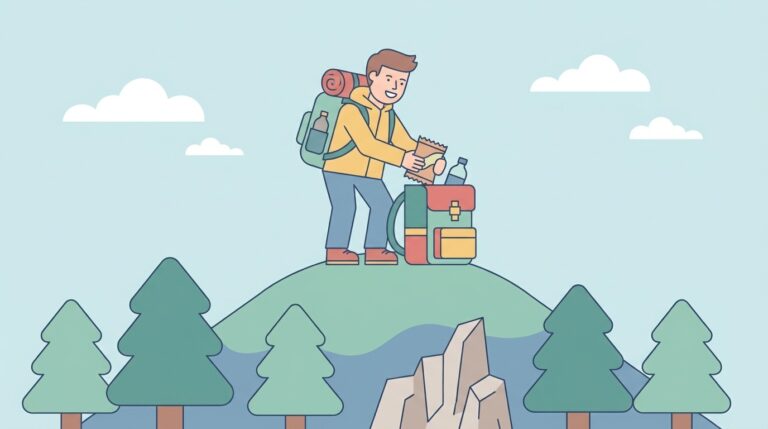
Imagine this: You’re halfway up Bukhansan (북한산), Seoul’s stunning national park. Your legs are burning, but the view is breathtaking. You sit on a rock, unwrap that delicious foil-wrapped gimbap you bought near the subway, and wash it down with some water. Perfect, right? But then… you look around for a trash can. You walk a little further. Still no trash can. Panic sets in. Where do I throw this away?!
If you’ve ever watched a Korean hiking vlog or drama where characters climb a mountain, you might have noticed something: the trails are incredibly clean. How? Because of a golden rule in Korean hiking culture: “쓰레기 되가져오기” (Taking your trash back).
Today, we’re diving into the essential Korean expressions you need for a Korean hiking adventure, the cultural nunchi (눈치) behind the “Leave No Trace” mindset, and how to avoid looking like a clueless tourist on the trails. Let’s pack our bags (and our trash) and get started!
Phase 2: Deep Dive into Core Expressions
Let’s look at the top 3 expressions you’ll hear or read when hiking in Korea.
1. 쓰레기는 되가져가세요.
- Pronunciation: sseuregineun doegajeogaseyo. [Sound analogy: sseu (like ‘soo’ but with a tight smile) – re – gi (hard g)]
- Meaning: Please take your trash back with you. (Literal: Trash, please take it back.)
- K-Culture Moment: You’ll see this written on huge banners at the entrance of every National Park in Korea. If an older hiker (ajeossi) sees you leaving a wrapper, he might tap your shoulder and say this firmly.
- Editor’s Insight: This isn’t just a polite request; it’s a social command. The prefix 되- (doe-) implies returning something to its original state or place. You brought it, so you must return with it.
- Situation Spectrum:
- Close Friends (Casual): ⚠️ (Too formal. Friends would say “쓰레기 챙겨!”)
- Strangers/Public Signs (Formal): ✅
- Boss/Elders (Formal): ✅
- 🤔 Think About It: Why is it ‘take back’ instead of just ‘don’t throw away’? How does emphasizing the action of returning reflect a sense of shared responsibility for nature?
2. 쓰레기통 어디 있어요?
- Pronunciation: sseuregitong eodi isseoyo? [eo sounds like the ‘u’ in ‘up’]
- Meaning: Where is the trash can?
- K-Culture Moment: You ask this at the mountain peak shelter. The park ranger smiles and points to your own backpack, replying, “산에는 없어요!” (There aren’t any on the mountain!)
- Editor’s Insight: A crucial survival phrase anywhere in Korea, but specifically on a mountain, asking this is the fastest way to out yourself as a beginner (등린이 – hiking newbie).
- Situation Spectrum:
- Anyone, anytime (Polite/Standard): ✅
3. 자기 쓰레기는 자기가 챙기자!
- Pronunciation: jagi sseuregineun jagiga chaenggija!
- Meaning: Let’s pack out our own trash!
- K-Culture Moment: You’re having a post-hike picnic (dwit-puri) near the trail. As everyone stands up to leave, the energetic friend claps their hands and shouts this to mobilize the group.
- Editor’s Insight: The word ‘챙기다’ (to pack, to take care of) is incredibly versatile in Korean. It sounds much warmer and more proactive than simply “don’t litter.”
- Situation Spectrum:
- Friends/Peers (Casual): ✅
- Boss/Elders (Formal): 🚫 (Never use ‘자기가’ or ‘-자’ with elders!)
Phase 3: Textbook vs. Real Korean
Let’s compare what your textbook teaches with what you’ll actually hear on the trails.
[Situation 1: Reminding someone not to litter]
* 📖 Textbook Korean: 쓰레기를 버리지 마십시오. (Do not throw away trash.)
* 🗣️ Real Korean: 쓰레기 두고 가면 안 돼~ (You shouldn’t leave your trash behind~)
* 💡 Why the difference?: Textbooks teach prohibitive grammar (-지 마세요), but Koreans often use softer, conversational boundaries (-면 안 돼) to maintain group harmony while enforcing rules.
[Situation 2: Asking for a bag for your trash]
* 📖 Textbook Korean: 쓰레기봉투를 주시겠습니까? (Would you please give me a trash bag?)
* 🗣️ Real Korean: 쓰레기 담을 봉지 하나만요. (Just one bag to put trash in, please.)
* 💡 Why the difference?: Efficiency! Dropping the verb ‘주세요’ and just ending with ‘하나만요’ (just one, please) is the ultimate native-speaker cheat code at a busy convenience store near the mountain.
Bottom Note: At a B1 level, focus on using “챙기다” (to take care of/pack) instead of just “가져가다” (to take). It shows a higher level of cultural fluency and care.
Phase 4: Cultural Context — K-Culture Deep Dive
4-1. The Non-verbal ‘Nunchi’ of the Mountain
When you pack up your trash, don’t just shove it loosely into your bag. Watch the older Korean hikers. They have a brilliant nunchi (situational awareness) for space. They meticulously fold plastic wrappers into tiny triangles to save space before zipping them away in a specific pocket of their high-tech hiking backpacks. If someone offers you a cherry tomato on the trail (a common gesture of goodwill), accept it with two hands, eat it, and immediately pocket the green stem.
4-2. The K-Food Connection: Summit Feasts
Why is there so much trash to bring down in the first place? Because for Koreans, climbing a mountain is only 50% about exercise; the other 50% is about eating.
– The Peak Menu: The holy trinity of Korean hiking food is Gimbap (김밥), Cup Ramyeon (컵라면 – usually Shin Ramyun, using hot water carried in a thermos), and previously, Makgeolli (막걸리 – rice wine).
– The Dilemma: Eating ramen means leftover broth. You cannot pour ramen broth onto the mountain (it kills the plants). Koreans actually carry an empty water bottle just to pour their leftover ramen broth into, to carry it back home! Understanding this extreme level of “Take Your Trash Back” shows immense respect for the shared space of the mountain.
Phase 5: Interactive Roleplay Scenario
Let’s put you in the scene.
Setting: Saturday, 1:00 PM. The rocky peak of Baegundae, Bukhansan. It’s crowded with people in colorful outdoor gear. You and your Korean coworker are sitting on a rock, having just finished eating kimbap and hard-boiled eggs.
Characters:
– YOU: An expat who loves nature but is still learning Korean mountain rules.
– Min-su (32): Your friendly coworker, fully dressed in neon hiking gear. He considers himself a mountain expert.
Dialogue:
Min-su: 와, 정상에서 먹는 김밥은 진짜 최고예요, 그쵸? 🍙
(Wa, jeongsang-eseo meongneun gimbabeun jinjja choegoyeyo, geuchyo?)
[Wow, kimbap eaten at the summit is truly the best, right?]
YOU: 네! 진짜 맛있었어요. 근데 쓰레기통이 안 보이네요.
(Ne! Jinjja masisseosseoyo. Geunde sseuregitongi an boineyo.)
[Yes! It was really delicious. But I don’t see a trash can.]
Min-su: 아, 한국 국립공원에는 쓰레기통이 없어요.
(A, hanguk gungnipgong-woneneun sseuregitongi eopseoyo.)
[Ah, there are no trash cans in Korean national parks.]
YOU: 헐, 진짜요? 그럼 이 계란 껍질이랑 호일은 어떡해요?
(Heol, jinjjayo? Geureom i gyeran kkeopjirirang hoireun eotteokaeyo?)
[OMG, really? Then what do I do with these eggshells and foil?]
Min-su: 다 자기 가방에 챙겨가야 돼요! 쓰레기는 되가져가기!
(Da jagi gabang-e chaenggyeogaya dwaeyo! Sseuregineun doegajeogagi!)
[You have to pack it all in your own bag! Take your trash back!]
(🎭 Stage Direction: Min-su pulls out a small plastic bag from his backpack and holds it open)
🔀 Your Turn! How do you respond?
– A) “아, 그럼 거기 제 것도 버려주세요!” (Oh, then please throw mine away in there too!)
– B) “아, 제가 제 가방에 넣을게요!” (Ah, I will put it in my bag!)
– C) “산에 버리면 안 돼요?” (Can’t we just throw it on the mountain?)✅ Best Choice: B — Reason: Taking responsibility for your own trash is the core of this culture. Min-su will respect you highly for this!
⚠️ Choice A Analysis: Min-su might do it because he’s nice, but it lacks the “Leave No Trace” individual responsibility.
🚫 Choice C Analysis: Never say this! You might get scolded by every ajeossi within earshot!
Phase 6: 10-Second Shadowing Drill
Listen to the rhythm and repeat after me. Pay attention to the pauses!
😤 Firmly but cheerfully: 자기 쓰레기는 / 자기가 / 챙겨갑시다!
(jagi sseuregineun / jagiga / chaenggyeogapsida!)
Translation: Let’s each take care of our own trash!
Phase 7: K-Culture Mini Dictionary
Here are 4 keywords to level up your Korean hiking vocabulary:
1. 등린이
* Romanization: deung-rin-i
* English: Hiking beginner (Mountain newbie)
* Context: A portmanteau of 등산 (hiking) + 어린이 (child). Used playfully to describe someone who is just starting out, usually panting after 10 minutes.
2. 뒷풀이
* Romanization: dwit-pu-ri
* English: After-party / Post-hike meal
* Context: The meal after the hike. Usually involves Pajeon (green onion pancake) and Makgeolli at a restaurant at the bottom of the mountain.
3. 정상석
* Romanization: jeongsang-seok
* English: Summit stone
* Context: The large engraved rock at the top of a mountain. Koreans will wait in line for 30 minutes just to take a picture hugging this rock.
4. 종량제 봉투
* Romanization: jongnyangje bongtu
* English: Standardized volume-based garbage bag
* Context: When you take your trash home from the mountain, you can’t just throw it anywhere. You must put it in your district’s specific paid garbage bag. A crucial part of life in Korea!
Phase 8: Traveler Survival Kit
Whether you are hiking Namsan or Seoraksan, keep these phrases handy.
🆘 Survival Expression #1: “How much further?”
– 🇰🇷 “정상까지 얼마나 남았어요?” (jeongsang-kkaji eolmana namasseoyo?)
– 📍 Use it: When you are dying on the trail and need hope.
– 💡 Pro Tip: If a Korean hiker coming down tells you “다 왔어요, 5분만 가면 돼요” (You’re almost there, just 5 more minutes)… DO NOT BELIEVE THEM. It is a well-known Korean hiking lie meant to encourage you. It probably means 30 more minutes!🆘 Survival Expression #2: “Please give me a bag.”
– 🇰🇷 “쓰레기 담을 봉지 하나만 주세요.” (sseuregi dameul bongji hanaman juseyo.)
– 📍 Use it: At the convenience store before starting the hike, so you have something to put your trash in.
📌 Editor’s Travel Note:
– Map Apps: Google Maps doesn’t work well in Korea, especially for hiking trails! Download Naver Map or KakaoMap; they have incredibly detailed hiking trail routes (even showing stairs vs. dirt paths!).
– Toilets: Restrooms at the mountain entrance are clean, but do not dump your large mountain trash in the bathroom bins. It’s considered very rude.
Phase 9: Critical Thinking — “One Step Deeper”
Food, Identity, & Shared Responsibility
🧠 Think Deeper:
Why is the rule “쓰레기 되가져오기” (Take your trash back) followed so strictly by millions of Koreans? It connects deeply to the concept of “우리” (We/Our). In Korea, nature isn’t just a wild public space; mountains are seen as “우리 산” (Our mountain)—a shared communal garden. When you leave trash, you aren’t just breaking a park rule; you are disrespecting the collective “Us.” Furthermore, because sharing food (like kimbap and snacks) on the mountain is a profound bonding activity, taking responsibility for the resulting waste together is the final step of that communal bonding. It’s a beautiful mix of modern environmentalism and traditional collective respect.💬 Your Turn: How are national parks managed in your home country? Are there trash cans everywhere, or is it a strict “Leave No Trace” policy? Let us know in the comments!
Phase 10: FAQ & Avoiding Mistakes
Q: If I buy a drink at a rest stop halfway up, can I leave the cup there?
Yes and No. If it’s a private vendor that sells the drink, they usually have a small bin only for the items they sold. But do not dump your other trail trash there!
Q: Can I pour leftover water on the trees?
Yes, plain water is fine. But as mentioned earlier, never pour sugary drinks, coffee, or ramen broth into the soil.
❌ Common Mistake #1: Leaving a plastic water bottle on a bench thinking “someone else can recycle this.”
✅ Do this instead: Crush the bottle to make it small, put it in your backpack, and recycle it at your hotel or apartment!
Phase 11: Summary & Action Items
- One-Liner Summary: On Korean mountains, your backpack must be heavier on the way down than on the way up—because you must take your trash back (쓰레기 되가져오기)!
Your Missions for Today:
– 🥉 Bronze (Solo): Say “자기 쓰레기는 자기가 챙기자!” out loud 3 times while packing your bag today.
– 🥈 Silver (Online): Find a Korean hiking vlog on YouTube (search: 등산 브이로그). Try to spot the moment they eat and pack up their trash!
– 🥇 Gold (Real-world): Next time you go to a park or a hike (even outside Korea!), consciously pack out all your trash and say the Korean phrase in your head.
Phase 12: Quiz — Interactive Challenge
Test your mountain Nunchi!
1. You are at the top of Bukhansan. You finish your kimbap. What is the most “Korean” thing to do next?
A) Look for a trash can.
B) Bury the wrapper under a rock.
C) Fold the wrapper tightly and put it in your backpack.
2. True or False: If a Korean hiker tells you the peak is “only 5 minutes away,” you should prepare yourself for at least 20-30 more minutes of hiking.
3. Fill in the blank:
“한국 국립공원에는 _________가 없어요.” (There are no [trash cans] in Korean national parks.)
(Answers: 1. C / 2. True – It’s the famous Korean hiking lie! / 3. 쓰레기통)
Did you enjoy this Daily Hangul lesson? Share your own hiking stories in the comments below!
Frequently Asked Questions (FAQ)
Q: What does "쓰레기는 되가져가세요." mean in Korean and how do you pronounce it?
A: In Korean, "쓰레기는 되가져가세요." is pronounced [sseuregineun doegajeogaseyo. [Sound analogy: sseu (like 'soo' but with a tight smile] and means: Please take your trash back with you. (Literal: Trash, please take it back.)
Q: What does "쓰레기통 어디 있어요?" mean in Korean and how do you pronounce it?
A: In Korean, "쓰레기통 어디 있어요?" is pronounced [sseuregitong eodi isseoyo? [eo sounds like the 'u' in 'up'] and means: Where is the trash can?
Q: What does "자기 쓰레기는 자기가 챙기자!" mean in Korean and how do you pronounce it?
A: In Korean, "자기 쓰레기는 자기가 챙기자!" is pronounced [jagi sseuregineun jagiga chaenggija!] and means: Let's pack out our own trash!







