

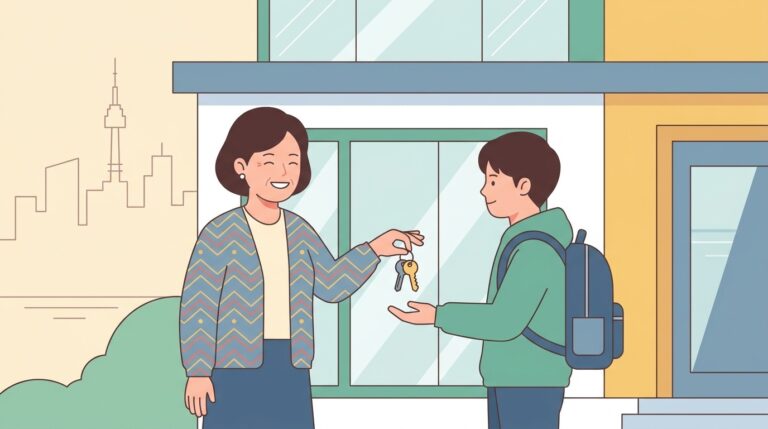
Phase 1: Empathy (The K-Drama Cold Open)
Hello there! This is your Daily Hangul Lead Editor.
Imagine this: You are watching a classic K-Drama. The main character is living in a cozy, slightly rundown rooftop apartment (옥탑방). Suddenly, there’s a loud knock knock! at the door. It’s a lady with curly hair, wearing colorful floral pants, holding a huge container of kimchi—or asking for this month’s rent.
If you move to Korea, this isn’t just a drama scene; it might be your reality! Renting an apartment here means you will inevitably cross paths with the 주인 아주머니 (Landlady) or 주인 아저씨 (Landlord).
But here’s the problem: Your translation app might tell you to call them “Lessor” or “Property Owner.” If you say that in Korea, they will stare at you in total confusion! Don’t worry. Today, I’ll share the real, everyday phrases you need to survive apartment life in Korea, based on real struggles from my A1 expat students.
Phase 2: Core Expressions Deep Dive
Let’s look at the 3 absolute essential phrases you need for your Korean landlord.
1. 주인 아주머니 / 주인 아저씨
- Pronunciation: ju-in a-ju-meo-ni / ju-in a-jeo-ssi (joo-een ah-joo-muh-knee / joo-een ah-juh-shee)
- Meaning: Literal: Owner Aunt / Owner Uncle. Real meaning: Landlady / Landlord.
- K-Culture Moment: In Korea, we rarely use cold, legal terms for everyday life. By calling your landlord “Aunt” or “Uncle,” you immediately establish a warmer, human connection. If you are polite to your ju-in a-ju-meo-ni, you might randomly find fresh fruit or side dishes at your door!
- Editor’s Insight: Think of this as a title of respect combined with friendliness. It sounds much softer than “Landlord.”
- Situation Spectrum:
- Casual with friends: 🚫 (They aren’t your friends!)
- Polite / Everyday interactions: ✅ (Perfect!)
- Legal documents: ⚠️ (Only use legal terms like 임대인 on paper)
- 🤔 Think About It: Why does the Korean language use family terms (Aunt/Uncle) for business relationships like renting a house? Does your culture do something similar?
2. 월세
- Pronunciation: wol-se (wall-say)
- Meaning: Literal: Month-tax. Real meaning: Monthly rent.
- K-Culture Moment: You’ll hear this word constantly when apartment hunting. Korea has a unique system where you pay a huge deposit (보증금, bo-jeung-geum) to lower your wol-se!
- Editor’s Insight: Just say “Wol-se” when referring to the money you pay every month. Simple and direct.
- Situation Spectrum:
- Usable in all situations: ✅
- 🤔 Think About It: Paying rent is stressful everywhere. How do people usually hand over rent in your country? In Korea, it’s mostly done via mobile bank transfer now!
3. ~가 고장났어요
- Pronunciation: ~ga go-jang-na-sseo-yo (~gah go-jahng-nah-ssuh-yo)
- Meaning: Literal: ~ is out of order. Real meaning: ~ is broken.
- K-Culture Moment: It’s mid-December, freezing outside, and your floor heating (보일러, boiler) stops working. This is a survival phrase! You text the landlord: “보일러가 고장났어요!” (The boiler is broken!).
- Editor’s Insight: You don’t need to explain how it broke. Just put the name of the broken item at the front, and add go-jang-na-sseo-yo.
- Situation Spectrum:
- Formal/Polite (to landlord): ✅
- 🤔 Think About It: Admitting something is broken can be scary. But in Korea, landlords usually fix basic appliances quickly. Have you ever had to report a broken item in a foreign language?
Phase 3: Textbook vs Real Korean
Let’s compare what textbooks teach with what Koreans actually say.
[Greeting Your Landlord]
* 📖 Textbook Korean: 임대인님, 안녕하십니까? (im-dae-in-nim, an-nyeong-ha-sim-ni-kka? – Hello, Mr. Lessor.)
* 🗣️ Real Korean: 아주머니, 안녕하세요! (a-ju-meo-ni, an-nyeong-ha-se-yo! – Hello, Auntie!)
* 💡 Why it’s different: “임대인” (Lessor) is strictly for legal contracts. Speaking it out loud sounds like a robot lawyer!
[Reporting a Problem]
* 📖 Textbook Korean: 에어컨이 작동하지 않습니다. (e-eo-keon-i jak-dong-ha-ji an-seum-ni-da. – The air conditioner is not operating.)
* 🗣️ Real Korean: 에어컨이 안 돼요. (e-eo-keon-i an dwae-yo. – The AC doesn’t work.)
* 💡 Why it’s different: “안 돼요” (Doesn’t work / Can’t) is the ultimate everyday magic phrase for anything that is broken, declined, or not functioning.
Bottom Note: For A1 beginners, sticking to “안녕하세요” (Hello) and “~가 안 돼요” (~ isn’t working) is perfectly polite and natural!
Phase 4: Cultural Context — K-Culture Deep Dive
4-1. Non-Verbal Elements (Nunchi with the Landlord)
When you meet your landlord in the hallway or the stairs, always give a slight bow (about 30 degrees) along with your “안녕하세요.” If you ever need to hand them something physically (like a document), always use two hands. This shows respect and instantly builds good Nunchi (social awareness).
4-2. The K-Drama Connection: The Magical “Ondol”
If you’ve watched any K-Drama, you’ve seen characters sleeping on the floor or sitting on a warm floor eating tangerines. This is because of the 보일러 (Boiler) / 온돌 (Ondol)—Korea’s underfloor heating system.
In winter, your relationship with your landlady might entirely revolve around this boiler! If it breaks, it’s an emergency. Unlike some Western countries where landlords might take weeks to respond, Korean landlords usually call a repairman immediately because freezing without floor heating is a serious issue here.
Phase 5: Real-Life Roleplay Scenario
Setting: A freezing Saturday morning in December. Your Seoul apartment is icy cold. You check the wall thermostat—the boiler is dead. You walk out to the hallway and bump right into your landlady.
Characters:
– YOU: An A1-level Korean learner, shivering and a bit panicked.
– Landlady (아주머니): A sweet but loud lady in her 60s, carrying a bag of groceries.
Dialogue:
YOU: 아주머니, 안녕하세요. 🥶
(a-ju-meo-ni, an-nyeong-ha-se-yo.)
[Hello, landlady.]
Landlady: 어머, 학생! 잘 잤어? 왜 이렇게 춥게 입었어!
(eo-meo, hak-saeng! jal ja-sseo? wae i-reo-ke chup-ge i-beo-sseo!)
[Oh my, student! Did you sleep well? Why are you dressed so coldly!]
YOU: 저… 보일러가 고장났어요.
(jeo… bo-il-leo-ga go-jang-na-sseo-yo.)
[Um… the boiler is broken.]
Landlady: 아이고, 진짜? 방이 얼음장이겠네!
(a-i-go, jin-jja? bang-i eo-reum-jang-i-gen-ne!)
[Oh my gosh, really? The room must be like an ice sheet!]
YOU: 네, 너무 추워요. 😭
(ne, neo-mu chu-wo-yo.)
[Yes, it is too cold.]
(🎭 Stage Direction: You rub your arms to show how cold you are)
Landlady: 걱정 마. 내가 바로 사람 부를게. 집에 있을 거지?
(geok-jeong ma. nae-ga ba-ro sa-ram bu-reul-ge. ji-be i-sseul geo-ji?)
[Don’t worry. I’ll call someone right away. You’ll be home, right?]
🔀 Your Turn! How do you reply?
– A) “네, 감사합니다!” (ne, gam-sa-ham-ni-da! – Yes, thank you!)
– B) “아니요, 저 바빠요.” (a-ni-yo, jeo ba-ppa-yo. – No, I’m busy.)
– C) “빨리 오세요.” (ppal-li o-se-yo. – Come quickly.)✅ Best Choice: A — It is polite, answers her question, and shows gratitude.
⚠️ Choice B & C Analysis: B is too direct and slightly rude if the repairman needs to come. C sounds like an order given to a servant, which is highly disrespectful to an older person!
YOU: 네, 집에 있어요. 감사합니다!
(ne, ji-be i-sseo-yo. gam-sa-ham-ni-da!)
[Yes, I am at home. Thank you!]
Landlady: 그래, 이따가 봐! 옛다, 귤 좀 먹어.
(geu-rae, i-tta-ga bwa! yet-da, gyul jom meo-geo.)
[Okay, see you later! Here, eat some tangerines.]
(🎭 Stage Direction: She forces three tangerines into your hands before walking away)
YOU: 우와, 감사합니다!
(u-wa, gam-sa-ham-ni-da!)
[Wow, thank you!]
Phase 6: 10-Second Shadowing Drill
Time to practice out loud! Pay attention to the pauses (/) and the emotion.
🥺 (With an urgent, pleading tone)
아주머니, / 보일러가 / 고장났어요.
(a-ju-meo-ni, / bo-il-leo-ga / go-jang-na-sseo-yo.)😊 (With a bright, respectful tone)
아주머니, / 이번 달 / 월세입니다!
(a-ju-meo-ni, / i-beon dal / wol-se-im-ni-da! – Auntie, here is this month’s rent!)
Phase 7: K-Culture Mini Dictionary
Here are 4 words you must know when renting in Korea:
1. 옥탑방
* Romanization: ok-tap-bang
* English: Rooftop room
* Context: A small room built on the roof of a villa. Cheaper rent, great views, but notoriously hot in summer and cold in winter. Very popular in K-Dramas for struggling young heroes!
2. 보일러
* Romanization: bo-il-leo
* English: Boiler (Floor heating)
* Context: Traditional Korean homes used fire under the floor (Ondol). Today, we use modern boilers that pump hot water through pipes under the floor.
3. 관리비
* Romanization: gwal-li-bi
* English: Maintenance fee
* Context: Usually paid monthly alongside rent. It covers building cleaning, internet (sometimes), and shared hallway lights.
4. 정
* Romanization: jeong
* English: Affection / Human bonding
* Context: The deep, emotional bond between Koreans. If you have good jeong with your landlady, she might help you like a real family member.
Phase 8: Traveler & Expat Survival Kit
Even if you are just staying in an Airbnb for a week, you might need to talk to the host (the owner!).
🆘 Survival Phrases for Accommodations
– 🇰🇷 “와이파이 비밀번호가 뭐예요?” (wa-i-pa-i bi-mil-beon-ho-ga mwo-ye-yo?)
– 🗣️ English: What is the Wi-Fi password?
– 📍 Where to use: Airbnb, hotel, cafe.
– 💡 Pro Tip: Koreans love fast internet. If there’s no sign, always ask!📌 Editor’s Travel Note
– Plumbing Warning: In older Korean buildings and villas, the plumbing is narrow. NEVER flush wet wipes down the toilet, or you will have to make a very embarrassing “변기가 고장났어요 (The toilet is broken)” call to the landlady!
– Trash Sorting: Korea is super strict about recycling and food waste (음식물 쓰레기). Always ask your host where the designated trash area is.
Phase 9: Critical Thinking Corner — “A Step Deeper”
Language & Power: The “Family” Trap?
In Korean culture, addressing business relations with family terms like Aju-meoni (Aunt) creates a sense of community and Jeong. It softens the harsh reality of capitalism. However, some younger Koreans feel this blurs boundaries, making it hard to complain about a broken sink because “she’s like an aunt to me.” By using these terms, you enter a uniquely Korean social contract: you give respect, and in return, you expect care.
💬 Your Turn: In your home country, is the relationship with a landlord strictly business, or does it ever become personal? Share your experience in the comments!
Phase 10: FAQ & Avoiding Mistakes
Q: Can I just call her “아줌마” (A-jum-ma)?
No, please don’t! While Ajumma means “middle-aged woman,” it has evolved to sound a bit disrespectful or rough. Always use “아주머니” (A-ju-meo-ni) for your landlady to show proper respect.
Q: What if the landlord is an older man?
Call him “주인 아저씨” (ju-in a-jeo-ssi). Ajeossi is generally acceptable for older men, though “사장님” (sa-jang-nim, Boss) also works well if he runs multiple buildings.
❌ Common Mistake #1: Saying “당신” (Dang-sin / You) to your landlady.
✅ Do this instead: Korean often drops the word “You.” Instead of saying “Can you fix it?” just say “고쳐주세요” (Please fix it). Using “Dang-sin” to an older person will make them very angry!
Phase 11: Summary & Action Items
One-Liner Summary: Treat your Korean landlord with respect by calling them Aju-meoni or Ajeossi, and remember that “~가 고장났어요” is your best friend when things break!
Action Mission:
– 🥉 Bronze (Solo): Stand in front of your mirror and practice saying, “아주머니, 안녕하세요!” with a polite 30-degree bow.
– 🥈 Silver (Online): Write a comment below in Korean telling us what is currently broken in your house! (e.g., TV가 고장났어요).
– 🥇 Gold (Real Life): Next time you see your Airbnb host or Landlady, greet them using the exact title you learned today!
K-Culture Mission:
Watch one episode of Reply 1988 or any K-Drama featuring a rooftop room, and try to spot how the characters greet the neighborhood “Aunties” or Landladies!
Phase 12: Quiz — Interactive Challenge
1. Situational Judgment:
Your shower head suddenly stops working in your Seoul apartment. You text your landlady. Which is the most natural A1 sentence?
– A) 임대인님, 샤워기가 작동하지 않습니다.
– B) 아주머니, 샤워기가 고장났어요.
– C) 아줌마, 샤워기 안 돼요.
(Highlight to see the answer 👉) Answer: B. A is too formal/legal. C uses “Ajumma” which is rude. B is perfectly polite and natural!
2. True or False — K-Culture Edition:
“In Korea, it is normal to hand cash or documents to an older landlady using just one hand if you are in a hurry.”
(Highlight to see the answer 👉) Answer: False! Always use two hands when giving or receiving something from an older person, no matter how rushed you are.
Great job today! With these phrases, you are ready to survive and thrive in any Korean apartment. See you in the next lesson! 🏠✨
Frequently Asked Questions (FAQ)
Q: What does "주인 아주머니 / 주인 아저씨" mean in Korean and how do you pronounce it?
A: In Korean, "주인 아주머니 / 주인 아저씨" is pronounced [ju-in a-ju-meo-ni / ju-in a-jeo-ssi (joo-een ah-joo-muh-knee / joo-een ah-juh-shee] and means: Literal: Owner Aunt / Owner Uncle. Real meaning: Landlady / Landlord.
Q: What does "월세" mean in Korean and how do you pronounce it?
A: In Korean, "월세" is pronounced [wol-se (wall-say] and means: Literal: Month-tax. Real meaning: Monthly rent.
Q: What does "~가 고장났어요" mean in Korean and how do you pronounce it?
A: In Korean, "~가 고장났어요" is pronounced [~ga go-jang-na-sseo-yo (~gah go-jahng-nah-ssuh-yo] and means: Literal: ~ is out of order. Real meaning: ~ is broken.







