

Phase 1: Empathy
Hello! I’m your Daily Hangul Editor.
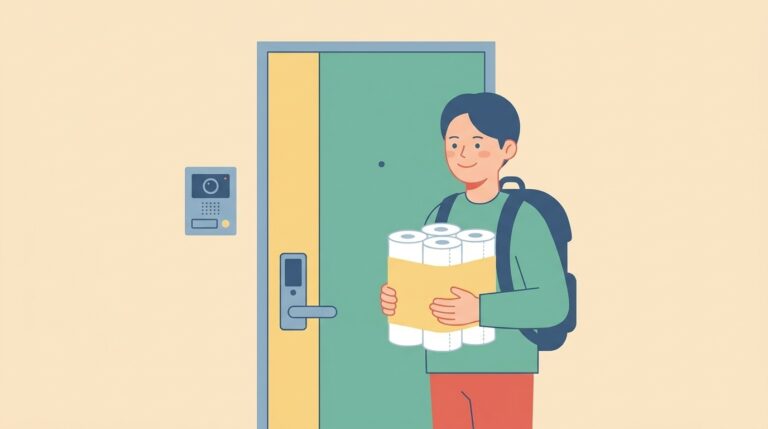
Imagine this: You’re standing in front of your Korean friend’s apartment. You’ve brought some snacks, successfully navigated the subway, found the right door, and confidently pressed the doorbell. Suddenly, a crackling voice comes through the intercom: “누구세요?” (Who is it?)…
Panic sets in. Your mind goes blank. In K-Dramas, the main character just casually says something into the machine, and the door magically opens. But what exactly do they say? If you just say “Me!” in English, will they know? Or what if you’re visiting an Airbnb or a guesthouse and need to announce yourself to the host?
If you don’t know the right phrases, you might end up standing awkwardly in the hallway for much longer than you’d like. But don’t worry! This guide is based on real moments my students have experienced. Today, we’ll turn you into a visiting pro who knows exactly how to handle Korean doors, intercoms, and entryways like a true local.
Phase 2: Core Expressions Deep Dive
1. 누구세요? (nu-gu-se-yo?)
- Pronunciation: [nuguseyo] — ‘nu-gu’ sounds like “new goo”, and ‘se-yo’ is a polite ending.
- Meaning: Literal: Who are you? / Real nuance: Who is it? (at the door)
- K-Culture Moment: This is the universal phrase you hear from inside the house or through the intercom whenever you ring a doorbell in Korea. Whether it’s a food delivery driver, a friend, or a package courier, this is the first thing Koreans say.
- Editor’s Insight: Even though it sounds like “Who are you?”, it is not rude at all! It is simply the standard way to ask who is at the door. If you are inside and someone rings your bell, this is what you should say.
- Situation Spectrum:
- Casual / Friends: ✅ (You can just say “누구야?” to close friends)
- Semi-formal / Strangers: ✅
- Formal: ✅
- 🤔 Think About It: Why do Koreans always use the polite form “~세요” to a closed door, even before knowing who is outside? How does your culture address an unknown person at the door?
2. 저예요! OOO이에요. (jeo-ye-yo! OOO-i-e-yo.)
- Pronunciation: [jeoyeyo! OOO-ieyo] — ‘jeo’ sounds like “jaw” but shorter.
- Meaning: Literal: It is me! I am [Name]. / Real nuance: It’s me, [Name]!
- K-Culture Moment: In K-Dramas, when a couple is fighting and the guy shows up at the girl’s house at midnight, he presses the bell and desperately says, “나야…” (It’s me… – casual). But since you are learning A2, we use the polite form “저예요” to be safe and friendly.
- Editor’s Insight: Saying just “저예요” (It’s me) works if they know your voice. But to be helpful, always add your name! Use “OOO이에요” if your name ends in a consonant (like Michael-ieyo), and “OOO예요” if it ends in a vowel (like Sarah-yeyo).
- Situation Spectrum:
- Casual / Friends: ✅ (나야! OOO야!)
- Semi-formal / Acquaintances: ✅
- Formal / Elders: ⚠️ (Better to say “OOO입니다”)
- 🤔 Think About It: Why does Korean have different words for “I” (저 vs. 나) depending on politeness, even when standing outside a door?
3. 실례합니다 / 들어가겠습니다 (sil-lye-ham-ni-da / deul-eo-ga-get-seum-ni-da)
- Pronunciation: [shil-lae-ham-ni-da / deul-eo-ga-get-sum-ni-da]
- Meaning: Literal: I am committing a discourtesy / I will enter. / Real nuance: Excuse me / Pardon my intrusion as I come in.
- K-Culture Moment: You open the door, step inside, and what do you say? You don’t just walk in silently! Announcing your entry shows respect for the homeowner’s private space.
- Editor’s Insight: “실례합니다” is great when entering an office or a less familiar place. If a friend invites you, a simple “초대해 주셔서 감사합니다” (Thank you for inviting me) combined with taking off your shoes works perfectly.
- Situation Spectrum:
- Casual / Friends: ⚠️ (Too stiff! Just say “우와 집 좋다~” – Wow, nice house!)
- Semi-formal / Coworkers: ✅
- Formal / Elders: ✅
- 🤔 Think About It: Acknowledge stepping into someone’s territory is a big deal in Korea. How do you greet a host when entering their home in your country?
Phase 3: Textbook vs. Real Korean
[When asked “Who is it?” at a friend’s door]
* 📖 Textbook Korean: 안녕하십니까? 저는 마이클입니다. (Hello. I am Michael.)
* 🗣️ Real Korean: 저예요! 마이클이요! (It’s me! Michael!)
* 💡 Why is it different?: The textbook version sounds like a robot selling insurance. Adding “~이요” to your name makes it sound natural, conversational, and friendly.
[When asking the host to open the door]
* 📖 Textbook Korean: 문을 열어 주세요. (Please open the door.)
* 🗣️ Real Korean: 문 좀 열어주세요~ (Please open the door~)
* 💡 Why is it different?: Adding “좀” (literally “a little”) softens the request. Without it, you sound like a police officer demanding entry!
[When entering the living room]
* 📖 Textbook Korean: 방문을 허락해 주셔서 감사합니다. (Thank you for permitting this visit.)
* 🗣️ Real Korean: 실례하겠습니다~ / 우와, 집 진짜 좋아요! (Excuse me~ / Wow, your house is really nice!)
* 💡 Why is it different?: A genuine compliment about the house is the best icebreaker in modern Korean society.
Phase 4: Cultural Context — K-Culture Deep Dive
4-1. Non-Verbal Cues: The Camera and The Shoes
- Look at the camera! Most Korean apartments have advanced intercom systems with cameras. When you ring the bell, the person inside can see you on a screen. Smile and give a little wave!
- The Golden Rule of the 현관 (Foyer): The absolute most important rule when visiting a Korean home is taking off your shoes. There is a small lowered area right inside the door called the hyeongwan. You MUST take your shoes off there before stepping onto the raised floor. Stepping on the main floor with shoes on is the ultimate faux pas!
4-2. K-Drama Connection: The Housewarming Gift
Have you noticed in K-Dramas that characters never show up to a friend’s new house empty-handed? They always carry massive packs of toilet paper (휴지 – hyuji) or laundry detergent (세제 – seje). Why? The bubbles from the detergent and the unrolling of the toilet paper symbolize “wealth and good fortune rolling in easily.” If you bring a 30-roll pack of toilet paper to a Korean friend’s housewarming party (집들이), you will instantly become the coolest, most culturally-aware foreigner they know!
Phase 5: Real-Life Roleplay Scenario
Setting: Friday night, 7:00 PM. You are invited to your Korean coworker Min-su’s apartment for a Chimaek (Chicken & Beer) housewarming party. You are standing outside his door, holding a pack of toilet paper.
Characters:
– YOU: A foreigner working in Korea, excited for your first Korean house party.
– Min-su (32): Your friendly Korean coworker who just moved.
Dialogue:
YOU: (Presses the doorbell) 딩동~
(Ding-dong~)
Min-su (Through intercom): 네, 누구세요?
(Ne, nuguseyo?)
[Yes, who is it?]
YOU: 저예요! 마이클이에요.
(Jeoyeyo! Maikeul-ieyo.)
[It’s me! It’s Michael.]
Min-su: 어, 마이클! 잠깐만!
(Eo, Maikeul! Jamkkanman!)
[Oh, Michael! Just a sec!]
(Stage Direction: The door lock clicks open. You open the door.)
YOU: 우와, 집 진짜 좋아요!
(Uwa, jip jinjja joayo!)
[Wow, your house is really nice!]
Min-su: 어서 와! 신발은 거기 벗고 들어와.
(Eoseo wa! Sinbareun geogi beotgo deureowa.)
[Welcome! Take off your shoes there and come in.]
YOU: 아, 네! 실례하겠습니다.
(A, ne! Sillyehagetseumnida.)
[Ah, yes! Excuse me for intruding.]
Min-su: 어? 선물은 무슨… 그냥 오지!
(Eo? Seonmureun museun… geunyang oji!)
[Huh? What’s with the gift… you should’ve just come!]
🔀 Your Turn! How should you respond to his polite refusal of the gift?
– A) “아, 그럼 다시 가져갈게요.” (Oh, then I’ll take it back.)
– B) “집들이엔 휴지죠! 축하해요!” (Toilet paper is a must for a housewarming! Congratulations!)
– C) “빨리 치킨 주세요.” (Give me chicken quickly.)✅ Best Choice: B — Reason: In Korea, a host will say “You shouldn’t have!” out of politeness. Confidently handing over the traditional gift with a smile shows you understand Korean culture perfectly.
⚠️ Choice A & C Analysis: Taking the gift back (A) is a huge mistake! And demanding food (C) is too blunt, even if you’re hungry.
YOU: 집들이엔 휴지죠! 이사 축하해요.
(Jipdeurien hyujijyo! Isa chukahaeyo.)
[Toilet paper is a must for a housewarming! Congrats on moving.]
Min-su: 센스 대박! 빨리 들어와, 치킨 시켰어.
(Senseu daebak! Ppalli deureowa, chikin sikyeosseo.)
[Your sense is amazing! Come in quickly, I ordered chicken.]
Phase 6: 10-Second Shadowing Drill
Read these out loud to master the natural rhythm. Pay attention to the pauses (/) and the emotion tags!
- 📞 When ringing the bell:
😊 저예요! / 마이클이에요! (jeo-ye-yo! / ma-i-keul-i-e-yo!) - 🚪 When stepping inside:
🙇♂️ 실례/하겠습니다~ / 집이 / 참 좋네요! (sil-lye / ha-get-seum-ni-da~ / jib-i / cham jon-ne-yo!) - 🎁 When giving the gift:
🎉 이사 / 축하해요! / 약소하지만 / 선물이에요. (i-sa / chu-ka-hae-yo! / yak-so-ha-ji-man / seon-mul-i-e-yo.)
(Congrats on moving! It’s small, but here’s a gift.)
Phase 7: K-Culture Mini Dictionary
1. 집들이
* Romanization: jip-deu-ri
* English: Housewarming party
* Context: A party hosted by someone who recently moved. Guests eat, drink, and bring practical household gifts.
2. 현관
* Romanization: hyeon-gwan
* English: Entryway / Foyer
* Context: The small space just inside the front door where you MUST take off your shoes. It is considered the border between the outside world and the clean inside.
3. 인터폰
* Romanization: in-teo-pon
* English: Intercom
* Context: Korean apartments are highly secure. You almost always have to use a video intercom at the building entrance and the apartment door.
4. 휴지
* Romanization: hyu-ji
* English: Toilet paper / Tissue
* Context: The most iconic Korean housewarming gift. It symbolizes things “unrolling” smoothly in your life.
Phase 8: Traveler Survival Kit
Since many of you stay at Airbnbs, Guesthouses, or visit local friends, here are the top survival phrases for doors and entrances!
🆘 Survival Phrases for Visiting & Check-in
– 🇰🇷 “예약했어요. (I made a reservation.)”
– 🗣️ ye-ya-kaes-seo-yo.
– 📍 Where to use: Ringing the bell at a guesthouse or small hotel.
– 🇰🇷 “체크인하러 왔어요. (I came to check in.)”
– 🗣️ che-keu-in-ha-reo wat-seo-yo.
– 📍 Where to use: Announcing yourself to an Airbnb host.
– 🇰🇷 “비밀번호를 잊어버렸어요. (I forgot the password.)”
– 🗣️ bi-mil-beon-ho-reul i-jeo-beo-ryeos-seo-yo.
– 📍 Where to use: When you get locked out of your digital door lock!📌 Editor’s Travel Note
– Digital Locks: 99.9% of Korean homes use digital keypad locks instead of physical keys. The host will give you a 4-to-6 digit code.
– Door etiquette: Always make sure the heavy apartment door fully clicks shut behind you.
Phase 9: Critical Thinking — “One Step Deeper”
🧠 Think Deeper: Inside vs. Outside (Space and Respect)
Taking off your shoes in Korea isn’t just about keeping the floor clean; it reflects a deep cultural boundary between the “Outside” (public, dirty, formal) and the “Inside” (private, clean, intimate). In traditional Korean homes (Hanok), people slept, ate, and sat directly on the heated floor (Ondol). The floor is the furniture. Therefore, wearing shoes inside is not just messy; it feels like an invasion of the home’s sanctuary.💬 Your Turn: Does your culture have strict rules about entering a house? Do you take off your shoes, or keep them on? Share in the comments!
Phase 10: FAQ & Avoiding Misunderstandings
- Q: Can I just open the door and shout “Hello” if it’s unlocked?
- A: NO! Even if it’s a close friend, always ring the bell or knock first. Privacy is highly respected.
- Q: Can I say “누구세요?” to a senior if they knock on my door?
- A: Yes. Because you don’t know who is behind the door yet, “누구세요?” is standard and polite enough for anyone.
- Q: Should I bring a gift every time I visit?
- A: Not every time. For a formal housewarming (집들이), yes. For a casual hangout, just bringing some drinks or a snack (like cake or fruit) is a great gesture.
❌ Common Mistake #1: Stepping onto the raised living room floor while taking off your shoes.
✅ Do this instead: Take your shoes off completely while still standing in the lowered 현관 (foyer), and then step up in your socks.
Phase 11: Summary & Action Items
One-Liner Summary: When the intercom asks “누구세요?”, answer confidently with “저예요! [Name]이에요!”, and never forget to take off your shoes at the hyeongwan!
Action Mission:
– 🥉 Bronze (Solo): Stand at your own front door, pretend to press the bell, and say “저예요! OOO이에요!” 3 times out loud.
– 🥈 Silver (Online): Comment below with what housewarming gift you would bring to a Korean friend’s house.
– 🥇 Gold (Real-world): Next time you visit any Korean space (a friend’s house, a traditional restaurant with floor seating), confidently take off your shoes at the hyeongwan and step up like a local.
🎬 K-Culture Mission: Watch an episode of a K-Drama today. Find a scene where a character rings a doorbell or enters a house. Do they bring toilet paper? Do they take their shoes off? Notice the hyeongwan!
Phase 12: Interactive Quiz
1. You ring a Korean friend’s doorbell, and you hear “누구세요?”. What is the most natural reply for an A2 learner?
A) 저는 마이클입니다. (I am Michael.)
B) 저예요! 마이클이에요. (It’s me! It’s Michael.)
C) 문 열어. (Open the door.)
Answer: B
2. True or False: It is polite to leave your shoes on if you are only staying for 5 minutes.
Answer: False! Even if you are stepping inside for 10 seconds, if you step on the raised floor, the shoes MUST come off.
3. Fill in the blank: At a Korean housewarming party (집들이), the most popular and traditional gift to bring is __________ (toilet paper).
Answer: 휴지 (hyu-ji)
Great job today! Next time you visit a Korean home, you won’t freeze at the door. See you in the next lesson! 🏠
Frequently Asked Questions (FAQ)
Q: What does "누구세요? (nu-gu-se-yo?)" mean in Korean and how do you pronounce it?
A: In Korean, "누구세요? (nu-gu-se-yo?)" is pronounced [nuguseyo] and means: Literal: Who are you? / Real nuance: Who is it? (at the door)
Q: What does "저예요! OOO이에요. (jeo-ye-yo! OOO-i-e-yo.)" mean in Korean and how do you pronounce it?
A: In Korean, "저예요! OOO이에요. (jeo-ye-yo! OOO-i-e-yo.)" is pronounced [jeoyeyo! OOO-ieyo] and means: Literal: It is me! I am [Name]. / Real nuance: It's me, [Name]!
Q: What does "실례합니다 / 들어가겠습니다 (sil-lye-ham-ni-da / deul-eo-ga-get-seum-ni-da)" mean in Korean and how do you pronounce it?
A: In Korean, "실례합니다 / 들어가겠습니다 (sil-lye-ham-ni-da / deul-eo-ga-get-seum-ni-da)" is pronounced [shil-lae-ham-ni-da / deul-eo-ga-get-sum-ni-da] and means: Literal: I am committing a discourtesy / I will enter. / Real nuance: Excuse me / Pardon my intrusion as I come in.







