

Phase 1: Empathy (Immersive Opening)
Hello! I am the Lead Editor of Daily Hangul.
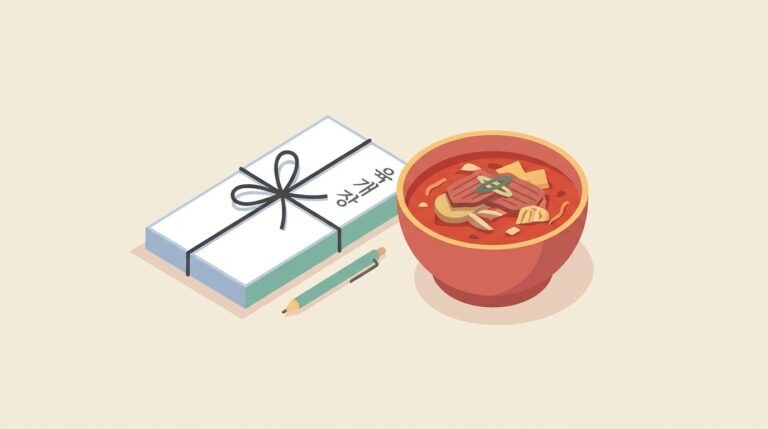
Picture this K-Drama scene: The protagonist is wearing a crisp black suit, entering a room filled with white chrysanthemums. They hand over a white envelope, bow twice, and then sit at a table to eat a bowl of spicy red soup with the grieving family.
If you were in that room, what would you say? In English, it is natural to say, “I am so sorry.” But if you translate that directly to Korean and say “미안합니다 (Mianhamnida),” you are actually saying, “This is my fault. I apologize for doing this.”
Wait, what? Yes! Korean funerals have very specific etiquette, and using the wrong phrase can cause massive confusion. As a veteran tutor and an expat who has attended several Korean funerals, I know how terrifying it is to make a mistake in such a sensitive situation.
Today, we are going to learn exactly how to offer your condolences gracefully in Korean. Do not worry; this guide is based on real questions from students just like you who wanted to be respectful but did not know where to start.
Phase 2: Core Phrases Deep Dive
1. 삼가 고인의 명복을 빕니다
- Pronunciation: Samga goinui myeongbogeul bimnida [Sam-ga go-in-ui myung-bok-eul bim-ni-da]
- Meaning: (Literal) I humbly pray for the deceased’s bliss in the afterlife. / (Real Nuance) May they rest in peace.
- K-Culture Moment: You will see this written on funeral wreaths, white envelopes, and social media posts when a celebrity passes away. It is the most standard, respectful phrase.
- Editor’s Insight: You do not usually speak this phrase out loud to the family. It feels a bit stiff, like reading a textbook. Instead, you write it on the envelope or send it in a formal text message.
- Situation Spectrum:
- Casual text to a close friend: ⚠️ (A bit too formal)
- Formal message/Envelope: ✅
- Speaking directly at the funeral: 🚫
- 🤔 Think About It: Why do Koreans use such a long, poetic phrase instead of a simple “RIP”? It reflects the traditional belief in the afterlife and the deep respect required for those who have passed.
2. 얼마나 상심이 크십니까?
- Pronunciation: Eolmana sangsimi keusimnikka? [Uhl-ma-na sang-shim-ee keu-shim-ni-kka?]
- Meaning: (Literal) How big must your heartbreak be? / (Real Nuance) I am so sorry for your loss.
- K-Culture Moment: When you finally hold the hands of your grieving coworker at the funeral home, looking them in the eyes.
- Editor’s Insight: This is the most natural, empathetic thing you can say in person. You are acknowledging their immense pain without making it about yourself.
- Situation Spectrum:
- Close friend: ✅ (You can say “얼마나 상심이 커” dropping the formal ending)
- Coworker (Semi-formal): ✅
- Boss/Elder (Formal): ✅
- 🤔 Think About It: Notice how this is phrased as a question? Korean culture highly values Nunchi (reading the room). By asking about their pain, you are showing deep empathy.
3. 좋은 곳으로 가셨을 거예요
- Pronunciation: Joeun goseuro gasyeosseul geoyeyo [Jo-eun go-seu-ro ga-shyuh-sseul guh-ye-yo]
- Meaning: (Literal) They must have gone to a good place. / (Real Nuance) They are in a better place now.
- K-Culture Moment: Sitting at the table, sharing a quiet moment over food, trying to offer a glimmer of comfort.
- Editor’s Insight: This is a soft, warm phrase. Use it after the initial formal greetings, when you are having a more personal conversation.
- Situation Spectrum:
- Casual: ✅
- Coworker (Semi-formal): ✅
- Boss/Elder (Formal): ⚠️ (Use cautiously, depending on your relationship)
- 🤔 Think About It: “Going to a good place” is a universal concept! Does your language have a similar way of avoiding the direct word for “death”?
Phase 3: Textbook vs. Real Korean
[Meeting the Grieving Family]
* 📖 Textbook Korean: “저의 조의를 표합니다.” (I express my condolences. – Very robotic)
* 🗣️ Real Korean: “얼마나 상심이 크십니까…” (How great your sorrow must be…)
* 💡 Why the difference?: Koreans prioritize shared emotion over formal declarations. Acknowledging the other person’s pain is considered much warmer.
[Handing the Condolence Envelope]
* 📖 Textbook Korean: “여기 제 조의금입니다.” (Here is my condolence money. – Too direct)
* 🗣️ Real Korean: (Hand it silently, or say gently) “작은 성의입니다.” (It’s a small token of my sincerity.)
* 💡 Why the difference?: In Korean culture, it is polite to be humble about your gifts or money, referring to it as just “a little sincerity.”
Bottom Note: For A2 learners, simply bowing slightly and saying “얼마나 상심이 크십니까?” is more than enough to show deep respect.
Phase 4: Cultural Context — K-Culture Deep Dive
4-1. Non-Verbal Elements
- The Power of Silence: Sometimes, not saying anything is the best etiquette. Holding their hand with a sad expression communicates more than words.
- The Bow (절 – Jeol): At a Korean funeral, you bow to the portrait of the deceased two and a half times. Then, you turn to the chief mourner (the family) and bow once.
- The Envelope: Condolence money (조의금 – jouigeum) must be placed in a clean, white envelope. Use crisp bills if possible, but traditionally, odd numbers (3, 5, 7, 10 – 10 is an exception) of 10,000 KRW bills are given.
4-2. K-Food Connection: The Spicy Beef Soup (육개장 – Yukgaejang)
If you have watched a funeral scene in a K-Drama (like My Mister), you have seen people eating a red soup. This is Yukgaejang.
* Why this food?: Funerals in Korea traditionally last for 3 days, and guests stay late into the night so the family does not feel lonely. Yukgaejang is easy to make in huge batches to feed hundreds of guests.
* The Color Red: In traditional Korean beliefs, the color red chases away evil spirits and bad luck.
* Etiquette: When eating at a funeral, never clink your glasses for a toast (건배 – geonbae). You can pour drinks for each other, but drink quietly.
Phase 5: Real-Life Roleplay Scenario
Setting: Friday night, 8 PM. A hospital funeral hall in Seoul. You are wearing a black suit. The scent of incense mixes with the smell of spicy soup. You are attending the funeral of your Korean coworker Min-su’s father. You take off your shoes and enter the main room.
Characters:
* YOU: An expat worker in Korea, wanting to be respectful but slightly nervous.
* Min-su (32): Your coworker, the chief mourner (상주 – sangju), wearing a black suit with a dual black stripe on his arm.
Dialogue:
(🎭 Stage Direction: You walk up to Min-su after bowing to the portrait.)
YOU: (Approaching carefully) 민수 씨…
(Minsu ssi…)
[Min-su…]
Min-su: 아, 여기까지 와주셔서 감사합니다.
(A, yeogikkaji wajusyeoseo gamsahamnida.)
[Ah, thank you for coming all the way here.]
🔀 Your Turn! How do you reply?
– A) “너무 미안합니다.” (Neomu mianhamnida.)
– B) “얼마나 상심이 크십니까?” (Eolmana sangsimi keusimnikka?)
– C) “안녕하세요! 아버지가 돌아가셔서 슬퍼요.” (Annyeonghaseyo! Abeojiga doragasyeoseo seulpeoyo.)✅ Best Choice: B — It perfectly expresses “I am sorry for your loss” in a culturally appropriate way.
⚠️ Why not A & C?: ‘A’ means “It is my fault.” ‘C’ uses “Hello” (안녕하세요), which means “Are you in peace?”—a terrible thing to ask at a funeral!
YOU: 얼마나 상심이 크십니까?
(Eolmana sangsimi keusimnikka?)
[How great your sorrow must be? / I am so sorry for your loss.]
Min-su: (Nodding slightly, looking down) 네… 바쁘신데 와주셔서 정말 감사합니다.
(Ne… Bappeusinde wajusyeoseo jeongmal gamsahamnida.)
[Yes… Thank you so much for coming despite being busy.]
YOU: 좋은 곳으로 가셨을 거예요. 힘내세요.
(Joeun goseuro gasyeosseul geoyeyo. Himnaeseyo.)
[He must be in a better place. Stay strong.]
Min-su: 저쪽 식당에서 식사하고 가세요.
(Jeojjok sikdangeseo siksahago gaseyo.)
[Please have a meal at the dining area over there before you go.]
YOU: 네, 감사합니다.
(Ne, gamsahamnida.)
[Yes, thank you.]
Phase 6: 10-Second Shadowing Drill
Speak out loud! Follow the pacing (/) and the emotion.
- 😢 깊은 위로를 전하며: 얼~마나 / 상심이 / 크십니까?
(Eol~mana / sangsimi / keusimnikka?) - 🥺 따뜻하게 다독이며: 좋~은 곳으로 / 가셨을 거예요.
(Jo~eun goseuro / gasyeosseul geoyeyo.) - 🙇 조심스럽게 봉투를 내밀며: 약소하지만 / 제 성의입니다.
(Yaksot-hajiman / je seong-ui-imnida.)
Phase 7: K-Culture Mini Dictionary
1. 눈치 (Nunchi)
* Romanization: nunchi
* English: Emotional intelligence / reading the room
* Context: The crucial social skill in Korea. Knowing when to speak, when to be silent, and reading the emotional state of the grieving family.
2. 조의금 (Jouigeum)
* Romanization: jouigeum
* English: Condolence money
* Context: Given in a white envelope. The amount depends on your closeness (usually 50,000 to 100,000 KRW).
3. 상주 (Sangju)
* Romanization: sangju
* English: Chief mourner
* Context: Usually the eldest son or closest family member. They stand near the altar to greet guests and receive bows.
4. 육개장 (Yukgaejang)
* Romanization: yukgaejang
* English: Spicy beef soup
* Context: The quintessential funeral food in Korea, served to guests who come to offer condolences.
Phase 8: Traveler Survival Kit (Expat Edition)
As a short-term traveler, you likely won’t attend a funeral. But if you are an expat, this is essential survival knowledge!
🆘 Survival Phrases #1
– 🇰🇷 “조의금 봉투 있나요?” (Jouigeum bongtu innayo?)
– 🗣️ English Guide: [Jo-ee-geum bong-too een-na-yo?]
– 📍 Where to use: Convenience stores (They sell pre-printed white envelopes!).
– 💡 Pro Tip: Look for the envelope with black Chinese characters (賻儀 – 부의) on the front.📌 Editor’s Travel Note
– What to wear: Black suit and a black tie for men. Black dress or suit for women. No bare skin (wear black socks or stockings).
– Where to buy: If you don’t have a black tie, convenience stores near hospitals often sell cheap black ties exactly for this reason!
– ATM: Bring cash! You must put physical cash into the envelope.
Phase 9: Critical Thinking Corner — “A Step Deeper”
Food & Identity (음식과 정체성)
In Western cultures, funerals are often solemn ceremonies followed by a brief reception. In Korea, a funeral is almost like a communal marathon. Relatives, friends, and coworkers gather, eat Yukgaejang, drink Soju, and sometimes even play card games through the night. Why? Because in Korean culture, eating together is the ultimate form of solidarity. Leaving the grieving family alone in a quiet, empty room is considered too harsh. The noise, the food, and the presence of people are meant to physically support the family until the burial.
🧠 Think Deeper:
The act of “eating together” (식구 – Sikgu, meaning ‘mouths that eat together’) defines the Korean community. Funerals are no exception.💬 Your Turn: How long do funerals last in your culture, and is there a specific food you share? Tell us in the comments!
Phase 10: FAQ & Misunderstanding Prevention
- “Can I say 안녕하세요 (Hello) when greeting the family?”
- NO! “안녕하세요” means “Are you in peace?” Since they are grieving, they are not in peace. Just bow silently or use “얼마나 상심이 크십니까?”
- “I don’t have a black suit. Can I wear dark navy?”
- Yes. Dark navy or dark grey is acceptable. Just avoid bright colors, flashy jewelry, and strong perfume.
- “Is it okay to hug the chief mourner?”
- Maybe. Usually, a bow is the standard. If you are extremely close friends and they initiate it, a hug is fine, but traditional etiquette relies on bowing and holding hands gently.
❌ Common Mistake #1: Clinking Soju glasses.
✅ Do this instead: Pour the drink for your friend, and let them pour for you. Drink quietly. Do not say “Cheers” (건배).
Phase 11: Summary & Action Items
- One-Liner Summary: At a Korean funeral, never say “I’m sorry” (미안합니다); instead, show empathy by asking “How great is your sorrow?” (얼마나 상심이 크십니까).
-
Action Mission 3 Steps:
- 🥉 Bronze (Solo): Practice saying “삼가 고인의 명복을 빕니다” out loud 3 times so you remember the rhythm.
- 🥈 Silver (Online): Find an envelope at a Korean convenience store and identify the funeral one.
- 🥇 Gold (Real-Life): (Hopefully you won’t need this soon, but…) Next time you watch a K-Drama funeral scene, spot the Yukgaejang and the two-and-a-half bows!
- K-Culture Mission: Go to YouTube and search “K-Drama funeral scene” (e.g., My Mister or Reply 1988). Observe the black armbands, the white envelopes, and the food tables.
-
Engagement: Have you ever attended a ceremony in a foreign country and felt totally lost? Share your story below!
Phase 12: Quiz — Interactive Challenge
1. Situational Judgment:
You just arrived at your Korean friend’s father’s funeral. You walk up to your friend. What is the BEST thing to say?
* A) 미안합니다. (I’m sorry.)
* B) 안녕하세요. (Hello.)
* C) 얼마나 상심이 크십니까? (How great is your sorrow?)
2. True or False — K-Culture Edition:
* “It is polite to say ‘Cheers’ (건배) when drinking Soju at a funeral to lift the mood.” (True / False)
3. Fill in the Blank:
When writing a condolence message, you should use: “삼가 고인의 ( ____ )을 빕니다.” (Hint: Starts with M!)
(Answers: 1: C – A means it’s your fault, B is inappropriate. / 2: False – Never clink glasses at a funeral. / 3: 명복 – myeongbok)
Frequently Asked Questions (FAQ)
Q: What does "삼가 고인의 명복을 빕니다" mean in Korean and how do you pronounce it?
A: In Korean, "삼가 고인의 명복을 빕니다" is pronounced [Samga goinui myeongbogeul bimnida [Sam-ga go-in-ui myung-bok-eul bim-ni-da] and means: (Literal) I humbly pray for the deceased's bliss in the afterlife. / (Real Nuance) May they rest in peace.
Q: What does "얼마나 상심이 크십니까?" mean in Korean and how do you pronounce it?
A: In Korean, "얼마나 상심이 크십니까?" is pronounced [Eolmana sangsimi keusimnikka? [Uhl-ma-na sang-shim-ee keu-shim-ni-kka?] and means: (Literal) How big must your heartbreak be? / (Real Nuance) I am so sorry for your loss.
Q: What does "좋은 곳으로 가셨을 거예요" mean in Korean and how do you pronounce it?
A: In Korean, "좋은 곳으로 가셨을 거예요" is pronounced [Joeun goseuro gasyeosseul geoyeyo [Jo-eun go-seu-ro ga-shyuh-sseul guh-ye-yo] and means: (Literal) They must have gone to a good place. / (Real Nuance) They are in a better place now.






