

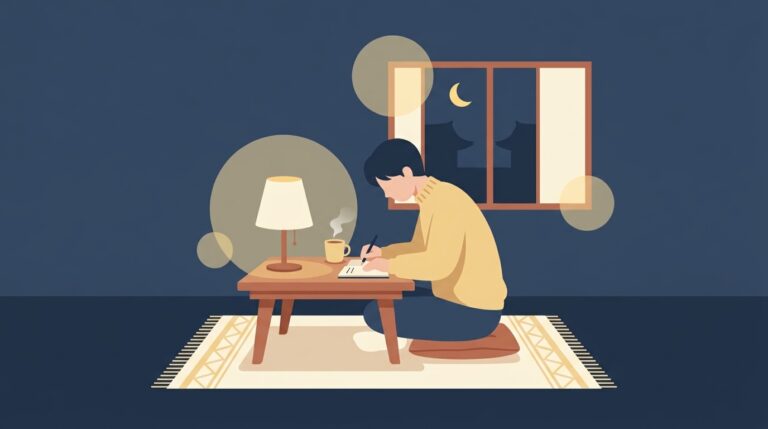
Phase 1: Empathy – The Late-Night Confession
Hello there! It’s your Daily Hangul Editor.
Picture this: It’s 2:00 AM. You’re lying in bed, scrolling through Weverse or Instagram, and your favorite K-Pop idol or K-Drama actor posts a long, heartfelt letter. They talk about how exhausted they were from their packed schedule, but then they end it with something like: “하지만 여러분 덕분에 오늘 하루도 무사히 넘겼어요. 너무 다행이에요. 이게 제 소확행이죠.”
As an advanced (C1) Korean learner, you can translate the words: “But thanks to you, I got through today safely. What a relief. This is my small happiness.” But do you feel the heavy sigh, the subtle shift in mindset, and the profound cultural weight behind those words?
If you’ve lived in Korea or studied the culture deeply, you know about the “빨리빨리” (ppalli-ppalli / hurry-hurry) culture. The pressure to succeed, the constant need to read the room (눈치, nunchi), and the relentless grind can lead to severe burnout. That’s why “힐링” (Healing) and mental care have become massive cultural movements in Korea.
In my years of tutoring expats and students in Seoul, I’ve seen so many hit a mental wall. You’re stressed, your Korean feels stagnant, and you just want to complain. But what if you could express your stress—and elegantly reframe it using positive psychology—exactly like a native Korean? Today, we’re learning how to write a Korean gratitude journal and master the art of mindful language.
Phase 2: Deep Dive into Core Expressions
Let’s look at the three pillars of Korean positive psychology. These aren’t just vocabulary words; they are cognitive reframing tools.
1. 덕분에 (Deokbune)
- Pronunciation: [deok-bu-ne] + [Sounds like: ‘duck-boo-neh’]
- Meaning: Literal: By the virtue of / Real nuance: “Thanks to [you/this], a bad situation turned good.”
- K-Culture Moment: At an award ceremony, an actor is holding back tears. Instead of saying “I worked hard,” they say, “모두 스태프분들 덕분입니다” (It’s all thanks to the staff). It immediately shifts the spotlight and shows deep humility.
- Editor’s Insight: This is the ultimate gratitude journal word. When you are stressed, using “덕분에” forces you to find the helper or the silver lining. It replaces resentment with appreciation.
- Situation Spectrum:
- Casual (Friends): ✅ (너 덕분에 살았다! / You saved my life!)
- Semi-formal (Co-workers): ✅
- Formal (Boss/Elders): ✅ (선배님 덕분에 잘 끝났습니다.)
- 🤔 Think About It: Korean culture is highly collective. Why is it considered more polite to attribute your success to someone else’s “덕” (virtue) rather than your own skill? How does this impact one’s mental health?
2. 다행이다 (Dahaengida)
- Pronunciation: [da-haeng-i-da] + [Sounds like: ‘da-hang-ee-da’]
- Meaning: Literal: It is a good fortune / Real nuance: “What a relief.”
- K-Culture Moment: In a K-Drama, the male lead rushes to the hospital. He sees the female lead sitting up, perfectly fine. He exhales a long, shaky breath, drops his shoulders, and whispers: “다행이다…”
- Editor’s Insight: This isn’t just “I’m glad.” It’s the sound of anxiety leaving the body. In positive psychology, acknowledging relief is a powerful way to close a stress cycle. In a journal, writing “그래도 ~해서 다행이다” (Still, it’s a relief that…) is the perfect way to reframe a terrible day.
- Situation Spectrum:
- Casual: ✅
- Semi-formal: ✅ (다행이네요)
- Formal: ⚠️ (Use 다행입니다, but ensure you aren’t brushing off a serious issue too lightly).
- 🤔 Think About It: How does saying “What a relief” differ emotionally from saying “I am happy”? Why do Koreans use relief as a primary measure of a good day?
3. 소확행 (Sohwakhaeng)
- Pronunciation: [so-hwak-haeng] + [Sounds like: ‘so-hwak-hang’]
- Meaning: Literal: Small but certain happiness (소소하지만 확실한 행복).
- K-Culture Moment: A vlog on YouTube titled “직장인 VLOG: 퇴근 후 마라탕, 이게 나의 소확행” (Office worker VLOG: Mala-tang after work, this is my small happiness).
- Editor’s Insight: Originally coined by Haruki Murakami, Korea adopted this word as a national survival tactic. When buying a house or getting promoted feels impossible (macro-stress), Koreans focus on micro-joys: an iced americano, petting a cat, a warm shower.
- Situation Spectrum:
- Casual/SNS: ✅
- Semi-formal: ⚠️ (Okay in small talk, but casual)
- Formal: 🚫 (Don’t use slang in official reports!)
- 🤔 Think About It: Is focusing on “small happiness” a healthy coping mechanism, or does it distract people from fixing larger societal issues?
Phase 3: Textbook vs. Real Korean (Journaling Edition)
At the C1 level, you know how to write a grammatically perfect sentence. But a diary shouldn’t sound like a news report. Let’s make it raw.
[Writing about a stressful day]
* 📖 Textbook: 오늘은 스트레스를 많이 받았습니다. 하지만 커피를 마셔서 기분이 좋아졌습니다.
* 🗣️ Real Korean: 오늘 진짜 역대급으로 힘들었는데, 퇴근길 아아 한 잔에 힐링. 그래도 다행이다.
* 💡 Why the difference?: Diaries use plain form (반말/일기체). Phrases like “역대급으로” (epic scale) and “힐링” (healing) make it sound like a modern Seoulite’s internal monologue.
[Expressing gratitude to a friend in text]
* 📖 Textbook: 지우 씨, 오늘 저의 고민을 들어주셔서 감사합니다.
* 🗣️ Real Korean: 지우야, 오늘 내 하소연 다 들어줘서 너무 고마워. 네 덕분에 진짜 멘탈 잡았다 ㅠㅠ
* 💡 Why the difference?: Advanced emotional connection requires vulnerability. “멘탈 잡았다” (literally: I caught my mental state / I kept my sanity) is a very common way to express psychological relief.
(Bottom Note for C1: Avoid overusing textbook polite forms (-습니다) when writing your personal gratitude journal. The plain form (-다/어) feels much more introspective and authentic.)
Phase 4: Cultural Context — K-Culture Deep Dive
4-1. Non-Verbal Cues of Mindfulness
When Koreans express relief (다행이다), they don’t just say the word. There is usually a deep, audible sigh: “휴…” (Hyu…). Unlike western cultures where sighing might solely indicate boredom or annoyance, the Korean sigh is often a physical release of tension.
Also, when writing a gratitude journal, the concept of 눈치 (Nunchi) is temporarily turned off. It’s the one space where Koreans don’t have to read the room.
4-2. The K-Pop Idol’s Public Diary
If you want to study high-level emotional Korean, read K-Pop idols’ posts on Weverse, Bubble, or Fancafe late at night (often referred to as ‘새벽 감성’ – 2 AM vibes).
Idols are under immense pressure, so they use these platforms as public gratitude journals. You will constantly see them reframe their fatigue:
“오늘 스케줄 너무 빡셌지만, 무대에서 팬들 목소리 듣는 순간 싹 다 잊혀졌어요. 우리 아미/엑셀/캐럿 덕분에 오늘도 행복하게 잠듭니다.”
(Today’s schedule was super intense, but the moment I heard our fans’ voices from the stage, I forgot it all. Thanks to our [Fandom Name], I can fall asleep happily today as well.)
Critical View: While this public gratitude is beautiful, it also highlights the blurred lines between personal mental care and performative emotional labor in the K-Pop industry. As a learner, borrowing their vocabulary is great for your own journaling, but understand the context in which it’s used.
Phase 5: Real-Life Roleplay Scenario
Setting: It’s 8:00 PM on a rainy Sunday. You are sitting at a quiet, wood-toned cafe in Yeonnam-dong. You have your notebook out, trying to write your Korean gratitude journal to shake off the Sunday scaries (월요병 – Monday sickness). Your Korean friend, Min-su, who is big on mindfulness, is sitting across from you.
Characters:
– YOU: An expat/student in Korea, feeling burnt out from a tough week at work/school.
– Min-su (30): Your supportive Korean friend who always looks on the bright side.
Dialogue:
Min-su: 휴, 너 요즘 진짜 바빠 보이더라. 번아웃 온 거 아니야?
(Hyu, neo yojeum jinjja bappa boideora. Beonaut on geo aniya?)
[Sigh, you look really busy lately. Are you getting burned out?]
(🎭 Stage Direction: Min-su takes a sip of his chamomile tea, looking concerned.)
YOU: 어, 솔직히 좀 한계야. 한국 회사/학교 생활 너무 빡세다.
(Eo, soljikhi jom hangyeya. Hanguk hoesa/hakgyo saenghwal neomu ppakseda.)
[Yeah, honestly I’m at my limit. Korean work/school life is too intense.]
Min-su: 맞아, 한국이 좀 빨리빨리가 심하잖아. 그래도 오늘 이렇게 커피 한잔 하니까 좀 낫지?
(Maja, hangugi jom ppallippalliga simhajana. Geuraedo oneul ireoke keopi hanjan hanikka jom natji?)
[Right, Korea’s hurry-up culture is severe. Still, having a cup of coffee like this makes it a bit better, right?]
YOU: 응. 비 오는 거 보면서 멍때리니까 이게 진짜 소확행이네.
(Eung. Bi oneun geo bomyeonseo meongttaerinikka ige jinjja sohwakhaengine.)
[Yeah. Spacing out while watching the rain, this is true small happiness.]
Min-su: 다행이다. 일기에 오늘은 스트레스 대신에 좋았던 거 하나만 써봐.
(Dahaengida. Ilgie oneureun seuteureseu daesine joateon geo hanaman sseobwa.)
[What a relief. In your diary, try writing down just one good thing instead of the stress today.]
🔀 YOUR TURN! How do you respond?
– A) “오늘 저를 도와주셔서 대단히 감사합니다.” (Too robotic and formal! Min-su will think you are a robot.)
– B) “그래야겠다. 오늘 네가 얘기 들어준 덕분에 멘탈 좀 회복했어. 고마워.” (Best choice! Acknowledges his help using ‘덕분에’ and sounds like a native.)
– C) “완전 대박 헐 짱이다.” (Way too slangy for a deep, emotional conversation.)✅ Best Choice: B. It perfectly balances vulnerability, gratitude, and advanced vocabulary (멘탈 회복 – mental recovery).
Phase 6: 10-Second Shadowing Drill
Read this aloud to practice the emotional pacing of a Korean sigh of relief.
😌 휴... / 그래도 / 큰일 없이 끝나서 / 너~~~무 다행이다! / 네 덕분에 / 오늘 진짜 / 소확행이었어.
(Hyu… / geuraedo / keunil eopsi kkeunnaseo / neo~~~mu dahaengida! / ne deokbune / oneul jinjja / sohwakhaengieosseo.)
(Translation: Sigh… still, I’m sooo relieved it ended without any major issues! Thanks to you, today was truly a small but certain happiness.)
Phase 7: K-Culture Mini Dictionary (Mental Care Edition)
1. 힐링 (Hilling)
* English: Healing (Mental/Emotional recovery)
* Context: It doesn’t mean physical medical healing. It refers to anything that cures your stress—a weekend getaway, eating good food, or watching a cozy drama.
2. 멍때리기 (Meong-ttaerigi)
* English: Spacing out / Zoning out
* Context: Actively doing nothing to rest the brain. Korea even hosts an annual “Space Out Competition” (멍때리기 대회) where the person with the steadiest heart rate wins. It’s a literal sport for mental health!
3. 번아웃 (Beonaut)
* English: Burnout
* Context: Extremely common word in modern Korean society due to the intense competition. Often followed by the phrase “번아웃 극복” (overcoming burnout).
4. 월요병 (Woryobyeong)
* English: Monday Sickness (The Sunday Scaries)
* Context: The dread of returning to work or school on Monday. Finding ‘소확행’ on Sunday night is the typical cure.
Phase 8: Traveler Survival Kit (Mindful Travel)
Even travelers face burnout! Missed trains, lost luggage, and navigating the crowded Seoul subway can cause mental breakdowns. Use positive psychology to reframe your travel mishaps.
🆘 Survival Reframing Phrases
– 🇰🇷 “오히려 좋아!” (Ohiryeo joa!)
– 🗣️ Pronunciation: [o-hi-ryeo jo-a]
– 📍 Meaning: “Actually, this is better!” (A popular meme phrase used when a plan fails, but you decide to view the unexpected outcome as a hidden blessing).
– 🇰🇷 “기차는 놓쳤지만 덕분에 맛집을 찾았어요.” (Gichaneun nochyeotjiman deokbune matjibeul chajasseoyo.)
– 🗣️ Pronunciation: [gi-cha-neun not-chyeot-ji-man deok-bu-ne mat-ji-beul cha-jat-seo-yo]
– 📍 Meaning: “I missed the train, but thanks to that, I found a great restaurant.”
– 🇰🇷 “조용한 카페 있나요? 좀 쉬고 싶어서요.” (Joyonghan kape innayo? jom swigo sipeoseoyo.)
– 🗣️ Pronunciation: [jo-yong-han ka-pe in-na-yo? jom swi-go si-peo-seo-yo]
– 📍 Meaning: “Are there any quiet cafes around? I want to rest a bit.”📌 Editor’s Travel Note:
If travel stress hits, search for “찻집” (Chatjib – Traditional Teahouse) on Naver Maps instead of “카페” (Cafe). Teahouses in areas like Insadong or Bukchon offer a serene, mindful atmosphere perfect for writing your gratitude journal away from the bustling crowds.
Phase 9: Critical Thinking — “One Step Deeper”
🧠 Think Deeper: Language & Power in the “Ppalli-ppalli” Society
The explosive popularity of words like 소확행 (Small but certain happiness) and 힐링 (Healing) in the 2010s wasn’t just a cute trend; it was a societal cry for help. In a hyper-competitive society where macro-goals (buying an apartment in Seoul, landing a job at a conglomerate) feel increasingly out of reach for the younger generation, language adapted to protect mental health. By shrinking the scale of “happiness” from “success” to “a cup of coffee,” Koreans reclaimed their power over their own joy. When you write a gratitude journal in Korean using these terms, you aren’t just practicing a language; you are participating in a modern cultural survival mechanism.💬 Your Turn: Does your culture have a specific word for “finding small joys in stressful times”? Or is happiness viewed as something large and grand? Share in the comments!
Phase 10: FAQ & Avoiding Misunderstandings
Q: Can I use ‘덕분에’ when talking about myself? (e.g., 내가 열심히 한 덕분에 / Thanks to my hard work)
A: Grammatically yes, culturally NO. Using ‘덕분에’ to praise yourself sounds incredibly arrogant. Always direct ‘덕분에’ towards someone else, a situation, or an object.
Q: Is it okay to write plain form (-다) in a diary even if my teacher told me to practice formal language?
A: Yes! In fact, writing a diary in -습니다 form looks like a military report. Personal journals are the one place where you must use the diary/plain form (e.g., 먹었다, 행복했다, 다행이다) to sound natural.
❌ Common Mistake: Translating “I am grateful” literally as “나는 감사하다” in a journal.
✅ Do This Instead: In written diaries, Koreans usually write “감사한 하루였다” (It was a thankful day) or simply end with “~해서 다행이다” (It’s a relief that…).
Phase 11: Summary & Action Items
🎯 One-Liner Summary: Transform your stress into mindfulness by mastering the Korean art of finding Sohwakhaeng (small happiness) and expressing relief (Dahaengida) and gratitude (Deokbune).
🚀 Action Mission 3 Steps:
– 🥉 Bronze (Solo): Tonight, write exactly three sentences in your diary ending with “~해서 다행이다” (It’s a relief that…).
– 🥈 Silver (Online): Go to a Korean learning forum or your favorite idol’s Weverse and leave a comment: “오늘 하루도 수고 많았어요. 여러분 덕분에 힐링해요!” (Great job today. I’m healing thanks to you all!)
– 🥇 Gold (Real Life): Next time a Korean friend or coworker helps you out, instead of just saying “감사합니다”, say “[Name] 씨 덕분에 살았어요!” (I survived thanks to you!).
🌸 K-Culture Mission:
Search “멍때리기 대회” (Space Out Competition) on YouTube tonight. While watching people literally do nothing for 90 minutes, practice your own mindfulness and write down one ‘소확행’ of your day.
Phase 12: Quiz — Interactive Challenge
1. Situational Judgment: Your friend bought you an iced americano when you were incredibly stressed. What is the most natural, C1-level way to express your gratitude?
– A) 커피를 사주셔서 대단히 감사합니다.
– B) 와, 네 덕분에 진짜 멘탈 살았다. 이게 소확행이지!
– C) 아메리카노 마셔서 다행입니다.
2. Fill in the Blank:
“오늘 지갑을 잃어버릴 뻔했는데, 바로 찾아서 정말 ________.” (I almost lost my wallet today, but I found it right away, so it’s such a ________.)
3. True or False – K-Culture Edition:
In Korea, taking a “mental break” by staring blankly at the Han River without doing anything is considered a weird behavior. (T/F)
(Toggle for Answers)
Click to reveal answers
1. B – A is too stiff like a textbook, C is grammatically okay but contextually awkward. B perfectly captures gratitude, relief, and cultural slang.
2. 다행이다 (Dahaengida) – Relief after a near-miss!
3. False – This is called “멍때리기” (spacing out), and it is highly encouraged for mental health. They even have official competitions for it!
Frequently Asked Questions (FAQ)
Q: What does "덕분에 (Deokbune)" mean in Korean and how do you pronounce it?
A: In Korean, "덕분에 (Deokbune)" is pronounced [deok-bu-ne] and means: Literal: By the virtue of / Real nuance: “Thanks to [you/this], a bad situation turned good.”
Q: What does "다행이다 (Dahaengida)" mean in Korean and how do you pronounce it?
A: In Korean, "다행이다 (Dahaengida)" is pronounced [da-haeng-i-da] and means: Literal: It is a good fortune / Real nuance: “What a relief.”
Q: What does "소확행 (Sohwakhaeng)" mean in Korean and how do you pronounce it?
A: In Korean, "소확행 (Sohwakhaeng)" is pronounced [so-hwak-haeng] and means: Literal: Small but certain happiness (소소하지만 확실한 행복).







