

Phase 1: Empathy (Immersive Opening)
Hello! I’m the Head Editor of Daily Hangul, your veteran Korean tutor and local culture navigator.
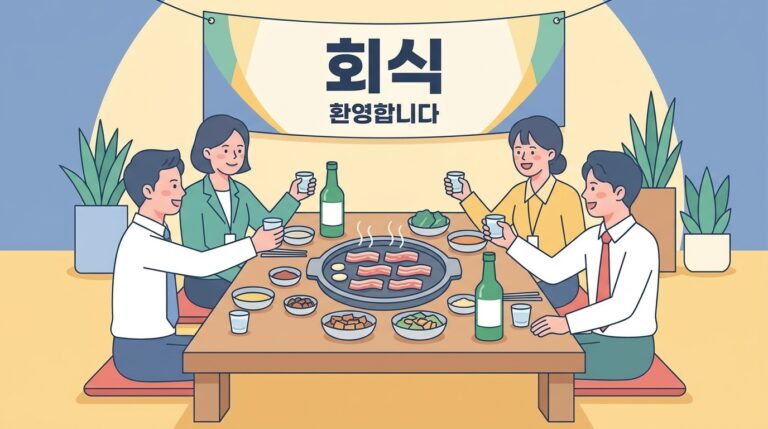
Picture this: It’s 7 PM on a Friday. The air is thick with the savory smoke of grilling pork belly (Samgyeopsal). Soju glasses are clinking, and your Korean boss turns to you with a flushed, happy face, raising his glass. In a K-Drama, the subtitle simply reads, “Cheers!” But as a B2 Korean learner, you know it’s never just “cheers.”
Hoesik (회식), or the Korean company dinner, isn’t just about eating and drinking; it’s an extension of the workplace. It’s where deals are smoothed over, team bonds are forged, and Nunchi (눈치) is tested to its limits. If you only know textbook phrases, you might accidentally offend a senior colleague. But if you master the subtle art of Hoesik etiquette? You won’t just be “the foreign coworker”—you’ll be the ultimate “Insider” (인싸) of your team.
Let’s dive into the unwritten rules and real-life phrases of the Korean company dinner, crafted from the real struggles and triumphs of my B2 students.
Phase 2: Deep Dive into Core Expressions
Here are the top phrases you need to navigate the hierarchy and harmony of a Hoesik.
1. 제가 한 잔 올리겠습니다.
- Pronunciation: je-ga han jan ol-li-get-seum-ni-da (The ‘으’ in ‘seum’ sounds like the disgusted sound you make when stepping in gum).
- Meaning:
- Literal: I will raise a glass up to you.
- Real Nuance: Let me pour you a drink (to a senior/boss).
- K-Culture Moment: The boss’s glass is empty. The music is loud, but a junior employee slides over smoothly with a Soju bottle, holding it with two hands, and says this line. The boss smiles proudly.
- Editor’s Insight: This is much more polite than “제가 드릴게요” (I’ll give it to you). The verb 올리다 (to raise/offer up) physically reflects the hierarchy. You are “lifting” your respect to them.
- Situation Spectrum:
- 친구 사이 (Casual): 🚫 (Too stiff, friends will laugh at you)
- 직장 동료 (Semi-formal): ⚠️ (Only if they are significantly senior)
- 직장 상사·어른 (Formal): ✅ (Perfect!)
- 🤔 Think About It: Why does Korean have a specific verb (올리다) just for giving things to seniors? How does your culture express respect when serving food or drinks?
2. 고기는 제가 굽겠습니다!
- Pronunciation: go-gi-neun je-ga gup-get-seum-ni-da
- Meaning:
- Literal: As for the meat, I will grill it.
- Real Nuance: I’ll take charge of the grill!
- K-Culture Moment: You’re at a Korean BBQ joint. The server brings the raw meat. If you’re the youngest (Maknae), you immediately grab the tongs and scissors and declare this loudly.
- Editor’s Insight: Grilling meat is a highly respected service at a Korean table. Claiming the grill shows proactivity and dedication to the team’s comfort. It’s the ultimate “brownie point” generator.
- Situation Spectrum:
- 친구 사이 (Casual): ✅ (Though usually with “내가 구울게”)
- 직장 동료 (Semi-formal): ✅
- 직장 상사·어른 (Formal): ✅
- 🤔 Think About It: In many Western countries, cooking is done in the kitchen by a chef. Why do Koreans prefer to cook the food together right at the center of the table?
3. 먼저 일어나 보겠습니다.
- Pronunciation: meon-jeo i-reo-na bo-get-seum-ni-da
- Meaning:
- Literal: I will try to stand up first.
- Real Nuance: I need to leave now / Excuse me, I’ll be heading home.
- K-Culture Moment: It’s 11 PM. The team is discussing moving to a karaoke room (Noraebang) for “Round 2” (2차). You are exhausted and need to catch the last subway.
- Editor’s Insight: Never just say “저는 갈게요” (I’m going). By saying “일어나 보겠습니다” (try to stand up), you are softening the blow. It shows you wish you could stay, but unfortunately, you must physically remove yourself.
- Situation Spectrum:
- 친구 사이 (Casual): ⚠️ (Use “나 먼저 일어날게”)
- 직장 동료 (Semi-formal): ✅
- 직장 상사·어른 (Formal): ✅
- 🤔 Think About It: The auxiliary verb “~아/어 보다” (to try doing) is used to soften sentences. Why do Koreans prefer indirectness over saying a blunt “I am leaving”?
Phase 3: Textbook vs. Real Korean
Let’s upgrade your B2 vocabulary from the classroom to the neon-lit streets of Gangnam.
[Suggesting a Toast]
* 📖 Textbook Korean: 우리 건배합시다. (Let’s toast.)
* 🗣️ Real Korean: 다 같이 잔 드시죠! 위하여! (Let’s all raise our glasses! For [us]!)
* 💡 Why the difference?: “건배” is a bit dry. Asking people to physically “lift their glasses” (잔 드시죠) and shouting “위하여!” (For our success/health!) builds explosive team morale.
[Reacting to the Boss’s Restaurant Choice]
* 📖 Textbook Korean: 이 식당 음식이 아주 맛있습니다. (The food at this restaurant is very delicious.)
* 🗣️ Real Korean: 부장님, 여기 완전 찐 맛집이네요! 센스 대박이십니다. (Manager, this is a true authentic hot spot! Your taste is amazing!)
* 💡 Why the difference?: At Hoesik, complementing the food is actually complementing the person who chose the venue (usually the boss). Adding trendy words like “찐 맛집” (authentic great restaurant) shows you are well-integrated into modern Korean culture.
[Bottom Note] As a B2 learner, using mild slang like “찐 맛집” or “센스” is highly charming. However, avoid heavy internet slang or cursing, as Hoesik is still an extension of the workplace.
Phase 4: Cultural Context — K-Culture Deep Dive
4-1. The Unspoken Rules (Non-verbal Elements)
Language is only 50% of Hoesik etiquette. Your body language speaks volumes:
* Two Hands Rule: When pouring or receiving a drink from a senior, ALWAYS use two hands. Place your left hand lightly on your chest or right elbow to show respect.
* The Head Turn: When you drink a shot of Soju in front of a senior, turn your head and upper body slightly to the side, covering your glass with your hand. Never make direct eye contact while drinking alcohol!
* Nunchi Game: If a senior’s glass is less than half full, it’s your cue to ask, “제가 한 잔 올리겠습니다.” Never let a boss pour their own drink!
4-2. K-Food Connection: The Social Bonding of Communal Dining
Why does the team eat from the same grill and share stews? In Korean food culture, eating from shared pots (with individual plates) signifies Jeong (정 – deep emotional connection). Serving someone a perfectly grilled piece of meat or pouring them a warm bowl of soup is a physical manifestation of caring. When you participate actively in this at a Hoesik, you aren’t just an employee; you become “our person” (우리 사람).
Phase 5: Real-Life Roleplay Scenario
Setting: Friday, 7:30 PM. A bustling Korean BBQ restaurant in Yeouido. The smell of roasted garlic is in the air. You are sitting at a table with your team.
Characters:
* YOU (Reader): The foreign employee who joined the Seoul office two months ago.
* Mr. Kim (50s): The Team Leader (부장님 – Bujangnim). Stern but secretly loves a good joke.
* Minsu (30s): Your friendly Korean colleague (대리 – Daeri).
Dialogue:
Mr. Kim: 자, 다들 이번 주 프로젝트 하느라 고생 많았어요! 많이들 먹어요. 🥩
(ja, da-deul i-beon ju peurojekteu ha-neu-ra gosaeng man-at-seo-yo! ma-ni-deul meo-geo-yo.)
(English) Alright, everyone worked hard on the project this week! Eat up.
(🎭 Stage Direction: Mr. Kim picks up his Soju glass, which is empty.)
YOU: 부장님, 제가 한 잔 올리겠습니다.
(bu-jang-nim, je-ga han jan ol-li-get-seum-ni-da.)
(English) Manager Kim, let me pour you a glass.
Mr. Kim: 오, 한국 회식 문화 좀 아는데? 좋아.
(o, hanguk hoesik munhwa jom a-neun-de? jo-a.)
(English) Oh, you know a bit about Korean dining culture? Nice.
Minsu: 저도 부장님께 한 잔 받겠습니다!
(jeo-do bu-jang-nim-kke han jan bat-get-seum-ni-da!)
(English) I would also like to receive a glass from you, Manager!
Mr. Kim: 그래, 그래. 다들 잔 드시죠. 우리 팀을 위하여!
(geu-rae, geu-rae. da-deul jan deu-si-jyo. u-ri ti-meul wi-ha-yeo!)
(English) Yes, yes. Everyone raise your glasses. For our team!
YOU & Minsu: 위하여! 🍻
(wi-ha-yeo!)
(English) Cheers!
(🎭 Stage Direction: Everyone clinks glasses. You turn your head slightly to take a sip.)
Minsu: (Looking at the grill) 아, 고기가 다 타가네요. 제가 굽겠습니다.
(a, gogi-ga da ta-ga-ne-yo. je-ga gup-get-seum-ni-da.)
(English) Ah, the meat is burning. I’ll grill it.
🔀 Your Turn! How should you respond?
– A) “네, 맛있게 구워주세요!” (Yes, please grill it deliciously!)
– B) “대리님, 고기는 제가 굽겠습니다! 집게 주시죠.” (Minsu, I’ll grill the meat! Give me the tongs.)
– C) “아줌마! 여기 고기 좀 구워주세요!” (Ma’am! Please grill the meat here!)✅ Best Choice: B — As the junior employee, offering to take the tongs from Minsu shows excellent Nunchi and team spirit.
⚠️ Choice A & C Analysis: Choice A makes you look passive. Choice C is rude; never yell “Ajumma!” (Use “사장님” or “여기요” instead), and in most standard BBQ places, the youngest staff member grills, not the restaurant staff, unless it’s a premium restaurant.
YOU: 대리님, 고기는 제가 굽겠습니다! 집게 주시죠.
(dae-ri-nim, gogi-neun je-ga gup-get-seum-ni-da! jip-ge ju-si-jyo.)
(English) Minsu, I will grill the meat! Please give me the tongs.
Minsu: 오, 그래요? 그럼 부탁할게요!
(o, geu-rae-yo? geu-reom bu-tak-hal-ge-yo!)
(English) Oh, really? Then I’ll leave it to you!
(🎭 Bonus K-Culture Scenario)
Mr. Kim: 자, 1차는 내가 쏜다! 2차 갈 사람?
(ja, il-cha-neun nae-ga sson-da! i-cha gal sa-ram?)
(English) Okay, Round 1 is on me! Who’s up for Round 2?
YOU: 부장님, 너무 아쉽지만 저는 오늘 먼저 일어나 보겠습니다. 내일 일찍 회의가 있어서요.
(bu-jang-nim, neo-mu a-swip-ji-man jeo-neun o-neul meon-jeo i-reo-na bo-get-seum-ni-da. nae-il il-jjik hoe-ui-ga it-seo-seo-yo.)
(English) Manager Kim, it’s such a shame, but I’ll have to head out first today. I have an early meeting tomorrow.
Phase 6: 10-Second Shadowing Drill
Practice these sentences out loud to get the exact rhythm and intonation of a Korean office worker!
- 😊 Polite & Enthusiastic: 부장님! / 제가 / 한 잔 / 올리겠습니다! (bu-jang-nim! / je-ga / han jan / ol-li-get-seum-ni-da!)
- 😤 Confident & Helpful: 대리님, / 고기는 / 제가 / 굽겠습니다! (dae-ri-nim, / go-gi-neun / je-ga / gup-get-seum-ni-da!)
- 🥺 Apologetic & Respectful: 죄송하지만 / 저는 먼저 / 일어나 보겠습니다. (joe-song-ha-ji-man / jeo-neun meon-jeo / i-reo-na bo-get-seum-ni-da.)
Phase 7: K-Culture Mini Dictionary
1. 눈치 (Nunchi)
* Romanization: nunchi
* English: Situational awareness / emotional intelligence
* Context: The quintessential Korean social skill. It’s the ability to “read the room”—like knowing when a senior’s glass is empty without them asking.
2. 회식 (Hoesik)
* Romanization: hoesik
* English: Company dinner / staff gathering
* Context: A crucial part of Korean corporate life used for team building. Often involves heavy drinking, but the culture is shifting towards lunches or cultural activities nowadays.
3. 건배사 (Geonbaesa)
* Romanization: geonbaesa
* English: A toast / toasting speech
* Context: At a Hoesik, someone (often the boss) will give a short speech followed by a synchronized shout. Knowing a clever Geonbaesa makes you a legend.
4. N차 (N-cha)
* Romanization: N-cha
* English: Round 1, Round 2, Round 3…
* Context: Koreans rarely stay at one venue. 1차 (Dinner/BBQ) -> 2차 (Pub or Chicken) -> 3차 (Karaoke). Knowing when to slip away during the transition is a survival skill!
Phase 8: Traveler’s Survival Kit
Even if you aren’t working in Korea, you’ll likely find yourself in a Korean restaurant. Here are the survival phrases you need:
🆘 Survival Phrases for the Restaurant
– 🇰🇷 “사장님, 여기 불판 좀 갈아주세요!” (sa-jang-nim, yeo-gi bul-pan jom ga-ra-ju-se-yo!)
– 🗣️ Meaning: Boss, please change the grill plate here!
– 📍 Where to use: K-BBQ restaurants when your meat starts burning.
– 💡 Pro Tip: In Korea, you must aggressively call the server. Don’t wait for eye contact! Press the call button (벨) on the table, or raise your hand and say “사장님” (Boss) or “저기요” (Excuse me).📌 Editor’s Travel Note
– Splitting the bill (더치페이): In a traditional Hoesik, the boss or the company card pays. But with friends, tell the cashier “따로 결제할게요” (We will pay separately).
– Tipping: There is ZERO tipping culture in Korea. If you leave money on the table, the server will chase you down the street to give it back!
Phase 9: Critical Thinking Corner — “A Step Deeper”
Language & Power in the Korean Workspace
Have you ever noticed how the physical actions in a Korean Hoesik mirror the grammar? You must use formal language (존댓말) to seniors, and this verbal respect is paired with physical actions: bowing, using two hands to pour, and turning away to drink. In Western cultures, eye contact during a toast signifies trust and equality. In Korea, breaking eye contact while drinking is a sign of submission and deep respect for the hierarchy. It reveals that in Korea, social harmony is built not always on equality, but on everyone playing their distinct role beautifully.
💬 Your Turn: Does your culture have specific rules for who sits where, or who pours the drinks at a dinner table? Share your thoughts in the comments!
Phase 10: FAQ & Avoiding Misunderstandings
Q: “What if I don’t drink alcohol? Can I refuse a drink from the boss?”
* A: Yes, but how you do it is crucial. Never just say “아니요” (No). Say, “제가 술을 잘 못 마셔서, 사이다로 받겠습니다” (I can’t drink alcohol well, so I will receive Sprite instead). Let them pour you a glass of water or soda, and still clink glasses with everyone!
Q: “Can I use ‘당신’ (you) when talking to a coworker?”
* A: 🚫 NO! This is a huge B2 trap! In Korean, “당신” is only used between married couples or when you want to start a street fight. Use their title (e.g., 부장님, 대리님) or their name + 씨 (e.g., 민수 씨).
❌ Common Mistake #1: Pouring your own drink.
✅ How to fix it: In Korea, pouring your own drink (자첨) is said to bring bad luck (or means you’ll stay single for 3 years!). Always wait for someone to pour for you, and actively pour for others.
Phase 11: Summary & Action Items
One-Liner Summary: A successful Korean Hoesik isn’t about drinking the most; it’s about mastering the Nunchi of pouring, grilling, and politely excusing yourself with respectful phrases.
Your Action Missions:
* 🥉 Bronze (Solo): Stand in front of a mirror, hold an imaginary bottle with two hands, and practice saying “부장님, 제가 한 잔 올리겠습니다!”
* 🥈 Silver (Online): Write a short comment below about your favorite Korean food to eat at a team dinner.
* 🥇 Gold (Real Life): Next time you are at a K-BBQ restaurant with friends, grab the tongs and declare, “고기는 제가 굽겠습니다!”
K-Culture Mission: Watch an episode of “Misaeng” (미생) or “Work Later, Drink Now” (술꾼도시여자들) and spot the exact moment a junior employee turns their head away to take a shot of Soju!
Phase 12: Interactive Challenge Quiz
1. Situational Judgment: The boss’s Soju glass is completely empty. What should you do?
– A) Ignore it; he’ll pour it himself.
– B) Say “건배합시다!” and clink your glass with his empty one.
– C) Hold a bottle with two hands and ask, “부장님, 제가 한 잔 올리겠습니다.”
(Answer: C. A is a lack of Nunchi. B is highly inappropriate!)
2. Fill in the Blank: You are extremely tired and need to leave the Hoesik after Round 1.
“저기… 저는 내일 일이 있어서 먼저 ________ 보겠습니다.”
(Answer: 일어나 – meaning “to stand up/leave”)
3. True or False: If the CEO gives you a shot of Soju, you should look him directly in the eyes while drinking it to show confidence. (T/F)
(Answer: False. You must turn your head slightly away to show respect.)
Frequently Asked Questions (FAQ)
Q: What does "제가 한 잔 올리겠습니다." mean in Korean and how do you pronounce it?
A: In Korean, "제가 한 잔 올리겠습니다." is pronounced [je-ga han jan ol-li-get-seum-ni-da (The '으' in 'seum' sounds like the disgusted sound you make when stepping in gum] and means: Literal: I will raise a glass up to you.
Q: What does "고기는 제가 굽겠습니다!" mean in Korean and how do you pronounce it?
A: In Korean, "고기는 제가 굽겠습니다!" is pronounced [go-gi-neun je-ga gup-get-seum-ni-da] and means: Literal: As for the meat, I will grill it.
Q: What does "먼저 일어나 보겠습니다." mean in Korean and how do you pronounce it?
A: In Korean, "먼저 일어나 보겠습니다." is pronounced [meon-jeo i-reo-na bo-get-seum-ni-da] and means: Literal: I will try to stand up first.







