

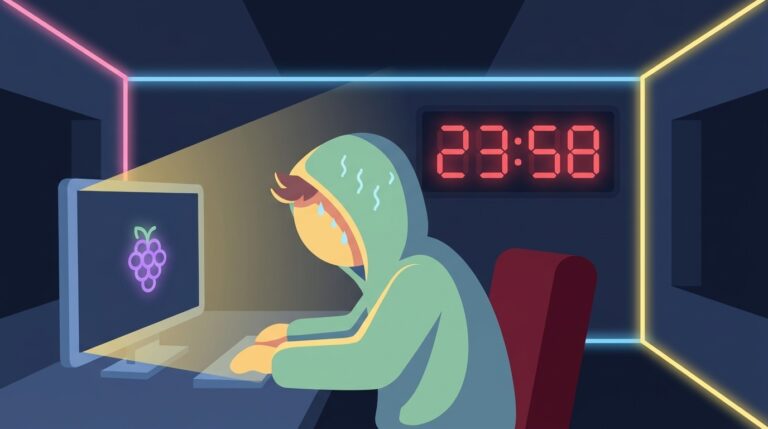
Phase 1: The Adrenaline Rush of 7:59:59 PM
Hello! I’m your Daily Hangul Editor, your veteran tutor and local cultural navigator.
Picture this: You are in a dimly lit Korean PC Bang (Internet Cafe). The air is thick with tension. Around you, dozens of people are staring intensely at their monitors, their right hands hovering over their mice like cowboys waiting for a duel. On their screens? A digital clock ticking down the milliseconds. 7:59:58… 7:59:59… 8:00:00! Suddenly, a symphony of frantic mouse clicks erupts. A second later, someone sighs deeply, while another buries their face in their hands.
Welcome to the battlefield of Korean performing arts. Whether it’s a front-row seat to see your favorite K-Pop idol in a musical or the grand finale of a world tour, getting a ticket in Korea isn’t just a purchase—it’s an extreme sport.
If you’re at a C1 level, you already know how to say ‘표를 예매하고 싶어요’ (I want to book a ticket). But if you say that to a Korean fan, they’ll smile politely while internally preparing for battle. Today, we’re diving into the absolute insider slang of the Korean ticketing war. Knowing these terms won’t just help you get that front-row seat; it will instantly earn you the respect of any native Korean fan. Let’s get clicking!
Phase 2: Core Expression Deep Dive
Let’s break down the ultimate survival vocabulary for the ticketing battlefield.
1. 피켓팅 (Piketting)
- Pronunciation: [pi-ket-ting] (Sounds like ‘pea’ + ‘get’ + ‘ting’)
- Meaning: Blood-ticketing (Literal) vs. A fiercely competitive ticketing war (Real nuance)
- K-Culture Moment: This is a portmanteau of ‘피’ (blood) and ‘티켓팅’ (ticketing). You’ll hear this on entertainment news when a famous idol’s concert sells out in 30 seconds. If your friend asks how the ticketing for the Dracula musical went, you wipe fake sweat from your forehead and say, ‘완전 피켓팅이었어…’ (It was an absolute bloodbath…)
- Editor’s Insight: This word captures the exhaustion and sheer competitiveness of the event. It’s not actually violent, but the emotional toll feels like you’ve been to war.
- Situation Spectrum:
- Casual friends: ✅
- Semi-formal colleagues: ✅ (Totally fine if talking about hobbies)
- Formal/Elders: ⚠️ (They might not know the slang, though it’s widely used in media now)
- 🤔 Think About It: Why do Koreans associate buying concert tickets with ‘blood’? How does this reflect Korea’s hyper-competitive Ppalli-Ppalli (hurry up) culture, even in leisure activities?
2. 이선좌 (Iseonjwa)
- Pronunciation: [ee-seon-jwa]
- Meaning: This seat is already selected (Literal) vs. The heartbreaking pop-up of doom (Real nuance)
- K-Culture Moment: You see a glorious purple square (an available VIP seat!) on the screen. You click it with lightning speed. But alas, a gray pop-up box appears: ‘이미 선택된 좌석입니다’ (This seat has already been selected by another customer). Fans abbreviate this agonizing sentence to ‘이선좌’.
- Editor’s Insight: It’s a noun used almost like a physical blow. You don’t just ‘see’ an Iseonjwa; you ‘get hit’ by it. (이선좌 맞았어).
- Situation Spectrum:
- Casual friends: ✅
- Semi-formal colleagues: ⚠️ (Only if they are fellow fans)
- Formal/Elders: 🚫
- 🤔 Think About It: Koreans love four-syllable acronyms (사자성어 style) for modern struggles. Does your native language have specific slang for digital frustrations?
3. 취켓팅 (Chwiketting)
- Pronunciation: [chwi-ket-ting] (The ‘chwi’ sounds like a sharp sneeze: ‘chwee’)
- Meaning: Cancelled ticketing (Literal) vs. The 2 AM zombie watch (Real nuance)
- K-Culture Moment: You failed the initial 피켓팅. Is it over? No. People who bought tickets via bank transfer have until 11:59 PM the next day to pay. If they don’t, those tickets are automatically canceled and released back into the system, usually around 2:00 AM. Fans stay awake, refreshing their browsers like zombies, hoping to snatch these up. This is ‘취켓팅’.
- Editor’s Insight: Use this when you want to show your unwavering determination. ‘나 오늘 밤새서 취켓팅 참전한다’ (I’m staying up all night to participate in the Chwiketting war).
- Situation Spectrum:
- Casual friends: ✅
- Semi-formal colleagues: ✅
- Formal/Elders: 🚫
Phase 3: Textbook vs. Real Korean
How do advanced learners sound versus actual Korean fans in the wild?
[Describing the Difficulty]
* 📖 Textbook Korean: 표를 예매하기가 너무 어렵습니다. (It is very difficult to book tickets.)
* 🗣️ Real Korean: 이번 콘서트 완전 피켓팅 장난 아니야. (This concert’s blood-ticketing is no joke.)
* 💡 Why the difference?: ‘장난 아니다’ (is no joke) combined with slang instantly makes you sound like a passionate native rather than a polite student.
[Failing to Get a Seat]
* 📖 Textbook Korean: 다른 사람이 먼저 표를 샀어요. (Someone else bought the ticket first.)
* 🗣️ Real Korean: 아, 눈앞에서 이선좌 맞았어. 멘붕이야. (Ah, I got hit with an Iseonjwa right before my eyes. Mental breakdown.)
* 💡 Why the difference?: Personifying the error message as something that ‘hits’ you (맞다) adds dramatic, empathetic flair.
[Planning for Plan B]
* 📖 Textbook Korean: 나중에 취소된 표를 사려고 합니다. (I plan to buy a canceled ticket later.)
* 🗣️ Real Korean: 무조건 취켓팅 노려야지. 2시에 보자. (I absolutely have to aim for Chwiketting. See you at 2 AM.)
* 💡 Why the difference?: Using verbs like ‘노리다’ (to aim/target) emphasizes that ticketing is treated like a tactical hunting game.
Bottom Note for C1 Learners: You have the grammar down perfectly. Now, it’s about replacing those polite, clinical verbs with dynamic, action-oriented verbs (맞다, 노리다, 참전하다) to capture the cultural emotion.
Phase 4: Cultural Context — K-Culture Deep Dive
4-1. Non-Verbal Elements: The Art of ‘광클’ (Mad Clicking)
When engaging in 피켓팅, there is a specific physical etiquette. You don’t use Wi-Fi; you plug directly into a LAN cable at a PC Bang. You open a separate tab for Navyism (네이비즘), a website that shows the exact server time of the ticketing site down to the millisecond. The atmosphere is like a temple—absolute silence, except for the frantic click-click-click-click (광클 – mad clicking) right at 00.00 seconds. If someone groans loudly, you read the room (Nunchi): they just got hit by an 이선좌.
4-2. The K-Pop & Musical Connection: ‘포도알’ (Grapes) and ‘용병’ (Mercenaries)
In the Korean musical and K-Pop scene, ticketing isn’t a solo mission. Fans recruit their fastest-clicking friends to help them. These friends are called 용병 (Mercenaries). Furthermore, on Interpark (Korea’s biggest ticketing site), available VIP seats are displayed as little purple squares. Fans lovingly, yet desperately, call these 포도알 (Grapes).
* ‘내 자리 하나쯤은 있겠지…’ (Surely there’s one seat for me…)
* Reality: The grapes disappear before you even blink.
Phase 5: Real-Life Roleplay Scenario
Scenario A: The Main Roleplay – The 8 PM War
- Setting: A high-end PC Bang in Sinchon. It’s 7:55 PM. The neon lights reflect off the monitors. You and your Korean friend are logged into Interpark, preparing to book VIP tickets for a highly anticipated musical starring your favorite actor.
- Characters:
- YOU: An expat in Seoul, a massive musical theater fan, relying on your friend’s expertise.
- Minji (28): Your Korean friend, a veteran K-Pop fan and your designated ‘Mercenary’ (용병) for the night.
Minji: 자, 5분 남았어. 서버 시간 켜놨지? 새로고침(F5) 절대 미리 누르면 안 돼!
(Ja, obun namasseo. Seobeo sigan kyeonwatji? Saerogochim(F5) jeoldae miri nureumyeon an dwae!)
[Okay, 5 minutes left. You have the server time on, right? Do NOT press refresh (F5) early!]
YOU: 응, 켜놨어. 손에 땀 나… 나 진짜 앞자리 꼭 가고 싶어.
(Eung, kyeonwasseo. Sone ttam na… Na jinjja apjari kkok gago sipeo.)
[Yeah, it’s on. My hands are sweating… I really want to go to the front row.]
Minji: 걱정 마, 내가 오늘 너의 완벽한 용병이 되어줄게. 10초 전! 9, 8…
(Geokjeong ma, naega oneul neoui wanbyeokan yongbyeongi doeeojulge. Sipcho jeon! Gu, pal…)
[Don’t worry, I’ll be your perfect mercenary today. 10 seconds left! 9, 8…]
(🎭 Stage Direction: The Navyism clock hits 8:00:00. Both of you click instantly!)
YOU: 어? 하얀 화면만 나오는데? 에러 난 거 아니야?
(Eo? Hayan hwamyeonman naoneunde? Ereo nan geo aniya?)
[Huh? It’s just showing a white screen? Is it an error?]
Minji: 기다려!! 대기열(queue) 뜨는 중이니까 절대 건드리지 마!
(Gidaryeo!! Daegiyeol tteuneun junginikka jeoldae geondeuriji ma!)
[Wait!! The queue is loading, so absolutely do not touch it!]
YOU: 헉, 내 앞에 3,000명 있대. 이거 망한 거지?
(Heok, nae ape samcheonmyeong itdae. Igeo manghan geoji?)
[Gasp, it says there are 3,000 people in front of me. We’re doomed, right?]
Minji: 아냐, 뮤지컬은 금방 빠져. 오, 나 좌석 창 들어왔다! 포도알 보인다!!
(Anya, myujikeoreun geumbang ppajyeo. O, na jwaseok chang deureowatda! Podoal boinda!!)
[No, musicals drop quickly. Oh, I’m in the seating chart! I see grapes!!]
YOU: 진짜? 1열? VIP석 1열 잡아줘!!
(Jinjja? Il-yeol? VIP-seok il-yeol jabajwo!!)
[Really? First row? Grab the 1st row VIP seat!!]
Minji: 아악!! 이선좌!! 누가 벌써 채갔어!
(Aaak!! Iseonjwa!! Nuga beolsseo chaegasseo!)
[Aaagh!! Iseonjwa!! Someone already snatched it!]
🔀 Your Turn! The screen freezes slightly after another click. What do you do?
– A) ‘아 답답해! F5 누를래!’ (Ah, this is frustrating! I’m pressing F5!)
– B) ‘차분하게… 취소표 나올 때까지 존버(hold on)하자.’ (Let’s stay calm and hold on until canceled tickets appear.)
– C) ‘그냥 암표(scalped ticket) 사면 안 돼?’ (Can’t we just buy a scalped ticket?)✅ Best Choice: B — Patience is key! If you refresh (A), you go back to the end of the 10,000-person queue. Never do A!
⚠️ Choice C Analysis: Never suggest buying scalped tickets (플미/암표). Entertainment companies strictly cancel illegally traded tickets, and it’s highly frowned upon in the fan community.
YOU (Choosing B): 아쉽지만 어쩔 수 없지. 우리 이따가 취켓팅 노려볼까?
(Aswipjiman eojjeol su eopji. Uri ittaga chwiketting noryeobolkka?)
[It’s a shame, but what can we do. Shall we aim for canceled ticketing later?]
Minji: 좋아! 오늘 밤 2시에 다시 만나자. 내가 기필코 잡아낸다.
(Joa! Oneul bam dusi-e dasi mannaja. Naega gipilko jabanaenda.)
[Good! Let’s meet again tonight at 2 AM. I will absolutely catch one.]
Scenario B: Bonus K-Culture Moment – The Twitter Ticket Transfer (양도)
A week later, you find someone transferring a ticket on social media.
YOU: 안녕하세요, 드라큘라 14일 VIP석 양도하시나요?
(Hello, are you transferring the VIP seat for Dracula on the 14th?)
Seller: 네, 원가 양도(transferring at original price)합니다. 아옮(ID transfer)은 본인이 직접 하셔야 해요.
(Yes, transferring at cost. You have to do the ID transfer yourself.)
YOU: 아, 제가 외국인이라서요. 현장 수령할 때 예매 내역서만 보여줘도 되나요?
(Ah, because I’m a foreigner. Can I just show the booking confirmation when picking it up on-site?)
Seller: 헉, 요즘 본인 확인 빡세서 신분증 원본 없으면 못 들어가실 텐데요…
(Oh, identity verification is so strict these days, you probably can’t get in without the original ID…)
(Editor’s Note: Ticket transfers are incredibly risky now due to strict ID checks at venues! Be careful!)
Phase 6: 10-Second Shadowing Drill
Channel your inner frustrated fan. Remember, rhythm and emotion are just as important as pronunciation!
😤 아, / 진짜! / 또 / 이선좌야! / 나 / 똥손인가 봐...
(A, / jinjja! / Tto / iseonjwaya! / Na / ttongsoninga bwa...)
[Ah, seriously! It’s Iseonjwa again! I guess I have poop hands (bad luck)…]
- Pro-tip: Stress the ‘또’ (again) with intense frustration. ‘똥손’ (poop hands) is cute but self-deprecating slang for someone with bad luck or poor physical coordination.
Phase 7: K-Culture Mini Dictionary
Here are the sacred keywords of the Korean ticketing battlefield:
1. 눈치 (Nunchi)
* Romanization: nunchi
* English: Situational awareness / reading the room
* Context: In a PC Bang, having nunchi means keeping quiet when everyone is tense at 7:59 PM.
2. 용병 (Yongbyeong)
* Romanization: yongbyeong
* English: Mercenary
* Context: Friends or family members enlisted to help you click and secure a ticket from different computers.
3. 똥손 / 금손 (Ttongson / Geumson)
* Romanization: ttongson / geumson
* English: Poop hands / Gold hands
* Context: ‘똥손’ means you have terrible luck or slow reflexes (always getting Iseonjwa). ‘금손’ means you are incredibly lucky and skilled, managing to snatch the 1st-row center seat.
4. 플미 (Peul-mi)
* Romanization: peul-mi
* English: Premium (Scalped tickets)
* Context: Short for ‘Premium’. Buying tickets from scalpers at inflated prices. Highly discouraged and actively fought against by entertainment companies.
5. 네이비즘 (Navyism)
* Romanization: neibijeum
* English: Server time clock
* Context: A website that shows the exact server time of the ticketing platform. The ultimate compass for Korean fans.
Phase 8: Traveler’s Survival Kit
If you are traveling to Korea and want to catch a musical in Daehangno or a K-Pop concert at KSPO Dome, you need to navigate the Global Ticketing pages (like Global Interpark or Yes24 Ticket).
🆘 Survival Expressions for Global Ticketing & Venues
– 🇰🇷 ‘글로벌 페이지에서도 예매 가능한가요?’ (Geullobeol peijieseodo yemae ganeunghangayo?)
– 🗣️ Meaning: Can I also book on the global page?
– 🇰🇷 ‘외국인 현장 수령 부스는 어디인가요?’ (Oegugin hyeonjang suryeong buseuneun eodi-ingayo?)
– 🗣️ Meaning: Where is the on-site ticket pickup booth for foreigners?
– 🇰🇷 ‘여권이랑 예매 내역서 여기 있습니다.’ (Yeogwonirang yemae naeyeokseo yeogi itseumnida.)
– 🗣️ Meaning: Here is my passport and booking confirmation.📌 Editor’s Travel Note: The Strict Reality of ID Checks
– Physical ID is Law: In Korea, ticket scalping is a huge issue. To combat this, venues enforce strict ‘본인 확인’ (Identity Verification). If you bought the ticket on the Global site, you MUST bring your physical passport or Alien Registration Card (ARC). Photos of your passport will be rejected!
– Name Matching: Ensure the name on your ticketing account matches your passport exactly (including middle names).
– Payment: Global pages usually accept foreign Visas and Mastercards, but Korean domestic pages require local cards and phone number verification.
Phase 9: Critical Thinking Corner — ‘One Step Deeper’
🧠 Think Deeper: Digital Speed & The ‘Ppalli-Ppalli’ Culture
The phenomenon of ‘피켓팅’ (Blood-ticketing) perfectly encapsulates Korea’s world-renowned internet infrastructure and its Ppalli-Ppalli (hurry up) culture. In many countries, buying a theater ticket is a leisurely activity. In Korea, leisure itself has been gamified into a hyper-competitive race. This stems from a society where efficiency and speed are highly valued, and digital infrastructure (like PC Bangs with zero-latency ping) allows for millisecond-level competition. The language evolves to reflect this: we don’t just ‘buy’ tickets; we ‘go to war’ (참전하다), ‘get hit’ by errors (맞다), and hire ‘mercenaries’ (용병). It shows how a nation’s technological advancement directly shapes the social behavior and vocabulary of its youth.
💬 Your Turn: How does ticket booking work in your culture? Is it a relaxing process, or do you also have a version of ‘피켓팅’? Share your experiences in the comments!
Phase 10: FAQ & Avoiding Misunderstandings
Q: Can I use words like ‘똥손’ (poop hands) with older Koreans?
* Maybe, but be careful. While it’s common internet slang, saying ‘똥’ (poop) in front of your boss or an elder might make you sound a bit too unrefined. Keep it among friends!
Q: If I can’t get a ticket, can I buy one from X (Twitter) or Carrot Market (당근마켓)?
* High Risk! While ‘양도’ (transfer at original price) exists, many companies now ban name-changing on tickets. If the seller can’t physically walk you into the venue with their ID, you might be denied entry.
❌ Common Mistake #1: Pressing ‘Refresh’ (F5) when the loading circle spins.
✅ Do This Instead: In Korean ticketing, once you are in the virtual queue, take your hands off the keyboard. Refreshing kicks you out of the line and puts you at the very back.❌ Common Mistake #2: Assuming global tickets can be picked up from the automated kiosks.
✅ Do This Instead: Foreigners usually must go to a dedicated, human-staffed booth called ‘현장 수령’ (On-site pickup) for passport verification.
Phase 11: Summary & Action Items
🎯 One-Liner Summary: To survive Korea’s performing arts scene, you must upgrade from ‘booking a ticket’ to fighting the ‘피켓팅’ war, dodging the ‘이선좌’, and grabbing the purple ‘포도알’.
Action Mission 3 Steps:
– 🥉 Bronze (Solo): Look at your hands and declare, ‘나는 똥손이 아니다! 금손이다!’ (I don’t have poop hands! I have gold hands!) 3 times in the mirror.
– 🥈 Silver (Online): Go to a K-Pop or K-Musical forum and leave a comment: ‘다음 피켓팅 꼭 성공하세요!’ (Please succeed in your next blood-ticketing!)
– 🥇 Gold (Real-world): Next time you try to book a hot restaurant or a concert, text your Korean friend: ‘우리 오늘 피켓팅 참전하자!’
🎸 K-Culture Mission:
Go to YouTube and search ‘아이돌 피켓팅 브이로그’ (Idol ticketing vlog). Watch how fans act exactly at 7:59:59. You’ll hear them scream ‘이선좌!’—now you’ll know exactly what they are feeling!
Phase 12: Quiz — Interactive Challenge
Test your new C1 Korean ticketing survival skills!
1. Situational Judgment: It’s 2:15 AM. You are sitting in the dark, refreshing Interpark to catch a ticket someone forgot to pay for. What are you doing right now?
A) 용병 (Yongbyeong)
B) 취켓팅 (Chwiketting)
C) 이선좌 (Iseonjwa)
2. Fill in the Blank:
‘아, 방금 VIP석 눌렀는데 ______ 맞았어. 진짜 멘붕이야.’
(Ah, I just clicked the VIP seat but got hit by a ______. Total mental breakdown.)
3. True or False – K-Culture Edition:
If you buy a ticket on the Global Interpark site, you can just show a photo of your passport on your phone to get into the concert. (T/F)
👀 Click here for Answers!
1. B) 취켓팅 (Chwiketting) – Staying up to catch canceled tickets is the art of Chwiketting.
2. 이선좌 (Iseonjwa) – The dreaded ‘already selected seat’ pop-up.
3. False! Korean identity verification is merciless. You MUST bring your physical, original passport. A photo will get you turned away at the door!
Ready to grab your ‘포도알’? Let us know which concert or musical you’re aiming for next in the comments!
Frequently Asked Questions (FAQ)
Q: What does "피켓팅 (Piketting)" mean in Korean and how do you pronounce it?
A: In Korean, "피켓팅 (Piketting)" is pronounced [pi-ket-ting] and means: Blood-ticketing (Literal) vs. A fiercely competitive ticketing war (Real nuance)
Q: What does "이선좌 (Iseonjwa)" mean in Korean and how do you pronounce it?
A: In Korean, "이선좌 (Iseonjwa)" is pronounced [ee-seon-jwa] and means: This seat is already selected (Literal) vs. The heartbreaking pop-up of doom (Real nuance)
Q: What does "취켓팅 (Chwiketting)" mean in Korean and how do you pronounce it?
A: In Korean, "취켓팅 (Chwiketting)" is pronounced [chwi-ket-ting] and means: Cancelled ticketing (Literal) vs. The 2 AM zombie watch (Real nuance)






