

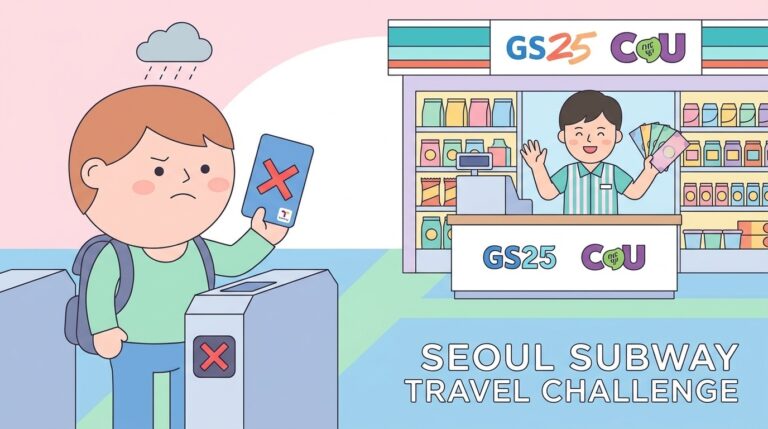
Phase 1: Empathy (The “Oh No” Moment)
Hello! I’m your Daily Hangul Editor.
Picture this: It’s 8:30 AM at Gangnam Station. The subway transfer music is playing in the distance. You’re in a rush, confidently walking up to the turnstile. You tap your trusty T-money card, expecting that satisfying single ‘beep’ (삑) that opens the gate to Seoul’s efficient transport system. But instead, a red light flashes, the gate locks your thighs, and a robotic female voice announces loudly to everyone around you:
“Beep-beep-beep! 잔액이 부족합니다.” (Jan-aegi bujokamnida)
Panic sets in. The busy Seoulites behind you let out a tiny sigh. You’ve just experienced the ultimate Korean public transport rite of passage: The Insufficient Balance moment.
In K-Dramas, this is usually the exact moment a handsome stranger or a reliable best friend swoops in, taps their card twice, and says, “Two people, please!” (두 명이요!). But in reality? You need to step aside and fix it yourself.
Don’t worry! As someone who has lived in Seoul for over a decade and still occasionally forgets to top up her card, I’m going to teach you exactly how to navigate this situation like a seasoned local. By the end of this post, you’ll know exactly what to say to the convenience store clerk without breaking a sweat.
Phase 2: Core Expressions Deep Dive
Let’s break down the three most important phrases you need for this mission.
1. 잔액이 부족합니다.
- Pronunciation: Jan-aegi bu-jo-kam-ni-da (The ‘Jan-aeg’ sounds a bit like ‘John-egg’)
- Meaning: (Literal) The balance is insufficient. / (Real nuance) You’re out of money on this card!
- K-Culture Moment: This is the machine’s voice. You will never actually say this to a person, but you must recognize it. In Korean variety shows (like Running Man), they often use this exact soundbite as a comedic sound effect when someone runs out of luck or money!
- Editor’s Insight: The word ‘부족하다’ means ‘to lack’ or ‘to be short of’. It’s a great B1 vocabulary word to use when you lack sleep (잠이 부족해요) or time (시간이 부족해요).
- Situation Spectrum:
- Machine Voice: ✅
- Formal Writing/News: ✅
- Daily Conversation: ⚠️ (A bit too stiff for casual chat)
- 🤔 Think About It: Notice the polite ‘-ㅂ니다’ ending? Why do Korean subway machines speak to you in the highest formal form (Honorifics)? It reflects the societal norm where service providers (even robotic ones!) must show maximum respect to the customer.
2. 교통카드 충전해 주세요.
- Pronunciation: Gyo-tong-ka-deu chung-jeon-hae ju-se-yo (‘eu’ in ‘deu’ sounds like the disgusted sound you make when stepping in gum)
- Meaning: (Literal) Please charge the transport card. / (Real nuance) I’d like to top up my T-money card, please.
- K-Culture Moment: You walk into a brightly lit CU or GS25 convenience store. The clerk is scanning barcodes. You place your card on the counter and say this. If you have a special K-Pop idol edition T-money card (a popular concert merch!), the clerk might even smile.
- Editor’s Insight: ‘충전’ (Chung-jeon) is a magical word. It means ‘to recharge’. You use this for your phone battery, your T-money card, and even your energy! (“I need a coffee to recharge” = 커피로 에너지 충전해요).
- Situation Spectrum:
- Convenience Store/Subway Booth: ✅
- Friends (Casual): 🚫 (You wouldn’t ask a friend to do this)
- 🤔 Think About It: Why use ‘해 주세요’ (Please do it for me) instead of just ‘I want to recharge’? Korean language heavily relies on asking for favors politely rather than stating direct demands. It builds a cooperative atmosphere.
3. 현금만 되나요?
- Pronunciation: Hyeong-eum-man doe-na-yo?
- Meaning: (Literal) Is it only cash possible? / (Real nuance) Do I have to pay in cash?
- K-Culture Moment: Korea is a heavily cashless society. You can buy a 1,000 KRW pack of gum with a credit card. But T-money top-ups? CASH ONLY! This phrase is a lifesaver when you’re caught off guard.
- Editor’s Insight: Adding ‘-만’ (man) means ‘only’. ‘되나요?’ is a very soft, polite way to ask “Is it possible?” or “Does it work?” It sounds much friendlier than “Cash only?”
- Situation Spectrum:
- Clerk/Staff: ✅
- Co-workers/Strangers: ✅
- 🤔 Think About It: Even in hyper-digital Korea, some systems remain stubbornly analog. Can you guess why the transit system prefers cash for card recharges? (Hint: It has to do with credit card processing fees for micro-transactions!)
Phase 3: Textbook vs. Real Korean
Let’s look at how language shifts from the classroom to the bustling streets of Seoul.
[Situation 1: Asking to top up]
* 📖 Textbook Korean: 교통카드를 충전하고 싶습니다. (I want to recharge my transit card.)
* 🗣️ Real Korean: 이거 충전이요. (This, recharge please.)
* 💡 Why is it different?: Seoul moves fast. Adding ‘이요’ (i-yo) to a noun is the ultimate Korean lifehack for speaking politely but incredibly quickly.
[Situation 2: Specifying the amount]
* 📖 Textbook Korean: 만 원어치 충전해 주시겠어요? (Would you please recharge ten thousand won worth?)
* 🗣️ Real Korean: 만 원만 해주세요. (Just 10,000 won, please.)
* 💡 Why is it different?: Efficiency! ‘만’ (only) combined with ‘해주세요’ (please do) is the standard template for ordering or requesting specific amounts in stores.
Bottom Note: At a B1 level, you want to sound natural but still respectful. Stick to noun + ‘이요’ or noun + ‘해주세요’. It’s the sweet spot between a textbook and a local!
Phase 4: Cultural Context — K-Culture Deep Dive
4-1. Non-Verbal Cues: The ‘Two-Handed’ Handover
Language is only half the battle. When you hand your T-money card and cash to the convenience store clerk, try to use two hands, or hand it over with your right hand while your left hand lightly supports your right elbow. This is a subtle display of respect in Korea. Also, read the room (Nunchi): if there’s a line of people behind you buying instant ramen and soju, have your cash and card ready before you reach the register!
4-2. K-Pop Connection: The Idol T-Money Card
If you’re a K-Pop fan, you probably already know this: T-money cards aren’t just plastic transit passes. They are highly coveted merchandise! Convenience stores often release limited-edition BTS, SEVENTEEN, or BLACKPINK T-money cards.
– Fan Phrase: “혹시 방탄소년단 티머니 카드 남은 거 있어요?” (By any chance, do you have any BTS T-money cards left?)
Sometimes, fans will buy the card but never actually use it to tap into the subway to keep it in mint condition. But if you do use it, handing a beautiful photo card of your bias to the clerk to recharge is a fun, distinctly K-Pop travel experience.
Phase 5: Real-Life Roleplay Scenario
Setting: It’s 6:45 PM. You are inside a brightly lit CU convenience store right outside Jamsil Station. You have a K-Pop concert starting in 15 minutes, but your transit card is empty, and you need it to get home later. The clerk is busy organizing triangle kimbaps (삼각김밥).
Characters:
– YOU: A slightly frantic foreigner running late.
– Alba (알바생 – Part-time clerk): A 20-something university student in a CU vest.
Dialogue:
Alba: 어서 오세요~
(Eoseo oseyo~)
[Welcome~]
(🎭 Stage Direction: The clerk briefly looks up from the kimbaps)
YOU: 안녕하세요, 교통카드 충전해 주세요.
(Annyeonghaseyo, gyotong-kadeu chungjeonhae juseyo.)
[Hello, please recharge my transit card.]
Alba: 네, 카드리더기에 올려주세요. 얼마 해드릴까요?
(Ne, kadeu-rideogie ollyeojuseyo. Eolma haedeurilkkayo?)
[Yes, please put it on the card reader. How much should I do?]
YOU: 만 원이요.
(Man won-iyo.)
[10,000 won, please.]
Alba: 네, 결제 도와드리겠습니다.
(Ne, gyeolje dowadeurigetseumnida.)
[Yes, I’ll help you with the payment.]
🔀 Your Turn! How do you hand over the payment?
– A) Hand over your international VISA credit card.
– B) Hand over a crisp 10,000 KRW bill.
– C) Hold up your phone for Apple Pay.✅ Best Choice: B — T-money recharges are strictly cash only in Korea!
⚠️ Choice A & C Analysis: If you hand over a card, the clerk will apologetically cross their arms into an ‘X’ and say, “현금만 가능합니다” (Cash only). You’ll have to run to an ATM!
YOU: (Handing over cash) 여기요.
(Yeogiyo.)
[Here you go.]
Alba: (Types on the machine… BEEP!) 네, 만 원 충전되었습니다. 영수증 필요하세요?
(Ne, man won chungjeondoeeotseumnida. Yeongsujeung piryohaseyo?)
[Yes, 10,000 won has been recharged. Do you need a receipt?]
YOU: 아니요, 괜찮습니다. 감사합니다!
(Aniyo, gwaenchanseumnida. Gamsahamnida!)
[No, it’s okay. Thank you!]
Phase 6: 10-Second Shadowing Drill
Read this aloud to practice your rhythm! Pay attention to the pauses (/) and the emotion tags.
🏃♂️ (Rushing but polite)
저기요, / 교통카드 / 만 원 / 충전해 주세요!
(jeogiyo, / gyotong-kadeu / man won / chungjeonhae juseyo!)
🙏 (Apologetic - handing over the cash)
아, / 현금 여기 있습니다.
(ah, / hyeongeum yeogi itseumnida.)
Phase 7: K-Culture Mini Dictionary
1. 알바 (Alba)
* Romanization: Alba (from the German word ‘Arbeit’)
* English: Part-time worker / Clerk
* Context: You’ll see ‘Albas’ at convenience stores, cafes, and restaurants. They are the backbone of Korean retail!
2. 눈치 (Nunchi)
* Romanization: Nunchi
* English: Situational awareness / Reading the room
* Context: Having “quick Nunchi” means having your cash ready before the clerk asks for it to keep the line moving fast.
3. 삑 (Ppik)
* Romanization: Ppik
* English: Beep (onomatopoeia)
* Context: The sound a card reader makes. Koreans often playfully say “삑!” when tapping something.
4. 빨리빨리 (Ppalli-Ppalli)
* Romanization: Ppalli-Ppalli
* English: Hurry, hurry / Fast-paced
* Context: The core ethos of Korean society. The reason why subway gates close quickly and why short, efficient phrases are preferred at convenience stores.
Phase 8: Traveler Survival Kit
🆘 Survival Phrases for the Subway Station
– 🇰🇷 “기계가 현금을 안 먹어요.” (Gigye-ga hyeongeum-eul an meogeoyo.)
– 🗣️ Gi-gye-ga hyeong-eum-eul an meog-eo-yo.
– 📍 Use when: The top-up machine keeps spitting your cash back out. (Literally: “The machine isn’t eating the cash.”)
- 🇰🇷 “이거 환불 되나요?” (Igeo hwanbul doenayo?)
- 🗣️ I-geo hwan-bul doe-na-yo?
- 📍 Use when: You’re leaving Korea and want to refund the remaining balance on your card.
📌 Editor’s Travel Note
– Where to Top Up: You can recharge at any convenience store (CU, GS25, 7-Eleven, Emart24) or at the machines inside subway stations.
– Cash is King: Always keep at least 10,000 to 20,000 KRW in physical cash in your wallet specifically for T-money top-ups and street food.
– The Transfer Magic: If you tap your card when getting off the bus or subway, your next transfer within 30 minutes is free! Always remember to tap out.
Phase 9: Critical Thinking Corner — “One Step Deeper”
Global Era vs. The Cash Society (글로벌 시대의 현금)
🧠 Think Deeper:
South Korea is arguably one of the most technologically advanced and cashless societies in the world. You can pay for a 50-cent item with a Samsung Pay scan without anyone blinking an eye. Yet, the transportation card system (T-money) stubbornly requires physical cash for recharges. This contrast often shocks foreigners. It’s an interesting intersection of hyper-modern infrastructure and legacy financial systems (avoiding credit card processing fees for micro-transactions). It reminds us that no matter how ‘global’ or ‘digital’ a society becomes, local analog quirks always survive.💬 Your Turn: Does your country’s public transport system still use cash, or has it gone completely digital (like tapping a credit card directly)? Share in the comments!
Phase 10: FAQ & Mistake Prevention
Q: Can I just tap my international credit card at the turnstile?
No. Unless you have a specific Korean credit card with a deferred transit function (후불교통카드) or a specialized tourist card (like the NAMANE or WOWPASS), you must use a T-money card.
Q: What if I don’t know enough Korean numbers to say the amount?
Just hand the clerk the exact bill (e.g., a 10,000 won note) and say “전부 다요” (Jeonbu da-yo – “All of it, please”).
Q: Can I use 반말 (Casual speech) like “충전해줘” to a young clerk?
NO. Never. Even if the clerk looks 10 years younger than you, they are providing a service in a public space. Using casual speech to service workers is considered very rude in Korea (often called 갑질 – abusing power).
❌ Common Mistake #1: Trying to pay for a T-money recharge with a credit card.
✅ Do This Instead: Always bring cash. If you forget, look for an ATM (usually located inside the convenience store itself!).
Phase 11: Summary & Action Items
One-Liner Summary: When your transit card beeps an error, find a convenience store, grab some cash, and confidently say: “교통카드 충전해 주세요!”
Action Mission 3 Steps:
– 🥉 Bronze (Solo): Stand in front of a mirror with any card and cash, and say “만 원 충전해 주세요” three times.
– 🥈 Silver (Online): Post a picture of your favorite K-Pop idol T-money card (or a cute Korean subway map) on your social media and caption it with “교통카드 충전해 주세요!”
– 🥇 Gold (Real-world): On your next trip to Korea, bypass the subway machines and successfully top up your card at a convenience store using only Korean!
K-Culture Mission: Next time you watch a K-Drama set in Seoul, pay close attention to the subway or bus scenes. Can you hear the famous “삐빅!” sound? Bonus points if you catch the machine saying “환승입니다” (Transfer)!
Phase 12: Quiz — Interactive Challenge
1. Situational Judgment:
You are at a GS25. You want to add 5,000 won to your card. You hand the clerk your card and a 50,000 won bill, but you only want 5,000 won added. What should you say?
– A) 오천 원만 충전해 주세요.
– B) 오만 원 충전해 주세요.
– C) 교통카드 부족합니다.
2. Fill in the Blank:
You want to ask if you can pay with a credit card.
“혹시 신용카드 ______?”
(Hint: A polite way to ask “Is it possible/Does it work?”)
3. True or False — K-Culture Edition:
“In Korea, it is perfectly fine to tap your T-money card for two people at the same time if you tell the bus driver beforehand.” (T/F)
👀 Click here for answers!
- A (오천 원만 충전해 주세요 – Please recharge ONLY 5,000 won. If you say B, they will put all 50,000 won on the card! C is what the machine says, not you.)
- 되나요 (doenayo)
- True! Before you tap, tell the driver “두 명이요” (Two people), wait for them to adjust the machine, and then tap. It’s a great local skill to have!
Frequently Asked Questions (FAQ)
Q: What does "잔액이 부족합니다." mean in Korean and how do you pronounce it?
A: In Korean, "잔액이 부족합니다." is pronounced [Jan-aegi bu-jo-kam-ni-da (The 'Jan-aeg' sounds a bit like 'John-egg'] and means: (Literal) The balance is insufficient. / (Real nuance) You're out of money on this card!
Q: What does "교통카드 충전해 주세요." mean in Korean and how do you pronounce it?
A: In Korean, "교통카드 충전해 주세요." is pronounced [Gyo-tong-ka-deu chung-jeon-hae ju-se-yo ('eu' in 'deu' sounds like the disgusted sound you make when stepping in gum] and means: (Literal) Please charge the transport card. / (Real nuance) I'd like to top up my T-money card, please.
Q: What does "현금만 되나요?" mean in Korean and how do you pronounce it?
A: In Korean, "현금만 되나요?" is pronounced [Hyeong-eum-man doe-na-yo?] and means: (Literal) Is it only cash possible? / (Real nuance) Do I have to pay in cash?







