

Phase 1: Empathy (Welcome to the K-Beauty Wonderland!)
Hello! I’m your Daily Hangul Editor.
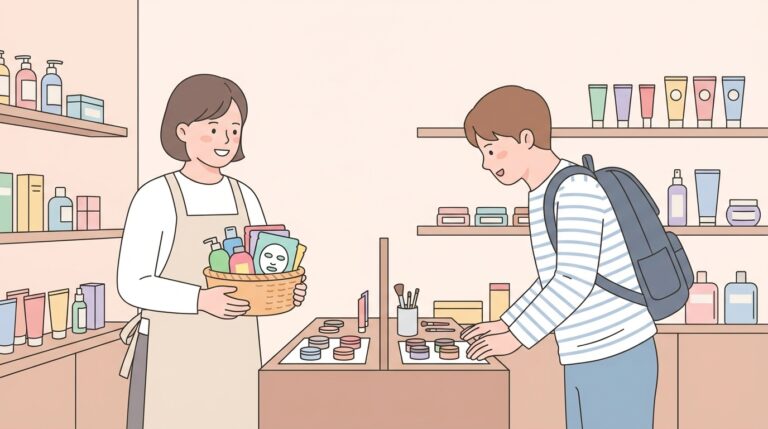
Picture this: You are walking down the vibrant streets of Myeongdong or Hongdae. Neon signs are flashing, K-Pop is blasting from every corner, and suddenly, a friendly staff member steps right into your path, handing you a free sheet mask with a bright smile. “Hello! Please come in!”
You walk into the store, mesmerized by the endless rows of colorful serums and lip tints. But then, the staff member starts following you, rapidly explaining product benefits in Korean. You just want to browse peacefully, but how do you say that without sounding rude? Or what if you actually want to try that beautiful lip tint, but you aren’t sure if you’re allowed to open it?
If you’ve ever felt that slight panic in a Korean cosmetic ‘roadshop’ (street-level cosmetic stores like Olive Young, Innisfree, or Etude House), you are not alone! Today, we are going to learn the essential survival phrases to help you shop like a true Seoulite.
Let’s dive into the real Korean you need to confidently navigate the K-Beauty paradise!
Phase 2: Core Expressions Deep Dive
1. 그냥 구경만 할게요 (I’m just looking, thanks.)
- Pronunciation: geunyang gugyeongman halgeyo [geu-nyang goo-gyoung-man hal-ggeh-yo]
(Tip: The ‘으/eu’ in ‘geu’ sounds like the disgusted sound you make when you step in gum!) - Meaning: Literal: “I will only do sightseeing.” / Real nuance: “I’m just browsing, so you don’t need to help me right now.”
- K-Culture Moment: This is your magic shield. When a passionate staff member approaches you with a shopping basket and starts recommending the latest snail mucin cream, a polite smile and this phrase will make them give you space instantly.
- Editor’s Insight: The word ‘그냥 (geunyang)’ means ‘just’ or ‘without any special reason.’ Adding it softens the sentence so it doesn’t sound like a harsh rejection.
- Situation Spectrum:
- Casual (Friends): ✅ (Drop the ‘yo’: 그냥 구경만 할게)
- Semi-formal (Shop staff/Strangers): ✅
- Formal (Boss/Elders): ⚠️ (You rarely say this to a boss anyway!)
- 🤔 Think About It: Why do Korean shops have staff following you? In Korean service culture, ignoring a customer is considered rude. They hover to show they are attentive and ready to serve! How is retail customer service different in your home country?
2. 이거 테스터 있어요? (Is there a tester for this?)
- Pronunciation: igeo teseuteo isseoyo? [ee-guh tes-uh-tuh is-suh-yo?]
- Meaning: Literal & Real: “Do you have a tester for this?”
- K-Culture Moment: You see a K-Drama actress wearing a stunning lipstick, and you find the exact brand. But the display is full of sealed boxes. You need to swatch it on your hand first!
- Editor’s Insight: Koreans use the English word “tester” (테스터), so it’s super easy to remember! Never open a sealed box to check the color. Always look for the product marked “테스터” or ask this question.
- Situation Spectrum:
- Casual: ✅
- Semi-formal: ✅
- Formal: 🚫
- 🤔 Think About It: Korean cosmetics rely heavily on trying things out. Why do you think ‘swatching’ and physical testing remains so popular even in the era of online shopping?
3. 이거 새 걸로 주세요 (Please give me a new one of this.)
- Pronunciation: igeo sae geollo juseyo [ee-guh say gol-lo joo-say-yo]
- Meaning: Literal: “Please give this as a new thing.” / Real nuance: “I’d like to buy this. Can I get a brand new, unopened one?”
- K-Culture Moment: You’ve tested the moisturizer and you love it. But the shelf only has the tester left, or the boxes look a bit crumpled. You take the tester to the counter and say this to get a fresh one from their stock drawers.
- Editor’s Insight: ‘새 (sae)’ means new. It sounds exactly like the English word “say”.
- Situation Spectrum:
- Casual: ✅
- Semi-formal: ✅
- Formal: 🚫
Phase 3: Textbook vs. Real Korean
[Situation 1: Staff offering help]
* 📖 Textbook Korean: 무엇을 도와드릴까요? (How may I help you?)
* 🗣️ Real Korean: 찾으시는 거 있으세요? (chajeusineun geo isseuseyo? – Are you looking for anything?)
* 💡 Why the difference?: “How may I help you” sounds a bit robotic. Asking if you are searching for a specific item is much more natural and proactive in fast-paced retail.
[Situation 2: Getting extra freebies]
* 📖 Textbook Korean: 무료 견본품을 주실 수 있습니까? (Could you give me free sample products?)
* 🗣️ Real Korean: 샘플 많이 주세요~ (saempeul mani juseyo~ – Please give me lots of samples~)
* 💡 Why the difference?: In Korea, asking for ‘samples’ using the Konglish word is the absolute norm. Adding the cute ‘~’ tone at the end helps build a friendly rapport with the cashier!
Bottom Note: For A2 learners, keeping your requests short and using a polite, bright tone of voice is much more effective than constructing perfectly grammatical, overly complex sentences.
Phase 4: Cultural Context — K-Culture Deep Dive
4-1. Non-verbal Elements: The Art of the ‘Polite Nod’
When you say “그냥 구경만 할게요” (I’m just looking), you don’t need to make intense eye contact. A soft smile, a slight nod of the head, and waving your hand gently in a “no thank you” motion is the perfect combination. Korean Nunchi (reading the room) tells the staff: “Ah, they are fine on their own,” and they will retreat with a polite smile.
4-2. The “Silent Shopping” Basket Trend
Here is a fascinating K-Culture travel tip! Some K-Beauty roadshops (like Innisfree or certain Olive Young branches) realized that many introverted shoppers, including tourists, felt overwhelmed by eager staff.
So, they introduced a brilliant system: Color-coded shopping baskets!
– 🟢 Green / Pink Basket: “I need help! Please recommend products to me.”
– ⚫ Black / Grey Basket: “I can do it myself. Please let me shop in peace.”
If you grab the dark basket, you won’t even need to use your Korean phrases to be left alone! This perfectly shows how Korean retail culture is adapting to modern comfort levels.
Phase 5: Interactive Roleplay Scenario
Setting: Saturday afternoon, 3 PM. You are inside a bustling Olive Young in Gangnam. K-Pop music is playing loudly. You are looking at a display of acne patches.
Characters:
– YOU: A K-Beauty enthusiast visiting Seoul, looking for the best skincare.
– Jia (25): An energetic, smiling Olive Young staff member wearing an apron.
Dialogue:
Jia: (Approaching with a basket) 어서 오세요! 찾으시는 거 있으세요? 🌿
(eoseo oseyo! chajeusineun geo isseuseyo?)
[Welcome! Are you looking for anything?]
YOU: 아, 아니요. 그냥 구경만 할게요.
(a, aniyo. geunyang gugyeongman halgeyo.)
[Ah, no. I’m just looking.]
Jia: 네, 편하게 구경하세요~ (She steps back, but stays nearby)
(ne, pyeonhage gugyeonghaseyo~)
[Yes, please browse comfortably~]
(🎭 Stage Direction: 5 minutes later, you find a popular serum you saw on TikTok, but you want to smell it first.)
YOU: 저기요, 이거 테스터 있어요?
(jeogiyo, igeo teseuteo isseoyo?)
[Excuse me, is there a tester for this?]
Jia: 네! 이쪽에 있어요. 한 번 발라보세요. 요즘 제일 잘 나가는 거예요!
(ne! ijjoge isseoyo. han beon ballaboseyo. yojeum jeil jal naganeun geoyeyo!)
[Yes! It’s right here. Try applying it. It’s our best seller these days!]
🔀 Your Turn! How will you respond to Jia?
– A) 이거 새 걸로 주세요! (igeo sae geollo juseyo! – Please give me a new one of this!)
– B) 싫어요. (sireoyo. – I hate it. / No.)
– C) 이거 얼마예요? (igeo eolmayeyo? – How much is this?)✅ Best Choice: A or C — If you love it, A is perfect! If you want to check your budget first, C is a great survival phrase.
⚠️ Choice B Analysis: “싫어요” is too direct and blunt. If you don’t like it, it’s better to just say “감사합니다” (Thank you) and put it back down.
Phase 6: 10-Second Shadowing Drill
Practice these lines with feeling! Read aloud and follow the rhythm.
- ✋ (Politely but firmly)
아, 괜찮아요. / 그냥 / 구경만 할게요.
(a, gwaenchannayo. / geunyang / gugyeongman halgeyo.) -
🥺 (Curiously, pointing at a product)
저기요, / 이거 / 테스터 있어요?
(jeogiyo, / igeo / teseuteo isseoyo?) -
😊 (Brightly, handing the product to the cashier)
이거 / 새 걸로 / 주세요!
(igeo / sae geollo / juseyo!)
Phase 7: K-Culture Mini Dictionary
1. 로드샵
* Romanization: rodeusyap
* English: Roadshop
* Context: Affordable, street-level cosmetic brand stores (like Etude, Innisfree, Nature Republic). A staple of Korean shopping districts.
2. 덤 / 서비스
* Romanization: deom / seobiseu
* English: Extra / Freebie (Service)
* Context: The beautiful Korean culture of giving you free samples or extra items when you make a purchase. If a staff says “이건 서비스예요” (This is service), it means it’s free!
3. 득템
* Romanization: deuktem
* English: Scoring a great item / A great find
* Context: A slang term combining ‘득’ (deuk – to get) and ‘템’ (tem – item). You use this when you buy an amazing K-beauty product on a big sale.
4. 쌩얼
* Romanization: ssaengeol
* English: Bare face (no makeup)
* Context: Slang for a face without any makeup. Many K-beauty skincare products advertise that they will make your “쌩얼” look beautiful.
Phase 8: Traveler Survival Kit
Shopping in Korea is fun, but these phrases will save your life (and your wallet) at the checkout counter!
🆘 Survival Phrases for K-Beauty Shopping
– 🇰🇷 “이거 얼마예요?” (igeo eolmayeyo?) – How much is this?
– 🇰🇷 “택스 프리 돼요?” (taekseu peuri dwaeyo?) – Can I get Tax Free?
– 🇰🇷 “봉투 필요 없어요.” (bongtu piryo eopseoyo.) – I don’t need a bag.
📌 Editor’s Travel Note:
– Tax-Free: Most large K-beauty shops offer “Immediate Tax Refund” at the counter! Always bring your physical passport.
– Bags cost money: In Korea, environmental laws require stores to charge for plastic or paper shopping bags (usually 50 to 100 won). They will always ask you if you need one at the register.
Phase 9: Critical Thinking — “One Step Deeper”
Global Era: Konglish in K-Beauty
Have you ever noticed that Korean cosmetic bottles are covered in English, but the words don’t mean what you think they mean? In Korea, a hydrating liquid you pat onto your face after washing is called “Skin” (스킨), not toner. And a light moisturizer is called “Lotion” (로션), while heavier creams are just “Cream”.
As Korean beauty goes global, this unique “Konglish” (Korean-English) has become a staple of K-Beauty identity. It shows how the Korean language absorbs foreign words but completely adapts them to fit local needs.
💬 Your Turn: Are there any English words used in your country that have completely changed their original meaning? Share them in the comments!
Phase 10: FAQ & Avoiding Common Mistakes
Q: Can I use “주세요 (Please give me)” to the shop staff? Isn’t it too demanding?
Yes, you can! In English, “Give me this” sounds rude, but in Korean, “이거 주세요 (igeo juseyo)” is the most standard, polite way to ask for an item or make a purchase at a store.
Q: How do I get their attention if I need help?
Don’t whistle or snap your fingers! Just make eye contact and say “저기요~” (jeogiyo – Excuse me) in a bright tone.
❌ Common Mistake #1: Opening a sealed product to test the color.
✅ Do this instead: Never open a sealed box! Always look for the sticker that says “테스터” (Tester). If you can’t find it, ask: “테스터 있어요?”
Phase 11: Summary & Action Items
One-Liner Summary: To browse peacefully, just say “그냥 구경만 할게요” (Just looking), and to test that trending lip tint, ask “테스터 있어요?”
🎯 Your Action Missions:
– 🥉 Bronze: Stand in front of your mirror and practice saying “그냥 구경만 할게요” with a polite, natural smile 3 times.
– 🥈 Silver: Look at a Korean cosmetic product you own (or find one online). Try to spot any Konglish words like “Skin”, “Lotion”, or “Sun cream”.
– 🥇 Gold: Next time you enter a Korean market or shop, use “그냥 구경만 할게요” when greeted by the staff!
🌟 K-Culture Mission:
Go onto Google Street View and drop yourself into ‘Myeongdong’. Look at all the cosmetic shop fronts. Imagine walking in and using today’s phrases!
Did you find today’s lesson helpful? What K-Beauty product are you dying to buy in Seoul? Let me know in the comments below! 👇
Phase 12: Quiz — Interactive Challenge
1. You walk into Olive Young and want to look around without staff assistance. What is the BEST thing to say?
A) 이거 얼마예요? (How much is this?)
B) 무엇을 도와드릴까요? (How may I help you?)
C) 그냥 구경만 할게요. (I’m just looking.)
2. Fill in the blank: You want to buy a product but only the tester is on the shelf. “이거 ___ 걸로 주세요.” (Please give me a new one.)
A) 새 (sae)
B) 헌 (heon – old)
C) 덤 (deom – freebie)
3. True or False: In a Korean roadshop, it is perfectly fine to open a sealed box to see what the bottle looks like inside, as long as you put it back.
(Answers: 1: C, 2: A, 3: False! Always look for the “테스터” or ask the staff!)
Frequently Asked Questions (FAQ)
Q: What does "그냥 구경만 할게요 (I'm just looking, thanks.)" mean in Korean and how do you pronounce it?
A: In Korean, "그냥 구경만 할게요 (I'm just looking, thanks.)" is pronounced [geunyang gugyeongman halgeyo [geu-nyang goo-gyoung-man hal-ggeh-yo] and means: Literal: "I will only do sightseeing." / Real nuance: "I'm just browsing, so you don't need to help me right now."
Q: What does "이거 테스터 있어요? (Is there a tester for this?)" mean in Korean and how do you pronounce it?
A: In Korean, "이거 테스터 있어요? (Is there a tester for this?)" is pronounced [igeo teseuteo isseoyo? [ee-guh tes-uh-tuh is-suh-yo?] and means: Literal & Real: "Do you have a tester for this?"
Q: What does "이거 새 걸로 주세요 (Please give me a new one of this.)" mean in Korean and how do you pronounce it?
A: In Korean, "이거 새 걸로 주세요 (Please give me a new one of this.)" is pronounced [igeo sae geollo juseyo [ee-guh say gol-lo joo-say-yo] and means: Literal: "Please give this as a new thing." / Real nuance: "I'd like to buy this. Can I get a brand new, unopened one?"






