

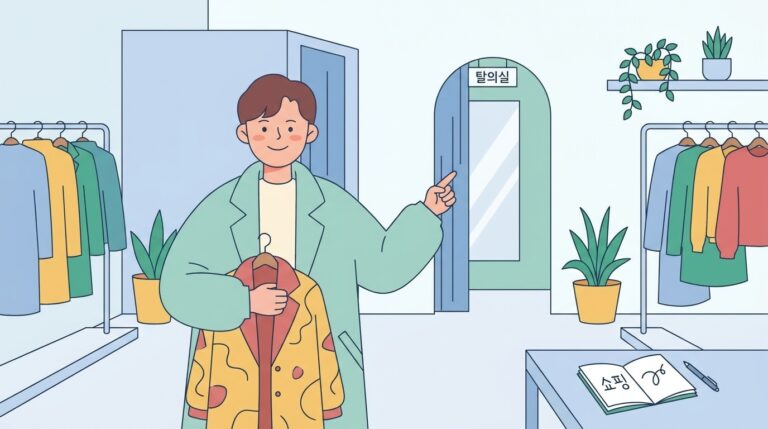
Hello there! I’m your Lead Editor from Daily Hangul.
Picture this: You are walking down the vibrant streets of Hongdae, or maybe exploring the endless maze of the Goto Mall (Express Bus Terminal Underground Shopping Center). Suddenly, you spot it. The jacket. It looks exactly like the one your favorite K-Drama lead wore in episode 8. Your heart beats faster. You want to buy it, but wait… will it fit?
You look at the shop owner. She looks at you. You want to ask, “Can I try this on?” but your mind goes blank. So, you just awkwardly hold the jacket against your chest, guess the size, and hope for the best.
Sound familiar? Don’t worry! This is a canon event for every traveler in Korea. Today, I’m going to teach you the magic phrases that will unlock the doors to Korean fitting rooms, and save you from the tragedy of buying clothes that don’t fit. Let’s dive in!
Phase 2: Core Expressions Deep Dive
Let’s master the 3 most essential phrases you need for a Korean shopping spree.
1. 입어봐도 되나요? (Can I try this on?)
- Pronunciation: i-beo-bwa-do doe-na-yo?
- i sounds like the ‘ee’ in ‘see’.
- beo sounds like ‘buh’.
- doe sounds like ‘dwe’.
- Meaning: Literal: “Is it okay even if I try wearing it?” / Real nuance: “Can I try this on?”
- K-Culture Moment: You are holding a cute top in Dongdaemun Night Market. You make eye contact with the vendor and softly say this phrase. They smile and point to a tiny curtained corner—the fitting room!
- Editor’s Insight: The ending “~되나요? (doe-na-yo?)” is your ultimate polite permission-asking tool. It sounds soft, polite, and very natural.
- Situation Spectrum:
- Friends (Casual): 🚫 (Too formal for friends)
- Shop Staff (Semi-formal/Polite): ✅ (Perfect!)
- Department Store/High-end (Formal): ✅ (Also perfectly fine!)
- 🤔 Think About It: Why do Koreans always ask for permission even when there is an empty fitting room right next to them? Could it be tied to the Korean culture of respecting the host’s (or owner’s) space?
2. 다른 사이즈 있나요? (Do you have another size?)
- Pronunciation: da-reun sa-i-jeu in-na-yo?
- Meaning: Literal & Real: “Do you have another size?”
- K-Culture Moment: You try on a “Free Size” (프리사이즈) shirt, but it feels a bit too tight. You peek out of the fitting room curtain and ask this.
- Editor’s Insight: Notice how “size” is just “sa-i-jeu”! Koreans use a lot of Konglish (Korean-English) in shopping. “있나요? (in-na-yo?)” just means “Do you have…?”
- Situation Spectrum:
- Friends (Casual): 🚫
- Shop Staff (Semi-formal/Polite): ✅
3. 조금 커요 / 작아요 (It’s a bit big / small)
- Pronunciation: jo-geum keo-yo / ja-ga-yo
- Meaning: “It’s a little big / small.”
- K-Culture Moment: The shop owner asks, “어때요? (How is it?)” as you step out of the fitting room. You want to politely explain why you aren’t buying it.
- Editor’s Insight: In Korea, saying “I don’t like the design” can feel a bit too direct. Blaming the size (“It’s a bit small”) is a polite, face-saving way to reject an item.
- Situation Spectrum:
- Friends (Casual): ⚠️ (Drop the ‘yo’ for friends: 조금 커/작아)
- Shop Staff (Semi-formal/Polite): ✅
Phase 3: Textbook vs. Real Korean
Let’s see how real people actually talk on the streets of Seoul.
[Asking to try clothes on]
* 📖 Textbook Korean: 이것을 입어 보아도 됩니까? (i-geo-seul i-beo bo-a-do doem-ni-kka?) – Very stiff and military-like.
* 🗣️ Real Korean: 이거 입어봐도 돼요? (i-geo i-beo-bwa-do dwae-yo?) or simply “피팅룸 어디예요?” (pi-ting-rum eo-di-ye-yo? – Where is the fitting room?)
* 💡 Why the difference?: Koreans prioritize efficiency and approachability in daily speech. The “~요(~yo)” ending is much softer and friendlier than the formal “~습니까(~seumnikka)”.
[When you don’t want to buy it]
* 📖 Textbook Korean: 마음에 들지 않습니다. (ma-eu-me deul-ji an-seum-ni-da. – It doesn’t enter my heart / I don’t like it.)
* 🗣️ Real Korean: 아, 좀 더 둘러보고 올게요~ (ah, jom deo dul-leo-bo-go ol-ge-yo~ – Ah, I’ll look around a bit more and come back.)
* 💡 Why the difference?: Korean culture highly values Kibun (기분, feelings/mood). Giving a “soft no” by pretending you might come back later protects the shop owner’s feelings.
Bottom Note: For A1 beginners, sticking to “입어봐도 돼요? (Can I try this on?)” is your safest and most natural bet!
Phase 4: Cultural Context — K-Culture Deep Dive
4-1. The Unspoken Rules of the Fitting Room
When handing clothes back to the staff, always use two hands or a slight head bow. It’s a non-verbal sign of respect. Also, be prepared to take off your shoes! Many Korean fitting rooms have a slightly raised floor, meaning it’s a “shoe-free” zone, just like a Korean home.
4-2. The “Face Cover” Culture (페이스 커버)
If you are shopping for clothes in Korea (especially white tops, sweaters, or dresses), you will inevitably encounter the Face Cover (페이스 커버).
Before you step into the fitting room, the staff will hand you a white, tissue-like hood. No, it’s not a ghost costume! Because K-Beauty makeup (especially foundation and lip tint) is so popular and transfers easily, shoppers are required to put this cover over their heads before pulling a shirt over.
- Critical View: This shows how much Korean shops value keeping their merchandise pristine. If you stain a white shirt with makeup in an underground mall, you might be forced to buy it!
Phase 5: Interactive Roleplay Scenario
Setting: Saturday afternoon, Hongdae. A trendy, aesthetic clothing boutique with K-Pop playing softly in the background. You found a gorgeous white knit sweater.
Characters:
– YOU: A traveler excited to update your wardrobe with K-fashion.
– Jihye (20s): The stylish boutique staff.
Dialogue:
YOU: 저기요~ 이거 입어봐도 되나요? 🧥
(jeo-gi-yo~ i-geo i-beo-bwa-do doe-na-yo?)
[Excuse me~ Can I try this on?]
Jihye: 네, 가능하세요! 피팅룸은 이쪽입니다.
(ne, ga-neung-ha-se-yo! pi-ting-ru-meun i-jjog-im-ni-da.)
[Yes, you can! The fitting room is this way.]
(🎭 Stage Direction: Jihye smiles, leads you to the room, and hands you a weird, square piece of thin fabric.)
Jihye: 하얀 옷이라서, 페이스 커버 꼭 써주세요~!
(ha-yan o-si-ra-seo, pe-i-seu keo-beo kkok sseo-ju-se-yo~!)
[Because it’s white clothes, please make sure to wear the face cover~!]
🔀 Your Turn! How do you react?
– A) Look confused and use it to wipe your face.
– B) Say “Ah, ne!” (Ah, yes!), go inside, put it over your head like a beekeeper, and then put the sweater on.
– C) Say “아니요, 괜찮아요” (No, it’s okay) and hand it back.✅ Best Choice: B — You nailed it! Wearing the face cover is mandatory for white tops in Korea.
⚠️ Choice C Analysis: If you refuse the face cover, the staff will panic and likely stop you from trying on the sweater to protect it from makeup stains.
YOU: (After trying it on, stepping out) 사이즈가 조금 작아요. 다른 사이즈 있나요?
(sa-i-jeu-ga jo-geum ja-ga-yo. da-reun sa-i-jeu in-na-yo?)
[The size is a bit small. Do you have another size?]
Jihye: 아, 손님, 그거 프리사이즈예요. 하나밖에 없어요 ㅠㅠ
(ah, son-nim, geu-geo peu-ri-sa-i-jeu-ye-yo. ha-na-bak-kke eop-seo-yo ㅠㅠ)
[Ah, customer, that is Free Size. We only have one (size) ㅠㅠ]
YOU: 아… 그럼 좀 더 둘러보고 올게요. 감사합니다.
(ah… geu-reom jom deo dul-leo-bo-go ol-ge-yo. gam-sa-ham-ni-da.)
[Ah… then I will look around a bit more. Thank you.]
Phase 6: 10-Second Shadowing Drill
Let’s practice the flow and rhythm. Remember to pause at the slashes (/)!
😊 저기요~ / 이거 / 입어봐도 / 되나요?
(jeo-gi-yo~ / i-geo / i-beo-bwa-do / doe-na-yo?)
Editor’s tip: Raise your pitch slightly at the end of “되나요?” to sound extra friendly and inquisitive!
Phase 7: K-Culture Mini-Dictionary
1. 프리사이즈 (Free Size)
* Romanization: peu-ri sa-i-jeu
* English: One-size-fits-all
* Context: Very common in Korean boutiques. However, “Free Size” in Korea usually fits a standard Korean S to M. Don’t feel discouraged if it doesn’t fit; it’s the clothes, not you!
2. 페이스 커버 (Face Cover)
* Romanization: pe-i-seu keo-beo
* English: Makeup protector hood
* Context: The thin mesh hood you wear before trying on tops to prevent makeup transfer.
3. 피팅룸 (Fitting Room)
* Romanization: pi-ting-rum
* English: Fitting room
* Context: Koreans use the English word! You can just ask “피팅룸?” with a questioning tone, and people will understand.
4. 아이쇼핑 (Eye Shopping)
* Romanization: a-i-syo-ping
* English: Window shopping
* Context: A classic Konglish word. When you are just browsing, you are doing “Eye Shopping.”
Phase 8: Traveler’s Survival Kit
Shopping in places like Myeongdong, Hongdae, or Dongdaemun? Save this card!
🆘 Survival Phrases for Korean Shopping
– 🇰🇷 “이거 얼마예요?” (i-geo eol-ma-ye-yo?)
– 🗣️ English: How much is this?
– 📍 Use it: Everywhere! Especially in markets without price tags.
- 🇰🇷 “조금 깎아주세요~” (jo-geum kka-kka-ju-se-yo~)
- 🗣️ English: Please give me a discount~
- 📍 Use it: ONLY in traditional markets or underground malls (if you pay in cash). Do NOT use this in Zara or department stores!
📌 Editor’s Travel Note
– Cash vs. Card: Korea is a cashless society. You can use credit cards for a $1 bottle of water! However, in underground shopping malls like Goto Mall, paying in cash (현금, hyeon-geum) or via bank transfer can sometimes get you a 10% discount.
– Returns/Refunds: In large stores, refunds are easy. But in small independent boutiques or underground malls, signs often say “No Refunds / No Exchanges” (교환/환불 불가), especially for white clothes or knitwear. Always ask before buying!
Phase 9: Critical Thinking — “One Step Deeper”
🧠 Think Deeper: Media vs Reality (Body Image & “Free Size”)
In K-Dramas, we often see a glamorous shopping montage where the chaebol (heir) says, “I’ll buy everything from here to here.” But the real shopping culture in Korea is heavily influenced by the “Free Size” (프리사이즈) concept. Unlike Western brands that offer extensive size ranges, many Korean street boutiques produce a single “one-size-fits-all” to keep manufacturing costs low and trends moving fast. This reflects Korea’s highly trend-driven, fast-paced fashion industry (Fast Fashion). However, it can also highlight the strict societal beauty standards in Korea, where standardizing a single, relatively small size is the norm.💬 Your Turn: Does your country have a “One-size-fits-all” culture? How does the sizing differ from Korea? Share your thoughts in the comments!
Phase 10: FAQ & Avoiding Common Mistakes
Q: Can I use “입어봐도 되나요?” to elders or shop owners much older than me?
Yes! The “~요” ending makes it polite enough to use with anyone working in a store, regardless of their age.
Q: Why did the shop owner say “NO” when I pointed at a white t-shirt?
Many small boutiques strictly prohibit trying on white shirts or tight knitwear because they stretch easily or get stained by makeup/sweat. If they cross their arms into an ‘X’, don’t take it personally!
❌ Common Mistake #1: Saying “안 사요!” (I won’t buy it!)
✅ Do this instead: When you decide not to buy something after trying it on, saying “안 사요” sounds very aggressive. Always use the gentle exit strategy: “좀 더 보고 올게요~” (I’ll look around a bit more). They know you aren’t coming back, and you know you aren’t coming back. It’s a peaceful agreement!
Phase 11: Summary & Action Items
One-Liner Summary: To avoid buying the wrong size, always smile and ask, “이거 입어봐도 되나요?” (Can I try this on?)
Action Mission 3 Steps:
– 🥉 Bronze (Solo): Stand in front of your mirror, hold up your favorite jacket, and confidently ask your reflection: “입어봐도 되나요?”
– 🥈 Silver (Online): Go to an online K-fashion store (like Musinsa or Chuu) and try to spot the word “프리” (Free size) in the item descriptions.
– 🥇 Gold (Real Life): On your next trip to Korea, visit a boutique in Hongdae, use this phrase to try something on, and don’t forget the face cover!
K-Culture Mission:
Next time you watch a K-Drama and see a shopping scene, listen closely. Can you hear the characters using the word “사이즈” (Size) or “입어봐” (Try it on)?
Did you ever have a funny fitting room experience while traveling? Tell me in the comments below! 👇
Phase 12: Interactive Challenge Quiz
Q1. You are in a small boutique and want to try on a beautiful white blouse. What is the FIRST thing you should do?
1. Take it and run into the fitting room.
2. Ask “입어봐도 되나요?” and wait for the Face Cover.
3. Put it on over your current clothes in the middle of the store.
Answer: 2! Always ask first, especially for white clothes, and use the face cover! (If you chose 1, you might be chased by the shop owner 🏃♀️)
Q2. True or False: If you don’t like an item, the most polite way to say no is “마음에 안 들어요” (I don’t like it).
Answer: False! The Korean “soft no” is “좀 더 둘러보고 올게요” (I’ll look around a bit more). Protect their kibun (feelings)!
Q3. Fill in the blank:
The shirt is too tight! You should ask: “다른 _____ 있나요?” (Do you have another _____?)
Answer: 사이즈 (sa-i-jeu)
Frequently Asked Questions (FAQ)
Q: What does "입어봐도 되나요? (Can I try this on?)" mean in Korean and how do you pronounce it?
A: In Korean, "입어봐도 되나요? (Can I try this on?)" is pronounced [i-beo-bwa-do doe-na-yo?] and means: a key conversational Korean expression covered in this lesson.
Q: What does "다른 사이즈 있나요? (Do you have another size?)" mean in Korean and how do you pronounce it?
A: In Korean, "다른 사이즈 있나요? (Do you have another size?)" is pronounced [da-reun sa-i-jeu in-na-yo?] and means: Literal & Real: "Do you have another size?"
Q: What does "조금 커요 / 작아요 (It's a bit big / small)" mean in Korean and how do you pronounce it?
A: In Korean, "조금 커요 / 작아요 (It's a bit big / small)" is pronounced [jo-geum keo-yo / ja-ga-yo] and means: "It's a little big / small."







