

Phase 1: Empathy & K-Culture Cold Open
Hello there! Daily Hangul Editor here.
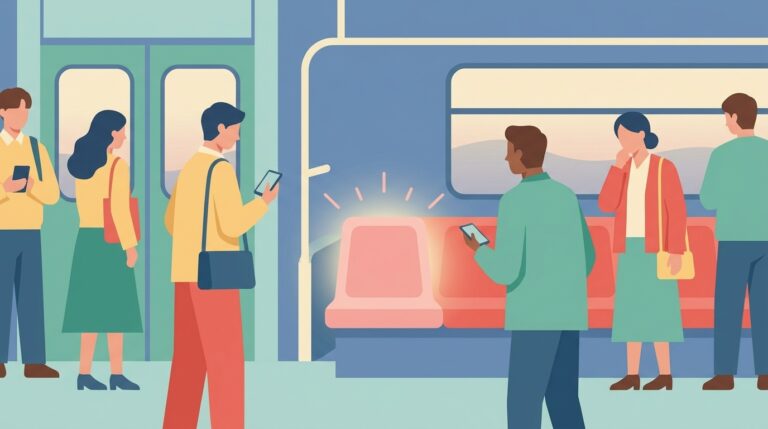
Imagine this: You are watching a popular K-Drama, and the protagonist is riding the Seoul subway after a grueling day at work. They look completely exhausted. The train is packed—what Koreans call ‘지옥철’ (jiokcheol, hell train). Suddenly, a seat opens up! It’s a bright pink seat at the end of the row. But wait… the protagonist just stares at it, sighs, and remains standing. Even more bizarre, no one else is taking the seat either.
If you have ever traveled to Korea or plan to, you will undoubtedly face this exact scenario. You are exhausted from shopping in Myeongdong, your feet are aching, and right there is a glowing pink seat. Why is everyone avoiding it like it’s enchanted?
Welcome to the unspoken rule of the 임산부 배려석 (Pregnant Women’s Priority Seat). Knowing how to navigate this isn’t just about reading a sign; it’s about mastering Korean ‘눈치 (nunchi)’—the fine art of reading the room. If you don’t know the etiquette, you might find yourself on the receiving end of some very intense glares from local ajummas! This guide is based on real moments of panic experienced by my students in Seoul. Let’s make sure you become an insider on Korean public transport!
Phase 2: Core Expressions Deep Dive
1. 임산부 배려석
- Pronunciation: [imsanbu baeryeoseok]
- Sound guide: ‘im’ as in him, ‘san’ as in sun, ‘bu’ as in boo, ‘bae’ as in bet, ‘ryeo’ (roll the R lightly + ‘yo’ but with an ‘uh’ sound), ‘seok’ as in suck.
- Meaning: Pregnant women’s priority seat.
- K-Culture Moment: You’ll see a pink sticker on the floor and a pink cover on the seat. In a K-Drama, a righteous character might tap a sleeping student on the shoulder and point to this sign to make them yield to a pregnant woman.
- Editor’s Insight: ‘배려’ (baeryeo) translates to consideration or care. It’s a beautiful word in Korean culture. This seat isn’t just ‘reserved’; it’s a designated space of ‘consideration’ for others.
- Situation Spectrum:
- Reading signs/Public announcements: ✅
- Everyday conversational use: ⚠️ (A bit formal, usually shortened in speech)
- 🤔 Think About It: Why use the word ‘배려 (consideration)’ instead of ‘전용 (exclusive use)’? What does this tell you about how Korean society views civic duty?
2. 비워두는 자리예요
- Pronunciation: [biwoduneun jariyeyo]
- Sound guide: ‘bi’ as in bee, ‘wo’ as in woe, ‘du’ as in do, ‘neun’ (make a disgusted sound ‘eu’ + n), ‘ja’ as in jar, ‘ri’ (light R + ee), ‘ye’ as in yeah, ‘yo’ as in yo.
- Meaning: Literal: ‘It is a seat to leave empty.’ / Real nuance: ‘We keep this seat open (just in case).’
- K-Culture Moment: You are about to sit on a pink seat, and your Korean friend pulls your sleeve and whispers this to you.
- Editor’s Insight: The verb ‘비워두다’ (to leave empty) is crucial here. In Korea, the general consensus is that even if the train is packed, the pink seat should remain empty so that a pregnant woman doesn’t have to awkwardly ask for it.
- Situation Spectrum:
- Casual with friends: ✅
- Explaining to a confused tourist: ✅
- Talking to an elder: ⚠️ (Use ‘비워두는 자리입니다’ instead)
- 🤔 Think About It: In many Western countries, priority seats are used until someone needs them. In Korea, keeping it empty is preferred. How does this connect to the Korean desire to avoid ‘burdening’ others?
3. 여기 앉으세요
- Pronunciation: [yeogi anjeuseyo]
- Sound guide: ‘yeo’ as in yup, ‘gi’ as in gee, ‘an’ as in an, ‘jeu’ (j + disgusted ‘eu’), ‘se’ as in say, ‘yo’ as in yo.
- Meaning: Please sit here.
- K-Culture Moment: You are sitting in a normal seat, and an elderly person or pregnant woman boards. You stand up, gesture to your seat, and say this. It’s an instant ‘Good Citizen’ badge.
- Editor’s Insight: This is the ultimate polite gesture. It’s short, respectful, and effective. The key is to say it while already standing up—actions speak louder than words in Korea!
- Situation Spectrum:
- To elders/strangers: ✅
- To friends: 🚫 (Too formal. Say ‘여기 앉아’ instead)
Phase 3: Textbook vs. Real Korean
[Explaining the Pink Seat]
* 📖 Textbook Korean: 이 자리는 임산부 배려석입니다. (This seat is the pregnant women’s priority seat.)
* 🗣️ Real Korean: 여기 임산부석이에요. (This is a pregnant seat.)
* 💡 Why the difference?: Koreans love efficiency! ‘임산부 배려석’ is a mouthful, so in everyday speech, the ‘배려 (consideration)’ part is often dropped to form ‘임산부석’ (Pregnant seat).
[Yielding Your Seat]
* 📖 Textbook Korean: 제 자리에 앉으시겠습니까? (Would you like to sit in my seat?)
* 🗣️ Real Korean: 여기 앉으세요. (Please sit here.)
* 💡 Why the difference?: Asking ‘would you like to sit?’ can make the other person feel pressured to politely decline. Simply offering the seat directly is considered more caring.
Bottom Note: For B1 learners, using ‘여기 앉으세요’ with a polite nod is the perfect balance of respect and natural fluency.
Phase 4: Cultural Context — K-Culture Deep Dive
4-1. Non-Verbal Communication
When yielding a seat in Korea, eye contact should be brief. Do not stare expectantly for a ‘thank you’. The most polite way is to stand up, say “여기 앉으세요” (Please sit here), and then gently step away or turn your back. This relieves the person of the ‘눈치’ (pressure) of feeling like they owe you immense gratitude.
4-2. K-Travel & Commuter Survival
The subway is the lifeblood of K-Travel. You will use it to go everywhere from Hongdae to Gangnam. During rush hour, the pink seat is a fascinating sociological experiment. You will see a wall of exhausted office workers crammed together, carefully preserving a small pocket of space around the glowing pink seat.
If you accidentally sit there without knowing, you might hear a loud ‘쯧쯧’ (tsk-tsk) from older passengers. It’s a quick way to learn!
Bonus K-Travel Phrases for the Subway:
1. 이번 역은 어디예요? (ibeon yeogeun eodiyeyo?) – What station is this?
2. 잠시만요, 내릴게요! (jamsimanyo, naerilgeyo!) – Excuse me, I’m getting off! (Yell this when the train is packed!)
Phase 5: Real-Life Roleplay Scenario
Setting: Friday at 6:30 PM. Seoul Subway Line 2 (The Green Line). You are heading to Gangnam for dinner. The train is absolutely packed. You are traveling with your Korean friend, Min-su (30, practical and always looking out for you).
Characters:
– YOU: A foreign traveler whose feet are killing you after 5 hours of walking around Bukchon Hanok Village.
– Min-su: Your local friend.
Dialogue:
Min-su: 와, 오늘 사람 진짜 많다.
(wa, oneul saram jinjja manta.)
[Wow, there are so many people today.]
YOU: 내 다리… 너무 아파요. 빈자리 없어요?
(nae dari… neomu apayo. binjari eopseoyo?)
[My legs… hurt so much. Are there no empty seats?]
Min-su: 강남역까지 한참 남았는데… 어? 저기 끝에 자리 하나 났어!
(gangnamyeokkkaji hancham namanneunde… eo? jeogi kkeute jari hana nasseo!)
[It’s a long way to Gangnam Station… Oh? A seat opened up at the end over there!]
(🎭 Stage Direction: You push through the crowd and see a bright pink seat. You sigh in relief and are about to sit down.)
Min-su: 야, 안 돼! 거기 앉으면 안 돼.
(ya, an dwae! geogi anjeumeyon an dwae.)
[Hey, no! You can’t sit there.]
YOU: 왜요? 아무도 안 앉잖아요.
(waeyo? amudo an anjjanayo.)
[Why? No one is sitting.]
Min-su: 저거 핑크색 자리잖아. 임산부 배려석이야.
(jeogeo pingkeusaek jarijana. imsanbu baeryeoseogiya.)
[That’s a pink seat. It’s the pregnant women’s priority seat.]
🔀 YOUR TURN! How do you respond?
– A) “아, 몰랐어요. 그럼 계속 서서 갈게요.” (Ah, I didn’t know. Then I’ll keep standing.)
– B) “임산부 없으니까 그냥 앉을게요!” (There are no pregnant women, so I’ll just sit!)
– C) “아하! 여기 비워두는 자리예요?” (Aha! Is this a seat to leave empty?)✅ Best Choice: C — This shows you quickly grasp the cultural concept and uses natural B1 grammar.
⚠️ Choice B Analysis: This is technically allowed by the law, but culturally it’s a huge faux pas. People will judge you silently (or loudly!). Choice A is safe but a bit passive.
YOU: 아하! 여기 비워두는 자리예요?
(aha! yeogi biwoduneun jariyeyo?)
[Aha! Is this a seat to leave empty?]
Min-su: 맞아. 초기 임산부들은 티가 안 나니까 아예 비워두는 게 매너야.
(maja. chogi imsanbudeureun tiga an nanikka aye biwoduneun ge maeneoya.)
[Right. Early-stage pregnant women don’t show, so leaving it completely empty is the etiquette.]
YOU: 알겠어요. 한국 문화를 배웠네요!
(algesseoyo. hanguk munhwareul baewonneyo!)
[I understand. I learned some Korean culture!]
Phase 6: 10-Second Shadowing Drill
Let’s practice the polite way to offer your normal seat to someone in need. Focus on the pauses!
😊 친절하게 (Kindly):
여기 / 앉으세요! / 저는 / 금방 / 내려요.
(yeogi / anjeuseyo! / jeoneun / geumbang / naeryeoyo.)
[Please sit here! I am getting off soon.]
Editor’s Tip: Adding ‘I am getting off soon’ makes the other person feel much less guilty about taking your seat!
Phase 7: K-Culture Mini Dictionary
1. 눈치
* Romanization: nunchi
* English: Social situational awareness / tact.
* Context: The ability to ‘read the air’. Not sitting in the pink seat when everyone else is standing requires good nunchi.
2. 임산부
* Romanization: imsanbu
* English: Pregnant woman.
* Context: You will see this word on subway seats, parking spots, and special badges issued by the government.
3. 지옥철
* Romanization: jiokcheol
* English: Hell train (jiok = hell, cheol = train/subway).
* Context: Used to describe the incredibly crowded Seoul subways during rush hour (usually Lines 2 and 9).
4. 양보
* Romanization: yangbo
* English: Yielding / Conceding.
* Context: ‘자리 양보’ (yielding a seat) is highly praised in Korean society as a sign of proper upbringing.
Phase 8: Traveler’s Survival Kit
Navigating Seoul’s massive public transport system is an adventure. Here are your lifesavers!
🆘 Survival Phrases for the Subway
– 🇰🇷 “이 역이 어디예요?” (i yeogi eodiyeyo?)
– 🗣️ Pronunciation: Ee yeog-ee uh-dee-yeah-yo?
– 📍 When to use: You missed the English announcement and need to know the current station.
– 💡 Pro Tip: Look for the station names on the platform pillars outside the window!📌 Editor’s Travel Note
– Useful Apps: KakaoMetro, Naver Map. (Google Maps doesn’t work well for walking/transit in Korea!).
– T-Money Card: Always tap your transportation card when you get OFF the bus/subway, or you will be charged a penalty fee on your next ride.
– Elevators: Elevators in subway stations are strictly reserved for the elderly, disabled, and people with strollers. If you use them just because you’re tired, you’ll get some fierce glares.
Phase 9: Critical Thinking Corner — “A Step Deeper”
🧠 Think Deeper: Society vs. Invisible Needs
Why does Korean society insist on leaving the pink seat completely empty, rather than just yielding it when a pregnant woman boards? This stems from the fact that early-stage pregnancy (초기 임신) is largely invisible. In a society where speaking up and causing an inconvenience (폐를 끼치다) is culturally frowned upon, a young pregnant woman might feel too intimidated to ask a seated person to move. By leaving the seat permanently empty, the community proactively removes the burden of asking. It reflects a shift in Korean society from ‘reactive politeness’ to ‘proactive consideration’ for invisible needs.
💬 Your Turn:
Does your country have priority seating on public transport? Do people sit there until asked, or do they leave it empty? Share your culture’s approach in the comments!
Phase 10: FAQ & Avoiding Mistakes
Q: “Can I sit in the elderly priority seats (노약자석) if the train is empty?”
No! The seats at the far ends of the train (노약자석) are strictly for the elderly, disabled, and pregnant. Even if the train is completely empty, young people do not sit there. Sitting there is a massive cultural taboo.
Q: “What if I am pregnant but I don’t look it yet?”
Korean clinics issue a pink “임산부 먼저” (Pregnant Women First) badge. You can attach it to your bag. When people see this badge, they will immediately clear the way.
❌ Common Mistake #1: Sitting in the pink seat and pretending to sleep.
✅ How to fix it: If you accidentally sat there, simply stand up as soon as you notice the pink sticker. No need to apologize loudly, just quietly vacate it.
Phase 11: Summary & Action Items
One-Liner Summary: On Korean subways, the pink seat (임산부 배려석) is best left empty (비워두다) as a sign of proactive consideration (배려) for those with invisible needs.
Action Mission 3 Steps:
– 🥉 Bronze (Solo): Say “여기 앉으세요” (Please sit here) out loud 3 times, practicing the friendly intonation.
– 🥈 Silver (Online): Find a Korean vlog about taking the subway and spot the pink seat in the background.
– 🥇 Gold (Real Life): Next time you are on public transport (anywhere in the world!), try offering your seat to someone using the Korean mindset of ‘proactive consideration’.
K-Culture Mission:
Search for a K-Drama subway scene on YouTube. Notice how the younger characters always stand in the middle aisle rather than taking the priority seats at the ends. It’s a subtle but universal Korean habit!
Phase 12: Quiz — Interactive Challenge
1. Fill in the Blank:
“You want to offer your seat to an elderly person. You stand up and say: ‘________ 앉으세요.'”
(A) 저기 (Over there)
(B) 여기 (Here)
(C) 빨리 (Quickly)
2. True or False — K-Culture Edition:
“It is completely acceptable for a healthy young student to sit in the pink ‘Pregnant Women’s Priority Seat’ as long as there are no pregnant women around.”
3. Situational Judgment:
You are sitting in a normal seat. An elderly woman boards the bus. What is the most polite action?
(A) Stay seated and ask her, “Do you want to sit?”
(B) Tap her shoulder and point to the floor.
(C) Stand up, gesture to your empty seat, and say “여기 앉으세요.”
(Answers: 1. B, 2. False, 3. C)
Frequently Asked Questions (FAQ)
Q: What does "임산부 배려석" mean in Korean and how do you pronounce it?
A: In Korean, "임산부 배려석" is pronounced [imsanbu baeryeoseok] and means: Pregnant women's priority seat.
Q: What does "비워두는 자리예요" mean in Korean and how do you pronounce it?
A: In Korean, "비워두는 자리예요" is pronounced [biwoduneun jariyeyo] and means: Literal: 'It is a seat to leave empty.' / Real nuance: 'We keep this seat open (just in case).'
Q: What does "여기 앉으세요" mean in Korean and how do you pronounce it?
A: In Korean, "여기 앉으세요" is pronounced [yeogi anjeuseyo] and means: Please sit here.







