

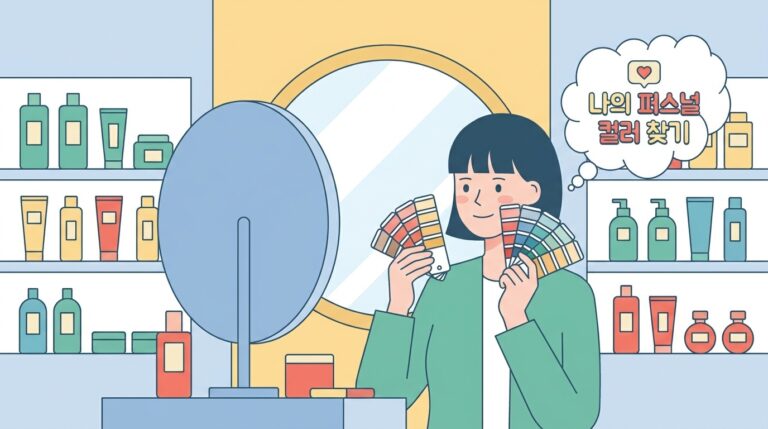
Phase 1: Welcome to the K-Beauty Matrix
Hello! I’m your Daily Hangul editor. Imagine this: You’re walking into Olive Young in Myeongdong, the mecca of K-Beauty. You want to buy a simple lip tint, but the display is full of cryptic labels. “여름 쿨톤 라이트 추천” (Recommended for Summer Cool Light)… “가을 웜 뮤트의 정석” (The standard for Autumn Warm Mute). The friendly clerk looks at you and says, “고객님은 쿨톤이셔서 이 색은 약간 톤그로일 수 있어요.” (Since you are a cool tone, this color might be a bit ton-geu-ro).
Wait, what on earth is a ton-geu-ro?
Welcome to Korea’s current biggest obsession: Personal Color (퍼스널 컬러). In Korea today, knowing your personal color isn’t just about makeup; it’s practically your second MBTI. If you don’t understand this vocabulary, navigating K-fashion, beauty salons, or even casual conversations with your Korean friends will feel like reading a secret code. But don’t worry! As your local culture navigator, I’m here to teach you the high-level, insider K-Beauty slang that will make Korean makeup artists and friends gasp and say, “Wow, you really know your stuff!”
Phase 2: Core Expressions Deep Dive
Let’s break down the ultimate C1-level expressions that rule the Korean fashion and beauty scene today.
1. 착붙템 (Holy Grail / Perfect Match Item)
- Pronunciation: chak-but-tem [Sounds like: “chuck-boot-tem”]
- Meaning: Literal = An item that sticks perfectly. / Real nuance = Your holy grail item, a color or product that suits you so perfectly it looks like it was custom-made for your skin.
- K-Culture Moment: You’ll see this word plastered all over K-Beauty YouTube thumbnails. When a K-Pop idol finds their perfect hair color and makeup styling, fans call it their chak-but styling.
- Editor’s Insight: Think of ‘착’ as the sound effect of a magnet snapping into place perfectly, and ‘붙’ meaning to stick. It’s the ultimate compliment for makeup or clothes. It feels intensely satisfying.
- Situation Spectrum:
- Friends (Casual): ✅
- Beauty Counter Clerk (Semi-formal): ✅ (Highly used in retail!)
- Formal Business Meeting: 🚫
- 🤔 Think About It: Why does Korean have so many words for things ‘fitting perfectly’ (like 찰떡, 안성맞춤, 착붙)? How does this reflect the Korean cultural appreciation for harmony and aesthetics?
2. 톤그로 (Tone-Clash / Makeup Disaster)
- Pronunciation: ton-geu-ro [Sounds like: “tone-guh-ro”]
- Meaning: Literal = Tone + Aggro. / Real nuance = Wearing a color that clashes horribly with your personal color, making your skin look dull, yellow, or unnaturally pale, thereby “drawing negative attention” (aggro).
- K-Culture Moment: Remember watching an old K-Drama from the early 2010s where the actress had a neon pink lip that completely washed her out? That is the definition of ton-geu-ro. Friends jokingly tease each other using this word when looking at old photos.
- Editor’s Insight: This word is delightfully savage but mostly used in a self-deprecating or playful way among friends.
- Situation Spectrum:
- Friends (Casual): ✅
- Coworkers (Semi-formal): ⚠️ (Only if you are close)
- Boss/Elders (Formal): 🚫
- 🤔 Think About It: “Aggro” comes from gaming culture (drawing the boss monster’s attention). How did a gaming term become essential beauty slang? It shows how deeply internet culture permeates everyday Korean life!
3. 얼굴에 형광등 켜지다 (Turning on a fluorescent light on your face)
- Pronunciation: eolgure hyeonggwangdeung kyeojida [Sounds like: “ul-gu-reh hyung-gwang-deung kyuh-ji-da”]
- Meaning: Literal = A fluorescent light is turned on your face. / Real nuance = A specific color makes your complexion look instantly brighter, clearer, and glowing.
- K-Culture Moment: During a personal color consultation, the consultant flips a fabric drape over your shoulders. Suddenly, your dark circles vanish and your skin glows. The consultant will definitely clap and say this phrase!
- Editor’s Insight: It’s a highly visual and poetic way to compliment someone. It doesn’t just mean “you look pretty”; it means “that specific color is doing magic for your skin tone.”
- Situation Spectrum:
- Friends (Casual): ✅
- Beauty Salons (Semi-formal): ✅
- Giving a compliment to a senior: ⚠️ (Use the polite form: “선배님, 얼굴에 형광등 켜진 것 같아요!”)
- 🤔 Think About It: Koreans prioritize clear, glowing skin (광채 피부) over almost any other beauty trait. Do beauty standards in your culture focus more on skin tone, facial features, or something else entirely?
Phase 3: Textbook vs. Real Korean
[Situation 1: Asking if a color suits you]
* 📖 Textbook Korean: 이 색깔이 저에게 잘 어울립니까? (Does this color suit me well?)
* 🗣️ Real Korean: 이거 완전 제 착붙이죠? (This is my perfect match, right?) / 이거 제 톤에 맞아요? (Does this fit my tone?)
* 💡 Why the difference?: Real Korean focuses on the highly specific “tone” rather than just general suitability, reflecting the hyper-categorized beauty trend.
[Situation 2: Realizing a makeup item looks terrible on you]
* 📖 Textbook Korean: 이 화장품은 제 피부색과 맞지 않습니다. (This cosmetic does not match my skin color.)
* 🗣️ Real Korean: 아, 이거 바르니까 완전 톤그로 끌었네. 얼굴이 둥둥 떠요. (Ah, putting this on is a total tone-clash. My face is floating.)
* 💡 Why the difference?: “얼굴이 둥둥 뜬다” (face is floating) perfectly describes the “ghost face” effect when foundation or powder is the wrong undertone.
Bottom Note: For C1 learners, mastering these nuanced descriptive phrases (floating face, turning on a light) is what elevates you from “good at Korean” to “sounds like a native speaker.”
Phase 4: Cultural Context — K-Culture Deep Dive
4-1. The Non-Verbal Nunchi of Personal Color
When Koreans discuss personal color or makeup, pay attention to the Nunchi (눈치). If you ask a store clerk, “Does this look good?” and they hesitate, tilt their head slightly, and say, “음… 그것보다는…” (Hmm… rather than that…), that’s your cue. They are too polite to say you look ton-geu-ro. The polite Nunchi move is to let them guide you to a different section!
4-2. The K-Pop Connection: Renewing the “Prime”
In the K-Pop fandom world, personal color is a serious topic of debate. When an idol changes their hair color from a warm bleached blonde to an ashy cool black, and suddenly they look breathtaking, fans will scream: “리즈 갱신했다!” (They’ve renewed their prime!).
Fans often analyze their bias’s personal color: “Jungkook is definitely a Winter Cool Deep, look at how he rocks that black leather!” If an agency gives an idol the wrong makeup, fans will protest, claiming the stylists are giving the artist ton-geu-ro. Understanding this vocabulary lets you read K-Pop Twitter like a true insider.
Phase 5: Real-Life Roleplay Scenario
Scenario A: The Gangnam Personal Color Studio
- Setting: A bright, minimalist Personal Color Studio in Sinsa-dong, Gangnam. Natural sunlight is pouring in. You are sitting in front of a large mirror wearing a white cape.
- Characters:
- YOU: An expat living in Seoul who finally booked a session after 2 months on the waiting list.
- Consultant Ji-ah (지아, 29): A chic, sharp-eyed professional wearing an impeccable navy blazer.
Ji-ah: 자, 이제 이 마젠타 핑크 천을 올려볼게요. (Ja, ije i majenta pingkeu cheoneul ollyeobolgeyo.)
Let’s place this magenta pink fabric on you now.
(🎭 Stage Direction: Ji-ah flips a shockingly bright pink cloth over your shoulders. Suddenly, your jawline looks wider and dark circles appear.)
Ji-ah: 어머… 입가에 그림자가 지고 다크서클이 부각되네요.
Oh my… shadows form around your mouth and your dark circles are accentuated.
🔀 Your Turn! How do you respond?
– A) “아, 예쁘지 않습니다.” (Very textbook, a bit stiff.)
– B) “헐, 완전 톤그로네요. 빨리 빼주세요! ㅠㅠ” (Heol, it’s a total tone-clash. Please take it off quickly!)
– C) “저한테는 무리인 것 같습니다.” (Sounds like a corporate email.)✅ Best Choice: B — Why? You are at a beauty salon! Using trendy words like “톤그로” shows you understand the culture. The consultant will definitely laugh and feel more comfortable with you.
Ji-ah: (Laughs) 네, 이건 피하시는 게 좋겠어요. 다음은 가을 웜톤의 머스타드 컬러입니다.
Yes, it’s best to avoid this one. Next is the Autumn Warm mustard color.
(🎭 Stage Direction: She flips a warm, muted yellow cloth. Instantly, your skin looks smooth and glowing.)
YOU: 와, 이거 보니까 얼굴에 형광등 켜진 것 같아요!
Wow, looking at this, it’s like a fluorescent light turned on my face!
Ji-ah: 맞아요! 완전 고객님 착붙템이네요! 고객님은 가을 웜 뮤트입니다!
Exactly! It’s your absolute holy grail! You are an Autumn Warm Mute!
Phase 6: 10-Second Shadowing Drill
Let’s practice your tone! Read this out loud. Pay attention to the pauses (/) and the emotion tags.
😲 와, / 이 립스틱 바르니까 / 얼굴에 형광등 켜진 것 같아요! (wa, / i ripseutik bareunikka / eolgure hyeonggwangdeung kyeojin geot gatayo!)
Wow, putting on this lipstick, it feels like a fluorescent light turned on my face!
😂 아까 그 색은 / 솔직히 / 완전 톤그로였어요. (akka geu saegeun / soljiki / wanjeon ton-geu-royeosseoyo.)
That color earlier, honestly, was a total tone-clash.
Phase 7: K-Culture Mini Dictionary
Here are the top K-Beauty buzzwords you need in your arsenal:
1. 웜톤 / 쿨톤
* Romanization: womton / kulton
* English: Warm Tone / Cool Tone
* Context: The foundation of Korean personal color. Warm tones are categorized into Spring (봄) and Autumn (가을). Cool tones are Summer (여름) and Winter (겨울).
2. 쿨병
* Romanization: kul-byeong
* English: “Cool-disease”
* Context: A funny slang for people who stubbornly insist they are “Cool Tone” (because they think it sounds chic, pure, or sophisticated) even when their skin is clearly Warm Tone.
3. 올영세일
* Romanization: ol-yeong-seil
* English: Olive Young Sale
* Context: The massive quarterly sale at Olive Young. When this happens, Koreans flock to the stores to stock up on their chak-but items.
4. 생얼
* Romanization: saeng-eol
* English: Bare face (no makeup)
* Context: When testing personal color, you must show up with a saeng-eol so the consultant can see your natural skin undertones accurately.
Phase 8: Traveler Survival Kit (Olive Young Edition)
If you are traveling to Korea, visiting an Olive Young or a K-Beauty flagship store is inevitable. Here is your survival kit:
🆘 Survival Expression #1: Asking for Recommendations
– 🇰🇷 “여름 쿨톤 립스틱 추천해 주실 수 있나요?” (yeoreum kulton ripseutik chucheonhae jusil su innayo?)
– 🗣️ English: Could you recommend a Summer Cool Tone lipstick?
– 📍 Where to use: Olive Young, Chicor, Sephora, Road shop brands.🆘 Survival Expression #2: Asking for a New Product
– 🇰🇷 “이거 새 상품으로 주세요.” (igeo sae sangpumeuro juseyo.)
– 🗣️ English: Please give me a new one (from the back).
– 📍 Where to use: Everywhere. Never take the tester to the register!📌 Editor’s Travel Note
– Testers: Koreans freely swatch testers on the back of their hands. However, it’s considered unhygienic to apply tester lipsticks directly to your lips! Use the provided tissue and cotton swabs.
– App to use: Download the HwaHae (화해) app. It’s Korea’s #1 beauty app that breaks down ingredients and categorizes reviews by skin type and personal color.
Phase 9: Critical Thinking Corner — “A Step Deeper”
🧠 Think Deeper: The Desire for Categorization in Modern Korea
Why is Korean society so obsessed with categories like MBTI, Blood Types (in the past), and Personal Color? In a hyper-competitive, fast-paced society (the Pali-Pali culture), efficiency is everything. Finding your personal color eliminates the “trial and error” of buying the wrong clothes or makeup. It is a highly efficient way to optimize your appearance. Furthermore, in a collective society, identifying as a “Spring Warm Light” or an “INFP” provides a profound sense of belonging to a specific “tribe.” It’s an intriguing blend of hyper-efficiency and the human desire for identity.
💬 Your Turn: Do you think categorizing beauty into “4 seasons” restricts creativity, or does it give you helpful guidelines? How does your culture view finding “the right colors”?
Phase 10: FAQ & Avoiding Misunderstandings
Q: Can I just guess someone’s personal color when I first meet them?
A: Actually, yes! Unlike asking someone’s age (which can be tricky), guessing someone’s personal color (e.g., “어머, 봄 웜톤이신가 봐요!” – Oh, you must be a Spring Warm tone!) is considered a fun icebreaker and a compliment in Korea!
Q: If I’m “Hot” (temperature-wise), am I a Warm Tone?
A: ❌ Common Mistake #1! Do not confuse physical temperature with color theory. A learner once said, “저는 더워서 웜톤이에요” (I’m hot, so I’m a warm tone). Koreans will find this adorable but very confusing! Always refer to the undertones of your skin (yellow base = warm, pink/blue base = cool).
❌ Common Mistake #2: Translating “You look sick” directly. If a color washes you out, in English we say “You look pale/sick.” In Korean, if you say “아파 보여요” (You look sick), they might genuinely worry about your health. Stick to “창백해 보여요” (You look pale) or simply “톤그로네요” (It’s a tone-clash).
Phase 11: Summary & Action Items
✨ One-Liner Summary: To survive the K-Beauty scene, avoid the Ton-geu-ro (makeup disasters) and find your Chak-but-tem (perfect match) that turns on a fluorescent light on your face!
🎬 Your Action Missions:
– 🥉 Bronze (Solo): Look in your makeup bag or closet. Identify your personal chak-but-tem and say the Korean word out loud.
– 🥈 Silver (Online): Go to a K-Pop idol’s music video on YouTube and leave a comment: “이번 스타일링 완전 착붙이네!” (This styling is a perfect match!)
– 🥇 Gold (Real Life): Next time you visit a Korean cosmetics store, ask the staff: “이거 웜톤한테 착붙일까요?” (Will this be a perfect match for a warm tone?)
Phase 12: Interactive Quiz — K-Beauty Master Challenge
1. Situational Judgment: Your Korean friend just dyed her hair bright orange, but it makes her skin look incredibly dull. She asks, “나 어때?” (How do I look?). What is the most natural, tactful C1-level response among close friends?
– A) “완전 얼굴에 형광등 켰네!”
– B) “너한테는 너무 톤그로다. 다시 염색해!”
– C) “음… 예전 흑발이 더 착붙이었던 것 같아.”
(Answer: C. It tactfully suggests her previous hair was a perfect match, softening the blow. B is correct vocabulary but a bit too harsh!)
2. Fill in the Blank:
“이 파운데이션은 제 피부에 안 맞아요. 바르면 얼굴이 둥둥 ( _____ ).”
(Answer: 떠요 – floats)
3. True or False – K-Culture Edition:
In Korea, “Cool Tone” means the colors are suited for people with a cool, unapproachable, and chic personality.
(Answer: False! It strictly refers to the skin’s blue/pink undertones, not personality, although the “Cool-disease” (쿨병) phenomenon shows some people wish it did!)
Frequently Asked Questions (FAQ)
Q: What does "착붙템 (Holy Grail / Perfect Match Item)" mean in Korean and how do you pronounce it?
A: In Korean, "착붙템 (Holy Grail / Perfect Match Item)" is pronounced [chak-but-tem [Sounds like: "chuck-boot-tem"] and means: Literal = An item that sticks perfectly. / Real nuance = Your holy grail item, a color or product that suits you so perfectly it looks like it was custom-made for your skin.
Q: What does "톤그로 (Tone-Clash / Makeup Disaster)" mean in Korean and how do you pronounce it?
A: In Korean, "톤그로 (Tone-Clash / Makeup Disaster)" is pronounced [ton-geu-ro [Sounds like: "tone-guh-ro"] and means: Literal = Tone + Aggro. / Real nuance = Wearing a color that clashes horribly with your personal color, making your skin look dull, yellow, or unnaturally pale, thereby "drawing negative attention" (aggro).
Q: What does "얼굴에 형광등 켜지다 (Turning on a fluorescent light on your face)" mean in Korean and how do you pronounce it?
A: In Korean, "얼굴에 형광등 켜지다 (Turning on a fluorescent light on your face)" is pronounced [eolgure hyeonggwangdeung kyeojida [Sounds like: "ul-gu-reh hyung-gwang-deung kyuh-ji-da"] and means: Literal = A fluorescent light is turned on your face. / Real nuance = A specific color makes your complexion look instantly brighter, clearer, and glowing.







