

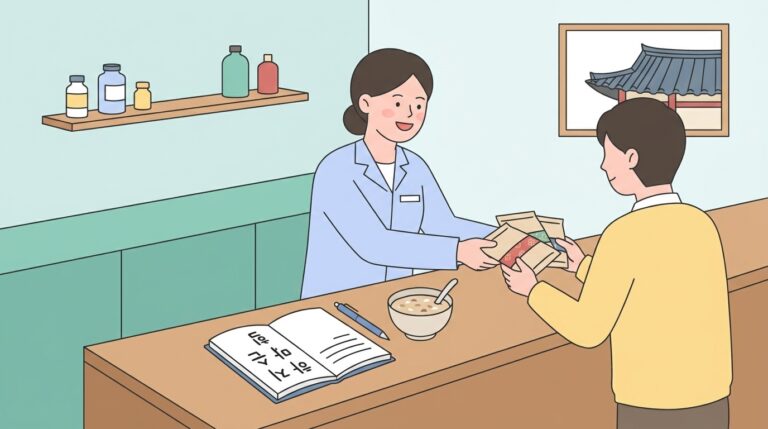
Phase 1: Empathy (Welcome to the K-Pharmacy)
Hello! I’m your Daily Hangul Editor.
Picture this: You’ve just watched your 50th K-Drama. You know the exact trope—the main character gets caught in a sudden downpour, immediately develops a dramatic fever, and the handsome lead rushes over with abalone porridge (전복죽) and medicine. It’s romantic, right?
But fast forward to reality: You are living in Seoul, you actually catch a cold, and you drag yourself to a local clinic, then to the pharmacy (약국). The pharmacist hands you a bag of medicine and fires off a rapid string of instructions: “식후 삼십분에 드시고요, 졸릴 수 있으니까…”
Wait, what? You just want to sleep, but you’re standing there nodding politely while catching maybe 10% of what was said. If you take it wrong, will your stomach hurt? Can you drink it with iced Americano?
Don’t worry. This guide is crafted from the exact panicky moments my expat students have shared with me. Today, we’re going to decode the hyper-fast, highly specific instructions you’ll hear at a Korean pharmacy, so you can heal up like a true local!
Phase 2: Core Expressions Deep Dive
Here are the top 3 phrases you will always hear at a Korean pharmacy.
1. 식후 30분에 드세요
- Pronunciation: sikhu samsipbune deuseyo [sheek-hoo sam-ship-boon-eh deu-seh-yo]
- Meaning: (Literal) Please consume it 30 minutes after a meal. / (Real Nuance) Take this medicine 30 minutes after you eat.
- K-Culture Moment: This is the golden rule of Korean medicine. In K-Dramas, someone is always nagging the sick person to “eat at least a spoonful of rice” before handing them their pills.
- Editor’s Insight: ‘식’ (sik) means meal, and ‘후’ (hu) means after. Notice how the pharmacist uses ‘드세요’ (deuseyo – the honorific form of ‘to eat’) instead of ‘먹어요’ (meogeoyo). In Korean, you “eat” medicine; you don’t “take” it.
- Situation Spectrum:
- Close Friends (Casual): 밥 먹고 먹어 ✅
- Colleagues (Semi-formal): 식후에 드세요 ⚠️
- Pharmacist to Patient (Formal): 식후 30분에 드세요 🚫 (Wait, pharmacists use this, YOU don’t say this to others unless you are the pharmacist!)
- 🤔 Think About It: Why is taking medicine so deeply connected to meal times in Korea? Does your culture tie medication strictly to breakfast, lunch, and dinner, or just to “every 8 hours”?
2. 하루 세 번, 꼬박꼬박 챙겨 드세요
- Pronunciation: haru se beon, kkobakkkobak chaenggyeo deuseyo [ha-roo seh bun, kko-bak-kko-bak chaeng-gyuh deu-seh-yo]
- Meaning: (Literal) Three times a day, regularly pack and consume it. / (Real Nuance) Take it three times a day, without skipping a single dose.
- K-Culture Moment: ‘꼬박꼬박’ (kkobakkkobak) is an adorable mimetic word representing doing something regularly without fail. It sounds like a caring mother packing your lunch.
- Editor’s Insight: The verb ‘챙기다’ (chaenggida) is uniquely Korean. It means to gather, to pack, or to take care of something/someone. Saying “약을 챙겨 먹다” implies taking your medicine responsibly and caring for your health, not just swallowing pills.
- Situation Spectrum:
- Close Friends (Casual): 꼬박꼬박 챙겨 먹어 ✅
- Colleagues (Semi-formal): 약 잘 챙겨 드세요 ✅
- Older People (Formal): 약 꼭 챙겨 드세요 ✅
- 🤔 Think About It: The word ‘챙기다’ is everywhere in Korea—챙겨 먹어 (make sure you eat), 짐 챙겨 (pack your bags), 사람을 챙기다 (take care of people). What does this word tell us about the Korean value of attentiveness?
3. 빈속에 드시면 속 쓰릴 수 있어요
- Pronunciation: binsoge deusimyeon sok sseuril su isseoyo [been-sohg-eh deu-shee-myun sohk sseu-reel soo ees-uh-yo]
- Meaning: (Literal) If you consume it on an empty inside, your inside might be bitter. / (Real Nuance) It can cause heartburn/stomach pain if taken on an empty stomach.
- K-Culture Moment: Korean food can be spicy, and Koreans are very sensitive to digestive health. ‘속이 쓰리다’ (sogi sseurida) is a ubiquitous phrase used for heartburn, a hangover, or even emotional pain!
- Editor’s Insight: ‘빈속’ (bin-sok) means empty stomach. ‘쓰리다’ (sseurida) sounds like a sharp, scraping pain. If you hear this, it’s a strict warning: do not take this pill with just your morning iced Americano!
- Situation Spectrum:
- Close Friends (Casual): 빈속에 먹으면 속 쓰려 ✅
- Pharmacist/Doctor (Formal): 빈속에 드시면 속 쓰릴 수 있습니다 ✅
- 🤔 Think About It: Koreans often use the word ‘속’ (inside/stomach) to describe feelings too (e.g., 속상하다 – to be upset). Why do you think emotions and the stomach are so closely linked in the Korean language?
Phase 3: Textbook vs. Real Korean
Let’s compare what your Korean textbook taught you with what you’ll actually hear at the pharmacy.
[Instruction: How to take the medicine]
* 📖 Textbook Korean: 이 약을 하루에 세 번 복용하십시오. (Please take this medicine three times a day.)
* 🗣️ Real Korean: 이거 하루 세 번 드시면 돼요. (You can just eat this three times a day.)
* 💡 Why the difference?: ‘복용하다’ (to ingest medication) is a Sino-Korean medical term. While printed on the prescription bag, spoken Korean heavily prefers ‘드시다’ (honorific of eat) to sound warmer and more approachable.
[Instruction: Dealing with side effects]
* 📖 Textbook Korean: 수면 유발 성분이 포함되어 있습니다. (A sleep-inducing ingredient is included.)
* 🗣️ Real Korean: 약 먹고 좀 졸릴 수 있어요. (You might get a bit sleepy after taking the medicine.)
* 💡 Why the difference?: Pharmacists deal with hundreds of patients a day. They translate complex medical jargon into easy, everyday feelings (‘졸리다’ = to be sleepy) for maximum efficiency.
[Instruction: Pain relievers]
* 📖 Textbook Korean: 통증이 발생할 시 복용하세요. (Take when pain occurs.)
* 🗣️ Real Korean: 아플 때만 하나씩 드세요. (Just take one whenever it hurts.)
* 💡 Why the difference?: ‘통증’ (pain) is clinical. ‘아프다’ (to hurt) is universally understood. Adding ‘-만’ (only) emphasizes not taking it unless absolutely necessary.
Phase 4: Cultural Context — K-Culture Deep Dive
4-1. Non-Verbal Cues (The Art of Nunchi at the Pharmacy)
When receiving your medicine, pay attention to the pharmacist’s hands. They will likely hand you your bag with two hands, or with their right hand supported by their left hand. This is a sign of respect. You should also receive the bag with both hands and give a slight bow of the head. Eye contact is good, but a gentle nod shows you are actively listening to the rapid instructions.
4-2. The Iconic ‘Yakbongtu’ (약봉투)
If you’ve seen a sick K-Drama character, you’ve seen the 약봉투 (medicine pouches). Unlike the West, where you get individual plastic bottles for each pill type, Korean pharmacists use a massive machine to pre-sort and seal your pills into individual, tear-away paper/plastic pouches.
One pouch = One dose. It contains the exact mix of painkillers, antibiotics, and vitamins you need for that specific time of day. The pharmacist’s instruction usually points to these pouches: “아침, 점심, 저녁” (Breakfast, Lunch, Dinner). It’s wildly convenient, but it strictly reinforces the “Take after meals” culture. You literally track your medication by your meal schedule!
Phase 5: Real-Life Roleplay Scenario
Setting: It’s 6 PM on a Tuesday in a busy pharmacy near Gangnam Station. You’ve just visited the ENT (Ear, Nose, Throat clinic – 이비인후과) because the seasonal fine dust gave you a nasty sore throat. The pharmacy smells faintly of herbal medicine and hand sanitizer.
Characters:
– YOU: An expat professional. You usually skip breakfast and just drink coffee.
– Pharmacist (약사님): A fast-talking, efficient professional in a white coat.
Dialogue:
약사님: 처방전 주시겠어요?
(cheobangjeon jusigesseoyo?)
[Translation] May I have your prescription?
(🎭 Stage Direction: The pharmacist extends their hand over the counter.)
YOU: 네, 여기 있습니다.
(ne, yeogi itseumnida.)
[Translation] Yes, here it is.
약사님: (Typing rapidly on the keyboard) 목이 많이 부으셨네요. 약은 3일 치예요.
(mogi mani bueusyeonneyo. yageun samil chiyeyo.)
[Translation] Your throat is quite swollen. Here is 3 days’ worth of medicine.
YOU: 네, 감사합니다. 어떻게 먹어야 하나요?
(ne, gamsahamnida. eotteoke meogeoya hanayo?)
[Translation] Yes, thank you. How should I take it?
약사님: 약은 하루 세 번, 식후 30분에 드시고요. 이 하얀 알약은 항생제니까 끝까지 다 드셔야 해요.
(yageun haru se beon, sikhu samsipbune deusigoyo. i hayan allyageun hangsaengjenikka kkeutkkaji da deusyeoya haeyo.)
[Translation] Take the medicine three times a day, 30 minutes after meals. This white pill is an antibiotic, so you must finish all of it.
🔀 Your Turn! How do you respond?
– A) “아, 저는 아침을 안 먹는데요…” (Ah, I don’t eat breakfast…)
– B) “네, 알겠습니다!” (Yes, understood!) – But you internally panic about breakfast.
– C) “아침에 커피랑 먹어도 돼요?” (Can I take it with coffee in the morning?)✅ Best Choice: A — Reason: It’s vital to communicate your eating habits. The pharmacist will give you an alternative solution.
⚠️ Choice C Analysis: Never suggest taking medicine with coffee in Korea! The pharmacist will likely gasp and give you a stern lecture about ‘속쓰림’ (heartburn).
(Assuming you chose A)
YOU: 아, 저는 아침을 안 먹는데요. 빈속에 먹어도 되나요?
(a, jeoneun achimeul an meongneundeyo. binsoge meogeodo doenayo?)
[Translation] Ah, I don’t eat breakfast. Can I take it on an empty stomach?
약사님: 빈속에 드시면 속 쓰릴 수 있어요. 아침에는 우유나 두유라도 조금 드시고 약 드세요.
(binsoge deusimyeon sok sseuril su isseoyo. achimeneun uyuna duyurado jogeum deusigo yak deuseyo.)
[Translation] If you take it on an empty stomach, you might get heartburn. In the morning, drink at least a little milk or soy milk before taking the medicine.
YOU: 아, 알겠습니다. 혹시 약 먹고 졸릴 수도 있나요?
(a, algesseumnida. hoksi yak meokgo jollil sudo innayo?)
[Translation] Ah, understood. By any chance, could the medicine make me sleepy?
약사님: 네, 콧물 약이 들어있어서 조금 졸릴 수 있어요. 운전은 조심하세요.
(ne, konmul yagi deureoisseoseo jogeum jollil su isseoyo. unjeoneun josimhaseyo.)
[Translation] Yes, there is runny nose medicine in it, so it might make you a bit sleepy. Be careful if you’re driving.
Phase 6: 10-Second Shadowing Drill
Let’s practice the most useful question when you’re a breakfast-skipper!
🥺 아침 안 먹는데 / 그냥 먹어도 / 괜찮아요?
(achim an meongneunde / geunyang meogeodo / gwaenchanayo?)
- Intonation Guide: Rise slightly at the end to make it a polite question. The emotion should be slightly apologetic (🥺).
- Meaning: I don’t eat breakfast, is it okay if I just take it (without eating)?
Phase 7: K-Culture Mini Dictionary
1. 약봉투
* Romanization: yakbongtu
* English: Medicine pouch / envelope
* Context: The iconic Korean way of dispensing prescription drugs. A strip of small, sealed packets, each containing a single dose of mixed pills.
2. 처방전
* Romanization: cheobangjeon
* English: Prescription
* Context: You get this piece of paper from the clinic and hand it to the pharmacy. In Korea, you rarely get prescription-strength drugs without one.
3. 식후 / 식전
* Romanization: sikhu / sikjeon
* English: After meals / Before meals
* Context: The core timeline of Korean medication. Most are ‘식후 30분’ (30 mins after), but some stomach meds are ‘식전 30분’ (30 mins before).
4. 속쓰림
* Romanization: soksseurim
* English: Heartburn / Stomach upset
* Context: A very common ailment in Korea, often linked to spicy food, stress, or taking harsh medicine on an empty stomach.
Phase 8: Traveler Survival Kit
Even if you’re just traveling in Seoul for a week, catching a cold or getting an upset stomach happens. Here is your pharmacy survival kit.
🆘 Survival Phrases TOP 3
– 🇰🇷 “소화제 하나 주세요.” (sohwaje hana juseyo.)
– 🗣️ Sound-alike: so-hwa-jeh ha-na joo-seh-yo.
– 📍 Best for: When you ate too much K-BBQ and need digestion medicine.
– 🇰🇷 “졸음 안 오는 약 있어요?” (joreum an oneun yak isseoyo?)
– 🗣️ Sound-alike: jo-reum ahn oh-neun yak ees-uh-yo?
– 📍 Best for: Buying cold medicine but you have a full day of touring ahead.
– 🇰🇷 “가장 가까운 약국이 어디예요?” (gajang gakkaun yakgugi eodiyeyo?)
– 🗣️ Sound-alike: ga-jang ga-kka-oon yak-goo-gee uh-dee-yeh-yo?
– 📍 Best for: Asking a hotel receptionist or convenience store clerk for directions.📌 Editor’s Travel Note
– Weekend Emergencies: Most pharmacies close on Sundays. However, you can buy basic over-the-counter meds (like Tylenol, digestion pills, and cold syrup) at convenience stores (편의점)!
– Liquid Medicine: Koreans love liquid medicinal drinks. If you buy a hangover cure (숙취해소제) or cold medicine, the pharmacist might give you a small glass bottle. Drink it warmly!
Phase 9: Critical Thinking — “A Step Deeper”
Food & Identity: Why are Korean pills tied to meals?
🧠 Think Deeper:
Historically, Korea was an agricultural society where life revolved around “삼시세끼” (three meals a day). Meals were communal, structured, and sacred—the foundation of a person’s life force (‘밥심’ – the power of rice). Therefore, taking medicine was naturally integrated into this unshakeable rhythm. If you skipped a meal, you were considered truly unwell. Even today, the pharmacist’s instruction to “take 30 minutes after eating” isn’t just about protecting your stomach lining; it’s a cultural reflex that assumes a proper, healthy life involves eating three solid meals a day.💬 Your Turn: Does your culture strictly link medication to meals, or is it more focused on specific time intervals (e.g., “every 8 hours”)? Share in the comments!
Phase 10: FAQ & Mistake Prevention
Q: “Can I just drink my medicine with orange juice?”
Editor says: NO! Korean pharmacists will gasp. Always take your medicine with water (물). Koreans are taught that juices or dairy can interfere with the chemical composition of the medicine.
Q: “Why did the pharmacist give me a liquid drink along with my pills?”
Editor says: That’s a ‘쌍화탕’ (Ssanghwa-tang) or a vitamin drink! Pharmacists often recommend taking your cold pills with a warm herbal drink to boost your energy. It’s a lovely touch of Korean care.
❌ Common Mistake #1: Saying “약을 먹고 싶어요” (I want to eat medicine) to a pharmacist.
✅ Do this instead: Say “약 주세요” (Please give me medicine). You don’t “want to eat” medicine like a snack. While Koreans use the verb ‘먹다’ for medicine, expressing it as a desire (싶다) sounds very unnatural.❌ Common Mistake #2: Assuming your prescription bottle will have your name and drug facts printed on it.
✅ Do this instead: Look at the large paper envelope (약봉투) your individual pouches came in. The dosage, your name, and sometimes pictures of the pills are printed on that outer envelope. Don’t throw it away immediately!
Phase 11: Summary & Action Items
One-Liner Summary: At a Korean pharmacy, remember that you “eat” (드시다/먹다) medicine, usually “30 minutes after meals” (식후 30분), packed in convenient little pouches (약봉투)!
Action Mission:
– 🥉 Bronze (Solo): Look in the mirror and practice asking, “졸린 성분 있나요?” (Are there drowsy ingredients?)
– 🥈 Silver (Online): Find a photo of a Korean ‘약봉투’ online and identify where it says “식후 30분”.
– 🥇 Gold (Real World): Next time you are in Korea, visit a pharmacy for some vitamins or hand sanitizer and listen carefully to how the pharmacist speaks to the customers!
🎬 K-Culture Mission:
Watch an episode of the K-Drama Hospital Playlist (슬기로운 의사생활) or Doctor Cha (닥터 차정숙). Spot the scene where a doctor gives a prescription or a patient tears open a ‘약봉투’ (medicine pouch) to take their pills. Notice if they eat first!
Phase 12: Quiz — Interactive Challenge
1. Situational Judgment:
You have a terrible stomachache and went to the pharmacy. You haven’t eaten anything all day. The pharmacist says, “이 약은 빈속에 드시면 안 됩니다.” What should you do?
– A) Take it immediately with iced coffee.
– B) Eat a small bowl of porridge (죽) or drink milk before taking it.
– C) Wait until tomorrow to take it.
2. Fill in the Blank:
Korean: 하루 세 번, _______ 30분에 드세요.
English: Take it three times a day, 30 minutes after meals.
3. True or False — K-Culture Edition:
In Korea, pharmacies will give you a large plastic bottle filled with 30 pills, and you have to count them yourself. (T / F)
(Scroll down for answers!)
Answers:
1. B – “빈속에 드시면 안 됩니다” means you shouldn’t take it on an empty stomach. Protect your stomach with some porridge!
2. 식후 (sikhu) – Meaning ‘after meal’.
3. False – Pharmacists usually dispense pills pre-sorted into single-dose paper/plastic pouches (약봉투)!
Frequently Asked Questions (FAQ)
Q: What does "식후 30분에 드세요" mean in Korean and how do you pronounce it?
A: In Korean, "식후 30분에 드세요" is pronounced [sikhu samsipbune deuseyo [sheek-hoo sam-ship-boon-eh deu-seh-yo] and means: (Literal) Please consume it 30 minutes after a meal. / (Real Nuance) Take this medicine 30 minutes after you eat.
Q: What does "하루 세 번, 꼬박꼬박 챙겨 드세요" mean in Korean and how do you pronounce it?
A: In Korean, "하루 세 번, 꼬박꼬박 챙겨 드세요" is pronounced [haru se beon, kkobakkkobak chaenggyeo deuseyo [ha-roo seh bun, kko-bak-kko-bak chaeng-gyuh deu-seh-yo] and means: (Literal) Three times a day, regularly pack and consume it. / (Real Nuance) Take it three times a day, without skipping a single dose.
Q: What does "빈속에 드시면 속 쓰릴 수 있어요" mean in Korean and how do you pronounce it?
A: In Korean, "빈속에 드시면 속 쓰릴 수 있어요" is pronounced [binsoge deusimyeon sok sseuril su isseoyo [been-sohg-eh deu-shee-myun sohk sseu-reel soo ees-uh-yo] and means: (Literal) If you consume it on an empty inside, your inside might be bitter. / (Real Nuance) It can cause heartburn/stomach pain if taken on an empty stomach.







